Nat Herz, Alaska Public Media

Scientists map shifting migration around Alaska mountains, using GPS-equipped eagles

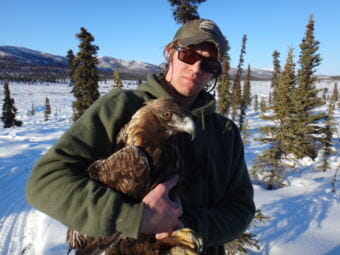
Joe Eisaguirre poses with a golden eagle at Gunsight Mountain off the Glenn Highway between Anchorage and Glenallen, where eagles were captured and fitted with GPS-tracking backpack harnesses. (Photo courtesy Joe Eisaguirre)

When golden eagles migrate to and from Alaska each year, they have to fly around a huge obstacle: the 16,000-foot peaks of the Wrangell Mountains.

Some of the eagles choose a route that skirts the northern edge of the mountains. Others go south. A new study examined how the weather affects which way the eagles fly.

First, the scientists caught golden eagles at Gunsight Mountain, off the Glenn Highway between Anchorage and Glenallen, using roadkill moose and caribou as bait. Then, they fitted the eagles with miniature, solar-powered GPS backpacks that weigh about as much as a Snickers bar.

Joe Eisaguirre holds a golden eagle fitted with a GPS-tracking backpack harness. The eagle is wearing a hood to keep it calm. (Photo courtesy Joe Eisaguirre)

“You put out some carrion bait to try to lure in the eagles,” said Joe Eisaguirre, a PhD student at University of Alaska Fairbanks and the lead author of the study, which appeared in a journal called Proceedings of the Royal Society B. “And yeah, catch them that way.”

Every few hours the backpacks pinged the eagles’ locations up to a satellite, and Eisaguirre and his collaborators could chart them on a map.

Every spring, the eagles migrate to Alaska, and in the fall they leave. Eisaguirre was looking for the answer to a pretty basic question: How does the weather affect the eagles’ route choice around the Wrangell Mountains?

His paper combined the eagle data with information from a weather model to show that in the fall, a northern route around the mountains becomes more popular with stronger winds from south.

“That south wind comes off the Gulf of Alaska, potentially bringing some pretty bad weather with it — some precipitation and low clouds that might make that route less desirable,” Eisaguirre said, referring to the southern route.

In the spring, when the weather is better, stronger south winds actually made the southern route more popular, the study found. Eisaguirre said he thinks that’s because the wind flowing into the mountains can create good updrafts that the eagles can use to fly.

The study’s results showed how changes in weather tied to climate change have the potential to change animals’ migration patterns, Eisaguirre said, though it will take more work to figure out exactly how that could happen with Alaska’s golden eagles.

House member named as next speaker lacks votes he needs to be elected

Rep. Dave Talerico, R- Healy, at a House Majority press availability, Feb. 4, 2016. (Photo by Skip Gray/360 North)

The representative identified Wednesday as the next speaker of the Alaska House currently lacks the 21 votes needed to be elected to the job, according to an interview with one of his colleagues.

Wasilla GOP Rep. David Eastman said he’s not ready to “sign on the dotted line” and vote for Rep. Dave Talerico of Healy, who Republicans said would be the next House speaker when the chamber convenes in January.

Eastman is one of the most conservative members of the Legislature, and his position on Talerico casts doubt on the durability of the new 21-member GOP majority announced Wednesday.

In the 40-member House, opposition from a single member could undercut the group’s ability to pass legislation. And it’s also still not clear that the majority will even have 21 members — one Republican, Bart LeBon of Fairbanks, has a narrow, 79-vote lead over his Democratic opponent, with absentee ballots still to be counted.

Rep. David Eastman, R-Wasilla, speaks during a House floor session in March. He hasn't apologized for comments he made about Alaska women being glad to become pregnant so they can travel for abortions. (Photo by Skip Gray/360 North)
Rep. David Eastman, R-Wasilla. (Photo by Skip Gray/360 North)

Republicans said at a news conference Wednesday that they have 21 members of a new majority that will take power back from the largely-Democratic group that’s controlled the House for the past two years. But there were only 20 people in the room — Eastman was missing.

Eastman said in a phone interview Thursday morning that he intends to vote for a Republican as speaker. But he wants to have a better feel for a candidate’s priorities and agenda before agreeing to vote for them, he said.

“I think we’ve got the right 21,” Eastman said. “But that still leaves 21 options for speaker. And I haven’t figured out which of those options is the best one for my district and the things I care about.”

Eastman is about to start his second two-year term in the House. In his first one, he became known for taking far-right, uncompromising positions on the state budget and social issues like abortion. And his willingness to break with some of his GOP colleagues underscores how the party could still face obstacles enacting its agenda even if Tuesday’s election gives Republicans control of the House, Senate and governor’s office.

But one of the new leaders of the House Republicans, Anchorage Rep. Lance Pruitt, said he’s confident the GOP will have at least 21 votes to elect Talerico as speaker. Eastman participated in the new majority’s discussions Wednesday and “engaged in the whole conversation,” Pruitt said.

“David’s going to vote for a Republican, and Dave Talerico is the Republican that we’ve all gotten behind,” Pruitt said. “He has got the support of the caucus.”

Republicans may take control of the Alaska Capitol. But don’t expect to hear “kumbaya” just yet.

Healy Republican Rep. Dave Talerico announces Wednesday that the GOP has formed a new, 21-member House majority caucus. Talerico says he’ll be the House speaker when the chamber convenes in January. (Photo by Nathaniel Herz / Alaska’s Energy Desk)

Alaska Republicans had a good night Tuesday.

The GOP kept its majority in the state Senate. It flipped at least two seats in the state House. And took back the governor’s office.

House members and senators are holding meetings this week to organize new caucuses leading each chamber. But it won’t necessarily be smooth sailing even if the Alaska Capitol ends up under one-party control, according to interviews with members.

That’s because within the Republican Party, there are diverse ideas about Alaska government and contentious issues like the Permanent Fund dividend and the state budget.

At a news conference Wednesday announcing the formation of a new Republican House majority, members said Rep. Dave Talerico of Healy, would be the new House speaker when the Legislature convenes in January. But Talerico struggled to describe the group’s organizing principles.

“We’re actually working on this right now,” Talerico said. “We have our work cut out for us, for sure, to put that together.”

Assuming Bart LeBon of Fairbanks holds on to a 79-vote lead after absentee and other outstanding ballots are counted, the GOP says it will have a 21 to 19 majority in the House. For the past two years, a largely-Democratic House majority coalition relegated most Republicans to the minority.

Talerico ultimately arrived at controlling spending and drafting a sustainable budget as two of his caucus’ priorities. But here’s the thing: While GOP members share the same party label, they don’t always have the same vision for state government.

For example, Republican legislators from coastal areas like Sitka and Kodiak might have different ideas about the importance of the state ferry system than, say, their counterparts from the road system.

Then there’s the question of the Permanent Fund. Mike Dunleavy, the Republican just elected governor, wants the government to write checks to each Alaskan that could be more than $6,000  — to cover next year’s dividend and the amount that lawmakers reduced dividends in the past three years.

But Anchorage Rep. Lance Pruitt, who Republicans say will co-chair the House Finance Committee next year, isn’t so sure about that.

“I think that one’s a little bit complex and probably pretty challenging,” Pruitt said in an interview Tuesday night. “But, you know what? He gets to propose that, and we get to analyze whether or not that we see that’s something that can happen.”

There are also ideological divides within Pruitt’s own group of House Republicans.

One of the most conservative GOP members, Wasilla Rep. David Eastman, has frustrated some of his Republican colleagues by staking out uncompromising, far-right positions on the budget and social issues. One of his Republican House colleagues, Gary Knopp of Kenai, said he’s not sure whether Eastman will fit into a GOP caucus, or whether Eastman wants to be part of one.

“I like Rep. Eastman — he’s a very, very smart man. He just needs to tone it down and work with the others and stop attacking them,” Knopp said Tuesday. “It’s kind of unfortunate, because he’s probably one of the brightest individuals. When I watch the work that he does and I read what he does, I have a lot of admiration for that. But I don’t have any admiration for his approach.”

At Wednesday’s news conference, Republicans said Eastman will be part of their new House majority. But Eastman wasn’t in the room, and he didn’t respond to a call or text message to confirm his membership.

Without Eastman, the new Republican majority would have just 20 seats in the 40-member House — which isn’t a majority at all.

Internal divisions within a majority caucus in the Legislature are nothing new — it’s normal when you’re trying to get more than 20 people to agree on subjects as complicated and polarizing as Permanent Fund dividends and closing a budget deficit.

The outgoing House majority, which is mostly Democratic, had its own dispute about this year’s Permanent Fund dividend. And three years earlier, six members of the previous Republican-controlled majority rebelled when their leaders proposed a complicated financial maneuver to balance the state budget.

What’s different is that next year the Capitol could be under one-party leadership — setting up higher expectations for Republicans to produce results.

But Pruitt, the Anchorage Republican representative, said debate and dissent are a welcome part of the legislative process.

“That’s what I love about being a part of the caucus that I’m a part of — we will come to an agreement in the end that we will work through and look through all the concerns that come from whatever direction and whatever walk of life people are bringing to the table,” he said. “In the end, I think we’ll get something done, and I think we’re going to do it in a timely manner, too.”

Other members of the new House Republican majority leadership announced Wednesday: Cathy Tilton of Wasilla will chair the House Rules Committee; Tammie Wilson of Fairbanks will co-chair the House Finance Committee with Pruitt; and Chuck Kopp of Anchorage will be majority leader.

Those positions are all contingent, though, on LeBon keeping his lead, and on Eastman agreeing to be a member of the Republican caucus. In a prepared statement Wednesday, the current Democratic House speaker, Bryce Edgmon of Dillingham, said it’s premature for the GOP to focus on its new organization, given that there are still unresolved races and uncounted ballots.

A spokeswoman for the Senate GOP said that group plans to form a new majority caucus by the end of the week. Republicans have at least 13 seats in that chamber, with one seat still too close to call — the race for a Fairbanks district between incumbent GOP Senate President Pete Kelly and Democratic Rep. Scott Kawasaki. Kelly leads by 11 votes, 4,048 to 4,037.

Alaska Republicans say Tuesday’s results could give them state House, Senate control

Alaska State Capitol, Feb. 7th, 2017. (Photo by Skip Gray/360 North)
Alaska State Capitol in February. (Photo by Skip Gray/360 North)

Alaska Republicans sounded confident Tuesday that preliminary election results will put them back in control of the state House after a two-year stint in the minority.

Lance Pruitt, a veteran GOP House member from Anchorage, said Tuesday that he expects to determine the makeup of a Republican House majority Wednesday.

“I believe that we’re going to be able to announce a Republican-led majority, based on what I’m seeing,”  said Pruitt, who led Democrat Liz Snyder by less than three points in the race for his East Anchorage seat.

For the past two years, the coalition majority in the House has consisted mostly of Democrats – it was 17 Democrats, three moderate Republicans and two independents. But preliminary results Tuesday showed the coalition losing three seats.

In Fairbanks, Republican Bart LeBon narrowly led Democrat Kathryn Dodge in the race to replace Democratic Rep. Scott Kawasaki. In Anchorage, independent Rep. Jason Grenn was more than 350 votes behind Republican challenger Sarah Rasmussen.

And in Homer, Republican Sarah Vance had a lead of more than 1,000 votes over Rep. Paul Seaton, a former Republican who dropped his party registration this year to run for re-election with support from the Democratic Party. Seaton was first elected to the House since 2002.

One Democratic leader, Nome Rep. Neal Foster, was still hoping that some tight races could tip toward the current majority.

“Sounds like we might be down a little bit. And I guess we’ll just have to wait til tomorrow, and I think what it’s also going to come down to, though, is absentee ballots and we’re just crossing our fingers,” said Foster, who was unopposed in his own re-election bid.

House Republicans have already scheduled a meeting in Anchorage on Wednesday morning to organize a new majority.

In the Senate, Republicans were expecting to claim at least 13 seats and will likely maintain their majority.

One seat was still up in the air after Tuesday: the race between Republican Senate President Pete Kelly of Fairbanks, and Kawasaki, the Democrat who’s currently in the state House.

But Republicans were already claiming a mandate from voters.

“It means we protect the Permanent Fund, grow the economy and don’t have to raise taxes,” said Mead Treadwell, the former lieutenant governor.

Democrats weren’t as buoyant. Foster, the Nome representative, said he’s worried that government programs important to his rural Alaska constituents will be cut if the House, Senate and governor’s office are all controlled by Republicans – which could be the result from Tuesday.

“We’re very, very afraid,” he said. “We’ve already made substantial cuts over the past 5 years.”

Foster said he’s especially nervous about a program that subsidizes electricity costs in rural Alaska, which can be six times the national average.

Absentee, other ballots could leave Alaska governor’s race undecided Tuesday

The Alaska Capitol Building in Juneau on June 6, 2017. (Photo by Jeremy Hsieh/KTOO)
Because it takes weeks for absentee ballots to trickle in, we may not know all the occupants of this building until long after Election Night. (Photo by Jeremy Hsieh/KTOO)

If you’re one of those people who’s been in suspense about the election on Tuesday, here’s some bad news for you.

It’s unlikely that we’ll know the results from all of the races in Alaska tomorrow night.

First of all, it takes a long time for the state elections division just to count all the ballots cast on Election Day. The last counts on primary night, in August, didn’t arrive until after 2 a.m, said Samantha Miller, a spokeswoman for the division.

Then there are absentee and other types of votes. Absentee ballots count as long as they’re postmarked on or before Election Day, which means many of them arrive afterwards.

Sen. Mark Begich, chairman of the Senate Commerce, Science and Transportation Subcommittee on Oceans, Atmosphere, Fisheries and the Coast Guard, speaks during the testimony of U.S. Coast Guard Adm. Robert J. Papp Jr., commandant of the Coast Guard, at a hearing in Washington, D.C, April 23, 2013. Papp discussed the Coast Guard fiscal year 2014 budget. (Photo by Petty Officer 2nd Class Patrick Kelley)
Mark Begich, the Democratic gubernatorial candidate, won his 2008 election for U.S. Senate even though he trailed in an initial count on Election Night. (Photo by Petty Officer 2nd Class Patrick Kelley)

The state also waits to count questioned ballots — like ones cast at the wrong precinct — and ballots cast on Election Day by people who went to regional elections headquarters, rather than the polling place where they live.

In the past, thousands of ballots have been counted after Election Night.

One person who’s intimately familiar with how Election Night results can change is Mark Begich, the Democrat who this year is running for governor. In 2008, U.S. Sen Ted Stevens was 3,000 votes ahead of Begich in the initial count.

But two weeks later, after absentee and other uncounted votes were tallied, Begich was declared the winner of the U.S. Senate race.

Another person who knows the feeling is Sitka Democratic Rep. Jonathan Kreiss-Tomkins. His first race, in 2012, wasn’t resolved until absentee ballot counts that happened after Election Night.

“Every day it was like watching the stock market ticker go up and down. Because my margin would shrink and grow. And it flipped. I was down for a while. At one point I was tied, 4,421 to 4,421, something like that,” he said. “Every day was sort of growing drama.”

Jonathan Kreiss-Tomkins
Rep. Jonathan Kreiss-Tomkins, D-Sitka. (Photo by Skip Gray/360 North)

Kreiss-Tomkins said he thinks more than one race could be that tight this year — including the races for governor and U.S. House, and the ones that determine whether the Alaska House stays controlled by its largely-Democratic majority coalition.

“The Congressional race and the gubernatorial race, really, have all the makings of being a nail-biter, days or weeks beyond election night,” Kreiss-Tomkins said. “Don’t expect instant gratification in knowing what Alaska’s going to look like in the next couple of years, in terms of elected officials.”

The state will make an initial tally of absentee and other uncounted ballots a week after Election Day. A final count will be done by November 21. Elections officials hope to certify the results by November 23.

As Alaska’s elections come down to wire, ads test limits of campaign finance laws


Rep. Les Gara addresses the Alaska House of Representatives, Feb. 4, 2015. (Photo by Skip Gray/360 North)
Anchorage Democratic Rep. Les Gara last week filed a complaint against a political group supporting the campaign of Republican gubernatorial candidate Mike Dunleavy, saying the group was obscuring the source of its money in a required disclosure in its radio ads. (Photo by Skip Gray/360 North)

In the last few days before an election, it’s pretty common for political groups to start playing fast and loose with Alaska’s campaign finance laws — and the state’s cash-strapped campaign finance regulators say they’d need a larger staff to monitor all the ads in the last-minute barrage.

Alaska law requires independent expenditure groups — the state-level version of “super PACs” that can accept unlimited donations from unions and corporations — to disclose their leaders and funders. Last week, Anchorage Democratic Rep. Les Gara filed a formal complaint accusing one such group backing Republican gubernatorial candidate Mike Dunleavy of playing an accelerated disclosure that breaks a part of that law requiring the information to be “easily heard.”

The group running the radio ads was Families for Alaska’s Future – Dunleavy. Nearly all of its money is from the Washington, D.C.-based Republican Governors Association — a GOP political group whose big donors include casino billionaire Sheldon Adelson and his wife, Miriam, Nike founder Phil Knight and Koch Industries.

The Dunleavy group’s chair, Anchorage media executive Steve Strait, said the disclosure is comprehensible to his “trained ear.” But he acknowledged that there’s a “tendency to speed it up” when groups like his are paying steep prices for their ads — as much as $10,000 for a single, 30-second television commercial.

“There’s a price to this time. It’s the value to it, whether it be 30 seconds or 60,” he said. “A third of the ad could be taken up with this text. You’ve gotta get it out of the way, and your message gets lost in there.”

The group, out of what Strait described as “an abundance of caution,” slowed down its disclosures after Gara complained. The agency that regulates Alaska’s campaign finance laws, the Alaska Public Offices Commission, declined to issue an expedited decision on Gara’s complaint before the election, saying that since the disclosure was fixed, it could deal with any violations later.

Gara argued that the disclosure broke the state’s law because it made it impossible to hear who was actually funding the messaging, and why the group might be supporting a particular candidate.

With Alaska’s political campaigns coming down to the wire, you don’t have to look very hard to find other ads testing the law’s limits.

One recently-posted satirical online video featured an anonymous person pretending to be the late U.S. Sen. Ted Stevens. From beyond the grave, Stevens tells voters to get rid of the Democratic gubernatorial candidate, Mark Begich, and vote for Mike Dunleavy.

The short video was shared by a conservative website. But there’s no disclaimer on it saying who created it or who paid for it, which is likely a violation of campaign finance law, according to APOC officials.

The agency, according to Executive Director Heather Hebdon, has two employees who monitor ads and respond to phone calls about possible violations. But she said there’s no way the agency can effectively monitor all the ads and communications from campaigns and other groups this late in the election. She estimated they’d need three more people just to stay on top of it all.

Lawmakers shrank the agency’s budget by more than one-third during the state’s budget crisis.

Site notifications
Update notification options
Subscribe to notifications