Nat Herz, Alaska Public Media

Alaska DOT is in crisis response mode — and it just got a new boss

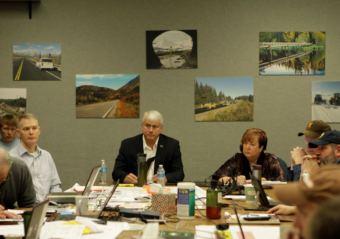
Alaska Department of Transportation Commissioner John MacKinnon sits at an incident command meeting Monday — his first day on the job and three days after a massive earthquake wreaked havoc on roads in Anchorage and the Mat-Su Valley. (Photo by Nathaniel Herz / Alaska’s Energy Desk)

Something you probably wouldn’t do in a corporate setting: replace a big business’s chief executive when it’s in the middle of a crisis response.

But that’s pretty much what happened Monday at the Alaska Department of Transportation, which has 3,000 workers.

As Governor Mike Dunleavy was sworn in, his new transportation commissioner, John MacKinnon, started his first day on the job, while the outgoing commissioner, Marc Luiken, packed up.

It was three days after a 7.0 earthquake hit Anchorage, causing major damage to roads and other infrastructure that DOT is still trying to fix.

On Monday at 7:30 a.m. sharp, DOT was having its pre-dawn incident command briefing in a conference room at its Anchorage headquarters, by the airport. The place was still kind of a mess — there was plaster on the floor that had fallen during the earthquake, piles of candy and a tray of stale tortilla chips.

As people went around a huge table introducing themselves, they got to Luiken, who identified himself as the “chief observer.”

“You’re still commissioner for a while,” MacKinnon quipped.

Outgoing Department of Transportation Commissioner Marc Luiken sits at Monday’s incident command briefing. (Photo by Nathaniel Herz / Alaska’s Energy Desk)

Luiken was joking — he was still, in fact, the transportation commissioner. But only for a few more hours, because of Dunleavy’s impending swearing-in 500 miles away, in the Northwest Alaska hub town of Kotzebue.

Monday was transition day — when Bill Walker, the governor for the past four years, was replaced by Dunleavy, a Republican.

Dunleavy spent the last year on the campaign trail often criticizing Walker and his policies.

So you might think the transportation department would be set up for some major changes as soon as Dunleavy takes office. But that’s not how MacKinnon sees it.

“It’s like a birthday. You’re not going to feel a year older. I don’t think it’s going to feel any different – it’s just moving into it, and Marc is moving out of it,” he said. “Frankly, you’ve got an incredible department that is taking care of the business. And very important business right now, getting things back on.”

At some of the other departments — there are 14 in all — major policy shifts are likely.

One example: Walker’s revenue commissioners pushed for taxes, while Dunleavy ran on an anti-tax platform. Dunleavy has also asked for resignation letters from an unusually large group of state workers.

But on the spectrum of executive branch agencies, DOT isn’t exactly the most political, and it’s unlikely that more than a handful of political appointees will be removed, according to MacKinnon.

He also convinced the Anchorage office chief, Dave Kemp, to postpone retirement and stay on for the first part of Dunleavy’s term.

And MacKinnon, 66, is more of an old hand than new blood — he was once deputy transportation commissioner, then ran a construction industry trade group that worked with the transportation department. He comes from a longtime Juneau family that moved there in the 1880s.

The Minnesota Dr. airport off-ramp buckled by an earthquake in Anchorage, Alaska, on Nov. 30, 2018. (Photo by Nat Herz/Alaska's Energy Desk)
This Minnesota Drive offramp in Anchorage was heavily damaged by Friday’s earthquake. The Alaska Department of Transportation had it reopened by Tuesday. (Photo by Nat Herz/Alaska’s Energy Desk)

“You would expect at the political level, in a campaign, there would be some differences of opinion. I think at the department level, though, you don’t take it apart like this and crank the rudder over hard,” MacKinnon said. “This department has a very important role in the economy of the state and public safety, and I think that role needs to be maintained and supported.”

While Dunleavy’s campaign focused on budget cuts, MacKinnon said one thing he’ll be looking at closely is whether transportation spending has already been cut too far.

“Have we cut too much? You know, that depends on who you ask,” he said. “But when the roads aren’t safe for school buses for the public to travel, we may have cut too much.”

He added: “I wouldn’t want my grandkids going out on a school bus on roads that weren’t maintained well.”

Meanwhile, in an office next door, Luiken, the outgoing commissioner, was taking care of a last few loose ends.

Leading up to the transition, Luiken said, he was keeping MacKinnon in the loop through emails and text messages. And, he said, he doesn’t think a department led by MacKinnon would have done much different in the earthquake’s wake.

“I think if the transition had happened Thursday afternoon that you would see probably almost identical responses,” he said. “I had my chance to do my part and I did. And after noon today it’s going to be Commissioner MacKinnon’s chance to do his part.”

Luiken talked with MacKinnon before the big Monday morning meeting. He said he told the incoming commissioner that he hopes to see certain Walker administration initiatives continue – particularly when it comes to the direction of the state ferry system and the Anchorage airport.

“I won’t say he’s fully on board. I’m not sure exactly where they’re going with the marine highway. But we see pretty close to eye-to-eye on what needs to be done to make it successful,” he said. “It may be a slightly different direction than what the Walker administration would have done. But I think the bottom line is that certainly in this department, we have Alaskans best interest in mind when we make decisions.”

Luiken said he has a job lined up, though he won’t say what it is yet.

He said his first task after leaving work midday Monday was taking his wife to lunch.

Post-earthquake, air traffic controllers exiled from Anchorage tower used a pickup truck instead

The Ted Stevens Anchorage International Airport is expecting to raise nearly $1 million with the new fees. (Photo by Michael Hayes)
The Ted Stevens Anchorage International Airport’s control tower, at far right, had to be evacuated after Friday’s earthquake. (Photo by Michael Hayes)

The 12-story air traffic control tower at Anchorage’s main airport is normally one of the best offices in town, with sweeping views of Cook Inlet, Denali and the Chugach Mountains.

On Friday morning, though, Anchorage’s 7.0 earthquake reminded controllers that their workplace rests atop a “150-foot toothpick,” said Clint Blaszak, a supervisor in the tower.

After evacuating, the controllers, who work for the Federal Aviation Administration, first headed for their backup location, the airport fire station.

But that building was closed to them, too, because of possible damage. So Blaszak and two colleagues went with Plan C: guiding in planes at the world’s fifth-busiest cargo hub from the cab of a pickup truck, at one end of the north-south runway.
Clint Blaszak (Photo by Nathaniel Herz / Alaska’s Energy Desk)

“Most of our equipment is windows. We had a window in the truck,” Blaszak said in an interview atop the tower Saturday. “Everybody had a radio. Everybody had a phone.”

Their improvised response, with help from some quick-moving runway inspectors, meant that the airport’s three runways were closed for less than 10 minutes, officials said.

Alaska Airlines diverted just two planes – one to Fairbanks and one that returned to Portland – and canceled just four flights that day, Marilyn Romano, the company’s regional vice president, said in an email.

Damage to the airport’s terminal did disrupt passenger traffic somewhat, and Romano said that Alaska Airlines had to pause its operations for a safety check.

But cargo traffic continued moving largely unabated, according to airport officials. And the earthquake could have caused a much bigger logistical mess if the controllers were knocked offline for long, said Sherri LaRue, associate professor of aviation technology at University of Alaska Anchorage.

“It’s an extraordinary situation. I give them a lot of credit,” LaRue said.

In Anchorage’s huge 1964 earthquake, the airport tower actually collapsed and one person died.

This time, Blaszak, 38, said the building swayed three or four feet, and he described watching transformers blow out around town during the pre-dawn earthquake. A coffee pot was knocked from its perch, and even Saturday morning, the platform was still missing some ceiling tiles.

In a break room one floor down, Patrick Beargie said he put a pillow over his head as locker tipped over, a fire extinguisher ripped out of the wall and a refrigerator rolled halfway across the room.

“It was just stuff, everywhere. The contents of everything just thrown all over the floor,” he said.

Immediately afterward, the tower controllers aborted an imminent landing by a FedEx jet. Their dramatic radio transmissions – “FedEx, go around, FedEx, go around!” – were captured in an audio recording subsequently replayed on news broadcasts.

The collapsed air traffic control tower at the Anchorage airport after the 1964 earthquake. (Photo by Federal Aviation Administration)

The airport’s three runways needed to be inspected for cracks before they could reopen, which airport manager Jim Szczesniak said took about eight minutes.

Once the magnitude of the earthquake became clear, the controllers all evacuated. Blaszak headed down the spiral staircase from the observation deck carrying a pair of radios.

Inside the truck, he said, the three controllers split up their duties. One worked the runways and taxiing, a second worked with another group of controllers that handle planes farther from the airport and a third coordinated.

Blaszak stressed that they relied on dozens of FAA employees at other locations.

Working from a truck isn’t completely unprecedented – controllers sometimes operate from trucks or tents or trailers during emergencies, or in the military. The Seattle airport built a temporary tower out of shipping containers after a 2001 earthquake destroyed the previous version.

The job demands a certain amount of improvisation, according to LaRue, the Anchorage aviation professor.

“Obviously, there are rules and you’re supposed to follow them, so you’d never say you’re supposed to be super creative,” she said. “But not everything is covered by a rule.”

If the controllers hadn’t been able to set up from the truck, experts said it probably wouldn’t have been an immediate safety risk to planes and passengers.

Without controllers, pilots can – and did – use a system called common traffic advisory frequency, or CTAF, that calls for them to announce their own positions and movements. But that’s far less efficient than instructions from the airport tower – LaRue compared it to relying on a four-way stop sign instead of a stop light.

Szczesniak, the airport manager, credited the quick-thinking controllers and speedy runway inspectors with keeping things moving.

“If I looked out the windows, it was like nothing happened as far as air traffic was concerned,” he said. “They were continuing to land and depart and land and depart, just like they would normally.”

In the aftermath of the earthquake, Blaszak said the controllers are reassessing their backup plans, given that their original Plan B – the fire station – turned out to be inaccessible.

Correction: A previous version of this story incorrectly stated that the Ted Stevens Anchorage International Airport is the nation’s fifth-busiest cargo hub. According to Airports Council International, the airport is the world’s fifth-busiest cargo hub and the second-busiest in the nation.

That guy driving the earthquake-marooned GMC? Yeah, he made his flight out of Anchorage.

The Minnesota Dr. airport off-ramp buckled by an earthquake in Anchorage, Alaska, on Nov. 30, 2018. (Photo by Nat Herz/Alaska's Energy Desk)
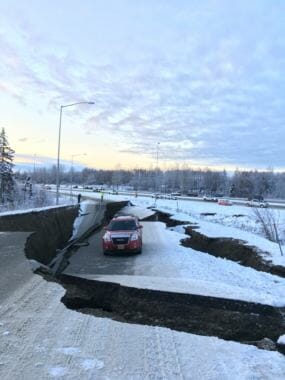
Tom Sulczynski’s GMC sits marooned on an island of pavement after a magnitude 7.0 earthquake in Anchorage on Friday, Nov. 30, 2018. (Photo by Nat Herz/Alaska’s Energy Desk)

Tom Sulczynski made his flight – though in fairness, it was delayed for four hours.

Sulczynski was driving that red GMC that became an icon of the Nov. 30 earthquake in Anchorage – it ended up stranded on an island of pavement on an offramp that collapsed all around it.

Photos of his car circulated nationwide as 47-year-old Sulczynski was just trying to get out of town. Reached Friday night in Juneau, where he was camped in the airport bar, Sulczynski said he has a long-running joke about his “guardian angel that works overtime.”

“I think that goes double for what happened here today,” he said. “And I’m not even religious.”

Sulczynski left Homer, the Kenai Peninsula town where he works in information technology, early Friday morning.

The four-hour drive meant that he and his girlfriend were pulling off Minnesota Drive and onto International Airport Road at exactly 8:29 a.m.

Sulczynski said he’s “not always, like, the punctual guy,” so he was excited to be arriving at the airport with plenty of time to spare.

“Being here early, I was so excited – I was like, ‘I finally did things right,'” he said.

And then the magnitude 7.0 earthquake started.

“Initially I thought I had a flat tire. Then I started thinking I, like, busted an axle. But I couldn’t quite figure out how I could have busted an axle. Because, like, the whole car was kind of weaving up and down – it was kind of freaky,” he said. “And then I saw the ground all around me breaking up and I was like, ‘Oh! My car’s fine. It’s all good. It’s just an earthquake.’”

By that point, Sulczynski said, he’d slowed down to the point where it wasn’t hard for him to stop before he reached the edge of the road.

There was still enough connected pavement that he and his girlfriend could walk away. And a driver who’d been behind them on the offramp offered a ride to the airport, where Sulczynski said he enjoyed some minor fame.

“We’ve had people buying us drinks in Anchorage because – we’re ‘The Car People.’ So, I’m going to live it up,” he said, chuckling. He added: “We’re getting good and drunk in the process.”

Sulczynski said his car was towed soon after the earthquake by a local company, Vulcan Towing. A woman at the company declined to comment Saturday, but Mahear Aboueid, a state transportation department worker who saw Sulczynski’s GMC being towed away, said Vulcan got it out with the help of some foam ramps.

“They strapped on a cable and brought it in,” he said.

The cause of the offramp’s collapse stemmed from the ground underneath being saturated with water, Aboueid said. During the earthquake, “liquefaction occurred,” he said, and the bottom of the offramp spread out. The rest of it followed.

Why did the chunk of pavement holding up Sulczynski’s car stay relatively stable? Aboueid, who was supervising repairs at the site Saturday, said he had no explanation for that. But, he added: “Pretty nice set-up for him.”

Aboueid said the offramp was probably the most heavily damaged stretch of road in the Anchorage bowl – though there was also serious damage to the Glenn Highway leading north from town, as well as to roads in the Mat-Su. The transportation department hopes to reopen the offramp Monday night, Aboueid said.

As for Sulczynski, he was in Seattle on Saturday, helping his girlfriend clean out a storage unit, then heading to California to visit family. He said he won’t know until Monday if he’ll have to pay for the tow.

Drivers escape danger as off-ramp crumbles after Anchorage earthquake

The Minnesota Dr. airport off-ramp buckled by an earthquake in Anchorage, Alaska, on Nov. 30, 2018. (Photo by Nat Herz/Alaska's Energy Desk)
The Minnesota Drive airport off-ramp buckled after an earthquake in Anchorage, Alaska, on Nov. 30, 2018. (Photo by Nat Herz/Alaska’s Energy Desk)

One of the most striking scenes from this morning’s earthquake in Anchorage is a photo of a car sunk seven feet down in a crevasse that opened up on a Minnesota Drive exit ramp.
Chris Riekena watched it happen. He was driving northbound on Minnesota just behind that car. His own vehicle started moving oddly in the quake, so he pulled over, thinking he had a flat tire.

“I mean, it’s amazing the chunk that they’re on. Like the little island of asphalt there on. Everything else is demolished,” he said. “And then I watched the car in front of us start to sink as the road pushed out to the left.”

Riekena said the exit ramp onto International Airport Road seemed to slump away. He was trying to keep his 7-year-old calm, but every time he looked up, the car ahead had sunk more. Riekena says the driver seemed unharmed and police were soon on the scene.

“And I think they just climbed out and I believe the guy went on his trip,” Riekena said. “He was headed to the airport, so…”

Alaska Department of Transportation is reporting road damage throughout town, on the Seward Highway and the Glenn Highway. Many traffic lights are out as well.

As ocean heats up off Northwest Alaska, the fishing does too

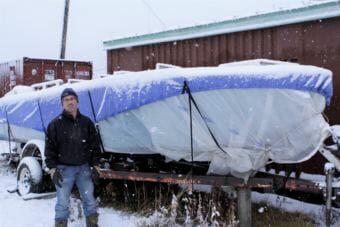
Seth Kantner stands next to his fishing boat outside his home in Kotzebue. Kantner caught twice as much salmon this past summer than in his previous best year fishing.

Alaska fishermen haven’t been having an easy time with the changing climate.

The cod population in the Gulf of Alaska is at its lowest level on record. Officials have declared disasters after the failure of multiple Alaska salmon fisheries.

So what’s happening farther north in Alaska might surprise you: Fishermen there have been landing huge catches, in numbers that haven’t been seen in decades.

Seth Kantner is one of them. He was raised in a sod igloo 150 miles from the Northwest Alaska hub town of Kotzebue, and has been commercial fishing for chum salmon in Kotzebue Sound for decades.

He’s also a writer, and in an interview from his pickup truck looking out over the sound, he said he’s a little apprehensive about some of the changes he’s been seeing in the region — particularly in the weather and the seasons.

Some of those changes, Kantner said, have fed into the fishing, which has been booming. In the summer of 2017, he fished to the last day of the season to try to hit 100,000 pounds of salmon for the year, which he said is “far and away the most I’d ever caught.”

This past summer, he added: “I broke 200,000 pounds, which is still — I can’t believe it.”

Just to be clear — Kantner said that two summers ago, he caught more fish than he’d ever caught before. And then this summer, he caught twice that much again.

Salmon fishing in Northwest Alaska isn’t nearly as lucrative as the big commercial harvest in places like Bristol Bay. But there are more than 200 active commercial permit holders in the region, with gross earnings of more than $4 million last year.

And Kantner isn’t the only one who’s been doing well. This year’s commercial harvest of chum salmon in Kotzebue Sound was nearly 700,000 fish, breaking a record nearly four decades old. To the south, the value of the commercial salmon catch in Norton Sound was also the highest ever.
You can tell just from the metaphors that Jim Menard, the area fishery manager, used to describe the runs over the past few years, in the course of a 30-minute phone interview: “blazing guns,” “gangbusters” and “on steroids.”

Summer chum.
Summer chum salmon. (Photo courtesy U.S. Fish and Wildlife Service)

One example was on the Nome River outside of that town. Menard said that in the past, a good pink salmon run was about 1 million fish. This year there were more than three times that.

Menard described looking into the river and seeing a solid black wall of salmon.

“I’d be throwing out my fishing line trying to reel it across and be snagging a pink in the back. You know, you’re not even trying to catch anything. There’s just so many pinks,” he said.

Menard said he thinks that relatively warm winters are helping fuel the region’s strong salmon returns. And in the nearby Chukchi and Bering seas, where the fish spend time before spawning, temperatures have been way above average in recent years.

Scientists caution against linking a single year’s conditions, or even a several-year-long stretch, to climate change. But they also say that ocean temperatures are expected to gradually rise due to global warming, with sea ice expected to diminish.

Those warmer ocean temperatures are more hospitable to species like sockeye and pink salmon, as well as chums, which are the commercially caught fish in Kotzebue, according to Ed Farley, a federal fisheries biologist in Juneau. That’s because when the water is warmer, there’s more abundant food for them, like certain types of plankton and small fish, he added.

“This loss of sea ice is shifting the food web,” he said. “And it’s also warmer. So, salmon do better in that environment.”

You might think Kantner, the Kotzebue fisherman, would be excited about the warmth and his big harvests. But he said his feelings are a lot more complicated, in part because his lifestyle revolves around much more than fish.

“Because I like ducks and caribou and salmon, and I’m worried something might happen where they just can’t deal with it, and then we don’t have them any more,” he said.

And while global warming might be better for salmon fishing, it’s also likely to make for scarcer ice — an essential platform for winter transportation in the region. Kantner said it’s hard to get excited about more fish when there are so many other things he could lose.

Nuclear power in Alaska? Experts say it’s not as far-fetched as you think.

A nuclear power plant in Illinois. Nuclear projects in Alaska would likely be much smaller. (Creative Commons photo by iluvcocacola)

Electricity is expensive in Alaska. And that can make things difficult for families and businesses.

One solution to that problem could be nuclear power. But the idea has been explored in Alaska before, in the Interior village of Galena, and went nowhere.

At an Anchorage conference this month, the Resource Development Council, an industry group, took another look.

“From a project development standpoint, it may sound crazy,” said Eric Fjelstad, an Anchorage lawyer who chairs the RDC’s board, as he introduced a pair of nuclear industry leaders the conference. But, he added: “I’ve been in discussions that were serious about: ‘Why don’t we have nuclear?'”

There are a lot of things that make nuclear power attractive in Alaska.

Chief among them is the state’s high price of energy. In rural Alaska, electricity can cost six times the national average.

It’s a big problem not just for the people who live here, but for developers trying to extract Alaska’s natural resources. Fjelstad works with oil and gas and mining companies, so he knows this firsthand.

“Frankly, a lot of these projects that are in Alaska are power-challenged. That’s one of the biggest cost items,” Fjelstad said in an interview. “Mines require a lot of energy. So do oil and gas projects and other things.”

Nuclear power, he added, “might be one of the tools in the toolbox.”

It’s not just big, remote industrial projects that could benefit from nuclear power. John Hopkins, who runs a nuclear power company and was one of the speakers at the conference, said he thinks his reactors could be competitive in Alaska road system communities too.

Hopkins’ company is called Nuscale. It’s based in Oregon and has 350 full-time workers; it’s trying to develop what are called small nuclear reactors, or SMRs.

Each one can produce 60 megawatts of electricity, or about half as much as Anchorage’s new power plant off the Glenn Highway. Nuscale wants to fit as many as a dozen at a time into a power plant, which Hopkins referred to as a “12-pack.” The company says the reactors can safely turn off and stay cool without human intervention.

“What we’re looking at is, does it make sense in a place like Fairbanks? We have a lot of defense priorities who need, essentially, 24-7 power,” Hopkins said in an interview. “And not only do you want to be able to provide the energy for the defense facilities, like let’s say Fort Greeley, but also the supporting community.”

Alaska has taken a pretty hard look at nuclear power before. More than a decade ago, Toshiba, the Japanese corporation, offered to give a small nuclear reactor to the Yukon River village of Galena. It would have run unattended and had almost no moving parts.

That project never happened. But energy experts say that small reactors like Toshiba’s and Nuscale’s could still be viable in Alaska. Gwen Holdmann, the director of the Alaska Center for Energy and Power at University of Alaska Fairbanks, helped write a report on them in 2011.

“At a conceptual level, the economics do work better here in Alaska that they might in most markets,” she said. “And it is because we are shipping in a lot of fuel, especially in our more remote locations.”

There are still all kinds of obstacles that would have to be negotiated to get nuclear power to Alaska.

Permitting. Earthquakes. What to do with the used fuel.

And before you even start worrying about those problems, there’s one thing that Holdmann says hasn’t changed from when she finished working on the report nearly a decade ago: You still can’t go out and buy a small modular reactor.

“They really are not prime time. They’re not ready. They’re not available. They’re not off-the-shelf,” she said.

Hopkins, who runs the nuclear power company, said his first project won’t be online until 2026.

In the meantime, Holdmann said her organization is looking at hosting a workshop on small nuclear reactor technologies within the next six months, in partnership with a federal nuclear lab in Idaho.

Site notifications
Update notification options
Subscribe to notifications