Nat Herz, Alaska Public Media

Dunleavy faces political, legal obstacles to enacting far-reaching budget cuts

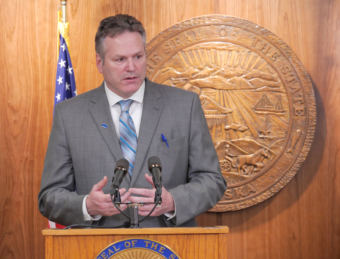
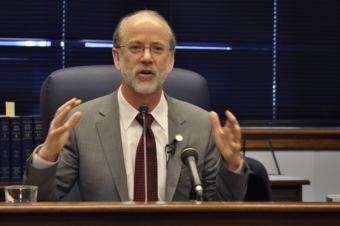
Gov. Michael Dunleavy introduces his amended state budget to reporters at a press availability at the Capitol in Juneau on Feb. 13, 2019.
Gov. Michael Dunleavy introduces his amended state budget to reporters at a press availability at the Capitol in Juneau on Feb. 13, 2019. (Photo by Skip Gray/360 North)

Alaska Gov. Mike Dunleavy proposed budget cuts Wednesday that could completely remake the state’s government and its education, health care and transportation systems.

But his power to reduce Alaska’s budget only goes so far — there are legal and political obstacles that stand between the governor and his goal of a balanced budget.

Alaska state government is a complex thicket of programs and services, each with its own set of constituencies. The Legislature also has its own budgeting powers. And some of the programs offered by the state require changes to laws or regulations before they can be cut back.

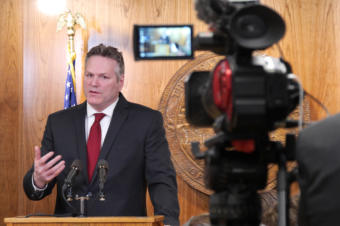
Gov. Michael Dunleavy introduces his state budget to reporters at a press availability at the Capitol in Juneau on Feb. 13, 2019.
Gov. Michael Dunleavy introduces his state budget to reporters at a press availability at the Capitol in Juneau on Feb. 13, 2019. (Photo by Skip Gray/360 North)

Take Medicaid, for example. Dunleavy proposed to cut more than $700 million, or about 30 percent, from the state-federal health care program, whose 210,000 beneficiaries include low-income Alaskans, pregnant women and people with disabilities.

But Dunleavy’s administration didn’t say specifically how it would would achieve the reductions — whether the state will pay lower rates to health care providers, for example, or cut off access to care for certain groups of Alaskans.

“Like health care in general, Medicaid is complex, and the governor’s ability to enact these changes will really depend on what the cuts are,” said Becky Hultberg, president of the Alaska State Hospital and Nursing Home Association, a trade group. “And we don’t know what the cuts are.”

Depending on what, exactly, Dunleavy proposes, his plans could require federal approval. Or the state Legislature might have to change Medicaid laws. And there’s no guarantee that the Trump administration, or the Legislature, will sign off.

Meanwhile, Dunleavy also proposed to close a huge chunk of Alaska’s $1.6 billion budget gap by boosting state tax revenue. The state would take the revenue — more than $400 million — away from cities and boroughs that collect it through property taxes that they levy on oil and gas infrastructure.

But before Dunleavy can take that step, lawmakers would have to pass a bill to eliminate the cities’ and boroughs’ taxing power. Each of those municipalities has at least one state representative and senator representing them. The North Slope Borough, which pays for most of its budget with oil and gas property tax revenue and would be most affected by Dunleavy’s proposal, has four lobbyists protecting its interests in Juneau.

“We will work with the governor and the Legislature to make our case. We want to be partners, not adversaries,” Mayor Harry Brower said in a prepared statement. “Because last time I checked, we are all Alaskans, and no one region should bear the brunt of the state’s fiscal problem.”

Programs that aren’t backstopped by specific laws or federal requirements could be more easily reduced. One of those is public broadcasting — Dunleavy proposed to completely eliminate the $2.5 million that the state sets aside for radio and TV.

KYUK, a regional station in the Southwest Alaska hub town of Bethel, gets about $150,000, or 10 percent, of its budget from the state. Shane Iverson, the station’s manager, said the reduction would equate to two of its 11 positions.

Advocates for programs like that were already strategizing about how they can change Dunleavy’s mind and rally state lawmakers to their defense.

“Those are the hopes, that the administration comes to learn how important public media is to Alaska, and at the same time that our Legislature hears from their constituents about how important public media is to their lives and livelihoods,” Iverson said.

But even if lawmakers reject some of the cuts that Dunleavy has proposed, veteran observers of the budget process were already looking forward to the governor’s trump card: his power to line-item veto money from individual programs.

That power is balanced by lawmakers’ ability to override Dunleavy’s veto. But doing so requires a three-fourths supermajority vote. And that’s a hard bar to clear, said Gregg Erickson, an economist and former publisher of the Alaska Budget Report.

“The constitutional structure in Alaska gives the governor unprecedented power,” he said. “It’s going to be, I think, difficult to ensure for certain that you have the three-fourths votes necessary to push the money, the appropriations out over the governor’s veto objections.”

Erickson said he expects Dunleavy to use his veto power to fulfill his budget-cutting objectives. And he suggested that anyone who opposes them should look to their legislators for support.

Ravenna Koenig contributed reporting from Fairbanks.

Watch the latest legislative coverage from Gavel Alaska:

Dunleavy reveals Alaska state budget proposal

Alaska’s schools, universities, health care programs and ferry system all would see huge spending cuts under a new budget proposed Wednesday morning by Republican Gov. Michael Dunleavy.
The spending plan would overhaul major government functions and eliminate specific programs and services. Dunleavy said the cuts are needed to balance the state budget while paying out larger Alaska Permanent Fund dividend checks under a historical legal formula.

“I’m going to be bold here for a moment. I think everyone in this room knows we have to get our fiscal house in order. And I think everyone in this room and in this state realizes that there’s going to be sacrifices across the board, that this has gone on too long, and that it’s got to stop,” he said.

The proposals were released Wednesday morning, and state lawmakers and budget experts were still piecing through them by midday.

One of the big takeaways is a 23-percent cut to Alaska’s per-student schools spending, a reduction of $279.4 million.

The proposal would cut state unrestricted general fund spending on its university system nearly in half — from $348.7 million to $193.1 million.

Dunleavy also wants major reductions in spending on Medicaid, the state-federal health care program for low-income Alaskans. And he’s proposing big cuts to state ferries and the potential to privatize parts of it.

One way Dunleavy would raise more money for the state? Take it from municipalities. He’s proposing to eliminate the ability of municipalities to levy property taxes on oil and gas infrastructure; that tax revenue would flow to the state instead.

Dunleavy’s budget proposal is only the first in a long legislative process — the plan now goes before the House and Senate, which have the power to add money back.

This story has been updated.

Don’t count on oil to bail out Alaska’s budget soon, says unpublished state tax memo

BLM_NPRA
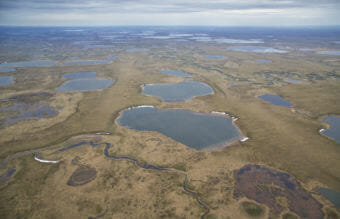
Part of the National Petroleum Reserve in Alaska. (Photo by Bob Wick, image courtesy Bureau of Land Management)

The National Petroleum Reserve in Alaska is a hot area for oil development right now. But don’t count on new production there to bail out the state budget any time soon.

That’s the takeaway from a previously unpublished, two-month-old analysis drafted by former independent Gov. Bill Walker’s administration.
The analysis, which is disputed by the major oil company in NPR-A, points out that at certain per-barrel prices, large-scale development in the reserve could cost the state hundreds of millions of dollars a year in the short-term, before adding billions to the state’s bottom line in the long-term.

Those short-term losses would accrue because Alaska law allows oil companies to deduct 35 percent of their investments from taxes they pay on existing oil production.

The analysis also notes that future state revenue from projects in the federal petroleum reserve won’t be the same as from projects on state lands. That’s because half of the royalties on federal land are paid to the federal government, while the other half go into an account that’s traditionally been set aside for grants to North Slope communities.

Anchorage Democratic Rep. Geran Tarr co-chaired the House Resources Committee last year. She said in a phone interview that the analysis counters arguments that new oil production could quickly fill the state’s big budget deficit.

“These headlines which have been in the news recently about this ‘North Slope renaissance’ – people are probably thinking, ‘Oh, wow, what’s going on? Is this going to be very positive, can this fix the problem?’ Well, it’s just not going to,” Tarr said.

The Walker administration’s analysis incorporates three big projects in the reserve – Greater Moose’s Tooth 1 and 2, and Willow – that are part of the portfolio of oil company ConocoPhillips. Oil is already flowing from GMT-1 and Conoco has started building GMT-2, but it’s still in the preliminary phases of developing Willow.

If all the projects are completed, the analysis says they could end up reducing state revenue by about $250 million a year for the next six years or so. Over the next 10 years, it says, the projects would reduce expected state revenue by about 6 percent, or $1.6 billion, if oil prices hover around $75 a barrel. Prices have fallen from $85 in October to $62 this week, and if they stay that low, the cost to the state of the new projects would be lower – because Conoco would have lower tax bills to apply its deductions against.

Oil company investment boosts Alaska’s economy in many ways outside the state budget, like through jobs, local property taxes and the grants to North Slope communities. Total revenue from the projects over the next 10 years would be about $3 billion when local, federal and private income is considered, the analysis says.

That figure rises to $18 billion over 20 years, of which the state share is $3.8 billion.

A Conoco executive, Scott Jepsen, said in a phone interview that it’s hard to judge the analysis without seeing the underlying data. Nonetheless, he thinks the analysis is “misleading,” adding that oil investment in the reserve “is not a drain on the state.”

“If you had no investment, yeah, for a year or so, you might have higher tax revenue. But long-term, you’re going to see significant shortfalls versus what you would have had if those investments were made,” said Jepsen, vice president of external affairs and transportation for ConocoPhillips Alaska. “You’ve got to be careful about how you try to characterize this as being negative on the budget. It’s actually going to be positive in terms of the revenue the state is going to have to spend as time goes by.”

The analysis was sent to key lawmakers Dec. 2 – the day before Republican Gov. Mike Dunleavy was sworn in.

The Dunleavy administration still stands behind its conclusions, said Chantal Walsh, director of the oil and gas division at the Department of Natural Resources.

The document is a “technical analysis” done by DNR and the Department of Revenue, she added, “and we feel it’s a pretty thorough technical evaluation.”

Alaska GOP Gov. Dunleavy seeks to oust Democratic chair of oil and gas watchdog agency

Hollis French participates in a discussion in a Senate Resources Committee meeting, Feb. 5, 2014. (Photo by Skip Gray/Gavel Alaska)

Republican Gov. Mike Dunleavy is seeking to oust former Democratic state Sen. Hollis French from his position at the top of a state agency that regulates the oil and gas industry.

A two-page letter from Dunleavy last month charges French with “neglect of duty and misconduct,” and levies five charges to justify the governor’s bid to remove French from chairmanship of the Alaska Oil and Gas Conservation Commission.
Dunleavy accuses French of typically working no more than four hours a day and pursuing “non-work-related interests” while in the office, among other charges. But the letter includes no supporting documentation or evidence.

By law, commissioners can only be fired for “cause,” including “incompetence, neglect of duty or misconduct in office.” A hearing on Dunleavy’s charges was scheduled to start earlier this week and, if necessary, continue through Friday, with attorney Tim Petumenos serving as the hearing officer, according to the governor’s correspondence.

If Dunleavy decides to fire French after the hearing, state law requires him to file “a complete statement of all charges made against the commissioner and the governor’s finding, based on the charges.”

Dunleavy’s letter was released Thursday to Alaska Public Media as part of a response to a routine records request for the governor’s correspondence. Dunleavy spokesman Matt Shuckerow confirmed the letter was written as the basis for “the commissioner’s removal from office for cause,” and referred further questions to the Department of Law.

French, an attorney and onetime Cook Inlet roughneck whose term as commissioner runs through early 2021, declined to comment. Cathy Foerster, one of two other commissioners, said the agency declined to comment.

The commission is charged with preventing waste and generally acting as a watchdog over Alaska’s oil industry. Two of its commissioners are paid $140,000 annually, while French, the chair, earns $145,000, according to budget documents.

State law requires one commissioner to be a geologist and another to be a petroleum engineer. The third commissioner is a member of the public, and Alaska governors, who choose the commissioners, have occasionally been accused of awarding the jobs to political allies.

Past commissioners include Sarah Palin, who boosted her profile after accusing one of her fellow commissioners, Republican Randy Ruedrich, of engaging in partisan political activity on state time.

Former Gov. Bill Walker appointed French to his post in 2016. That was two years after French ended his candidacy for lieutenant governor, allowing Walker, an independent, to merge his campaign with the Democratic gubernatorial candidate, Byron Mallott. Mallott became Walker’s running mate and the “unity ticket” ultimately won the election, beating incumbent Republican Gov. Sean Parnell.

The Legislature confirmed French by a vote of 34-25. Republican Sen. Anna MacKinnon of Eagle River justified her vote against French by accusing him of wrongly pushing for jurisdiction over a gas leak in Cook Inlet that took place in 2017.

As the Bering Sea warms, this skipper is chasing pollock to new places

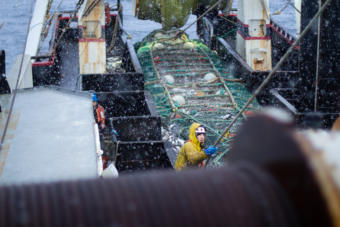
Crew members on the fishing vessel Commodore empty a trawl net of pollock on the Bering Sea in January. (Photo by Nathaniel Herz / Alaska’s Energy Desk)

The pollock fishing in the Bering Sea was “about as good as it gets,” skipper Dan Martin said as he steered his 133-foot trawler, the Commodore, over a dense school of the fish last month.

From the bridge, Martin watched as his sonar showed the fish streaming into his net – so thick that his instruments couldn’t distinguish the pollock from the ocean floor.

After just a few hours of fishing, Martin had filled the Commodore with more than 200 tons of pollock. As the wind and waves picked up, he started the nine-hour run back to Dutch Harbor, the Aleutian Island port.

Dan Martin, the Commodore’s captain, drives the boat out of Dutch Harbor in January. (Photo by Nathaniel Herz / Alaska’s Energy Desk)

The trip was what Martin called “classic” winter fishing: The pollock could be easily found at their traditional spawning grounds. But that’s not the case year-round, Martin said.

In the separate summer season, the pollock have become more erratic, he added, and he’s been forced to chase them into areas he hasn’t fished before. Those experiences – supported by recent scientific observations – show how climate change is casting uncertainty over the future of the billion-dollar pollock industry.

“As the fish change their behavior, you don’t have any historical values to weigh things against,” said Martin, standing at the wheel. “Across the board, everybody has a story about something that they haven’t seen before.”

Martin has been commercial fishing for more than three decades, and he’s gotten a pretty good feel for where to find pollock. He now manages a fleet of nine pollock boats for a company called Evening Star Fisheries.

Pollock are low-value fish — they sell for about 30 cents apiece. But more than 100,000 fit into a single netload on the Commodore, and some three billion pounds were hauled out of the Bering Sea last year by the fishing fleet, which is largely based in Washington state.

Roughly half the fish is set aside for so-called “catcher boats” like the Commodore – vessels that haul pollock in at sea, then deliver them, whole, to a processing plant on shore.

From his perch on the Commodore’s bridge, Martin, surrounded by monitors and instruments, worked with a crew of four on the deck below. Clad in helmets, lifejackets and rain gear, they helped set the quarter-mile-long trawl net behind the boat. Then they wrangled the massive, fish-filled tube back on board and flushed the pollock into the hold with water.

Crew members Joe Johnson, left, and Derrick Justice shovel pollock on the deck of the Commodore as another crew member, Brian Hagen, holds the hose. (Photo by Nathaniel Herz / Alaska’s Energy Desk)

The other half of the pollock catch is set aside for larger trawlers that then process and freeze the pollock in an onboard factory. They’re supported by crews that can be more than 100 people.

Products made from pollock include fish sticks, McDonald’s Filet-O-Fish sandwiches and surimi — the crab substitute sometimes tucked into sushi rolls. Much of the harvest is exported to Asia.

Pollock fishing is a major industry, responsible for more than 13,000 jobs, according to an estimate by the research firm McDowell Group.

But it’s also directly dependent on the stability of the Bering Sea ecosystem. And lately, both pollock fishermen and scientists have been noticing changes in the way that the ecosystem is behaving, especially during the summer fishing season.

The fishing vessel Commodore sits in port in Dutch Harbor next to its floating processing ship, the Northern Victor. (Photo by Nathaniel Herz / Alaska’s Energy Desk)

Temperatures in the Bering Sea last summer were as much as nine degrees Fahrenheit higher than normal.

And federal researchers have been making some surprising fish-related discoveries – specifically, they’ve found significant numbers of pollock and cod to the north of their typical ranges, said Jim Ianelli, a federal scientist.

“That area’s not being fished, and it’s not generally associated with being prime pollock habitat,” Ianelli said in a phone interview.

Scientists last year also found “really unusual” concentrations of pollock to the east, in the interior of Bristol Bay, Ianelli said. Those findings were buttressed by anecdotal reports of dead pollock from Bristol Bay commercial fishermen.

Ianelli said he thinks some of the Bering Sea’s fundamental features will help keep it a productive ecosystem, like the ample sun it gets during the summer and the way its geology allows for nutrients to circulate. But he also said that scientists still have lots of questions about how, exactly, climate change will affect the fish.

“We’re not very good at short-term forecasts,” he said. “We’re even worse at long-term questions.”

Martin, the Commodore captain, had his own unsettling experience last summer when he was fishing in an area called “the Horseshoe.”

Typically, the fish stay close to an underwater shelf there, and Martin knew it as a relatively safe spot where he wouldn’t have to worry about accidentally catching king salmon — a huge no-no for pollock trawlers.

But this time, Martin found himself chasing the fish nearly 10 miles off the edge, and he hedged his bets by dropping his net for a short test.

Crew members Derrick Justice, left, and Joe Johnson work to unload a trawl net full of pollock from on board the fishing vessel Commodore on Thursday, January 24, 2019. (Photo by Nathaniel Herz / Alaska’s Energy Desk)

“I just kept following my sonar farther and farther and farther off. It was like getting to the deep end of the pool. You’re like, ‘Well, don’t have my water wings, and I haven’t been this deep before,’” he said.

Even if pollock continue to fare well in the Bering Sea, they could pose problems for boats like Martin’s if they start straying too far from their normal areas.

That could make them too expensive to reach from Dutch Harbor, Martin said, since catcher boats are limited in how long they can fish and how much pollock they can store before it has to be delivered to a processor on shore.

If the pollock end up too far from port in the summer in the long term, Martin said it’s possible that his section of the industry would have to make major structural changes – like using floating processing vessels to handle fish from boats like the Commodore. Operators of the larger factory boats, meanwhile, said they can more easily adapt, since they can process fish onboard.

“These boats are more equipped to go further away and still be efficient,” said Jeff Garrison, captain on a factory vessel called the Starbound. “This fish is most ideal when it’s cut after a few hours, not after having 70-hour-old fish brought down from that far up.”

Martin is 53, and he’s already made a good living from the Bering Sea. But younger fishermen are staking their careers on pollock sticking around for decades longer.

Crew member Derrick Justice relaxes during a break from working on board the fishing vessel Commodore in January, 2019. (Photo by Nathaniel Herz, Alaska’s Energy Desk)

Derrick Justice, a deckhand on the Commodore from Washington, originally started fishing to pay his way through school. But during an interview in the boat’s galley, he said he “didn’t even make it” to college after earning $40,000 over the course of a few months in a fishing job.

“Earning my honest living was greater than what I was going to achieve by going to college, so I just stuck out with the hard work,” he said.

Justice, 24, is already making more than $100,000 a year. Veteran pollock fisherman can make $200,000 a year or more.

Justice said he wants to work his way up to being captain of a pollock boat. And he said he doesn’t worry too much about what’s happening in the ocean, or about how climate change and warming temperatures could affect fish populations.

Justice grew up in a family of fishermen and, he said, he loves to fish. But if the industry won’t give him a viable career, he said he could transfer his skills to a similar job, like on a cruise ship or tugboat.

“Mother Nature’s going to take its course, I suppose, just like it has since the beginning of time,” Justice said. “As far as I’m concerned, I just come up here, kill fish, make money, go home.”

Friends went looking for a missing Southeast Alaska artist. Instead, they found a note.

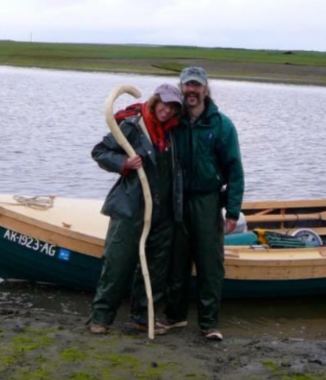
Eric and Pam Bealer, who lived outside of the tiny Southeast Alaska fishing town of Pelican, stand with the “Luna,” a dory that Eric Bealer built by hand. They went missing late last year. (Photo courtesy Eugene Solovyov)

Eric Bealer, a renowned Southeast Alaska wood block artist, was expected back from his remote summer cabin by the end of September along with his wife, Pam.

By early October, no one had heard from them. So two friends went out to the cabin, on the outer coast of Yakobi Island.

The friends left by boat from Pelican, a tiny fishing village where the Bealers lived the rest of the year. When they arrived at the cabin, there was no sign of the Bealers – just a box, and a note taped to the window on the front door.

“To the world and all concerned: This is to officially notify you that Eric and Pam Bealer, by their own choice and free will, have committed suicide,” it said, according to an Alaska State Troopers report. “We have gone to some effort to hide our bodies, as we do not want them found. Please do not waste time and money looking. It would serve no purpose. We are gone, leave us to our peace. (And yes, we have taken the dog with us…)(Oh, and we set the chickens free!)”

Among the items left behind by the Bealers was this note to the Sitka Conservation Society. It’s now included in court papers in proceedings opened by the society in an effort to have the Bealers formally declared dead.

The Bealers were both 58, born a day apart. They haven’t been seen since September, when they arrived at their cabin from Pelican.

Their apparent deaths have sent ripples of shock and grief through the people who knew them in Southeast Alaska and beyond. State troopers and the courts, meanwhile, are now trying to sort out the details of what the Bealers did, and what they left behind.

Since the note’s discovery, friends have held memorials for the couple; boxes and letters they left for people close to them have been mailed. But the Bealers still have not been declared dead: A “presumptive death” petition is pending in Sitka District Court before Magistrate Judge Amanda Browning.

In nearly identical, handwritten wills, the Bealers left their artwork to Eugene Solovyov, who runs a Sitka gallery. The rest of their property – including their money, boats hand-built by Eric Bealer and their home and land in Pelican – was set aside for a wilderness fund run by the Sitka Conservation Society.

“So that they may continue to help protect this land that I so love,” Eric Bealer’s will said. His wife’s had one extra word, “to help and protect.”

Eric Bealer was known for his distinctive wood engravings depicting wilderness scenes in the Tongass National Forest. He made posters for several years advertising Juneau’s Alaska Folk Festival.

Eric Bealer made this print to advertise the annual Alaska Folk Festival, in Juneau, in 2004. (Courtesy Alaska Folk Festival)

The intricate engraving form requires artists to cut away the surface of a wood block, leaving a design that gets inked and run through a hand-operated printing press.

Bealer’s prints typically cost less than $100 and usually reflected the rugged landscape of his home – its oceans, forests and animals along with the occasional person or boat. Some contained wry hints at a human presence, Solovyov said.

“He would show a particular scene but then add his own imaginary elements to it,” he said. Bealer, he added, was the gallery’s best-selling artist, popular among both tourists and locals.

Eric Bealer was born in Pennsylvania, and moved to Alaska in 1989, first settling in a different Southeast town, Haines.

He and Pam then relocated to Pelican and were living four miles outside the tiny fishing town, in an even tinier settlement. Friends described them as self-reliant naturalists: For a while, they owned a horse and kept sheep for the wool. They also raised chickens and gardened, fertilizing with manure and seaweed.

Eric built boats out of locally harvested cedar and spruce; Pam knitted and wove and made clothing. They would periodically ship Eric’s artwork to Sitka and elsewhere in Southeast Alaska by seaplane.

“They complemented each other extremely well,” Solovyov said.

But Pam Bealer had multiple sclerosis, and her health was slowly deteriorating, according to accounts that friends and family gave the troopers. But those close to them had different impressions of how bad things were, and of the Bealers’ plans.

Solovyov said Eric Bealer had talked “for years” about how the couple planned to kill themselves when Pam’s health became unmanageable.

“We all tried to talk him out of it,” Solovyov said. “We were just hoping that it wouldn’t be happening quite yet.”

Eric Bealer shows some of his artwork at a Sitka gallery. (Photo courtesy Eugene Solovyov)

Some friends gave similar reports to the troopers. One, a financial planner, noted that the Bealers had asked him a series of questions about their wills in May. But he thought that was more about the fact that the Bealers lived and traveled in a harsh environment, and knew the risks involved.

Others said the Bealers’ disappearance came as a complete surprise.

“We didn’t pick up on anything that they were planning on committing suicide,” Avery Simmons, the friend who found the note at the Bealers’ cabin, told state troopers.

The troopers searched both of the Bealers’ properties – their home near Pelican and their cabin on Yakobi Island. They also flew a plane around the harbor next to the cabin.

“I did not locate any sign of Pamela or Eric from the air or on the ground,” wrote trooper Branden Forst, who flew the plane.

The search for the Bealers has been formally suspended, said Jonathon Taylor, a troopers spokesman.

“We have not found any evidence or indication as to where they might be,” he said. “And given the very clear nature of the notes that were left behind, it seemed apparent that we might not actually be able to find them.”

If you or someone you know is thinking about suicide or hurting yourself, call the Careline at 877-266-HELP or seek help from a medical professional.

Site notifications
Update notification options
Subscribe to notifications