Nat Herz, Alaska Public Media

Candidate Dunleavy said he had no plans to cut ferries, schools, university. Then Gov. Dunleavy proposed deep reductions.

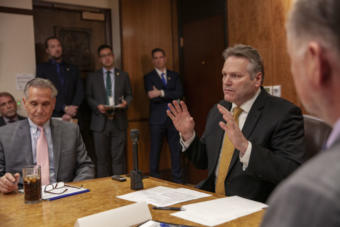
Mike Dunleavy talks to a group at a Juneau library in September, when he was still a candidate for governor. (Photo by Rashah McChesney/Alaska’s Energy Desk)

Shayne Thompson runs the store in the Tlingit village of Angoon, on Admiralty Island south of Juneau. There’s no road link to the mainland, so Thompson relies on the Alaska state ferry system to deliver his loads of fresh groceries, at least once a week.

That’s why Thompson voted for Republican Mike Dunleavy in last year’s gubernatorial election.

On the campaign trail, Dunleavy said “he was going to do everything he could to keep the ferry system intact,” said Thompson, 53.

The Alaska state ferry Malaspina off Sitka. Gov. Mike Dunleavy’s budget proposal would shut down the state ferry system Oct. 1. (Photo by Ed Schoenfeld/CoastAlaska News)

Two weeks before the election, Dunleavy told the Ketchikan Daily News that there was “no plan to hack, cut or destroy” the state ferry system. In another interview, with the city’s public radio station, he said: “I don’t envision at any time that there would not be a functional, robust ferry service in the Southeast, the panhandle of Alaska.”

In February, however, Dunleavy proposed a budget that would cut more than two-thirds of the state ferry budget and stop the system’s operations Oct. 1.

Now, Thompson said: “I feel like a fool, because of listening to somebody that was basically had a totally different agenda in mind when they were on the campaign trail.

Dunleavy’s plan would also make sharp reductions in government support for the state-run Pioneer Homes for elderly Alaskans, as well as to the University of Alaska system and to public schools – all of which, at various times during his gubernatorial campaign, Dunleavy said he did not plan to cut.

The reversals have left Dunleavy’s critics fuming. In interviews, they said the governor was able to make dubious claims about the budget on the campaign trail that were never debunked by a weakened mainstream media – which they said could have changed the outcome of the election.

“I think the campaign would have been different had he been more transparent about the costs of his proposals. And we didn’t have that conversation, so we can’t know how it would have come out,” said Anchorage Democratic Rep. Ivy Spohnholz. “I think Alaskans deserve transparency and disclosure in terms of what people want to achieve when they come into office.”

Dunleavy declined to be interviewed, but he has said that his evolving positions stem from falling projections of oil revenue.

A month before Election Day, oil prices were $85. They fell to $60 in the two months leading up to Dunleavy’s inauguration, costing the state $1.5 billion in projected revenue.

“We thought that we might be able to do this with reductions and efficiencies within certain areas of state government,” Dunleavy said last month on “Alaska Insight.” “When we got into office in December, we were hit with oil prices in the fifties and some said it was going to go further south.”

Dunleavy was also clear about his priorities during the campaign, said spokesman Matt Shuckerow: He opposed taxes and supported boosting the permanent fund dividend. And he wanted to make government more efficient, Shuckerow added.

“He was going to take a different direction, and that was addressing the structural deficit that we have,” Shuckerow said. “Most people we’ve heard from, there’s an understanding that the governor’s following through.”

As a candidate, when Dunleavy was asked by reporters and moderators whether he would cut specific state services, Shuckerow noted, he often left a caveat in his answers.

In an August debate on TV station KTVA, for example, Dunleavy was asked whether he’d cut several different programs. His answer for public education: “Not at this time.” Pioneer Homes and the university system? “No, for now.”

Dunleavy’s February budget proposes a 40% cut, or $134 million, in state support for the university system – some 17% of the system’s total budget, when federal and other revenues are included. Dunleavy’s administration is proposing to double the fees billed to some Pioneer Home residents, so that the state can reduce subsidies for the program. Per-student spending on public schools would fall by about one-fourth.

Meanwhile, Dunleavy pointed repeatedly on the campaign trail to at least $100 million – sometimes he said it was nearly $200 million – in spending that he said he could eliminate by getting rid of vacant positions in the state budget. Dunleavy, in an appearance on “Talk of Alaska,” said he was referring to a budgeting technique called the “vacancy factor.”

In fact, the vacancy factor is a multiplier that state agencies were already using to reduce spending, to account for employee turnover.

The Legislature’s nonpartisan budget analysts, in a presentation last year, said it’s a “myth” and “simply untrue,” that there are hundreds of millions of dollars in savings associated with the vacancy factor. And when Dunleavy released his budget in February, it did not include the savings from the vacancy factor that he referenced on the campaign trail.

Political blogger Dermot Cole has been highlighting that discrepancy, along with many of Dunleavy’s other campaign statements, since the governor unveiled his budget. In an interview, Cole described them as “impossible promises.”

“The Dunleavy campaign was more or less a fiscal fantasy from beginning to end that was able to exist because it wasn’t challenged by the press,” he said. “All of these assertions should have been treated with skepticism.”

Shuckerow said he hadn’t reviewed Dunleavy’s specific statements about the vacancy factor. But he said that the governor’s budget does reflect “significant changes to programs and operations.”

“This is all part of a broader conversation based on the information that we have about expenditures and revenues,” Shuckerow said.

Dunleavy’s political opponents have continually cited his shifting rhetoric in their criticism of his budget proposal – most recently, in a video released Monday that features labor leader Vince Beltrami.

“Dunleavy didn’t say he was going to devastate all the state services most Alaskans care about,” Beltrami said.

Anchorage Democratic Rep. Ivy Spohnholz. (Photo by Skip Gray/360 North)

But one Republican leader, Sen. Bert Stedman of Sitka, said he’s trying not to dwell on statements that were made months ago.

“I’m more concerned about putting an operating budget together in the Senate and working on the issues with the House than worried about particular political campaign promises,” said Stedman, co-chair of the Senate Finance Committee.

Even Spohnholz, the Democratic representative, acknowledged that her constituents are more focused on Dunleavy’s current proposals than on what the governor said during the campaign.

But she also argued that the governor’s lack of detail on the campaign trail means that he has less of a mandate for his budget now that he’s in office.

“What the governor campaigned on was a full dividend,” Spohnholz said. “He didn’t campaign on the cuts that he’s proposing.”

Dunleavy says money set aside for Alaska schools is subject to veto. Lawmakers disagree.

Gov. Mike Dunleavy talks about his goals during a press conference before his third cabinet meeting, on Tuesday, January 8, 2019, in Juneau, Alaska. (Photo by Rashah McChesney/Alaska's Energy Desk)
Gov. Mike Dunleavy talks about his goals during a press conference before his third cabinet meeting, on Tuesday, January 8, 2019, in Juneau, Alaska. (Photo by Rashah McChesney/Alaska’s Energy Desk)

A new fight has erupted in Juneau over spending on Alaska’s public schools.

It centers on whether Gov. Mike Dunleavy has the power to veto money that state lawmakers set aside for schools a year ago, for the upcoming school year — a practice that political insiders call “forward funding.”

The idea is to let school districts know how much money they’ll have for things like teachers, maintenance and supplies – and to do it more than a year in advance, so that legislative budget gridlock, or a gubernatorial veto, doesn’t derail districts’ planning.

The previously-budgeted money should mean that lawmakers won’t have to deal with a nasty education budget fight this year, right?

Not according to Gov. Mike Dunleavy, who said at a news conference earlier this week that the money “falls under the ability to veto, if that’s what we choose to do.”

A new four-page memo from Attorney General Kevin Clarkson backs Dunleavy’s argument, saying the Legislature’s move to forward-fund education was unconstitutional.

That, Clarkson wrote, is because the Alaska Constitution bans lawmakers from dedicating revenues to specific programs, and also because of requirements for annual budgeting and a section that sets out the governor’s line-item veto power.

The memo was first reported by the Alaska Landmine, a political blog, then distributed Thursday by Dunleavy’s office.

Dunleavy, a Republican, has pushed for sharp cuts to schools spending. He spoke at this week’s news conference with a red pen in his jacket pocket — a reminder of his authority to veto money for specific programs.

The state House on Thursday passed a version of the budget that relies on last year’s move to forward-fund education, and it has no per-student schools spending in it for next year.

Sen. Mia Costello (R-Anchorage) speaks to reporters at a Senate majority press availability, January 23, 2017. (Photo by Skip Gray/360 North)

Dunleavy’s administration argues that lawmakers need to include the schools’ money in the budget — which would make it subject to the governor’s veto. Otherwise, schools won’t get the cash when the new fiscal year starts July 1, Budget Director Donna Arduin wrote in a Monday letter to House leaders.

Anchorage Republican Sen. Mia Costello got her own legal opinion Wednesday from a legislative attorney that says the Dunleavy administration’s analysis is wrong. Costello’s memo said the governor already acknowledged the legitimacy of the forward funding when he put language in his own budget proposal to repeal the money.

Costello, in a phone interview Thursday, said lawmakers are still proceeding under the assumption that schools should get next year’s money without further action.

“We supported the schools with that amount of money, and we stand by that action,” she said.

Dunleavy’s red veto pen looms over this year’s budget debate

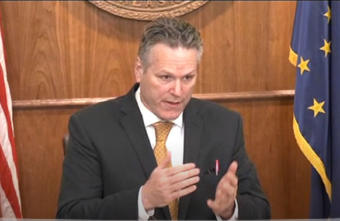
Alaska Gov. Mike Dunleavy speaks at his Tuesday news conference with a red pen in his jacket pocket — a reference to his veto power.
Alaska Gov. Mike Dunleavy speaks at his Tuesday news conference with a red pen in his jacket pocket — a reference to his veto power. (Gavel Alaska video still)

Alaska Gov. Mike Dunleavy spoke for half an hour at a news conference Tuesday, and his words made clear that he thinks lawmakers aren’t doing enough to cut the state budget.

His sharpest point, however, may have been in a silent message: the red pen tucked into his breast pocket, which was a reference to Dunleavy’s ability to cut the budget himself.

Lawmakers have so far rejected many of the steep cuts to public schools, ferries, health-care and the university system proposed by Dunleavy, a Republican. But before the Legislature’s budget can take effect, it stops at Dunleavy’s desk, where he can use that red pen to eliminate or reduce spending on individual programs through the line-item veto.

In Alaska, the governor wields line-item veto power stronger than in all 49 other states. That’s because it takes a three-fourths majority of the state Legislature to override such vetoes, while most other states require a two-thirds vote.

That high bar, combined with Dunleavy’s desire for spending cuts, is drawing new attention this year to the governor’s line-item veto power. In an interview, Rep. Lance Pruitt, R-Anchorage, said that discussions about overriding Dunleavy began before the governor introduced his austerity budget in February. (Pruitt leads the House Republican minority, and he wasn’t on board with the override ideas.)

Rep. Lance Pruitt, R-Anchorage, talks to reporters at a House Republican Minority press availability in his office at the Capitol in Juneau on March 14, 2019.
Rep. Lance Pruitt, R-Anchorage, talks to reporters at a House Republican Minority press availability in his office at the Capitol in Juneau, March 14, 2019. (Photo by Skip Gray/360 North)

“Even before we got down here to Juneau, people were kind of like, ‘Well, what about the veto overrides?’” Pruitt said. “There was a recognition then, because of what the governor had said — that he had no problem taking that action — that they had to account for that.”

The history of Dunleavy’s line-item veto power dates back more than a half-century, to the constitutional convention in Fairbanks that began in 1955.

At the time, delegates were frustrated both by how little power territorial Alaska had over its own affairs, and by inefficient governance from local federal bureaucrats. So they wanted to design a strong executive branch, balanced by a robust Legislature and independent judiciary, said Vic Fischer, the convention’s sole surviving delegate.

“We wanted to have a streamlined structure,” Fischer said in a phone interview. “We came with a totally different system, different structure, because we saw that the way that the federal system worked in Alaska could not continue under the statehood.”

The delegates made a concerted decision to create a higher bar for overriding vetoes of spending bills and items: They defeated a motion to lower it, to match the two-thirds majority needed to overturn vetoes of ordinary legislation, according to the convention’s minutes.

“You cannot exercise a strong executive arm unless you have a strong control on the purse strings,” Steve McCutcheon, the delegate who chaired the convention’s committee on the Legislature, said at the time.

Dunleavy has pointed to the convention’s minutes in referencing his line-item veto power, saying last month that the delegates “put that in there for a reason” and that it’s “not something I’ve made up.”

In fact, Dunleavy’s predecessor, independent Bill Walker, famously used his line-item veto power in 2016 to cut permanent fund dividends roughly in half, to $1,000. Citing the state’s huge deficit, Walker also vetoed hundreds of millions of dollars in cash tax credit payments to oil companies, along with money for the university and to pay off debt from public school construction.

Last year, Walker and state lawmakers filled a big chunk of the state’s deficit with revenue from Alaska’s $64 billion permanent fund. But in doing so, they cut residents’ annual dividends roughly in half from what they would have been, had lawmakers calculated them using a decades-old legal formula.

Dunleavy campaigned on boosting dividends, and when he introduced his budget in February, he proposed to pay for them by making steep cuts to government services: public schools, health care, ferries and the university system.

The state House has moved toward reducing Dunleavy’s proposed dividend and adding back much of the money for government programs that he wants to cut — though it’s still advancing significant reductions to spending on health care and school construction debt.

Dunleavy doesn’t have the power to add money back to the dividend once lawmakers approve the budget. But he’ll be able to use his line-item veto to reduce spending on specific programs – and at his Tuesday news conference, he said he’s waiting to see what the final budget looks like, once it moves through the Senate.

“If all we’re going to have in the budget are small reductions, then we really haven’t accomplished much this year,” Dunleavy said. “We’re not going to put any tools off the table, and I’m not going to be afraid to use any of the tools that the (state) constitution has provided the executive.”

Sen. Jesse Kiehl, D-Juneau, listens during a Senate Judiciary Committee meeting in Juneau on March 22, 2019. Assistant Attorney General William Milks was laying out some details of Senate Bills 23 and 24, which would compensate Alaskans for past cuts to the Alaska Permanent Fund dividend.
Sen. Jesse Kiehl, D-Juneau, listens during a Senate Judiciary Committee meeting in Juneau on March 22, 2019. (Photo by Skip Gray/360 North)

One concern voiced by lawmakers opposed to steep spending cuts is that Republicans might feel pressure to support any vetoes made by Dunleavy out of partisan loyalty.

“It’s the politics of it that’s much more difficult, because you bring in issues of individually bucking the governor,” said Sen. Jesse Kiehl, D-Juneau. “You have people who say, ‘I’m going to back my guy,’ even if the issues of right or wrong for their district might lean the other way.”

But, Kiehl pointed out, if Dunleavy goes too far with vetoes, he could end up uniting lawmakers against him, across party lines. Like, if the budget he signs has something for everyone to dislike: cuts to ferries that Southeast Alaska depends on, to school construction debt payments that are important in the Mat-Su, and to the university system, which is centered in Fairbanks.

“The simple fact is that this governor’s budget proposal has pain for the whole state,” Kiehl said. “And we all have issues that are particularly important to us. So you can’t get there picking off one or two — you have to get to three-quarters. So it’s going to be a broad agreement, if it happens.”


Watch the latest legislative coverage from Gavel Alaska:

Former Gov. Bill Walker lands at political ally’s law firm

Former Alaska Gov. Bill Walker talks strategy with one of his economic advisers on a trade mission to China last year. (Photo by Rashah McChesney/Alaska’s Energy Desk)

Former Alaska Gov. Bill Walker has a new job.

Walker, an attorney, this week joined the law office formerly known as Brena, Bell and Clarkson. The firm has changed its name to Brena, Bell and Walker, according to a document filed Friday in a federal case.

The “Clarkson” deleted from the name is Kevin Clarkson, who left his job to work as attorney general for Walker’s successor, Republican Mike Dunleavy.

Walker, 68, is a Republican-turned-independent who was elected governor in 2014. He suspended his campaign in last year’s gubernatorial race after his lieutenant governor, Democrat Byron Mallott, resigned.

Before he was elected, Walker and his wife, Donna, ran their own law firm, where they represented the city of Valdez, along with the Alaska Gasline Port Authority — a municipal entity that was promoting construction of a gas line from the North Slope to Valdez.

After Walker was elected, the firm was sold to Robin Brena, who also works on oil and gas law.

Walker, in a phone interview Friday, said he expects to resume doing work for Valdez, though he declined to identify other potential clients.

“Since I came out of law school, my focus has been on municipal law and helping municipalities with their legal, economic development issues and opportunities. So I’ll be doing that,” he said. “On the oil and gas side, I’ve certainly been involved in that, and I’ll continue that, as well.”

State corporate records show that Brena has been the sole owner of Brena, Bell and Clarkson. Walker declined to say whether he would become a part-owner of the firm.

Brena was a strong political supporter of Walker’s, donating tens of thousands of dollars to political groups that backed the governor’s campaign, and candidates and causes aligned with him.

While Walker has re-joined the private sector, he also hasn’t completely closed the door on his political career. In February, he reported transferring $47,099.53 into an account for a potential future political campaign.

“I’m not sure there’s anything to read into that at this point. My focus is on ways I can help clients, help local governments, help Alaska progress forward in a positive way,” he said. Seeking elected office, he added, “is not anything I’m posturing for, at this point.”

Aboard Alaska’s endangered ferries, passengers fear a ‘giant step back in time’

The MV Malaspina sits at the dock in Auke Bay, near Juneau, as the MV LeConte pulls away from the dock early Thursday. Both ships are part of the Alaska Marine Highway System.
The MV Malaspina sits at the dock in Auke Bay, near Juneau, as the MV LeConte pulls away from the dock early on March 28, 2019. Both ships are part of the Alaska Marine Highway System. (Photo by Nat Herz/Alaska’s Energy Desk)

Just after 6 a.m., a handful of cars drove down the ramp from the Juneau ferry dock into the MV LeConte for the ship’s twice-weekly loop through Angoon and nearby Tenakee Springs.

There’s no road to Angoon, a Tlingit village of 450, and there’s no airport, either. To get there from Juneau, you can buy a one-way seaplane ticket for $160 – or spend $55 to ride the ferry.

But Gov. Mike Dunleavy has taken aim at the ferry system’s budget, proposing sharp cuts that are threatening its future.

Southeast residents, ferry workers and political leaders have responded by staging rallies at the Capitol, arguing that the system is integral to the region’s commerce and character.

A single trip on the LeConte last week showed how residents have knit the ships into their lives – and how they would adapt if the ferries stopped running.

By the time the LeConte pushed off from the dock, the car deck held a pickup with a new gas stove and oven in the bed, a flatbed trailer stacked with lumber and a box truck filled with fresh produce and dairy.

Upstairs, on the observation deck, Shayne Thompson was drinking a cup of coffee. The box truck was his; Thompson runs Angoon’s store and puts supplies on the ferry every week. He said he remembers, as a child before regular ferry service, when food would come just once a month on a barge.

“Everybody would grab it, and then we’d be out for three weeks. That’s the way it would go – there was a lot of canned goods eaten then,” Thompson said. “We’re able to live a little healthier lifestyle at this point, thanks to the ferry. And it’s just fantastic.”

The MV LeConte cruises through Chatham Strait on its way north to Juneau from Angoon on Thursday.
The MV LeConte cruises through Chatham Strait on its way north to Juneau from Angoon on March 28, 2019. (Photo by Nat Herz/Alaska’s Energy Desk)

Angoon now has no regularly scheduled barges to bring in supplies; neither do a half-dozen other villages that Alaska’s ferries serve, according to the Department of Transportation and Public Facilities.

Dunleavy, a Republican, rode one of the state ferries from Washington to Ketchikan when he first arrived in the state, in 1983. And he was elected after saying there was “no plan to hack, cut or destroy” Alaska’s ferry system.

But when Dunleavy released his budget in February, he did propose to cut the ferries – by more than two-thirds. His proposal to the Legislature budgeted enough money to run the ships only for the first three months of the fiscal year, through Oct. 1. Then, the fleet would be tied up.

Dunleavy’s administration said the proposal would save the state $100 million. The governor argues that steep cuts are needed to balance Alaska’s budget, while at the same time paying larger cash dividends to residents.

His administration is offering to pay up to $250,000 to a consultant to study privatization and other options for the ferry system.

“Most of rural Alaska doesn’t have a ferry system. They don’t have roads. They want to get from one community to another, they have to fly. And I agree it’s an issue,” Dunleavy said last week on “Talk of Alaska.” “There is no easy solution to this problem. We’re trying to find out if there’s ways to make it more efficient, look at different runs, potentially consolidation, potentially privatization.”

Policymakers have, however, been studying possible reforms to the ferries for years, without reaching consensus. A 2017 report found that there are “no operating scenarios” where the system can pay for itself “and still fulfill its critical public service mission.”

Ticket sales generate a little more than one-third of the money required to run the ferries. For the LeCounte’s Angoon trip, fares would have to be five times higher – about $300 – for the route to pay for itself, according to an analysis provided by Dunleavy’s office.

If the ferry system shuts down, Thompson, who runs the Angoon store, said he could hire a barge to bring his freight to the village. But he predicted that prices would rise by about 25 percent, and fresh food would only come once a month.

“It’s like a giant step back in time,” he said. “We would have fresh produce and dairy for a week or two of the month. And then, for the rest of the month, it would be all dry goods.”

The MV LeConte approaches the dock at the Southeast community of Tenakee Springs on March 28, 2019.
The MV LeConte approaches the dock at the Southeast community of Tenakee Springs on March 28, 2019. (Photo by Nat Herz / Alaska’s Energy Desk)

Alaska operates nearly a dozen ferries, and they’re particularly indispensable in Southeast, a 300-mile long archipelago where only a few towns are connected to the road system.

Schools use the ferries to move sports teams. When cars need maintenance, people float them to mechanics in Juneau. Sick people who have a hard time loading into bush planes ride ferries to doctor’s appointments. The ships even carry the bodies of elders back to their hometowns.

The ferry system is “all things to all people, depending on the day,” said Kurt Rehfeld, who’s worked on Alaska ferries for 30 years – 19 of them on the LeConte. He described passengers almost like family; he knows their children and grandchildren.

“They travel to Juneau to keep their lifestyle alive. And we provide the opportunity for that,” Rehfeld said. “I think that’s what government does. I think government is there to make all of our lives a little bit better.”

In interviews at the Capitol, lawmakers who represent legislative districts off the ferry system said they understand its importance to Southeast Alaska. But several Republicans said that they’re unwilling to keep subsidizing it at the same level.

Anchorage Republican Rep. Lance Pruitt, the House minority leader, described his colleagues from Southeast as being resistant to necessary change.

“I think if they’d get on board and work with the governor – he’s not trying to destroy the system. He’s just trying to create a system that is functional and provides the service, but at a reduced cost,” Pruitt said. “Because we can’t continue to afford going about it the same way that we always have.”

He added: “Change is hard for anyone, and that’s not to fault Southeast. I think all of Alaska is going through that right now.”

The MV LeConte sits at the dock in Angoon on March 28, 2019.
The MV LeConte sits at the dock in Angoon on March 28, 2019. (Photo by Nat Herz/Alaska’s Energy Desk)

Southeast Alaskans note that the ferry system is called the “marine highway,” and they have a comeback ready for people who question its cost: People in Anchorage and Wasilla, Dunleavy’s hometown, don’t pay for plowing or maintenance on their state highways, either.

“You should start putting toll booths all over the place in the rest of Alaska,” said Albert Howard, a former Angoon mayor and tribal president who was eating lunch in the LeConte’s dining room. “Then, after you do that, then we’ll say, ‘We’re just going to close this strip of highway.’ Do you understand now?”

But Bert Stedman, the Sitka Republican who co-chairs the Senate Finance Committee, said his region has to accept a new political reality. When the ferry system was established a half-century ago, Southeast Alaska’s timber industry was booming. Now, Stedman says, “there’s no more pulp mills.”

“And we’ve gone from five senators to two. We have had a significant dilution, since the creation of the marine highway, of political influence. And that is continuing to erode,” Stedman said in an interview in his Capitol office. “We are not in the position where we can, frankly, dictate what we want to do. We just don’t have the numbers.”

Stedman spoke just after a long meeting with Ben Stevens, Dunleavy’s policy advisor tasked with reshaping the state ferry system. Stedman said he’s trying to work with the Dunleavy administration on a temporary plan to keep the ferries running, even if they’re running less often, until lawmakers can agree on a longer-term vision for the system.

On the LeConte, passengers said they could live with once-weekly trips to Angoon and Tenakee, rather than twice-weekly. On Thursday, the ship carried a few dozen people, even though it has room for 225.

As the LeConte neared Angoon, passenger Kevin Frank was leaving the dining room with a couple of boxes – hot sandwiches he was bringing ashore as a treat for his family.

Like others, he was already thinking about how he’d cope if the ferry runs less often. Frank said he’s looking for a new skiff, for harvesting seaweed and fishing for halibut and king salmon.

“Because Costco might not be an option,” he said.

Virginia GOP group helps boost conservative Anchorage School Board candidates

(Image courtesy Anchorage School District)

An independent political group with money from a national Republican organization is running radio ads boosting conservative candidates in Anchorage’s local school board races.

The group is called Families of the Last Frontier. It’s spending $7,000 on new ads that feature former Anchorage mayor Rick Mystrom endorsing conservative school board candidates Kai Binkley Sims and David Nees, according to a financial disclosure filed Wednesday.

The group’s chair — Anchorage Republican activist Steve Strait — didn’t immediately respond to a request for comment. Neither did Randy Ruedrich, a former Alaska Republican Party chairman whose company is also a donor to Families of the Last Frontier.

That group received $40,000 Wednesday from GOPAC, a Republican organization once run by Newt Gingrich, the former U.S. House speaker.

Virginia-based GOPAC’s major donors include tobacco company Reynolds American and beer company Anheuser-Busch, according to a report filed with the Internal Revenue Service.

It’s unusual for a national Republican group to get involved in local Anchorage elections. The races are officially nonpartisan, though the state Republican and Democratic parties often help recruit and fundraise for candidates.

Site notifications
Update notification options
Subscribe to notifications