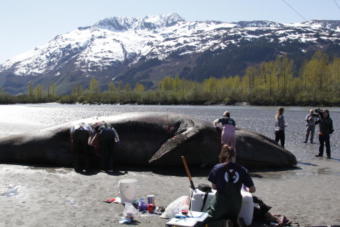
Workers collect samples from a gray whale beached at the end of the Turnagain Arm outside Anchorage in late May. (Photo by Nat Herz/Alaska’s Energy Desk)
Federal scientists are opening an official investigation into what’s causing the spike in gray whale deaths in the Pacific Ocean, including along Alaska’s coast.
The National Oceanic and Atmospheric Administration announced Friday that the 70 dead whales seen this year in the U.S. constitute “an unusual mortality event.”
The agency also announced that a dead gray whale was discovered this week in the Alaska Peninsula town of Chignik Bay. It’s the fifth one found in state waters this migratory season.
Scientists say many of the dead whales appear to be very skinny. That’s raising questions about whether global warming and reduced sea ice are affecting their feeding grounds in the Arctic, and their primary prey, shrimp-like creatures called amphipods.
But on a call with reporters, University of Washington oceanographer Sue Moore said the explanation is elusive.
“The Arctic is changing very, very quickly. And whales are going to have to adjust to that,” she said. “But gray whales are good at eating a variety of things. So it becomes a complex question very quickly.”
NOAA officials say it could takes months to years to assign a cause to the deaths.
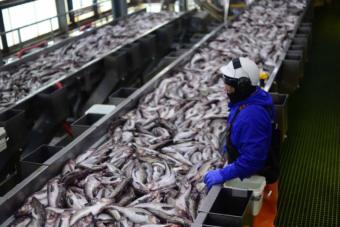
Pollock, seen here at a processing plant in Dutch Harbor in the Aleutian Islands, are one of the species being found in increasing numbers in the northern Bering Sea. (Photo by Berett Wilber)
Last fall, Adem Boeckmann, a commercial fisherman who lives outside Nome, pulled up some of the pots he uses to fish for crab on the ocean floor.
“Had 10 24-inch cod in each pot,” Boeckmann said. “I never saw anything like that.”
Cod, which is used in fish sticks and fish and chips, is caught in huge numbers by commercial boats in the Bering Sea. But not near Nome – typically, the fish is caught hundreds of miles south. Historically, the ecosystem where Boeckmann fishes has been centered on the ocean floor, without big populations of large fish.
Adem Boeckmann. (Photo courtesy Adem Boeckmann)
Federal scientists are setting off on their own Bering Sea fishing trip this summer, to investigate whether observations like Boeckmann’s – bolstered by the government’s own previous findings – could be indicators of profound shifts in the ocean ecosystem driven by global warming. The results of the summer fieldwork could have major implications for the Bering Sea’s billion-dollar fisheries, as well as for Alaskans who live, hunt and fish along the Arctic coast.
“Is this part of an environmental shift, where with the warming, the northern Bering Sea is going to become a top-down system?” asked Lyle Britt, a federal fisheries scientist who will spend more than a month at sea this summer. “Or, is this more like an ephemeral trend that just happened because we had an unusually warm year, and things will reset? We don’t really know.”
The surveys are done by the Seattle-based Alaska Fisheries Science Center, an arm of the National Oceanic and Atmospheric Administration.
This year’s effort should provide especially useful data, scientists say, because it will include the northern part of the Bering Sea. Researchers have been surveying the eastern Bering Sea for decades, and it is also included in this summer’s work.
But full surveys of the northern Bering Sea have been far less frequent, with the two most recent in 2010 and 2017. Scientists will return there this summer, and they’re hoping to collect new data to help them explain the dramatic differences between the two previous northern surveys.
These two photos show federal scientists’ catch at the same Bering Sea survey station in 2018 (left) and 2010. The 2010 catch was primarily a small fish called capelin, while the 2018 survey caught much-larger pollock. (Photos courtesy NOAA Fisheries)
In 2010, the results showed that pollock was absent from the northern Bering Sea in large numbers – the estimated biomass was just 20,000 tons, with cod biomass estimated at 29,000 tons. In 2017 – a warmer year with lower sea ice – the survey results showed 1.3 million tons of pollock, and another 280,000 tons of cod.
Federal scientists will start three months of surveys Friday from the port of Dutch Harbor, in the Aleutian Islands. They’ll work 13-hour days from hired fishing boats, dividing the Bering Sea into a grid of hundreds of 20-mile squares.
At each square, they’ll drop a 50-foot-wide trawl net into the water, drag it just above the ocean floor for a couple of miles, then pull it back out. Then, they’ll dump the contents on to a table to be sorted, to help scientists see what’s in the water.
“It is all very much alive and moving around,” Britt said. “If we tow in a spot where we get a lot of, say, king crab, you’ll watch this big pile of what looks like red spiders heading off across the deck, and you’ve got to go get them.”
This year’s survey should give scientists more insight into whether the results from 2017 – the ones that showed huge amounts of pollock and cod in the northern Bering Sea – reflected an isolated event or the start of a long-term trend. Ice cover in the Bering Sea was close to normal in the early part of this past winter and only declined to abnormal levels after January, according to NOAA.
Commercial fishing groups are among the stakeholders closely watching this summer’s surveys, since the results could have ramifications for the eastern Bering Sea cod and pollock fisheries, worth an estimated $2 billion. Captains have already seen a “gradual shift northward” in their cod fishing patterns, said Chad See, executive director of the Freezer Longline Coalition, an industry group.
But researchers and fishermen still want more information about where the northern Bering Sea cod came from. Did they swim there from fishing grounds in the eastern Bering Sea? Or did they come from elsewhere, like Russian waters to the west? If they swam north from eastern Bering Sea, that would help explain why scientists didn’t find more cod in the fishing grounds in their 2017 survey, See said.
“If it’s the same stock, one might say that the health of the stock, at least from a biomass perspective, is still very strong,” See said. “If the fish in the eastern Bering Sea just disappeared, we have a different problem entirely.”
Residents of the towns and villages along the Bering Sea are paying attention, too. Warming temperatures and diminished sea ice could have major impacts on the marine mammals that people target in subsistence hunts, and on the smaller organisms that those marine mammals eat, said Wes Jones, director of fisheries research and development at Norton Sound Economic Development Corporation.
NSEDC uses profits from its shares of federal commercial fishing quotas to pay for economic development programs in the Bering Strait region, which extends from Unalakleet to Nome to more remote coastal villages, like Wales.
Residents have been seeing shifts in the Bering Sea ecosystem for decades, said Laureli Ivanoff, an NSEDC spokeswoman.
Adem Kougarok Boeckmann and Anvil Kain Boeckmann stand above crab they caught from Norton Sound on the boat run by their father, Adem Boeckmann. (Photo courtesy Adem Boeckmann)
“Our communities and the people who have seen the changes are relieved Western science is now paying attention,” Ivanoff said.
Residents have been pushing for more involvement with federal scientific work in the region, and one of NSEDC’s biologists will participate in this summer’s northern Bering Sea survey, Jones added.
Meanwhile, small-boat fishermen in the region, like Boeckmann, are looking to the survey’s results to help them make decisions about how to respond to possible shifts in crab and fish stocks. Boeckmann has contemplated spending $30,000 on new gear that would allow him to commercially fish for cod.
But before he does that, Boeckmann said, he wants to know he’ll be able to consistently earn a profit. He recounted a conversation with a federal scientist who suggested that as quickly as the cod showed up off Nome, they could also disappear.
“Things have changed, absolutely,” Boeckmann said. “But there’s nothing saying it’s not going to flop right back to what it was for 100-plus years, tomorrow.”
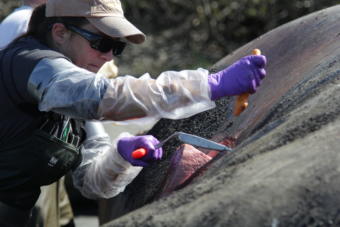
Dr. Kathy Burek, a veterinary pathologist, slices through the blubber layer on a gray whale that was beached at the end of the Turnagain Arm outside Anchorage on Tuesday. (Photo by Nat Herz / Alaska’s Energy Desk)
Cutting through a six-inch-thick layer of blubber demands a sharp knife.
But as she prepared to slice into the abdomen of a dead gray whale beached outside Anchorage on Tuesday, many of Kathy Burek’s knives were dull. Burek, a veterinary pathologist, had used them two days earlier to collect samples from a different gray whale, 100 miles away. Then, the next whale washed up.
“I didn’t have time. That’s what our problem is right here,” Burek said as she struggled to pull off a slab of blubber.
The whale sat at the mouth of the Placer River, at the eastern end of the Turnagain Arm. (Photo by Nat Herz / Alaska’s Energy Desk)
Scientists say more deaths are likely in Alaska, since each spring, gray whales swim 5,000 miles from Mexico to their Arctic feeding grounds.
“The level of strandings we’ve seen on the West Coast means Alaska should brace itself for probably some significantly elevated numbers of gray whale strandings,” said John Calambokidis, a research biologist at the Washington-based Cascadia Research Collective.
Burek was hired by NOAA to take samples from the stranded whale outside Anchorage, just off the Seward Highway at the eastern tip of Turnagain Arm. It had been floating in the arm for nearly two weeks, and she wasn’t planning an extensive necropsy – the animal version of an autopsy.
“It’s just not worth the time and effort because once we get inside the abdomen – the kidneys, the liver are just going to be kind of liquefied,” she said.
The whale, she added, looked “skinny.”
Experts say it appears that many of the other gray whales died of starvation. But scientists aren’t sure why.
Chunks of blubber were cut from the whale to allow Burek to access its abdomen. (Photo by Nat Herz / Alaska’s Energy Desk)
But researchers are also asking whether recent warming trends in the Arctic and reduced sea ice have affected the whales’ prey.
“We have to really be on top of: Is there any relationship to climate change? And does this link to any other factors that might be affecting other species as well?” Calambokidis said. “Could gray whales be an early warning sign of other things that we need to be watchful for?”
Gray whales were once hunted nearly to extinction by whalers. But they were protected by the Endangered Species Act, and the eastern North Pacific population rebounded and was removed from the endangered species list in 1994.
Each spring and fall, the whales swim on one of the longest known mammal migrations – between their winter area in Mexico and their summer feeding grounds in the Chukchi, Beaufort and Bering seas in the Arctic. They primarily eat tiny, shrimp-like creatures called amphipods, sucking them off the ocean floor and filtering mud and seawater out through their baleen.
Burek and volunteer Travis Shinabarger work on the whale. (Photo by Nat Herz / Alaska’s Energy Desk)
NOAA surveys the gray whales’ feeding patterns each summer. Last year’s survey results are now getting scrutinized to see if they can help explain this year’s deaths, said Michael Milstein, a NOAA spokesman.
“The scientists that do those surveys are going back through their records and trying to understand if there was something unusual about when and where the whales were feeding,” he said.
A sample of abdomen muscle. (Photo by Nat Herz / Alaska’s Energy Desk)
Milstein said they’ll be doing another survey this year, trying to determine: “Are there more whales that are competing for limited resources? Or, for some reason, is that food less nutritious or not providing them as much energy to sustain them on that long migration?”
NOAA also hopes to gather information from dead whales, like the one beached outside Anchorage earlier this week. The agency is encouraging people to report them as soon as possible, so that scientists can get to them to collect data before the whales start decomposing.
Burek wasn’t optimistic about the quality of samples she’d get Tuesday, but it turned out that the whale was in better shape than she thought.
After cutting and peeling a swath of blubber off one side, Burek cut into the whale’s abdomen, which released periodic spurts of gas and a foul smell. Internal organs slowly slid out of Burek’s incision. They were in better shape than she expected.
“Ooh, guess what that is – that’s the kidney!” Burek said, as she sliced into the big red mass. “We got kidney!”
Burek placed tiny chunks into bags and vials – muscle, testicle, even poop. They’ll be tested later, as potential clues for researchers trying to solve the mystery of why whales are dying.
NOAA asks Alaskans who see a beached or dead whale to call 877-925-7773.
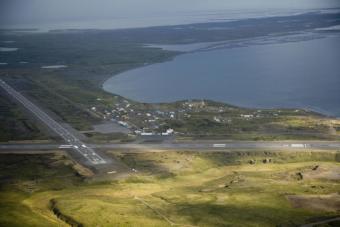
The runway at the Alaska Peninsula village of Cold Bay is long enough for jets to land — unlike the airstrip at the nearby fishing town of King Cove. The Trump administration has appealed a federal judge’s ruling that blocked a land exchange meant to facilitate a road between the two communities. (Public domain photo by U.S. Fish and Wildlife Service)
President Donald Trump’s administration on Friday appealed a court ruling that blocked plans to build a long-sought road through the Izembek National Wildlife Refuge.

Attorneys for U.S. Interior Secretary David Bernhardt filed the appeal of a March decision by U.S. District Court Judge Sharon Gleason that set back the administration’s plans for a 12-mile road through the refuge on the Alaska Peninsula.
An Interior Department spokeswoman, Molly Block, declined to comment.
Residents of the fishing village of King Cove, which is only accessible by boat and small plane, have pushed for decades for permission to build the road to the nearby village of Cold Bay and its jet runway.
Bad weather sometimes makes air and boat travel impossible to and from King Cove. And residents, with political support from Alaska’s elected officials, argue that the road to Cold Bay would make it easier for them to be evacuated during medical emergencies.
Environmental groups have opposed the road, arguing that winter storms and snow would make it no more reliable for King Cove than small planes or boats. They also say it would set a bad precedent to build the project inside a refuge.
Environmental groups sued the Trump administration last year over a land exchange between the federal government and an Alaska Native corporation meant to facilitate the road’s construction.
Gleason invalidated the exchange in a March ruling, saying the Trump administration violated the Administrative Procedure Act by failing to justify its change in policy from the Obama administration.
The case now moves to the U.S. Court of Appeals for the 9th Circuit.
Alaska lawmakers say that they’re getting tough on crime with a new bill to lengthen prison sentences.
The legislation, House Bill 49, is under debate as the Legislature nears the end of its annual session. It would reverse many of the pieces of Senate Bill 91 – the 2016 legislation that many Alaskans blame for a spike in crime.
But the new bill comes with a big price tag, and not everyone agrees that it will drive crime rates back down – including Doug Elkins, a convicted felon who was released from prison last month.
In an interview at Partners for Progress, an Anchorage organization that helps released prisoners “re-enter” society, Elkins said he’s been cycling in and out of prison since the 1970s. He’s working on getting clean and went to a drug treatment program in prison, he said.
Doug Elkins, 62, says he just finished a 20-month prison sentence, which is estimated by the state to cost $100,000. He said he got high immediately after leaving jail. (Photo by Nat Herz / Alaska’s Energy Desk)
But his sentence didn’t solve his problems, he said. Others who work with released prisoners like Elkins said that enhancing access to programs for mental health treatment and drug addiction would do more to reduce crime than boosting sentences.
“For 20 months, I sat in jail not wanting to do nothing but get high. And then, once I got out that’s exactly what I did: I went and got high,” said Elkins, 62, in an interview. “Going to jail, all that’s going to do is remove you from the situation for a minute.”
A 20-month term, like the one Elkins said he served, costs Alaska $100,000, according to state figures that place the daily cost of a prison bed at $169.
Reducing imprisonment for nonviolent criminals was policymakers’ goal in 2016 when they passed SB 91, a major restructuring of Alaska’s criminal justice laws. The idea, supported by both in-state and out-of-state research, was that longer prison sentences aren’t shown to keep prisoners from committing more crimes once they get out.
So SB 91 reduced sentences for nonviolent crimes and budgeted some of the savings to boost drug treatment, as well as programs to help people transition from prison back to regular life. Almost immediately, the changes faced a backlash. Gov. Mike Dunleavy ran on undoing the legislation.
“To the criminals, and to the rapists and molesters who see our children as nothing more than opportunities, I say this to you: We will do everything in our power to stop you, apprehend you and put you in prison for a very long time,” Dunleavy said at his State of the State speech earlier this year, when he pledged to repeal and replace SB 91.
https://vimeo.com/312884678
Critics of the law, like Dunleavy, have tied it to a spike in crime in Alaska.
Anchorage District Attorney John Novak said he rejects that idea that SB 91 just happened to coincide with a crime wave driven by other factors.
He said he and his colleagues in law enforcement feel like SB 91 deprived them of the tools they need to make Alaska safe – particularly when it comes to provisions that made it easier for defendants to get out on bail before trial.
“We’re all frustrated. We’re in this business to try to make our community safer, and it’s a very uncomfortable discussion when we interact with our neighbors and our friends and our community members and they look at us, like, ‘What are you doing?’” Novak said in an interview. “I don’t know how many more murders and auto thefts and whatnot we need to show that it doesn’t work.”
John Novak is Anchorage’s district attorney. He says that by loosening bail requirements and reducing prison sentences, Senate Bill 91, the 2016 criminal justice legislation, made it harder for law enforcement to keep Alaskans safe. (Photo by Nat Herz / Alaska’s Energy Desk)
Novak said he disagrees with the premise that it makes sense to reduce prison sentences for nonviolent criminals; prosecutors have cited federal data that showed a significant number of people imprisoned for drug crimes to be later arrested on charges of violent crimes.
Novak said some people will object to his position as supporting “mass incarceration.”
“Putting people behind bars for doing crimes of violence, pointing guns at people, stabbing people, assaulting people, putting people in the hospital – I would submit that that’s a good thing,” he said. “Particularly if they’re in their prime time crime time years, their twenties.”
Before this year, lawmakers had already repealed many elements of SB 91, including in a 2017 special session called by former Gov. Bill Walker – before all of SB 91’s provisions had even taken effect. A new Department of Corrections unit created by SB 91 to supervise defendants released on bail before trial, for example, didn’t take effect until the start of 2018.
Eva Gregg, a recovering alcoholic who was volunteering at the Anchorage re-entry center last week, said that boosting prison sentences comes with a social cost, too.
Addressing state lawmakers, she said: “I’d really ask them: If you were the alcoholic and if you were the addict, is that where you would want to be sent because of the things you’re doing to support your alcoholism, your drug addiction?”
“Have some empathy,” added Gregg, 52.
Eva Gregg, 52, volunteers at Partners for Progress’ re-entry center in downtown Anchorage. She says lawmakers considering tough-on-crime measures should think about where they’d want to be sent if they were caught committing crimes to support a drug or alcohol addiction.
Cathleen McLaughlin, who runs the re-entry center, said she’s worried about lawmakers throwing out parts of SB 91 that she thinks have been working – like boosting support for programs outside of prison, like hers.
McLaughlin said the big failure of the legislation was not in reducing sentences, but in not doing even more to ease released prisoners’ access to speedy treatment for mental health problems or drug addictions.
“We have to acknowledge that we have not lived up to that promise of SB 91,” McLaughlin said. “We refer people all the time to get assessments and treatment – they’re never timely.”
McLaughlin said some of her center’s clients have severe mental health problems.
And until they’re stabilized, she added, it’s likely they’ll go on to commit more crimes – tougher sentences or not.
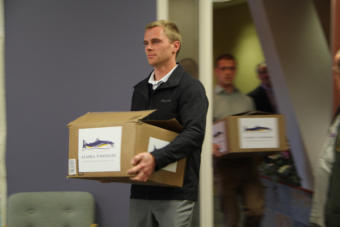
Clark Penney, a grandson of developer Bob Penney, carries a box into the Alaska Division of Elections office in Anchorage in 2015, when he was working on an initiative to ban commercial setnet fishing in certain parts of the state. Penney was recently hired by the state under a no-bid contract — after his grandfather, Bob Penney, donated more than $300,000 to an effort to help elect Gov. Mike Dunleavy. (Alaska Journal of Commerce file photo)
Now, his grandson’s company has been hired by the state under a no-bid, $8,000-a-month contract.
Clark Penney’s company, Penney Capital, was hired to help with a Dunleavy administration initiative, the New Industrial Development Team, to bring new businesses to Alaska and expand existing ones, according to a copy of Penney’s contract.
Penney is the latest in a series of appointments and hires by Dunleavy’s administration that have raised questions, even among his allies, about whether they’re driven by personal and political allegiance rather than objective qualifications. Last month, a high-level $94,000-a-year labor relations job went to a 25-year-old with no labor relations experience who had worked on Dunleavy’s campaign and as an assistant to Dunleavy’s chief of staff.
Several other Dunleavy picks withdrew from consideration for state positions after generating controversy during the Legislature’s confirmation process.
“The sole-source contract to an individual who doesn’t appear to have the experience to do the job is almost unbelievable when you add in the campaign connection,” Rebecca Logan, a Republican and former candidate for Anchorage mayor, wrote in a Facebook post responding to the Alaska Landmine’s story.
Logan, who supported Dunleavy’s campaign, added: “I hated it when [former] Gov. [Bill] Walker had the friends and family job program — I hate it in the Dunleavy administration also. This is not good government.”
The state has procurement laws and regulations that govern hiring, in order to make sure contracts go to the most qualified people and businesses. Those regulations generally require contracts to be put out to competitive bid.
Penney has worked at Morgan Stanley and Merrill Lynch, and he’s now listed as a financial adviser at a California-based firm, Cypress Wealth Services, that manages money and advises “high net worth families, business owners, and institutions,” according to the firm’s website. Penney has offices in California and Anchorage, according to the website, and Karsten Rodvik, an AIDEA spokesman, said he believes Penney will be able to continue his work at the financial services firm while under contract with the state.
AIDEA, in its written justification of the no-bid contract, said Penney’s experience and network of investors will be “invaluable” to the Dunleavy administration’s economic development team and in “bringing new business and development opportunities to the state.”
A rejection of the waiver would have delayed the governor’s agenda, the justification said.
Penney didn’t respond to requests for comment, while Dunleavy’s office referred questions to AIDEA. Rodvik said he did not know the specific legal or regulatory authority that AIDEA used to hire Penney on a no-bid basis. But he reiterated that the need to go outside the standard competitive process stemmed from the urgency of the work.
“The goal here was to get moving,” Rodvik said. “It was important that there not be any delay in the work of this new industry development team, or delay in achieving tangible results.”
Clark Penney is a grandson of Bob Penney, who gave more than $300,000 to a political group that supported Dunleavy in last year’s election. Before he was elected, Dunleavy said that when it comes to policy, he would treat Bob Penney like any other constituent.
Clark Penney’s contract with AIDEA calls for him to earn $8,000 a month, plus travel expenses, through June. It includes an option for three one-year extensions, with a total budget of $441,000.
Penney is working from state offices in the Atwood Building in downtown Anchorage, Rodvik said.
The money for Penney’s contract comes from the Department of Commerce, which has an existing economic development office that could be reorganized or eliminated this year.
In his budget released in February, Dunleavy proposed to move Alaska’s three economic development specialists from the commerce department into the governor’s office. But now the Legislature is considering eliminating those three jobs altogether.
The commerce department also houses the New Industry Development Team to which Penney belongs. The team has not been officially announced, but a fact sheet lists Penney as its “managing director.” Its 11 other members include several other commerce department employees; Mark Parker, the chief executive of a holding company of an Alaska Native corporation; and Nick Begich, a tech entrepreneur.
Close
Update notification options
Subscribe to notifications
Subscribe
Get notifications about news related to the topics you care about. You can unsubscribe anytime.