Daphne Jackson of Palmer holds up a sign at a demonstration Monday outside Alaska Republican lawmakers’ special session meeting at Wasilla Middle School. (Photo by Nat Herz/Alaska Public Media)
Monday’s special session in Wasilla wasn’t just a meeting for Alaska’s Republican legislators.
It also gave road-system Alaskans a chance to offer their opinions about the huge dilemma facing lawmakers right now: whether to uphold Republican Gov. Mike Dunleavy’s major line-item budget vetoes, which would cut hundreds of millions in state spending on programs like its university system, cash payments to the elderly and early education.
Dozens of constituents turned out, first lining a stretch of the Parks Highway before walking to Wasilla Middle School, where they greeted lawmakers with dueling chants: “Save our state,” “Follow the law” and “Override!”
The demonstrators along the highway had gathered for an event in support of Dunleavy. One was Steven VinZant, 57, who held a “Save the PFD” sign. He said he supports the line-item vetoes because of what he sees as inefficiencies and high salaries in state government, including the University of Alaska system, which would lose $130 million if the vetoes are upheld.
Steven VinZant of Soldotna waves to drivers along the Parks Highway on Monday during a demonstration before Alaska Republican lawmakers’ special session at Wasilla Middle School. (Photo by Nat Herz/Alaska Public Media)
“There are some awful big beautiful buildings that cost an awful lot of money that could have been more utilitarian,” VinZant said, referring to university buildings. “We could have more books, more computers, if we didn’t have grandioso buildings for millions of dollars.”
Many of the demonstrators were from the Mat-Su, which is one of the most conservative areas of the state. But VinZant wasn’t. He drove 3 1/2 hours to Wasilla from his home in Soldotna, where he has worked as an adjunct professor at the state university system.
VinZant said he’s a little worried about what the steep budget veto to the university could mean for his students. But he also said he’s on their side in trying to stop lawmakers from reducing the permanent fund dividend, as they have done in the past few years.
“I’m fighting for the fact that $3,000 of your school money was stolen from you,” he said. “And they’re looking at stealing more.”
Others who lobbied lawmakers to override the vetoes met the opposing protesters outside Wasilla Middle School. The two groups squared off along a pathway into the school.
Some of the veto critics delivered their messages to lawmakers delicately. But Dave Musgrave of Palmer, a retired professor, sent his with a threat.
Dave Musgrave of Palmer yells in support of overriding Gov. Mike Dunleavy’s budget vetoes during a demonstration Monday before Alaska Republican lawmakers’ special session meeting at Wasilla Middle School. (Photo by Nat Herz/Alaska Public Media)
“Ten percent of my PFD will go to defeat any Mat-Su delegate who votes for the vetoes,” he said. “I know how hard those people at the university work. And the state is cutting off their nose to spite their face in this case.”
In spite of that, Musgrave said he’s been having respectful discussions about the vetoes with one of the Mat-Su’s senators, Republican Mike Shower of Wasilla.
“We have a reasonable conversation,” he said. But he added, “I’d like to see Mike move more towards our direction.”
Al Gross, a fisherman and orthopedic surgeon, grins after registering his U.S. Senate campaign in Anchorage on Tuesday. He’s running as an independent against incumbent Republican Sen. Dan Sullivan. (Photo by Nat Herz/Alaska’s Energy Desk)
Republican U.S. Sen. Dan Sullivan has drawn his first serious opponent: Al Gross, a doctor and fisherman from the Southeast town of Petersburg.
Gross, an independent, registered his campaign Tuesday morning at the Anchorage office of the Division of Elections.
A promotional video released with Gross’ announcement features shots of him on his fishing boat, the Ocean Pearl, as a narrator touts his Alaska credentials.
“Bought his first fishing boat with a bank loan at age 14,” the ad says. “And killed a grizzly bear in self-defense after it snuck up on him.”
Gross, 57, owns two limited-entry permits to fish for salmon, according to a state database. He also once earned as much as $2.5 million a year as an orthopedic surgeon, but he quit his practice and now wants to reform the health care system.
In an interview after registering his candidacy and paying the $100 fee, Gross said that as an independent, he’d be well-positioned to broker a deal on health care with members of both parties. One of the failures of former President Barack Obama’s Affordable Care Act, he said, was its lack of GOP buy-in.
“It needs to be a bipartisan solution,” Gross said.
Avrum Gross served as Alaska’s attorney general from 1974 to 1980. (Photo courtesy Alaska State Library)
Al Gross has been registered as nonpartisan for much of the past 25 years, though in early 2017, he switched his affiliation to Democratic before changing back to nonpartisan early last year.
“When the time came for me to choose my party, I chose nonpartisan because to me, that represents Alaska,” he said. “I’m not doing this for partisan politics.”
Nevertheless, Gross is seeking support from the Alaska Democratic Party by running in its primary election. And he’s using a veteran Democratic ad-maker, Mark Putnam, who worked with Mark Begich in his 2014 U.S. Senate campaign.
At the end of his new video, Gross criticizes Sullivan for voting along party lines. During a nearly two-month listening tour that took him from Southeast Alaska to the North Slope — part of it on the Ocean Pearl — Gross said he heard from Alaskans who want change.
“People are very concerned about the future of the state of Alaska, about the state of our educational system, about jobs and our economy,” he said. “Alaska’s been in recession for a long time, and they’re not happy with the leadership that we have in the state.”
A spokesperson for Sullivan’s re-election campaign, Mike Dubke, declined to comment on Gross’ announcement.
Jim Lottsfeldt, a strategist who ran a super PAC aligned with Begich in 2014, said Gross’ initial messaging appears to pick up where Begich left off: attacking Sullivan, a native of Ohio, as an outsider with a comparatively short history in the state.
“Positioning as the homegrown Alaskan versus the carpetbagger — I think that’s going to be the tenor of it,” Lottsfeldt said.
Lottsfeldt worked with Gross on a pair of aborted citizen initiatives that the two had hoped to put on the ballot in 2018. He’s not working on Gross’ campaign — but by noon Tuesday, he said the candidate had already called to ask for a contribution.
Nathan Gordon Jr., 24, patrols for polar bears in Kaktovik, the only village inside the Arctic National Wildlife Refuge’s coastal plain – the area that Congress, in 2017, opened to drilling. Gordon supports oil exploration in the refuge and says he thinks caribou wouldn’t be affected by drilling infrastructure: “I wouldn’t be worried about it at all. It’ll be a lot safer for them to be out there than being hunted by me.” (Photo by Nat Herz / Alaska’s Energy Desk)
The Trump administration will soon take a big step toward drilling for oil in the Arctic National Wildlife Refuge. It hopes to sell leases to companies before the end of the year.
It’s a major reversal, after Congress opened up the refuge a year and a half ago. For decades, opponents argued that drilling will harm the refuge’s unique landscape, and its caribou and birds. But many of the Alaska Native residents of Kaktovik, the only community inside the refuge, see oil development as an opportunity — though others remain deeply skeptical.
Even into June, a mile-long shelf of ice hemmed in the village of 250, which sits on an island in the Arctic Ocean on Alaska’s northeast coast.
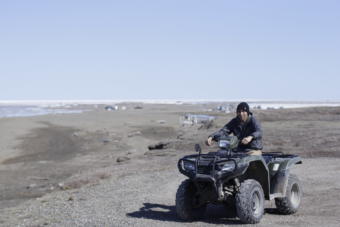
But Arctic sea ice has been melting, and that means more hungry polar bears have been coming to Kaktovik. On a recent warm spring day, Nathan Gordon Jr., 24, kept watch from the seat of his four-wheeler. He is part of the village’s polar bear patrol.
“It’s part of my job to make sure the town is safe, and all the visitors and the polar bears at the same time,” he said.
The Arctic Refuge’s tundra and mountains surround Kaktovik — there are no roads in or out, and there’s no oil infrastructure nearby.
But Gordon’s paycheck comes largely from the oil industry, thanks to drilling in Prudhoe Bay to the west. The industry pays some $370 million in annual property taxes to the North Slope Borough, and that money, in addition to Gordon’s salary, helped build Kaktovik’s $16 million new basketball gym. It also funds a full-time fire department, with two gleaming fire trucks.
Residents also have flush toilets, which are lacking in dozens of other villages outside the refuge. Oil, Gordon said, has done a lot for Kaktovik and its Native Inupiat residents, and he supports drilling in the refuge.
Kaktovik has a full-time fire department with two fire trucks, funded by taxes on oil that the industry pays to the North Slope Borough. (Photo by Nat Herz / Alaska’s Energy Desk)
“People have been benefiting really great through all of this,” he said. “Opening ANWR — it would be great for our kids, for the economy, for our village and everything that would go on.”
Kaktovik is surrounded by the refuge’s coastal plain — the area that Congress opened to development. Indigenous opposition to drilling is centered in Gwich’in communities, more than 100 miles away from the refuge’s coastal plain.
In interviews, Kaktovik’s drilling boosters said they’re frustrated with what they see as a tendency by outsiders to defer to the views of the Gwich’in people, even though the Inupiat have lived on the North Slope for thousands of years.
“They try and just blatantly tell us: ‘No, you cannot do this on your own land. We have more of a right to what you do in your own community, in your own village,’” said Charles Lampe, 43, a Kaktovik whaling captain who supports development. “They think that we’re trying to make it to where it’s just going to be a big oil field out there. That’s not what we’re trying to do.”
Kaktovik’s drilling backers say they want to make sure that development doesn’t jeopardize residents’ ability to harvest both caribou and whale.
The average Kaktovik household consumes hundreds of pounds of caribou each year, and as much as 1,000 pounds of bowhead whale, according to surveys. When it comes to caribou, Gordon said he doesn’t expect them to harmed by oil infrastructure.
“I wouldn’t be worried about it at all,” he said. “It’ll be a lot safer for them to be out there than being hunted by me.”
If development does harm the Porcupine caribou herd, whale meat would be a safety net for the residents of coastal Kaktovik that’s lacking in landlocked Arctic Village. But Lampe, the whaling captain, rejected the idea that Arctic Village is more dependent on caribou.
Kaktovik sits on an island in the Arctic Ocean on Alaska’s northeast coast. It’s the only village within the Arctic National Wildlife Refuge’s coastal plain, which Congress opened to oil exploration in 2017. (Photo by Nat Herz / Alaska’s Energy Desk)
“If they wanted whale, we’d send them whale,” Lampe said. “I mean, that’s the kind of community and the kind of people we are.”
Other Kaktovik residents are less convinced that oil infrastructure can coexist with their traditions. A poll of 93 people conducted by the village government found 52 percent in favor of development, 32 percent oppose it and the rest are unsure.
Carla Kayotuk, an avid hunter and camper who opposes drilling, said that even living in a small village, she values the open spaces nearby.
“When we get away, it’s quiet right now. And I’m afraid, once the development starts happening, that’s not going to happen,” she said. “Where are we going to go?”
Speaking up against development can be intimidating here, Kayotuk said. She’s been accused of ignoring benefits from oil that could come to the village, she said.
“We’re not ignorant,” she said. “We just value something different than what you value.”
It’s still too early to know exactly how close oil infrastructure might come to Kaktovik. After a lease sale, companies will still have to drill wells to see if commercially viable amounts of oil even exist under the coastal plain. If they find it, they’ll need environmental reviews and permitting before they can pump it out.
From atop the bluff at the edge of town, Gordon, the polar bear patroller, looked out over the tundra to the west, where he thinks the first development is likely. What does he think he’ll see on the horizon once development starts?
“Nothing,” he said. “You won’t be able to see a footprint out there.”
It will take years to see if Gordon’s prediction comes true.
Alaska Gov. Mike Dunleavy speaks to a crowd in Anchorage earlier this year. (Photo by Zachariah Hughes / Alaska Public Media)
Alaska conservatives have fought for decades to block the state from paying for what they call “elective” abortions – those outside cases of rape or incest, or when the mother’s life is in danger.
But over those decades, they’ve been stymied by the Alaska Supreme Court, which has rejected their efforts on constitutional grounds — most recently in February.
Those rulings have negated lawmakers’ efforts to strip abortion-related funding from the state budget. So on Friday, Republican Gov. Mike Dunleavy employed a new tactic: He vetoed $335,000 from the budget of the Alaska Supreme Court.
“The legislative and executive branch are opposed to state-funded elective abortions; the only branch of government that insists on state-funded elective abortions is the Supreme Court,” Dunleavy’s administration wrote in a budget document released Friday. “The annual cost of elective abortions is reflected by this reduction.”
A court system spokeswoman declined to comment on the veto, which represents a little less than half a percent of the system’s yearly budget. A spokesman for Dunleavy, Matt Shuckerow, declined to answer questions about the decision.
The move was immediately cheered by abortion opponents and denounced by supporters of abortion rights.
Dunleavy’s critics said the veto marks the second case in which he’s undermined the Alaska Constitution and the judiciary’s independence. It follows his temporary refusal in March to follow the constitutionally-outlined process for appointing a judge to the Palmer Superior Court.
“What the governor is essentially trying to do is penalize the court system for accurately and reasonably interpreting the Constitution consistent with the history and consistent with court precedent,” said Anchorage Democratic Rep. Matt Claman, an attorney. He added: “It reflects a lack of respect for the rule of law.”
Rep. Matt Claman, D-Anchorage (Photo by Skip Gray/360 North)
In the 1976 Hyde Amendment, Congress barred the federal government from paying for abortion except in extreme cases.
Alaska’s health department in 1998 adopted regulations to align the state’s Medicaid program with the Hyde Amendment. But in a 2001 decision, the state Supreme Court rejected that move, saying the Alaska Constitution’s equal protection guarantee requires the state to give “uniform and high-quality medical care” both to women who choose to have abortions, and those who choose to give birth.
In 2013 and 2014, both the health department and the state Legislature attempted to restrict state-funded abortions to cases when they were “medically necessary.” In February, the Supreme Court, in a 4-1 decision, invalidated those restrictions as well.
Social conservatives have rejected the justices’ legal reasoning. And they’ve argued that the state’s Constitutionally-outlined system for selecting judges skews liberal. (The seven-member, nonpartisan Alaska Judicial Council, which screens applicants for judgeships, is made up of three attorneys, three members of the public and the Alaska Supreme Court’s chief justice.)
“The majority of the Alaska Supreme Court has taken a very partisan position on state funding for abortion here in Alaska,” Wasilla Republican Rep. David Eastman said in a phone interview Friday. “And there’s really no legal or constitutional basis for that.”
Rep. David Eastman, R-Wasilla (Photo by Skip Gray/360 North)
Critics said Dunleavy’s move sets a dangerous precedent. The courts, they argued, should be free to make decisions based on what the Constitution says – not based on their fear of backlash from another branch of government.
“When you have a court system being punished financially for executing the rights given to Alaskans in our state Constitution, that’s a threat to our democracy,” said Anchorage Democratic Rep. Ivy Spohnholz.
For the most part, each of Alaska’s three branches of government try to tread carefully around the others’ territory.
The courts avoid infringing on the Legislature’s internal workings; lawmakers rarely meddle with the budget for the governor’s office, and vice versa.
But Eastman said elected officials like he and Dunleavy shouldn’t have to defer to the Supreme Court justices’ interpretation of the Constitution.
“I take the same oath to the Alaska Constitution that the five members of the Supreme Court take,” Eastman said. “The oath I took was not to follow blindly after whatever it is that members of the Supreme Court say the Constitution says. That’s not the oath. Maybe some people think it should be, but it’s not.”
Eastman and other conservatives cheered Dunleavy’s decision. In a message to supporters, Jim Minnery, head of the anti-abortion group Alaska Family Action, wrote that the Supreme Court “will start feeling the pain of their own arrogance.”
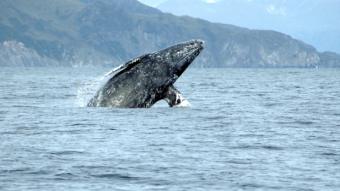
Scientists say it will probably be a long time before they can confidently explain the spike in gray whale deaths along the Pacific Coast, including in Alaska.
But one big question they’re now exploring is how warming waters in the Arctic, where the whales feed, could be connected – especially since many of the dead whales have appeared underfed.
“It’s hard not to tie the two together, given that that’s why these whales come to Alaska every year,” said Bob Foy, who directs a Seattle-based federal fisheries research center that’s part of the National Oceanic and Atmospheric Administration. “The timing of there potentially being a feeding issue is right, in terms of overlapping with these changes in the ecosystems that we’ve seen.”
Gray whales aren’t exactly the easiest animals for scientists to track. First, they live in the ocean, making their movement and feeding patterns hard to follow.
And twice each year, they go on one of the world’s longest known mammal migrations, swimming 5,000 miles between their winter area in Mexico and their summer feeding grounds in the Arctic.
That means there could be a number of causes of the spike in deaths that scientists have documented this spring.
But a lot of the attention is going toward the Arctic.
The region is warming twice as fast as the rest of the world, and scientists have observed record-low levels of sea ice in the past few years. As a result, the ocean ecosystem there is in “state of flux,” Foy said.
That has to do with the way sea ice affects the marine food web and the growth of the tiny phytoplankton that form its base.
When ice is present late into the spring, it creates conditions that cause most of the phytoplankton to fall all the way to the ocean floor, known as the benthos. At the bottom, the phytoplankton supports an ecosystem dominated by invertebrates, like crabs and sea stars – there aren’t typically a lot of fish like cod and pollock swimming around. And that “benthic-dominated” ecosystem is what supports gray whales’ primary prey – shrimp-like creatures called amphipods.
Workers collect samples from a dead gray whale that was beached at the end of the Turnagain Arm outside Anchorage last month. (Photo by Nat Herz / Alaska’s Energy Desk)
But when the sea ice retreats earlier, more of the phytoplankton is eaten by a different species of plankton called zooplankton. The zooplankton then supports fish and other species above the ocean floor that are normally found farther south, like pollock and cod. But it means less of the phytoplankton is left to fall to the ocean floor and support the sea life there – including, potentially, the amphipods that gray whales like to eat.
“The result of that change in the food web could very definitely lead to a lower amount of food available on the bottom of the ocean,” Foy said.
Scientists don’t yet have enough information specific to gray whales to label climate change or declining sea ice as the smoking gun, Foy said. But they’ve seen enough other events that have come along with Arctic warming, like sea bird die-offs, that they’re asking questions.
“I don’t think we’re going to put all our eggs in that basket. There’s a number of other potential sources of harm that could explain this,” Foy said. “Once we have an opportunity to collect all of these data, we’ll have an opportunity to put a better story together.”
Scientists haven’t ruled out an outbreak of disease, and they’re also looking at how the whales’ steadily increasing population might play a role. But warming oceans are definitely one possible explanation.
Or, they could be complicating or exacerbating another phenomenon, said John Calambokidis, a research biologist and whale expert at the Washington-based Cascadia Research Collective. Arctic warming alone doesn’t seem like a perfect explanation, he said, since warmer conditions have occurred over several years and the spike in deaths only began this spring.
“It doesn’t hold water as the sole factor. That doesn’t mean it might not have some role,” Calambokidis said. “I’m totally supportive of this as a key issue that we need to pay attention to. Because it has huge implications.”
Officials at Denali National Park and Preserve are studying whether the existing path of the park’s 92-mile road can be spared from a creeping landslide, in what scientists say could be a preview of Denali’s future as its permafrost thaws.
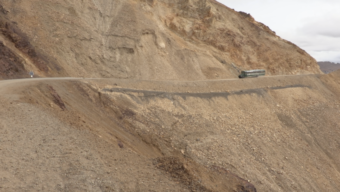
The creeping pile of earth, at Polychrome Pass halfway along the road, is not just rocks falling down a hillside — it’s whole section of mountain, including the road, that’s slowly sliding downhill.
Just between September and March, the landslide pushed a 100-yard stretch of the gravel road six feet, leaving a head-high cliff where it once connected to to the rest of the route. Maintenance staff had to fill the gap with rock and gravel to make it passable.
An image showing the site of the Pretty Rocks landslide. (Image courtesy National Park Service)
And the pace of the slide is accelerating. In 2016, it pushed the road three feet down the mountain. In 2017, that pace doubled. And in 2018, it doubled again, moving a full 12 feet over the course of the year.
Since most tourists access the park using the road, the “Pretty Rocks” landslide poses an “existential threat” to Denali’s current visitor model, according to a new National Park Service report. And Congress is paying attention: With support from U.S. Sen. Lisa Murkowski, R-Alaska, lawmakers earlier this year asked the Park Service to report on the potential for a re-route and to deliver quarterly updates on risks.
Park managers are fixing problems at the site as they crop up and hope to maintain the road’s existing path. But they are also exploring other options, in case the slide keeps accelerating.
Ideas include bridging over or tunneling under the slope. Structures could be built to block the landslide, or rock could be removed from above to reduce the risk.
Or, managers could move an estimated five miles of road. But that idea faces logistical and financial obstacles. Congress would likely have to approve any new alignment through Denali’s designated wilderness, according to the report. And while park officials declined to give a cost estimate, Murkowski said it would be more than tens of millions of dollars.
“It’s basically taking all the funding that we would see as a state, for what would go to parks in the first place,” Murkowski said in an interview last week, after a speech at an Anchorage conference. “To rebuild this, or to do an alternate route, is going to be exceptionally expensive. It is just not easily done.”
These photos show the same area of the Denali Park Road in September and March. Over the winter, a slow-moving landslide pushed a 100-yard stretch of road about six feet downhill, leaving this drop-off behind. (Photos courtesy National Park Service)
Experts say Denali’s broader landslide problem is a natural result of putting the park in a dynamic, scenic environment. But they also say global warming is likely to worsen the risk by thawing permafrost that helps stabilize some of the area’s rugged terrain.
Temperatures have been far above average at the park headquarters every year since 2014, said Rick Thoman, a specialist at the Alaska Center for Climate Assessment and Policy. In 2016, the average temperature was the highest in a record dating back to the 1920s, at four degrees Fahrenheit above normal, he added.
One study predicts that the portion of the park underlaid with permafrost will shrink from 50% in the 2000s to 6% by the 2050s.
“If we want to understand how to maintain infrastructure in areas where we have permafrost like this, we need to understand how that’s going to respond to continued warming,” said Denny Capps, the Denali park geologist.
It took 15 years for the Alaska Road Commission to build the park road, which was finished in 1938.
Planners originally eyed a lower route near Polychrome Pass. But park service officials pressed for the higher path along a mountainside because of its “expansive views,” after a site visit by their chief landscape architect, according to a 2011 history of the road.
Building at that spot required extensive blasting, and the dropoffs on the south side are so precipitous that some nervous early tourists insisted on walking the stretch of road, rather than driving. Today, the majority of Denali’s 600,000 annual visitors access the park through the road as passengers on tour buses; during the summer, the road is generally closed to private vehicles after 15 miles.
A tour bus drives past the site of the Pretty Rocks landslide at Polychrome Pass, in Denali National Park and Preserve. The old road bed can be seen below. (Photo by Joey Mendolia/Alaska’s Energy Desk)
Landslides aren’t a new challenge for park managers. Two decades ago, maintenance staff were fixing small cracks in the road caused by the Pretty Rocks slide. And periodic mudslides and landslides have covered the park road and interfered with traffic.
But at Pretty Rocks, the problem is quickly worsening and threatening to become unmanageable.
The process causing the slide is a basic one. Rockfall and debris flows deposit loose material on the slope above the road, and it can only get so deep before it starts sliding downhill — Capps compares it to dumping sand on a pile.
It’s been hard for park staff to determine how much global warming and permafrost thaw are contributing to the landslide, in part because the landslide is moving so quickly that it breaks their monitoring equipment. But they have confirmed that the permafrost beneath the site is near thawing, and they know that when it thaws, it does less to stabilize the slope.
“When it’s frozen, it helps hold things together,” Capps said. “When it thaws, it releases.”
Experts expect that as permafrost thaws across Denali, more landslides are likely to develop at other places along the road. And the park is working with University of Alaska Fairbanks researchers to build a model to show where the risks are highest, by mapping data on past landslides with risk factors like slope angle, vegetation and permafrost.
A group of cyclists pedals on the Denali Park Road through the site of a creeping landslide at Polychrome Pass. (Photo by Nathaniel Herz/Alaska’s Energy Desk)
One of the researchers, Louise Farquharson, said the focus on the Pretty Rocks landslide threatens to distract from what is likely to be a broader problem.
“It’s like we should be triaging, and we’re just focusing on one patient,” she said.
The businesses that give tours along the park road and use it to ferry visitors to Denali’s lodges are concerned about the park’s landslide problem, and Alaska’s tourism industry has pushed Murkowski and the Energy and Natural Resources Committee she chairs for more federal spending on park maintenance.
A 2016 landslide that limited traffic along the Denali road cost one company $20,000, according to federal testimony last year from Sarah Leonard, president of the Alaska Travel Industry Association. The company chartered flights to move guests to and from its lodge and lost customers who were planning day trips, Leonard said.
A co-owner of one lodge at the end of the road said he wants to see Denali’s managers continue drafting response plans, so that an individual landslide doesn’t force a hasty reaction.
“I think now is the time to start recognizing: Maybe it’s not a question of if, it’s a question of when. So let’s not wait,” Simon Hamm, co-owner of Camp Denali, said in a phone interview from the lodge. “Let’s start doing something thoughtful and artful now, so that in the heat of the moment we’re not dropping bulldozer blades and plowing up wilderness.”
In the past year, managers have become increasingly focused on the problem, Hamm said. He added: “Good people are making good efforts to try to come up with contingencies.”
Close
Update notification options
Subscribe to notifications
Subscribe
Get notifications about news related to the topics you care about. You can unsubscribe anytime.