Nat Herz, Alaska Public Media

After leaving Trump administration, Balash will work for oil company that’s developing an Alaska project

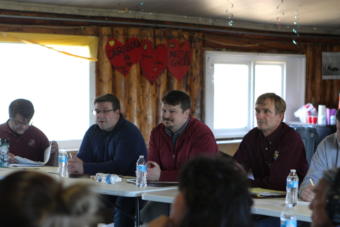
Joe Balash, who served as assistant secretary for land and minerals management at the U.S. Interior Department in the Trump administration, sits at a meeting on oil leasing in the Arctic National Wildlife Refuge earlier this summer in Arctic Village, whose indigenous Gwich’in residents are fighting the development. (Photo by Nat Herz/Alaska’s Energy Desk)

Joe Balash, the high-level Alaskan appointee at the U.S. Department of the Interior who pushed to open the Arctic National Wildlife Refuge to oil leasing, is taking a job with an oil company seeking to develop a major project in Alaska.

Balash, an assistant secretary at the department who oversaw the Bureau of Land Management, left his job last week, without saying if he’d taken a new job elsewhere. The Washington Post reported Wednesday that Balash has accepted a position with Oil Search, a Papua New Guinea-based company that first expanded into Alaska in 2017.

Before his federal job, Balash — who went to high school in North Pole and still has family in Alaska — worked as a special assistant to Sarah Palin when she was Alaska’s governor, then later served as the state’s natural resources commissioner. At the Interior Department, he’s been an advocate for the Trump administration’s strategy of “energy dominance,” pushing to open more federal lands to drilling in the Arctic Refuge and in the National Petroleum Reserve-Alaska.

Oil Search is advancing a project on the North Slope called the Pikka development, which could ultimately produce as many as 120,000 barrels of oil a day — boosting the total amount of oil extracted in the state by about one-fourth. The project is 100 miles west of the Arctic Refuge on state- and privately-owned land, not federal land, though the company had to secure a federal wetlands permit from U.S. Army Corps of Engineers.

Balash declined to comment Wednesday when contacted by Alaska’s Energy Desk, but he confirmed to the Post late Tuesday that he would begin working for Oil Search. He said he would abide by a Trump administration ethics pledge that, for five years, blocks high-level appointees from lobbying the agency where they worked — though he added that he would supervise Oil Search employees who do work with the Interior Department.

Environmental organizations quickly blasted Balash for accepting a job in the oil industry.

“Throughout his time at Interior, Joe Balash spearheaded efforts to suppress science, ignore indigenous rights and sell off the Arctic Refuge for drilling at all costs,” the Sierra Club’s Lena Moffitt said in a statement. “Now, he’s shamelessly seeking to profit from this destruction while the American people and our public lands pay the price.”

Wildfires and warming could transform Alaska’s forests, making leafy trees dominant over evergreens, study says

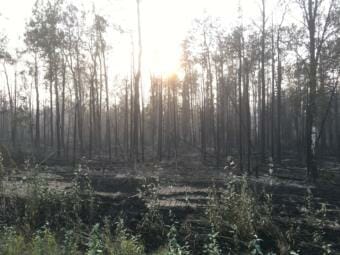
Trees that burned in the McKinley wildfire are still standing next to the Parks Highway on Tuesday, Aug. 20, 2019. (Photo by Nat Herz/Alaska Public Media)

Wildfires have burned across Southcentral Alaska all summer, and they could be transforming Alaska’s forests for the long term, according to a new scientific paper published last week.

If wildfire frequency and temperature rise in Alaska like the paper’s authors expect, their climate model says broadleaf trees like birch and aspen will become dominant, taking over from evergreens like spruce, which are better adapted to cold weather and scarce nutrients.

“We will see a longer and larger phase of deciduous forest – they grow bigger, they last longer, and they actually can outcompete the spruce for longer,” said Jim Randerson, an earth science professor at University of California Irvine and one of the paper’s authors. “That’s what leads to this forest transition.”

Such a change could affect the pace of climate change itself, according to the authors, since leafy trees pump more water into the air, which has the potential to boost the greenhouse gas effect. It could also affect Alaskans’ experiences in the forest, like when they hunt or hike.

Ted Spraker, chair of the Alaska Board of Game and a longtime hunter, said thick spruce forests are not known as an easy place to find moose.

“I’ve hunted on the Kenai for a long time, and hunting in dense cover is really difficult,” he said. “Moose are really hard to see, they’re very cagey — they easily can get away from you.”

After a fire burns in the Alaska boreal forest, there’s usually a specific chain of events that follows, which ecologists refer to as “succession.” First, it’s the leafy trees that come back. But the same reason those trees can get into those areas first is the reason that they don’t always stick around.

“Deciduous trees sort of live fast and die young,” said Bill Riley, another of the study’s co-authors and a senior scientist at Lawrence Berkeley National Laboratory in California.

The deciduous trees — the leafy ones — are good at absorbing the large amounts of nutrients that are available after a fire. But eventually, once those nutrients start to become more scarce, the evergreens start to do better, because they’re more efficient — they don’t shed their leaves every year, and they’re more tolerant of shade.

That means the leafy trees that grow right after a fire eventually get replaced by evergreens, like spruce. But the new paper, published last week in a journal called Nature Plants, predicts that global warming and more frequent wildfires could change that, in part by warming up soils and making nutrients more available.

“In the future climate, with the warming, there will be more nitrogen,” Riley said. “That benefits the deciduous plants really even more, and they grow taller and outcompete for light in the long run.”

The paper’s results depend on an array of assumptions, like how much success humans have in reducing emissions, and how wildfire frequency increases in the future.

If the authors’ assumptions turn out to be true, the paper predicts that leafy species will actually become the dominant trees in Alaska boreal forests by about 2060, taking over from evergreens. That point will come sooner with more frequent or intense wildfires, the paper says.

The general trends predicted by the paper correspond with on-the-ground observations scientists have been making in Alaska’s boreal forests, said Glenn Juday, a forest ecologist at University of Alaska Fairbanks.

“Does it violate any observations of reality as it’s unfolding that we are seeing? The answer is no, not at all,” Juday said. “It’s very much in accord with the big theme: Fires burn and are carried on the landscape by the conifers. And if they are so severe and so large and so frequent, they interfere with the ability of the conifers to recruit, outgrow and dominate the succeeding stands. We’re definitely seeing that.”

BP and Hilcorp just announced Alaska’s biggest oil industry deal in years. Here’s why it matters.

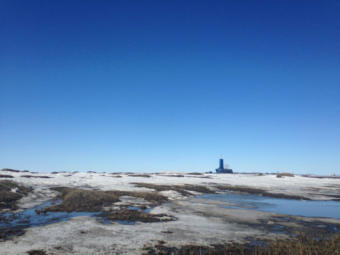
An oil rig contracted by BP looms on the horizon at Prudhoe Bay. (Photo by Elizabeth Harball/Alaska’s Energy Desk)

The $5.6 billion BP-Hilcorp deal has huge implications for Alaska’s petroleum industry. But if you don’t work for an oil company, you might be wondering: Why should I care? And why does this matter?

The acquisition raises an array of questions about what will happen when BP, which has deep roots in Alaska, finalizes the sale of its assets to Hilcorp, a privately-owned company that’s operated in the state for less than a decade.

Hilcorp’s leaders will make many of those decisions, but the company is notoriously press-averse and did not make its executives available for interviews Tuesday. In an email, spokesperson Justin Furnace said it would take time before the company releases details about its plans for workers, like how many could be laid off.

“BP’s workforce on the North Slope is obviously vital to the operation. Our plans for that workforce will develop as we determine how we will integrate the acquisition into Hilcorp’s existing operations and we receive a list of eligible employees from BP so we can begin the interview process,” Furnace said. As for Hilcorp’s vision for its new stake in the Prudhoe Bay field, which produces $17 million of oil each day, Furnace said: “We will be working to evaluate new opportunities at Prudhoe, but this process will take many months.”

Without many details from Hilcorp, we turned to experts to help answer four of the biggest questions raised by the acquisition.

1. Should Alaskans be worried about Hilcorp investing less money in workers and infrastructure, since the company has a reputation for cost-cutting?

Not necessarily, said Bill Popp, president of the Anchorage Economic Development Corp. (Editor’s note: Popp is also on the board of directors of Alaska Public Media.)

Popp said he thinks there may be initial job losses as a result of the deal. But many of those positions could be replaced with contractors, he added.

And, Popp said, it’s possible Hilcorp will make new investments in Prudhoe Bay to try to boost oil production, while BP might not have. Hilcorp is known for reviving oil fields that were previously in decline.

“On the face of it, not knowing what Hilcorp’s detailed plans are yet, I still believe that in all likelihood we are going to see a net increase in economic activity in the coming years, after the transition is completed,” Popp said.

2. What does the Hilcorp deal say about Alaska’s oil-fueled economy more broadly?

Alaska’s economy has run on oil since the trans-Alaska pipeline switched on in 1977. But production has been steadily declining since the 1980s, and some analysts said they saw BP’s departure as another sign of the decline of fossil fuels’ importance in the state.

But that’s not the only way to interpret Tuesday’s news, said Mouhcine Guettabi, an economist at the University of Alaska Anchorage Institute of Social and Economic Research. BP is leaving the state, he said, but there’s also an interested buyer at the other end of the sale.

“To me, that was the thing: Rather than view it as, ‘BP no longer sees Alaska as attractive,’ maybe BP found somebody that’s willing to pay a handsome price for these fields,” Guettabi said. “I don’t know that this is the definitive statement to the decline in the importance of oil in Alaska’s economy.”

3. BP is known for its philanthropic presence in Alaska. Will Hilcorp continue that tradition?

BP said it gave away more than $4 million last year to Alaska organizations, and it has its own community meeting center that nonprofits can use for free.

Tuesday’s news is likely to cause anxiety in Alaska’s nonprofit world, especially given how much turmoil recent state budget cuts have caused for organizations, said Diane Kaplan, president of the Rasmuson Foundation, Alaska’s largest private grantmaker.

“I think it’ll be unsettling to the nonprofit community to have that change on top of all the other changes going on,” she said.

Diane Kaplan, president and CEO of the Rasmuson Foundation, addresses a crowd in Bethel. (Photo by Dean Swope/KYUK)

Kaplan pointed out that Hilcorp has a program where it sets aside $2,500 in a charitable giving account for each new employee, then matches donations of up to $2,000 a year. And she said she’s hopeful that the company is serious about establishing a strong philanthropic presence in Alaska.

One reason for that, Kaplan said, was a meeting that a group of senior Hilcorp executives requested with her a few weeks ago, before the sale took place. They wanted to discuss charitable giving, she said, though they wouldn’t address the then-swirling rumors of the possible purchase of BP’s assets.

“It was a very good meeting. We were really happy, especially now that we know what the outcome of the discussions with BP were, that they took the time at a busy time to come and talk about philanthropy,” Kaplan said. “I’d say that’s a very good sign.”

Furnace, the Hilcorp spokesman, said in an email that “giving back to the communities where we live and work is very important to Hilcorp and to our employees.” He pointed to more than $2 million in past contributions by the company and its employees to Alaska-based charities – they totaled nearly $315,000 last year – as well as money set aside for scholarships.

4. What about Hilcorp’s environmental and safety record?

The company has had multiple accidents since it started operating in Alaska in 2012. State regulators levied fines against Hilcorp in 2017 after three North Slope workers nearly died from inhaling nitrogen during a well cleanup.

The same year, one of its pipelines in Cook Inlet, not far from Anchorage, leaked natural gas for weeks, prompting Hilcorp to temporarily shut down an associated oil platform after discussions with then-Gov. Bill Walker.

And in December, a worker for a Hilcorp contractor was killed in a drilling accident on the North Slope.

In an email, Furnace said “if we can’t do a project safely and responsibly, we will not undertake that project.”

“While we have not been incident-free, Hilcorp has focused intently on achieving high standards of safety and environmentally responsible operations throughout our Alaskan operations,” he said. “We do this through close coordination with local, state, and federal agencies that work to enhance public safety, improve emergency preparedness and protect the environment. And just as importantly, we do this through the continual building of a company culture that upholds and rewards integrity, accountability and responsibility.”

But environmental advocates quickly raised questions about the deal.

“Hilcorp’s business model is to come in to old fields and to bring out the profits. And to do that, it has to cut corners with worker safety and environmental protection,” said Bob Shavelson, advocacy director at Cook Inletkeeper and a strident Hilcorp critic. “And we’ve seen that time and time again in Cook Inlet.”


Even before vetoes, poll by anti-tax Gov. Dunleavy shows Alaskans, narrowly, favoring more taxes

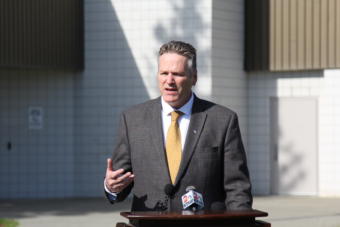
Gov. Mike Dunleavy speaks at a press conference in front of Wasilla Middle School on June 14, 2019. (Photo by Wesley Early/Alaska Public Media)

A newly-released poll commissioned by Republican Alaska Gov. Mike Dunleavy’s office found that a narrow majority of respondents support raising taxes to help pay for state government — a sign that one of the governor’s central fiscal positions might not match the views of most Alaskans.

The poll was conducted in the spring, weeks before Dunleavy made an array of line-item budget vetoes that prompted public outcry and sparked a campaign to recall him.

(Click here to read the poll.)

Fifty-two percent of respondents said they believe more taxes are needed, while 46% said no and 2% said they were unsure. The poll surveyed 604 registered voters from May 28 to June 1, and its margin of error was 4%.

Dunleavy’s office never released the results of the poll publicly. But a database of spending records showed that the governor’s office paid $34,500 in late June to Dittman Research, an Anchorage-based polling company.

Dittman is run by Matt Larkin, a political consultant to conservative candidates. He ran a super PAC-like group that spent nearly $2 million to help get Dunleavy elected last year.

In response to a public records request, the governor’s office released a four-page summary of the poll results Friday afternoon. Dunleavy’s spokesperson, Matt Shuckerow, declined to comment on the poll’s results.

The tax question wasn’t the only one that showed respondents leaning away from the governor’s views. Forty-seven percent said they wanted their local legislators to be less supportive of Dunleavy’s policies, compared to 40% who wanted them to be more supportive.

The poll didn’t directly ask people if they approved of Dunleavy’s performance as governor. But respondents were evenly split – 47% to 47%, with 6% unsure – when asked if they supported the governor’s budget.

Other questions produced more favorable answers for Dunleavy. Fifty-four percent of respondents opposed diverting part of the permanent fund dividend to pay for government services, which aligns with the governor’s agenda, while 43% were in support and 3% were unsure. (That question was asked a second time after the poll tested different arguments for and against using money from the dividend on government services; the results changed to 55% opposed, 44% in support and 1% unsure.)

A majority of respondents, 55%, also supported repealing Senate Bill 91, the 2016 criminal justice legislation that Dunleavy successfully pushed to roll back. Nineteen percent wanted the legislation to stay in place, while 26% were unsure.

Dunleavy and Alaska lawmakers have been fighting over the state budget since the annual legislative session began in January. Their debate centers on how to balance spending on government services with residents’ annual dividend payments from the $66 billion Alaska Permanent Fund, since Alaska doesn’t have enough revenue to sustain both of them at status quo levels.

Dunleavy has pushed to keep calculating and paying the dividends under a decades-old legal formula, which would set them at roughly $3,000 this year. He proposed closing the resulting budget deficit, which he said was $1.6 billion, with steep cuts to government services.

The state Legislature largely rejected that proposal, reducing the dividend to $1,600 and restoring many of the cuts that the governor wanted to make.

Alaska is the only state with no statewide sales or income tax; it repealed its income tax in 1980, amid a boom in oil revenue. But as oil taxes and royalties have declined in recent years, lawmakers have periodically proposed levying new taxes on the public to help close the state’s budget deficit.

A left-leaning coalition of political activists also filed an initiative this week that would raise taxes on oil companies.

Dunleavy, a Republican, has repeatedly dismissed those ideas.

“You have to manage your programs better before you even talk about taking the PFD or a tax,” he said at a campaign debate hosted by KTUU-TV and Alaska Public Media last year. “You need to put those instruments in place because if you don’t, your government will continue to grow out of control and we’ll be going to the people of Alaska year after year for more taxes or more permanent fund take.”

Experts: Heat and drought, not spruce beetles or leaf miners, turned Alaska forests into kindling

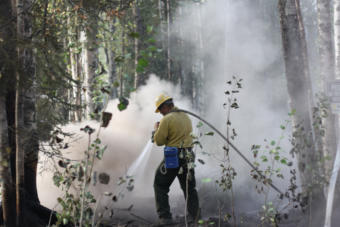
Jacob Thompson with the Chugiak Volunteer Fire and Rescue Company sprays down smoldering brush near a home in the vicinity of the McKinley Fire on Tuesday, Aug. 20, 2019. (Photo by Nat Herz/Alaska Public Media)

If wildland firefighters can be said to have a nemesis, that nemesis is black spruce. So much so that they have a nickname for it.

“Yeah, I’ve heard it, like, ‘gasoline on a stick,’” said Chris Moore, a fire behavior analyst who’s working with the team fighting the McKinley Fire in the Matanuska-Susitna Borough.

Wildfires can blow through black spruce in spectacular fashion, with flames blasting up in the air. But when fire reaches different kinds of trees, like white spruce, it slows down. And hardwoods, like birch trees, can be allies to firefighters.

“I don’t know if it’s lore, or just institutional knowledge in Alaska that most of the time, the hardwoods are a barrier,” Moore said.

But in the McKinley Fire, which sprung up after a record hot, dry summer, those usual rules haven’t always held, according to Moore.

Moore said that fire has still been spreading through the white spruce, many of which have been killed by a massive beetle outbreak, which has consumed hundreds of thousands of acres in the region.

Even the birch trees haven’t blocked the fire’s spread the way they usually do, Moore added. The birch have also been affected by an insect called the leaf miner, which, like it sounds, feeds on the leaves. In the Mat-Su, leaf miners have left huge swaths of birch trees with leaves that look brittle and brown.

But before blaming the insects for the wildfires burning around the state, fire experts said it’s important to consider the extreme warmth and drought in Southcentral Alaska this summer — and the fact that several fires that blew up recently were fueled by extreme winds. Those factors, experts said, are more influential than the spruce beetles and leaf miners.

The McKinley Fire, as seen in an aerial photo, burns Sunday near the Parks Highway north of Anchorage.
The McKinley Fire, as seen in an aerial photo, burns Sunday near the Parks Highway north of Anchorage. (Photo by Clay Dillard/KTNA)

“Almost all the studies I think I’ve seen, climate is the winner — that is, that’s what controls fire activity in most of these forests in Alaska,” said Jeff Hicke, a geography professor at the University of Idaho who studies the intersection of climate, insect outbreaks and wildfire. He added: “The marginal effect of having beetle kill is very small.”

It’s not that the insects have had no effect on the fires burning in Alaska right now, experts said. It’s just that the influence of the heat, drought and winds are much more pronounced.

“I haven’t heard someone specifically on the fire or someone that has more on-the-ground time here say: ‘Because of the leaf miner, this fire was more explosive or harder to put out or anything like that,’” Moore said. “It just was noted that the hardwoods are not a barrier to fire spread like they normally are. So, I’m just equating that to how dry it is here in Southcentral.”

Scientists have established that the dead needles on recently killed spruce trees are more flammable, and it’s likely that those dead trees can dry out and catch fire more quickly in the spring, Hicke said. But, he added, wildfires and spruce beetle outbreaks have relatively little overlap, which has made it difficult for scientists to say definitively whether beetle-killed spruce are more fire-prone or burn more severely.

“The case studies are very limited,” he said.

One thing scientists do know is that spruce beetles fare better in a warmer climate. Spruce trees can get drought-stressed in those conditions, making it harder for them to fend off the beetles with sap.

Higher temperatures also make it easier for the beetles to survive the winter, and if it’s warm enough, they can shorten their life cycle to one year, instead of two years.

A smoke plume from the McKinley Fire burns Sunday along the Parks Highway. (Photo by Maureen Clark/Alaska Division of Forestry)

“All of a sudden the lid is off,” said Glenn Juday, professor emeritus of forest ecology at University of Alaska Fairbanks. “The spruce beetles are able to outrun their natural controls and they spread out in large insect outbreaks and kill a lot of trees.”

If all this talk of hotter weather and insect outbreaks sounds apocalyptic, experts say it is likely Alaska will see more wildfires, and more beetles, as the climate warms.

But that trend won’t continue forever, Juday said, because the spruce trees aren’t as effective at reproducing after multiple fires. Instead, the types of trees in the forest will eventually start to shift: There will be more of the hardwoods, which don’t burn as easily.

“You’ve got birch, and you’ve willows, you’ve got alders and you’ve got some aspen,” Juday said. “We’re studying that very closely, because it is now an unmistakable trend.”

Simulations, however, suggest that by the end of the century, it will be warm enough that even those hardwoods will start burning more readily.

At least 50 structures lost in McKinley fire north of Willow

The McKinley wildfire burns Sunday afternoon north of Anchorage as a line of traffic snakes down the Parks Highway just off the turnoff to Talkeetna. (Photo by Katie Writer/KTNA)

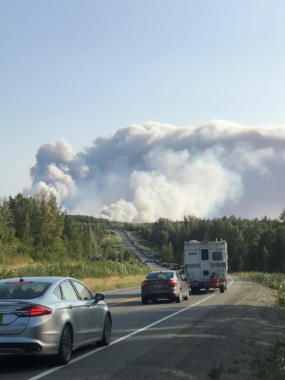
At least 50 structures burned Sunday in the McKinley wildfire north of Anchorage, according to the Division of Forestry. The fast-moving, wind-driven wildfire north of the community of Willow forced the closure late Sunday of the only highway leading north from Anchorage, burning on both sides of the road.

Officials could not immediately provide details on where the buildings were destroyed, though area residents reported seeing homes burning along the highway to the north of Willow, which is some 70 miles north of Anchorage.

“Every house down the highway for like three or four miles was burnt,” said James Baker, a 55-year-old retiree. He was one of many people who were forced to evacuate to a shelter in Wasilla from the Hidden Hills subdivision, which sits in a rural area a few miles east of the Parks Highway.

A 28-mile stretch of the highway was closed, snarling traffic on the only direct route between Anchorage and Fairbanks. Several schools in the area will be closed Monday, officials announced.

Driven by unusually dry weather and stiff winds from the north, the McKinley fire intensified quickly late Sunday, growing from 150 acres to about 1800, or roughly three square miles. Ten crews of hotshot firefighters and a half-dozen aircraft are being dispatched to the fire from the Lower 48.

“The fire has become much more active, definitely intensified,” Tim Mowry, a spokesman for the Alaska Division of Forestry, said in a phone interview Sunday evening.

State and local firefighters were focusing on protecting buildings and “saving homes,” Mowry said.

There are no towns along the closed stretch of highway, but there are many homes, and Mowry said that “hundreds, if not thousands,” could be forced to evacuate.

With only one road in and out, state troopers drove through the Hidden Hills subdivision to tell people to evacuate, said Craig Thurman, a pastor at a Baptist church there.

“Most of us just grabbed what we needed to grab and got out of there,” Thurman said.

Thurman said friends he’d spoken with described flames touching their vehicles as they evacuated the subdivision.

Baker and others from the subdivision were waiting at the shelter to find out what happened to their homes. Most of the houses in the subdivision are a few miles east of the highway, and the fire initially burned in a swath that moved south between the highway and the homes.

But residents were worried about what could happen if the wind shifted, and some said they’d heard Sunday evening that the fire had started moved toward their homes. It made for an anxious night, said Renee Schinton, a musher who drove to the shelter with her dogs.

“Not knowing where I’m going to live. Not knowing where I’m going to go, if I’m going to have a house or anywhere to go,” she said. “I can’t go to a hotel – I have 11 dogs.”

Musher Renee Schinton evacuated from her home in the Hidden Hills subdivision Saturday. She was moving her 11 dogs from her trailer to a rope tied in the parking lot outside a shelter in Wasilla. (Photo by Nat Herz/Alaska Public Media)

Officials said downed power lines likely started the fire. An unusual weather pattern brought the dry, windy weather to Southcentral Alaska that’s been fueling the fire, said National Weather Service meteorologist Bill Ludwig.

Typical late summer weather for the region is wetter, with moisture coming in from the ocean to the west, Ludwig said. But a ridge of high pressure has been blocking that wetter weather from moving toward the area, allowing dryer winds to flow through from the north, said Ludwig.

The winds were forecast to die down overnight, he added.

Site notifications
Update notification options
Subscribe to notifications