Nat Herz, Alaska Public Media

Ben Stevens once left the Alaska Senate in disgrace. Now he’s Gov. Dunleavy’s top deputy.

Ben Stevens speaks at a conference in Fairbanks in 2004, when he was the state Senate’s majority leader. (Photo by Erik Hill/Anchorage Daily News)

A year before Alaska’s last gubernatorial election, Ben Stevens was thinking about running.

Stevens is a son of the late U.S. Sen. Ted Stevens and a former Alaska Senate president. He’d been out of the public eye for a decade, after he decided against running for re-election amid an ethics controversy that grew into bribery allegations against him. Stevens was ultimately investigated by four federal agencies. He was never charged with a crime.

Since then, Stevens had worked on a ship in the Aleutian Islands, then run a tugboat company in Anchorage. Now, politics was calling him back.

“I’ve lived through a few storms in my life,” he said at the time, with the Republican primary a year away. “I think I know what it takes to survive, and I know what it takes to move into the future.”

Stevens never joined the race, but he found a job in the governor’s office nonetheless.

In December, he was hired as a policy advisor to Mike Dunleavy, the Republican who was elected governor a month earlier. Then, in July, Dunleavy announced that Stevens would become his chief of staff — making him one of the most powerful unelected officials in the state.

People who have worked with Stevens in the Capitol say his political skills and dealmaking experience will be an asset for Dunleavy as he heads into his second legislative session, after a bruising first session that incited a recall campaign.

But Stevens’ appointment also comes with a potential liability: His rise to an influential, public role revives some of the questions raised by Legislature’s 2006 corruption scandal — like the allegations by two former oil industry executives who said their company paid Stevens bribes when he was a senator.

Today, Stevens and his family maintain financial connections to Alaska’s natural resource industries and business figures that routinely lobby the government. This includes the company pushing the controversial Pebble mine project, which, according to a spokesman, last year paid Ben Stevens $50,000 to serve on a citizens advisory committee. And Stevens’ wife, Elizabeth, works part-time for an advocacy group that pushes for lower oil taxes.

For Dunleavy, meanwhile, Stevens’ elevation may signal a shift. In the early months of his administration, the governor pushed an uncompromising conservative agenda, proposing dramatic budget reductions and legislation that were opposed by some of his fellow Republican lawmakers.

Stevens’ promotion coincides with the departures of two of Dunleavy’s more hardline senior aides — Tuckerman Babcock, Stevens’ predecessor as chief of staff, and Donna Arduin, the former budget director.

Tuckerman Babcock, left, Gov. Mike Dunleavy and Ben Stevens pose for a photo earlier this year. (Photo courtesy Office of the Governor)

Stevens represents a different, pragmatic brand of GOP politics, with closer links to business and the oil industry that powers the state’s economy. And some lawmakers see him as a competent deputy who could help bridge the rift that’s formed between Dunleavy’s administration and legislative leaders from his own party.

“Gov. Dunleavy needed to make some changes for the betterment of his organization, and I think Ben Stevens was a good pick for his chief of staff,” said Sitka Republican Bert Stedman, who served in the state Senate with Stevens and still holds the same seat. “Serving in the Senate, putting end of the year packages together — he knows how it’s done, knows you don’t get everything, you’ve got to compromise, give and take and put a package together that can get the votes.”

Stevens has always maintained his innocence in the 2006 corruption scandal. But he refused to publicly explain what he did in exchange for the money he received from the oil industry company while he was a senator, a total of more than $240,000 over five years.

“I think the outcome of the federal investigation pretty much answers any questions,” Stevens said in 2017, when he was considering running for governor. “The outcome is the answer.”

Ted Stevens, meanwhile, was convicted in 2008 of breaking federal ethics laws by failing to report some $250,000 in gifts and services from one of the same oil industry executives that accused his son. But that conviction was dismissed the following year by a federal judge who said prosecutors had botched the case by withholding evidence that could have helped exonerate the senator — namely a private interview that prosecutors conducted with the oil executive that undercut some of his damaging testimony.

A spokesman for the governor’s office, Matt Shuckerow, responded to requests for comment on this story with a brief email Tuesday: “The Stevens family has been falsely accused for years. Unfortunately, this appears to be the same tired piece others have already written.”

Through Shuckerow, Ben Stevens declined to be interviewed.

A ‘real deal, tough guy “Deadliest Catch” captain’

Stevens is the youngest of three sons of Ted Stevens, who served 40 years in the U.S. Senate and was renowned for his fierce advocacy for his home state. Federal policies he pushed were instrumental in the development of Alaska’s infrastructure, and its resource industries like oil, mining and commercial fishing.

In the late 1990s and early 2000s, Stevens chaired the Senate Appropriations Committee – a job that allowed him to steer immense amounts of federal money to Alaska. Between 1999 and 2005, one group calculated that he and the rest of Alaska’s Congressional delegation sent more than $3 billion to the state through earmarks – specific projects designated by individual lawmakers.

Ben Stevens spent 15 years as a commercial fisherman, catching just about “every species that had a gill,” he once said. Ted Stevens said his son started as a dock hand in Kodiak, before he turned 20; Ben Stevens also worked in Bristol Bay and captained a crab boat in the Bering Sea. One longtime family friend, political consultant Art Hackney, described Ben Stevens as a “real deal, tough guy ‘Deadliest Catch’ captain.”

Stevens started in politics in 2001 at age 42, after he applied to fill a vacancy left by a GOP state senator who resigned. Democratic Gov. Tony Knowles chose Stevens from a list of four candidates advanced by Republican Party leaders.

Stevens quickly rose into the Senate’s leadership as a reliable GOP vote who, given his family history, was treated with deference by his colleagues, said Andrew Halcro, a former Republican legislator. Observers expected him to follow his father into higher political office, Halcro added.

Halcro was one of the three other candidates vying for the Senate seat that Stevens was chosen for. He said Stevens had a reputation for testiness with colleagues and constituents, in a different way than his father, who was known for his explosive temper. One incident that generated headlines was when Ben Stevens, in an angry email to a critic from Wasilla, called her “Valley trash.”

“Ted fought for Alaska,” Halcro said. “Ben was fighting with Alaskans.”

Sitka Republican Sen. Bert Stedman. (Photo by Skip Gray/Gavel Alaska)

But Stedman, the senator who served with Stevens, said he never found him to be cold or standoffish — just serious.

“When he’s working, he’s working, and he’s paying attention to what’s on his desk,” said Stedman. “I thought Ben was very astute in the politics of the building. Very quick study, had a very good grasp of people’s positions, and would listen to the arguments. He has a lot of political skill, and it showed.”

‘I’ve been living with it my whole life’

Once Stevens entered the Legislature, he had to file financial disclosures with the state. And those disclosures prompted news stories about how the Republican lawmaker was earning income – and about whether Stevens was being hired because of his connection to his powerful father, rather than his own qualifications.

Critics cited his job as chief executive of the Special Olympics World Winter Games in Anchorage, which paid an average of $238,000 a year for the three years before he joined the Senate. The games relied on $13.6 million of government money, which organization officials said Ted Stevens helped deliver.

While Ben Stevens held that job, he also ran a consulting business on the side, Stevens and Associates. He founded the business in the mid-1990s as his fishing career wound down, and kept it alive while he served as a state senator.

His clients included a number of fishing interests, which built on his work in the fishing industry, but there was also an Alaska Native corporation and an oil-field services company. And many of those same consulting clients benefited from legislation pushed by Ted Stevens, or actions taken by federal agencies that he worked with.

At the time, Ted Stevens said his son’s business success came at his own initiative, while Ben Stevens acknowledged that people sometimes attributed his success to his father.

Ben Stevens poses next to a new statue of his father, Ted Stevens, at Ted Stevens Anchorage International Airport earlier this year. (Photo by Marc Lester/Anchorage Daily News)

“I’ve been living with it my whole life,” he said in a 2002 interview. “But there’s nothing I can do to get rid of him as my dad.”

Ben Stevens’ client that drew the most scrutiny was Veco, the oil-field services company.

Stevens started working for Veco in 1995, six years before his state Senate appointment.

Veco’s chief executive, Bill Allen, was a friend of Ted Stevens – the two men were once partners in a group that owned a thoroughbred racehorse. And while Veco was paying Ben Stevens, the company benefited from several actions taken by his father. In 1999, Ted Stevens intervened on Veco’s behalf in a dispute it had with Pakistan’s government over payment for work the company did on construction of a pipeline, the L.A. Times reported in 2003. Ted Stevens also mandated that federal money be used to train Veco’s and other Alaska companies’ Russian workers, the Times said.

After Ben Stevens was appointed to the Senate in 2001, he remained on contract for Veco, collecting about $50,000 a year. By then, Allen testified later, Stevens had four children.

“How am I supposed to say, ‘Now that you’re a senator, Ben, I can’t give you more money,’” Allen said at the corruption trial of a different lawmaker. “I couldn’t do that.”

‘Like concrete’

Stevens’ connection to Veco became a focal point when he was Senate president in 2006, the last year of his term. That was when lawmakers were trying to pass a new long-term oil-tax regime, seen by then-Gov. Frank Murkowski as a key step toward building a natural gas pipeline from the North Slope.

House lawmakers approved legislation to set the oil-tax rate at 23.5%. Veco was lobbying for a tax rate no higher than 20%, and one of Stevens’ colleagues in the Senate, Gene Therriault, said that in private meetings, Stevens objected to proposals higher than that rate. When the Senate ultimately approved a 22.5% tax, Stevens said it was non-negotiable, “like concrete,” and the Senate’s rate – 1% less than the one passed earlier by the House – was the one signed into law.

Some of the disclosures made as part of the federal investigation suggested that Stevens’ policy stance was guided by his financial arrangement with Veco.

Ben Stevens’ portrait from when he served in the state Senate. (Photo courtesy Alaska Republican Majorities)

An attorney for Allen, Veco’s chief executive, subsequently signed plea agreement documents that said Veco’s “consulting” payments to Stevens were not for consulting but instead were for “giving advice, lobbying colleagues, and taking official acts in matters before the Legislature.” The signed documents said Stevens did almost no other work for Veco, that the value of his compensation far exceeded the value of his non-legislative consulting work, and that Allen and Stevens had strategized about how to “kill” legislation that Veco didn’t support.

Stevens’ Senate office was searched twice by the FBI. But while several other Veco-aligned legislators were convicted of bribery-related crimes, Stevens was never charged. His attorney, at one point, questioned the validity of Allen’s allegations by noting that the former Veco executive was trying to minimize penalties for his own criminal conduct. And Stevens, in a 2005 news conference, said: “I’ve never, and would never, cross the line between my personal business affairs and the oath of office I signed to serve in the Alaska state Senate.”

Nonetheless, Stevens never explained what he did for Veco in exchange for the consulting payments, which totaled $243,250 over the five years he worked as a senator. “I don’t have to say that,” he said at the news conference, noting that he’d filed his required financial disclosures with state regulators.

‘He gave up a really good job’

Stevens did not run for re-election in 2006. A year later, he spent time in the Aleutian Islands as a crewman on a boat that was supporting a planned Arctic offshore drilling effort by Shell, according to an Anchorage Daily News report. He subsequently worked as a captain for Kirby Corp., a shipping company, according to his LinkedIn profile.

In 2015, his profile says, Stevens became president of Cook Inlet Tug and Barge, a subsidiary of Seattle-based Foss Maritime that has about 35 employees.

His income from the company was between $200,000 and $500,000 for the first 11 months of 2018, according to the financial disclosure that Stevens was required to file after taking his job in the governor’s office. (The rules require income to be reported within a broad range, rather than a specific number.) As chief of staff, Stevens now earns $175,000 a year, according to the governor’s office.

“In the marine world in Alaska, working as the president of Cook Inlet and really running your own business is a pretty enviable spot. He was perfect for that job – and so to give that up took something,” John Parrott, Foss’ chief executive, said in a phone interview. “He gave up a really good job.”

Another significant source of income for Stevens was his position on the advisory committee for the proposed Pebble mining project. The massive copper and gold prospect is among the world’s largest, but it’s been controversial in Alaska because of its proximity to the huge, commercially valuable run of sockeye salmon into Bristol Bay. The mine’s opponents have criticized Dunleavy for taking positions that they see as favorable to the project, like sending a letter in July that encouraged a company to invest in Pebble.

The advisory committee was formed in mid-2017 as a sounding board for the company as it was developing a scaled-back version of its project plans, said Pebble spokesman Mike Heatwole. Members included Alaska Native leaders and former government and military officials, and Stevens was added in early 2018 for his “public policy expertise,” Heatwole said.

The committee had a goal of two to three in-person meetings annually, as well as periodic phone calls. Members were paid $50,000 a year if they chose to collect it, which Stevens did, Heatwole said.

“The amount of time and caliber of people we were choosing – we thought it was professionally courteous to offer up a stipend,” Heatwole said.

Stevens left the committee when he took his job in the governor’s office, and state law does not specifically restrict public officials from participating in decisions or discussions involving their former employers. A spokesman for the governor’s office, Matt Shuckerow, didn’t respond to questions about how Stevens would participate in any Pebble-related decisions.

‘The clock has ticked’

Stevens’ wife, Elizabeth, meanwhile, remains the executive director and manager of a dormant group, Keep Alaska Competitive Coalition, that’s fought to hold oil taxes at lower rates. The president of the group’s board is Jim Jansen, a longtime friend of Ted Stevens and the current chairman of transportation company Lynden Inc. — whose subsidiary hired Ben Stevens to work in the Aleutian Islands after he left the state Senate.

Ben Stevens’ official governor’s office portrait. (Photo courtesy Office of the Governor)

The coalition helped push for the passage of Senate Bill 21 in 2013, which remains the broad framework of Alaska’s oil-tax regime and which critics have attacked for a system of credits and deductions that they say is too generous to the oil industry. The coalition also campaigned against the legislation’s repeal during a referendum campaign in 2014, and it has fought other changes to the state’s oil tax system as they’ve come up in the Legislature. The group pays a Juneau-based lobbyist, Reed Stoops, $30,000 a year.

Elizabeth Stevens’ income from the group was between $20,000 and $50,000 last year, according to Ben Stevens’ financial disclosure.

After Ben Stevens was hired as Dunleavy’s chief of staff, the coalition assessed whether his job presented a conflict with his wife’s work and concluded that it didn’t, Jansen said.

“The governor, in his platform, was anti-oil taxes,” Jansen said. “And Ben has always kind of come from that school.”

In political circles, Stevens remains a polarizing figure. Halcro, the former legislator, said that if he were governor, he wouldn’t let Stevens “within 500 miles” of his cabinet.

Stedman, meanwhile, said “the clock has ticked for well over a decade,” and that Stevens will help the governor achieve his goals.

“Let Ben Stevens prove otherwise. My guess is he’s going to want to prove up that he is capable and fair and concerned about the well-being of the state,” Stedman said. That might be a different view than some of his colleagues who served during the 2006 corruption scandal, but he doesn’t think those events will repeat themselves, he added.

“Some of us will always be watching for that type of stuff,” Stedman said. “Because we don’t want to do it again.”

Judge: Alaska’s justice system is failing in the case of slain Mountain Village woman

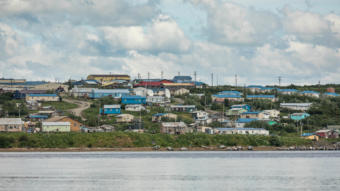
The Yukon River community of Mountain Village is seen on June 27, 2019. (Photo by Loren Holmes/Anchorage Daily News)

In an unusual order, an Alaska judge has declared a crisis in the state’s courts, saying that turnover among public defenders is delaying criminal trials and denying justice for victims and defendants alike.

“The state of Alaska’s criminal justice system is operating on the fringes, barely able to protect against the deprivation of fundamental rights, barely able to respond in a professionally responsible manner to Alaska(‘s) rising violent crime rates,” Fairbanks Superior Court Judge Michael A. MacDonald wrote in a blistering Aug. 30 decision, which has previously not been reported.

The remarks by the veteran judge came in a 37-page order to delay the murder trial of Alexie Walters, a man accused of beating his girlfriend, Gertrude Queenie, to death in 2017 in Mountain Village, on the Yukon River in Southwest Alaska. The public defender representing Walters was juggling 200 cases and resigned due to “mental exhaustion” a week before the trial was to begin in July, according to the order.

MacDonald, who was appointed by then-Gov. Sarah Palin in 2007, admonished public defenders for “specific professional failures” in their handling of Walters’ case.

But he added that those specific failures were symptoms of broader dysfunction, like public defender and prosecutor jobs going unfilled because of obstacles to recruitment and retention, as well as travel restrictions. And he blamed the dysfunction not on managers but on spending plans and policy decisions made by Alaska governors and lawmakers over the years, and continuing to this day.

“The record in this case should reflect that, as a result of the policy and budget choices made by the legislative and executive branches the people of Alaska must tolerate long delays in the prosecution of the type of crimes charged in this case — crimes against women, crimes fueled by substance abuse, crimes against law enforcement officers, crimes against rural Alaskans,” the judge wrote.

Rising caseloads, tight budgets

MacDonald’s ruling addresses some of the most urgent problems facing Alaska’s criminal justice system, where policymakers and the public have increasingly turned their focus in recent years. In 2017, the year Queenie was killed, the rate of women killed by men in Alaska was three times the national average and the highest in the United States, according to the Violence Policy Center.

An ongoing Daily News and ProPublica investigation has found that one in three Alaska communities has no local law enforcement of any kind. In some villages, city and tribal leaders say they have no choice but to hire convicted criminals as cops. In June, U.S. Attorney General William P. Barr declared a public safety emergency in the state, announcing $10.5 million in funding for village police, equipment and public safety buildings.

The judge’s order describes a disparity in the next phase of the criminal justice system — the one that begins after a suspect is arrested and the clock starts ticking toward a timely resolution for defendant and victim.

Alaska’s public defenders have argued for the past two years that rising caseloads and tight budgets are straining their ability to fulfill their constitutional obligation to represent their clients. Judges appoint public defenders for defendants who can’t afford to hire their own lawyers.

The Alaska Public Defender Agency’s longtime director, Quinlan Steiner, announced his resignation in April. Gov. Mike Dunleavy named Steiner’s replacement Tuesday: Samantha Cherot of Anchorage, who has worked both as a public defender and a private criminal defense and family attorney.

Doug Moody, a supervisor at the Public Defender Agency, said in a phone interview Tuesday that Cherot will be reviewing MacDonald’s critique.

“Without a doubt, the new director will get this order for a variety of reasons, and will be thinking about how we can do things more efficiently,” Moody said.

MacDonald declined to be interviewed, saying that Walter’s case is still open.

‘I killed her’

MacDonald’s order and decision are part of the ongoing effort to hold a criminal trial in Fairbanks for Walters, who was 34 when troopers arrested him Oct. 5, 2017, in Mountain Village on charges of murder, assault and evidence tampering.

According to the charges, his mother called to report the attack and Walters fired a shotgun when two Village Police Officers attempted to approach him. Troopers arrived hours later and interviewed Walters, who admitted to beating Queenie, his 22-year-old girlfriend, with his fists and a broom handle.

“I was the only one there, I did that, I killed her,” he told investigators, according to the charges.

The trial has been delayed at least 15 times at the request of the defense, according to MacDonald’s order. At one June hearing, shortly before she resigned, the public defender noted she was working a double case load. She had “hit the wall,” an acting supervisor later told the judge.

Anna Bill, a former Mountain Village police officer honored by the Alaska Federation of Natives for her advocacy on behalf of Alaska Native women and children, said the homicide was devastating for the victim’s family.

Former Mountain Village police officer Anna Bill holds a Shirley Demientieff Award presented to her during the Alaska Federation of Natives Convention in the Dena'ina Center on Thursday, Oct. 18, 2018. Lt. Gov. Valerie Davidson is at left.
Former Mountain Village police officer Anna Bill holds a Shirley Demientieff Award presented to her during the Alaska Federation of Natives Convention in the Dena’ina Center on Thursday, Oct. 18, 2018. Lt. Gov. Valerie Davidson is at left. (Photo by Bill Roth/Anchorage Daily News)

Bill said that in her experience with the criminal justice system, cases involving white defendants and victims appear to be resolved more quickly than cases involving Alaska Natives. “All the white people are getting done first while the Natives get pushed to the back burner,” Bill wrote in a Facebook message when asked about the case. She said she was not a police officer in the village at the time of the killing.

An employee at the city of Mountain Village said the city currently has no police officer and that no officials were available to comment on the case.

MacDonald serves as the presiding judge for the Fairbanks-based Fourth Judicial District. The district covers an enormous and geographically diverse swath of Alaska, from the woodsy Alaska-Canada border in the Interior to the Bering Sea coast.

‘Delay is always the friend of the defense …’

In addition to the Mountain Village case, the judge wrote, he’s overseeing two other homicide trials and a sexual assault case that have all been significantly delayed due to a public defender withdrawing “late into the case.”

Such delays typically benefit defendants and make it harder for prosecutors to secure convictions, said Alaska Deputy Attorney General John Skidmore.

“Witness memories fade,” Skidmore said. “Delay is always the friend of the defense because it makes it harder for prosecutors to put on their case.”

Skidmore said the number of prosecutors is rebounding following a reduction years earlier and now includes more than 120 attorneys. A district attorney has been selected to oversee the Bethel office and Skidmore said he is in talks with the North Slope Borough in hopes of funding the first Utqiagvik-based district attorney in several years.

The Public Defender Agency’s budget, meanwhile, has grown by 9% in the past two years. But its workload is growing more quickly — just between the 2017 and 2018 fiscal years, it saw a 16% increase in felony cases statewide, according to data the agency has presented to the Legislature. While the agency’s inflation-adjusted spending has doubled in the past 30 years, its felony caseload has tripled, it says.

Last year, Steiner, who was then the agency’s director, warned that his attorneys were at their limit and would have to start refusing to handle new cases without a $1 million boost to their $26 million budget. Even after that request was granted, Steiner said at a legislative budget hearing in March that he needed at least nine more lawyers, on top of an existing staff of roughly 75 criminal attorneys, to fulfill the agency’s constitutional obligations.

The need for nine more lawyers was based on a 45-year-old standard set by the American Bar Association that public defenders’ annual caseloads should not exceed 150 felonies. A separate 1998 audit done for the Alaska Legislature said the state’s public defenders can “ethically” handle no more than 59 cases in a 60-hour workweek; by that standard, Steiner said at the March hearing, his agency needed 66 more lawyers to fulfill its constitutional obligations.

Moody, the Alaska Public Defender Agency supervisor, said there are currently 11 vacant attorney positions out of 98 statewide. (In addition to the 75 criminal attorneys, about 25 more work on appeals and children’s cases.) At one point, the agency’s seven-attorney Bethel office was down to three, he said.

State lawmakers this year held the public defenders’ base budget effectively flat, though they included some $1.3 million, or a roughly 5% boost, in separate criminal justice legislation that was expected to generate more prosecutions.

In arguments included with MacDonald’s order, public defenders described an agency at its breaking point, struggling to retain experienced attorneys and unable to compete for recruits against cities with a lower cost of living and comparable pay.

“Our salaries up here used to be the draw,” an attorney for the agency said. “But there are plenty of public defender offices in the Lower 48 who are offering those exact salaries right now with lower cost of living and more stability in their government and their budget.”

The public defender agency asked that MacDonald be disqualified from the Mountain Village case because of his bias against the agency and Walters, the defendant. The motion filed by Walters’ new public defender, Julia Metzger, cited MacDonald’s comments in hearings over the summer, including remarks about the public defender agency neglecting clients and accusing its attorneys of “complete abandonment and total disregard of professional responsibilities.”

Metzger said MacDonald launched into a “17-minute diatribe” at a July 18 hearing, during which he predicted the public defender agency might continue to delay the Mountain Village homicide trial until 2020. He warned Metzger against “scurrying around in district court,” spending time on lesser felony cases instead of the homicide case, according to her motion. (The motion argued that the judge misunderstood the limits on public defenders, who do not choose which charges are filed.)

MacDonald denied the request, saying his findings “are not an indictment” of the Alaska Public Defender Agency nor its attorneys.

“On the whole they are to be commended for all they do in the face of serious institutional limits,” he wrote.

According to online court records, no new trial date has been set in the killing of Gertrude Queenie.

This story was produced as part of a collaboration between Alaska Public Media and the Anchorage Daily News. It was republished with permission.

Marooned: Cordova braces for a winter without ferry service

There’s not much that happens at 4:30 a.m. in the coastal Alaska fishing town of Cordova in September, except at the ferry dock.

One morning last week, the car deck of the Aurora, the 235-foot Alaska state ferry, was brightly lit as pickups pulling huge trailers rolled aboard — fishermen bringing their families back to the road system at the end of the season.

Cordova has no roads in or out except for the ferry, which the state calls the Alaska Marine Highway System. Its ships typically run a few times each week throughout the winter, but not this year: Steep budget cuts made by the state Legislature and Gov. Mike Dunleavy mean that Cordova’s ferry service will end Friday. And it won’t start up again for at least seven months.

“It’s an exodus,” said a bleary-eyed Clay Koplin, Cordova’s mayor, who woke up at 4 a.m. to speak with a reporter before the Aurora’s departure. “People are trying to get out of here.”

Cordova Mayor Clay Koplin stands at the end of the ramp onto the Aurora at his town’s ferry dock Monday, Sept. 9, 2019. (Photo by Nat Herz/Alaska’s Energy Desk)

Alaska’s coastal residents have long warned of dire effects if lawmakers sharply reduce ferry budgets: big increases to grocery prices, loss of businesses and jobs and even the permanent departure of residents who can’t afford to pay for regular plane flights. Now, absent an adjustment to the ferry schedule by Dunleavy’s administration, those warnings could become reality.
After this week, Cordova, Valdez and Tatitlek, a Native village in Prince William Sound, won’t see another ship until May, forcing residents to spend at least $150 for plane tickets instead of $70 for a ferry ride. Kodiak and two Native villages nearby will also lose service for more than three months between January and April. And some Southeast towns will go without ferries for a month or more.

Koplin said he’s still pressing Dunleavy’s administration to relent and find a way to shuffle the ferry system’s ships to provide his town with periodic winter visits. If that doesn’t happen, he added, Cordova will explore ideas for private service — but it won’t do so quietly.

“There’s middle ground. It’s called baseline, minimal service, and that is not what Cordova is getting — we’re getting the lights turned off,” Koplin said. He added: “The message is, let’s keep this road open. We will work with you to do that. But if this road gets closed, the gloves are off — it is elected leaders’ responsibility to lead. And if an administration can’t understand services and provide services, then we need a new administration.”

Alaska’s ferry system was established in the 1960s, and it now runs along more than 2,000 miles of coastline, from Dutch Harbor in the Aleutian Islands all the way down to Washington state. It serves major commercial fishing hubs, tourist destinations and Native villages, and it brings families moving to Alaska from the Lower 48.

The ferries have faced a budget crunch since Alaska’s oil revenues crashed in 2014; during Gov. Bill Walker’s four years in office, the ferry budget dropped from $162 million to $140 million. One of its ships, the Taku, was sold off and scrapped last year, and two more are being prepared for sale.

Last winter, Cordova endured two service gaps of roughly a month.

Cordova will go more than seven months without state ferry service this winter. (Photo by Nat Herz/Alaska’s Energy Desk)

This year, Dunleavy proposed far more dramatic reductions to the ferry system, as he tried to balance the state’s budget while sticking to a decades-old legal formula that requires much larger permanent fund dividend payments to residents. He initially proposed cutting more than two-thirds of the system’s budget, leaving enough money to run it at the previous year’s levels for just a few months.

After negotiating with the Legislature and hearing vocal pushback from constituents, Dunleavy ultimately signed a budget that cut spending on ferries by 30% — far less than his original plan. But it still required substantial reductions, and when Dunleavy’s administration, in July, proposed its draft schedule for the upcoming winter, it included the seven-month gap for Cordova.

Crew members on the Alaska ferry Aurora prepare for it to dock in Cordova on Sunday, Sept. 8, 2019. (Photo by Nat Herz/Alaska’s Energy Desk)

In response, lawmakers added $5 million for ferries when they passed a second budget aimed at restoring money to other programs that Dunleavy had vetoed. At a subsequent legislative hearing in Cordova, some 250 people — more than 10% of the town’s population — showed up to object to the seven-month service gap. Nonetheless, Dunleavy vetoed the $5 million, though his administration did add an extra week of trips in Prince William Sound before cutting it off for the winter.

Those who say the ferry system can be run more efficiently point to the numbers.

The state subsidy for the Prince William Sound route averages $5 million a year. It costs $27,000 each day the Aurora operates, and in the winter, its average daily revenue is $4,000, with 13 passengers and seven vehicles per trip, according to the Alaska Department of Transportation and Public Facilities.

In an interview, Dunleavy’s Transportation commissioner, John MacKinnon, said it’s unlikely that the schedule for Prince William Sound will change at this point. But he said that when the ferry schedule was proposed, he and other department officials understood it would be a tough winter for Cordova.

“When this came out, a number of us looked at that and said, ‘You know, that’s a big gap for the Aurora in Prince William Sound,’” he said.

Before the schedule was finalized, MacKinnon said he asked ferry managers whether another ship, the Tustumena, could be moved to Prince William Sound for a week each month. But the answer was no, he said — there were problems making the Tustumena work in that area.

Cordova High School sophomores Cody Shaw and Amee Hamberger do homework on board the Alaska ferry Aurora on their way back from a cross-country running trip on Sunday, Sept. 8, 2019. (Photo by Nat Herz/Alaska’s Energy Desk)

MacKinnon was born in Juneau, and he said he understands the importance of the ferries to Alaska’s coastal towns. But he rejected the argument made by boosters of the system that spending on ferries is the equivalent to spending on road maintenance and snow plowing. When budgets for paved highways are cut, MacKinnon said, there are more crashes, and people can die.

“You don’t see people dying in ferry accidents in Alaska. You see people dying on roads in Alaska,” he said. “When we reduce maintenance to our highways, that’s a direct health, life, public safety issue. When we reduce ferry service, it’s a matter of convenience.”

A crew member from the Alaska ferry Aurora directs traffic as it loads onto the ship before it leaves Cordova early Monday, Sept. 9, 2019. (Photo by Nat Herz/Alaska’s Energy Desk)

MacKinnon said he doesn’t expect Cordova to face gaps this big for the long-term — there’s a new ship coming online next year, and he said he wants to restore some level of winter service for the town. But he also said the state’s economy is only so big, and may not be able to support all of its communities in the way that it once did.

Denise Branshaw, whose family runs a fishing business in Cordova, disputed MacKinnon’s idea that the ferry budget isn’t a matter of public safety.

When it stops running, she said, people have to switch to riskier forms of transit, like bush planes. She recalled a crash near Kodiak a decade ago that killed five fishermen while the Tustumena, which normally serves that area, was working in Prince William Sound, instead. (The pilot was also killed.)

“We lost five lives,” Branshaw said. “And it’s going to happen again.”

Branshaw was on the ferry with her husband — they were bringing a truck to Anchorage, and each of them had a long shopping list.

“House supplies, groceries, supplies for my daughter’s family, for friends. Stuff for repairs; we’re getting furniture, a stove,” she said. “We’re going to be spending thousands, because we’re not going to be able to do it again for eight months.”

Cars and trucks pack the car deck of the Alaska ferry Aurora before it departs Cordova early Monday, Sept. 9, 2019. (Photo by Nat Herz/Alaska’s Energy Desk)

The impact of the ferry cuts won’t just hit Cordova, residents said — they’ll spill across Prince William Sound to Anchorage, too, since people won’t be going there for car repairs and groceries, and staying in hotel rooms. Instead, Cordovans will buy their goods from Amazon, or have them shipped up from Seattle.

“We’re not the only ones who benefit” from the ferry system, said Koplin, the mayor. Ferries help get his town’s money flowing through Anchorage and other communities, he added, so “they should help pay for it.”

“And when the state is involved financially, they are paying for it. That’s how it works,” Koplin said. “This is a system — it’s not Cordova’s ferry. It’s the state’s ferry.”

Passengers on the Alaska ferry Aurora sleep on its trip across Prince William Sound after an early-morning departure on Monday, Sept. 9, 2019. (Photo by Nat Herz/Alaska’s Energy Desk)

On the Aurora, passengers said they could live with significantly less ferry service, but many said they’re frustrated by the abrupt shift.

“I’ve lived here 36 years and just literally, within a month, find out it’s over,” said Becky Chapek, a Cordova business owner who describes herself as a “frequent floater.”

“That’s really a betrayal. That is a promise that went away without cause and without anything we did, as a community, to ask for that type of treatment. It’s not right,” she said. “It’s not like we’re extravagant — we’re sleeping on the floor. We just want, basically, a link. It just has to be dependable.”

Other Cordovans said they’ll face higher costs when they have to fly to Anchorage for medical treatment; school sports teams have had to curtail their travel schedules. All those things start to stack up against the town, said Kaleb Carrillo, a high school senior who was riding the Aurora back from a swim meet the previous day.

“You want your kids to be able to have opportunities,” he said. “I’m sure we’ll figure it out. It’s just — it’ll make it a lot harder.”

Eoghan Fajardo, a member of Cordova High School’s cross-country running team, stands on the upper deck of the Alaska state ferry Aurora on its way across Prince William Sound on Sunday, Sept. 8, 2019. (Photo by Nat Herz/Alaska’s Energy Desk)

A year after a dam was removed, this river near Anchorage is still waiting for water

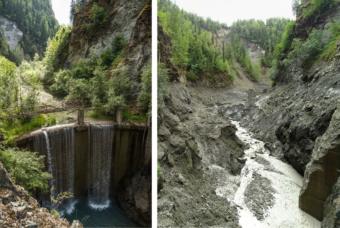
The removal of the lower Eklutna dam, pictured before and after its demolition, was finished last summer. (Photo by Loren Holmes/Anchorage Daily News)

Last summer, a conservation group teamed up with an Anchorage-area Native tribe to finish removing a defunct dam on the Eklutna River, northeast of the city.

That effort couldn’t succeed on its own, largely because higher upstream, utilities divert the river’s water into a hydroelectric power plant. The groups that removed the lower dam envisioned that their project would push the utilities into action to improve salmon habitat and boost a fishery that could bring together the Eklutna Native people, the original residents of the Anchorage area.

But now, a year later, there’s still only a trickle of water flowing through the canyon where the dam once stood.

Since its removal, the utilities have gotten an early start on a legally-mandated process to address some of the damage to fish and wildlife habitat caused by the upstream hydroelectric project. But that process begins with a study phase — no concrete steps are required until 2027.

Brad Meiklejohn, who spearheaded the $7.5 million dam removal for a group called the Conservation Fund, is pushing the utilities to act more quickly. The status quo, Meiklejohn said, is “subsidizing cheap power on the backs of Natives and salmon.”

“That’s the cost we’ve externalized here,” he said. “To keep postponing this, and keep having the fish and the Native people pay the price because of our lack of innovation and creativity – I think that’s criminal.”

Brad Meiklejohn, who works in Alaska with a group called the Conservation Fund, spearheaded the dam removal project. (Photo by Loren Holmes/Anchorage Daily News)

The lower Eklutna dam was built in the 1920s to supply power to Anchorage, but it was shut down when the federal government built the much larger project at Eklutna Lake, far upstream, in the 1950s.

The federal project was a major undertaking driven by the scarcity of power in Anchorage — in the 1940s, the city resorted to generating some of its power with the stern half of the Sackett’s Harbor, a shipwrecked tanker. The Eklutna project required hundreds of workers and construction of a 4.5-mile tunnel through a mountain, which brings the lake water to the site of the project’s two generators.

In 1997, the project was transferred by the federal government to three utilities. One was Municipal Light and Power, Anchorage’s publicly owned utility, and the other two were cooperatives — Matanuska Electric Association, and Chugach Electric Association, which serves the Anchorage area.

Today, the project generates 175,000 megawatt-hours of electricity a year, or enough for 25,000 homes, according to a new informational website created by the utilities.

That’s less than 5% of the power used by the Railbelt, which runs from the Kenai Peninsula to Fairbanks. But it’s among the cheapest energy sources for the region, which makes it more valuable to the utilities.

Eklutna Lake is also the source of about 90% of Anchorage’s drinking water. But that amounts to just 10% of the water that’s diverted from the river, according to the utilities; the remaining 90% goes to generate electricity.

Meiklejohn said he doesn’t want to interfere with the city’s drinking water supply. But he estimates that just 10% of the diverted water would be needed to support salmon spawning, with minimal impacts to power costs.

“I think it’s a solvable problem. I think there’s enough water to allow some to go into the river for the fish,” he said. “And I would love to see the utilities get a little more proactive on this, and get some of their best and brightest minds working on a solution.”

The lower dam’s removal was a four-year effort that finished last year — Meiklejohn’s organization partnered with the Eklutna people to do the work, hiring Eklutna Inc., their Alaska Native village corporation, as the contractor.

In interviews, officials who work with the utilities said that they’re committed to addressing the impacts of the upstream hydroelectric project. But, they said, they also have obligations to their members and customers, and they want the studies to happen first to help guide their actions.

“We have to understand what the trade-offs are,” said Bill Falsey, the municipal manager for Anchorage, whose public utility owns 53% of the hydroelectric project. “We’re not going to know what policy option makes the most sense until we have really run all the scenarios.”

The hydroelectric project drains out of the lake through a tunnel in the bottom, and utility officials said it could also cost money to reconfigure their infrastructure to send water down the river. And, Falsey added, “it’s not even a known quantity what it will take to get fish to return.”

“That’s what this is about,” he said. “That’s why we are engaged in these studies.”

As part of the project’s transfer from the federal government to the utilities, they were not required to get an operating license from the Federal Energy Regulatory Commission. Environmental reviews and restrictions that could have accompanied the licensing process were replaced by an eight-page agreement that the new owners signed with federal agencies.

The 1991 agreement, which is enforceable by federal court, requires the utilities to begin studying fish and wildlife impacts of the hydroelectric project no later than 25 years after the purchase took effect in 1997, or 2022.

The utilities started the study process this summer, three years earlier than the agreement requires. But actions to address the impacts identified by the studies are not required to start until 2027, and they don’t have to be finished until 2032.

The agreement ultimately asks the utilities to deliver draft recommendations to the governor. The governor is then charged with adopting a formal plan that balances “efficient and economical power generation” and energy conservation with fish and wildlife, recreation, water supplies and “other beneficial public uses.”

Critics point out that the agreement contains no protections for the Eklutna people, and doesn’t reference them whatsoever.

In an interview, Aaron Leggett, president of the Native Village of Eklutna, said tribal members have gotten used to being patient. But he said he also sees the story of the lower dam’s removal as being too compelling to ignore, which leaves him “optimistic.”

“I think at the end of the day, we’ll get there,” he said. “We’re at the point where, at a minimum, we know we’ve taken the dam out. And to us, that’s something to be celebrated.”

More than half of Eklutna’s tribal members live in or near the Anchorage area, Leggett said. And reviving a salmon run in their community, he added, could help unify them.

Here’s how a Kenai Peninsula wildfire could cause higher electric bills in Anchorage and Fairbanks

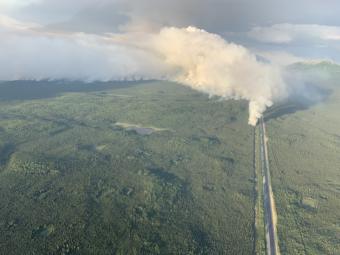
A plume of smoke rises near the Sterling Highway in this aerial photo.
Firing operations conducted by fire crews north of the Sterling Highway and transmission lines. (Photo courtesy Alaska Division of Forestry)

The Swan Lake wildfire on the Kenai Peninsula could cause Anchorage and Fairbanks residents’ electrical bills to go up, due to damaged transmission lines that carry power to those cities from a major hydroelectric dam near Homer, officials said.

The transmission lines were shut off in mid-August at the request of the team managing the crews fighting the wildfire, which is 35 miles wide and has burned more than 250 square miles since it started in June. Cory Borgeson, chief executive of the Fairbanks-based Golden Valley Electric Association, said he’s concerned the lines may not be fixed for months — possibly even until next summer.

“From the folks that have had a cursory look at the line, there’s significant damage, poles that have been burned and the like,” Borgeson said in a phone interview Tuesday.

Borgeson said he learned about the damage from Brad Janorschke, the manager of Homer Electric Association, which owns the roughly 15 miles of transmission lines exposed to the fire.

Janorschke was out of the office this week and couldn’t be reached for comment. But HEA spokesperson Bruce Shelley said that the member-owned cooperative needs the fire to die down before it can fully assess its infrastructure.

“I’m no expert in the area, but I can’t imagine we’re not going to have some damage to the line,” he said. “As soon as they give us the green light to go and inspect this and assess the damages, we will be Johnny-on-the-spot.”

The Bradley Lake dam is 125 tall, and it’s about 25 miles from Homer. (Photo by Quinton Chandler/KBBI)

The damaged power lines connect the population centers of Anchorage, Fairbanks and the Matanuska-Susitna Borough with the 125-foot-tall Bradley Lake dam, at a remote site near Homer. The project was built in the 1980s for more than $300 million, and it has a 120-megawatt capacity — enough to supply power for tens of thousands of homes. It produces up to 10% of the railbelt’s power needs.

The dam, which is being expanded, is among Alaska’s cheapest power sources. To replace the hydroelectric power, utility managers said they have to use more expensive sources, like natural gas or oil. And that means customers’ bills are likely to rise later this year.

How much? It’s a little too early to say exactly, though it’s unlikely to be a major increase, utility officials said.

“Any time you’re replacing hydro power with natural gas, you’re going to see that increase, and especially with the number of days that have gone by as this fire has burned,” said Julie Hasquet, spokesperson for Chugach Electric Association, the Anchorage-based cooperative that gets about one-fourth of its power from Bradley Lake.

But, Hasquet added, “We won’t know the impact until we’re through this entire process and have an opportunity to work with Homer Electric Association to assess the damage.”

One data point comes from Matanuska Electric Association, a cooperative that serves some 50,000 members in the Matanuska and Susitna river valleys. The utility has spent a total of some $408,000 to replace power it would have used from Bradley Lake during the current outage and a previous, three-week shutdown in June and July, according to spokesperson Julie Estey.

The daily cost of the outage is roughly $12,000, which will have to be paid by MEA’s customers, she said. She added that those costs will not be shared equally, however, since some buyers, like businesses and the local school district, purchase larger quantities of power than homeowners.

Firefighting officials said they are trying to facilitate utilities’ access to the transmission lines as soon as possible. But in part because of the fire’s massive size, “we still have some mop-up and some containment to do that is in the areas where the transmission lines travel,” said Jeremy Robertson, liaison officer with the fire management team.

“We’re doing everything we can to make them accessible to the people who operate and maintain those lines,” he said. “We continue to update and collaborate with Homer Electric Association daily — we’re in almost constant communication with them. And it is our priority to try to open up the infrastructure.”

Democratic presidential candidates spent 7 hours talking climate change. Alaska was barely mentioned.

Massachusetts U.S. Sen. Elizabeth Warren was one of two candidates to say the word “Alaska” at the CNN Democratic Presidential Town Hall on climate change in New York on Wednesday. But it was only a passing reference. (Photo by CNN)

Ten Democratic candidates devoted a total of seven hours to the issue of climate change at a CNN town hall Wednesday. But they never discussed Alaska, according to transcripts, even though the state is is the fastest-warming in the country.

“They’re in that election, East Coast bubble and that’s what they talk about,” said Mark Begich, a Democrat who represented Alaska in the U.S. Senate between 2009-2015.

Begich said it was “amazing” that there wasn’t more discussion of his home state, given that it’s “ground zero” for the effects of climate change.

“You betcha, they’ll get a few comments from me,” he added, referring to the Democratic presidential candidates. “I will send off some texts to the ones that I communicate with and say, ‘Don’t forget Alaska.’”

Alaska’s temperature has been warming twice as fast as the world average, and faster than any other state, according to last year’s National Climate Assessment, which includes an entire chapter on Alaska. Warming is suspected to have caused salmon die-offs this summer; thawing permafrost is threatening infrastructure; and coastal erosion is forcing an entire village to relocate.

Rep. Andy Josephson, D-Anchorage, speaks during a hearing at the Capitol in March. (Photo by Skip Gray/360 North)

“Look at the impacts, especially in the Arctic,” Begich said. “We’re like the lab of climate change that encompasses every element of the environment.”

The Democratic presidential candidates did devote ample time to policies that would affect national and global carbon emissions — which could in turn affect the rate of warming in Alaska. Many of them endorsed the idea of carbon taxes or fees, and some proposed banning the leasing of federal lands and offshore areas for fossil fuel production.

The word “Alaska” was uttered five times during the debate, according to transcripts — and three of those were references by Bill Weir, CNN’s climate correspondent, to a recent trip to the state.

The fourth time was when Massachusetts U.S. Sen. Elizabeth Warren said that in thinking about climate change, “We have to think about the whole world.”

“We can’t just think about cleaning up the United States of America,” she said. “We cannot think about from the East Coast to the West Coast, plus Hawaii and Alaska.”

The only other mention was a quick reference by New Jersey U.S. Sen. Cory Booker, when he was arguing for a ban on offshore drilling.

“Why? Because when we know they drill, they spill,” he said. “Ask Alaska. Ask California. Ask the Gulf Coast.”

Casey Steinau, the Alaska Democratic Party chair, said she and other party leaders try to bring up the subject of global warming in their conversations with national figures. And she noted that Democratic former President Barack Obama visited the state in 2015 to highlight his climate policies.

The state party, she added, will have a climatologist, Brian Brettschneider, deliver the keynote speech at its gala next week.

“This is really important,” she said.

Site notifications
Update notification options
Subscribe to notifications