Nat Herz, Alaska Public Media

Trump to pick former Alaska oil industry attorney for federal judgeship

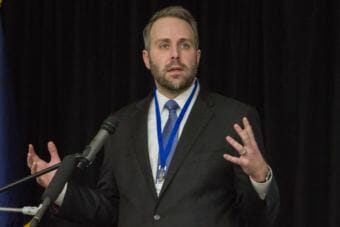
Joshua Kindred, then an attorney for the Alaska Oil and Gas Association, spoke at Southeast Conference’s Mid Session Summit Feb. 13, 2018. (Photo by Heather Holt.)

President Donald Trump announced Wednesday that he intends to pick Joshua Kindred, a former oil industry attorney, as a new U.S. District Court judge for Alaska.

Kindred works as a lawyer in Anchorage for the U.S. Department of Interior. Before that, he was regulatory and legal affairs manager for the Alaska Oil and Gas Association, an industry group that sometimes participates in lawsuits to defend oil development in federal court.

Kindred has also worked as a state prosecutor. He’s married to Tali Birch Kindred, who unsuccessfully applied to fill an open state Senate seat in August, following the death of her father, Chris Birch, who held the seat previously.

Kindred’s nomination must be confirmed by the U.S. Senate. A previous Trump nominee for an Alaska judgeship, Jon Katchen, withdrew his name last year before he was confirmed.

AFN convention highlights Native groups’ tension with Alaska Gov. Dunleavy as recall effort looms

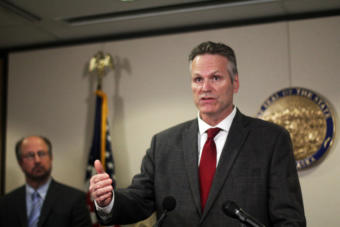
Alaska Gov. Mike Dunleavy speaks at a news conference at his Anchorage office on Friday, Sept. 27, 2019.
Alaska Gov. Mike Dunleavy speaks at a news conference at his Anchorage office on Sept. 27. (Photo by Nat Herz/Alaska Public Media)

In Alaska Gov. Mike Dunleavy’s first few months in office this year, the Republican traded shots with the state’s primary Alaska Native advocacy group, the Alaska Federation of Natives.

Dunleavy’s budget proposed cuts to programs important to Alaska Native groups: rural law enforcement, payments to senior citizens and health care. AFN’s leaders strenuously objected, and amid the months-long fight over the budget, one Native corporation endorsed the campaign to recall him.

Now, with that recall fight looming, this week’s AFN convention could preview some of Dunleavy’s next steps when it comes his relationship with an important voting bloc.

By moderating some of his more severe budget positions, he could stave off broader support for his recall among Alaska Native groups, political observers said. But if he sticks to them, he could risk an aggressive campaign against him.

“The Native interests of the state have a tremendous amount of votes, a tremendous amount of money,” said Jim Lottsfeldt, an Anchorage political consultant. “The question is: Can Dunleavy change his spots?”

In a prepared statement, Dunleavy spokesman Jeff Turner said the governor is looking forward to sharing his “experience, knowledge and perspective” at the convention. And the administration still sees a number of areas of potential partnership with the Native community and tribal entities, said John Moller, the governor’s Alaska Native and rural affairs adviser.

Moller pointed to an existing compact on child welfare and protection between the state and Native groups, and said the administration is interested in exploring a new one on education.

“The doors aren’t closed and they never were closed,” said Moller, an Alaska Native who’s originally from Unalaska. “However people come to those conclusions is their business. But nonetheless, I’m hoping for a great AFN.”

In interviews, Alaska Native leaders said that things remain tense with Dunleavy’s administration.

The governor has vetoed line-items important to AFN, like assistance payments to municipalities and money for village public safety officers, who police rural areas.

tribal advisory committee created by Dunleavy’s predecessor, independent Gov. Bill Walker, has stopped meeting. And in August, CIRI, the Anchorage-based Alaska Native regional corporation, endorsed the Dunleavy recall campaign, saying the governor’s actions were “harming all Alaskans and threatening the state’s business environment.”

Melanie Bahnke runs a Nome-based tribal organization called Kawerak and had a widely publicized confrontation with Dunleavy when he visited Nome earlier this year. In an interview this week, she said her group has invited Dunleavy’s administration to work with them, but gotten little traction.

“That invitation still stands, with all state agencies and the governor. We extended that invitation when he was here,” she said. “But there hasn’t been much knocking on our doors.”

AFN’s annual convention begins Thursday in Fairbanks with the theme, “Good Government, Alaska Driven,” which many see as a swipe at the governor. The convention program says Dunleavy “tested the bounds” of that principle this year, and its agenda includes several sessions that question the governor’s policies.

Next year’s theme is set, too, with a nod toward the 2020 election: “Good Government, Alaska Decides.”

Julie Kitka, AFN’s president, said the themes are less about targeting the governor personally and more about articulating a different vision for state government.

“What we’re having trouble with, as a state, is setting our priorities. And so our ‘Good Government, Alaska Driven,’ our ‘Good Government, Alaska Decides’ is about a call to action for people to be engaged in setting the priorities for the state,” she said. “We did not feel that our ideas and issues and concerns were taken seriously by the new administration.”

Kitka and other Native leaders said that AFN, which arose amid a land claims fight in U.S. Congress in the 1960s and 1970s, has been making a new effort to engage with state government in Alaska after decades of focus on the federal government.

The organization made a major push in Juneau in the past several years lobbying lawmakers to approve and preserve criminal justice reform, since Alaska Natives are overrepresented in the state’s prisons. And since Dunleavy took office in December, AFN has been pressing his administration and the Legislature to preserve programs important to its members and rural Alaska residents.

The group’s leaders, Kitka said, have developed a “new appreciation of the important role of state government, and for it to function well.”

This week’s convention will largely be focused on policy. But the looming question is a political one — whether Dunleavy will find a way to repair his relationship with AFN and other Native groups before the courts issue a final decision on whether to let the recall campaign move forward.

Support from Native and rural interests can be pivotal both because they make up a swing voting bloc, and because Alaska’s regional Native corporations are big businesses that can be deep-pocketed donors to campaigns.

Those corporations can be slow about taking political stances, Lottsfeldt said, and so far CIRI is the only one to take a formal position on the recall. But many more corporations took action in 2010, when they and AFN raised more than a million dollars to help Republican U.S. Sen. Lisa Murkowski win a write-in campaign over Tea Party candidate Joe Miller.

“They try to stay above the fray,” Lottsfeldt said. But, “There’s times when they see certain existential crisis, and the nomination of Joe Miller to the U.S. Senate clearly was one of them. They’ll have to decide whether they’re at one of those moments in time again.”

Dunleavy is set to deliver a 15-minute speech at the convention Thursday morning, and Moller, the governor’s adviser, will appear on a panel later at the convention. He described the administration’s relationship with the Native community as an evolving one.

“With any administration, you start off with relationships that are more mature than others,” he said. “I’m doing what I can in the areas that I have any kind of knowledge in. And we continue on trying to develop all of the relationships with Alaskans.”

There’s a new fight over Bering Sea black cod. Warming water may be to blame.

Black cod, also known as sablefish, range from the West Coast all the way to Japan. (Photo by Alaska Department of Fish and Game)

Fish politics in Alaska usually get serious when there aren’t enough fish to go around. But a new fight is brewing over black cod because there are so many of them — possibly as a result of the ocean’s warming waters.
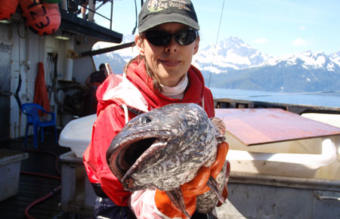
Record numbers of young black cod, also known as sablefish, are swimming off Alaska’s coast; scientists estimate that this group of fish, which had huge reproductive success in 2014, is twice the size of the next-largest on record, from 1977.

The small-boat fishermen who catch black cod, many of whom live in Southeast Alaska, are eagerly waiting for the young fish to grow larger and commercially valuable. But they’re getting frustrated seeing increasing numbers of black cod caught accidentally, as bycatch, by the Seattle-based trawlers that target lower-value species in the Bering Sea, like the pollock that go into McDonald’s Filet-O-Fish sandwiches.

“This recruitment event is what we’re counting on to keep the fishery going for the next 10 or 15 years,” said Tad Fujioka, a Sitka fisherman who decided to buy black cod fishing rights a few years ago, in part because of the boom in their numbers. “We need to save these fish for years to come.”

Much of Alaska’s commercially-sold black cod is caught hundreds of miles east of the Bering Sea. But they’re known to swim long distances, so the small-boat fishermen worry that they’ll have fewer left over after the trawlers’ accidental catches.

“You can’t catch these fish twice,” Bob Alverson, who heads a Seattle-based group of small-boat fishermen, testified at a meeting of fisheries managers last week. “So if they die out there, they’re not likely to have a chance at migrating back.”

The trawlers’ black cod catch is approaching what was previously set as the “overfishing level” for the Bering Sea. That could lead to restrictions being placed on fishermen. Fisheries managers are expected to decide in the next few months whether to raise that limit.

Representatives for the trawlers, meanwhile, say that skippers are encountering much larger numbers of black cod mixed in with the fish that they’re targeting – even though they haven’t changed their fishing practices. Trawlers, who tow a large, open-mouthed net through the water, are already trying to avoid other species like king salmon and herring, and that makes it harder to stay away from black cod.

“We try and go shallow to avoid them and they’re shallow. We try to go deep — I knew one guy who went to over 200 fathoms fishing for pollock, and he still got sablefish,” Brent Paine, a trawl industry representative, testified at last week’s meeting. “It’s very hard to try and avoid them.”

Sablefish are commonly found in deep waters. (Photo by Alaska Fisheries Science Center/NOAA Fisheries)

Bering Sea trawlers had pulled up nearly 2,500 metric tons of sablefish by late September — about 10 times what they caught in all of 2016.

“This is really uncharted waters,” Paine said. “We never even dreamed that sablefish would be an incidental catch problem.”

Scientists note that while the trawlers’ accidental catch is way up, it’s still relatively small in the context of the booming black cod numbers. This year’s catch by the Bering Sea trawlers is less than 1 percent of the total amount of the fish between two and five years old estimated to be present in Alaska waters, according to Dana Hanselman, a Juneau-based federal fisheries scientist and black cod expert.

And reports continue to come in that even younger black cod are also present in large numbers — people have been finding salmon bellies full of them, said Hanselman.

Hanselman said researchers are starting to think that Alaska’s warming ocean temperatures could be playing a role in black cod’s increasing numbers.

“They’re a long lived species, and that allows them to span across poor and favorable environmental conditions,” he said. “What we’re seeing now, perhaps, is that sablefish are one of the winners of this marine heatwave that we’re kind of seeing.”

At least one laboratory study backs up that idea — Juneau-based scientists found that black cod grew faster and did better in warmer temperatures, up to a certain point. But, Hanselman added, it’s too early to draw firm conclusions about the cause of the fish’s abundance.

“It’s just an interesting thing we’re observing at the moment and saying, ‘Wow, this really seems to correspond with this high heat wave,’” he said.

Grilled black cod collars are a tasty, oily treat cherished by fishermen. (Photo by Berett Wilber)

Scientists have observed similar trends with sablefish all along the west coast, Hanselman added. One theory is that because sablefish are more mobile, they can move toward warmer temperatures when they’re advantageous, he said.

But the small-boat fishermen who target black cod, generally using long lines of hooks that sit on the ocean floor, are skeptical that they’ll see much benefit from climate change. That’s in part because many of them also fish for other species that could be vulnerable, like salmon.

Fujioka, the Sitka fisherman, said he’s worried about what could happen to the young black cod between now and when they grow to be commercially valuable — and he’s not counting on a long-term boom yet.

“This is just the second time we’ve seen this since 1977. So it seems like you’d want a little more data before you decided that really was a cause-and-effect, and not just a coincidence,” he said. He added: “It would be nice to at least have one winner to put in a pile with a bunch of losers.”

Fisheries researchers hold a large black cod. (Photo by Aaron Baldwin/Alaska Department of Fish and Game)

As this year’s fishing season winds down, representatives for the trawlers say they’ve taken measures to try to avoid more accidental black cod catches. One fishing cooperative is requiring members to report all black cod bycatch, with information about location and depth, to a Google group. The captains are being asked to start their trips by catching a small amount of fish, to see how many black cod are present.

For next year, the cooperative plans to set specific bycatch levels that, when reached, will prompt more aggressive management measures, Mark Fina, an official with the group, testified at last week’s meeting. That’s in part because of the way the bycatch problem cropped up so quickly this year, he added.

“I don’t know whether it’s safe to say that something this significant can sneak up on you,” he said. “But I can say that not everybody in the co-op knew what was going on.”

Dunleavy picks top deputy, former oil industry lobbyist to chair state oil watchdog

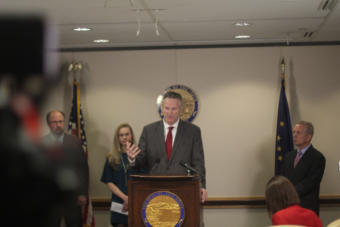
Alaska Gov. Mike Dunleavy speaks at a news conference at his Anchorage office on Friday, Sept. 27, 2019.
Alaska Gov. Mike Dunleavy speaks at a news conference at his Anchorage office on Friday, Sept. 27, 2019. Dunleavy announced Tuesday afternoon that he has named Jeremy Price to the Alaska Oil and Gas Conservation Commission. (Photo by Nat Herz/Alaska’s Energy Desk)

Alaska Gov. Mike Dunleavy has named a former oil lobbyist who currently works as his deputy chief of staff to chair the Alaska Oil and Gas Conservation Commission, the public agency that acts as a watchdog over the state’s oil industry.

Dunleavy announced Tuesday afternoon that he’d named Jeremy Price to the commission seat reserved for a member of the public; two other seats are set aside for a geologist and petroleum engineer.

Price has been an aide to U.S. Sen. Lisa Murkowski and U.S. Rep. Don Young, both Alaska Republicans. He’s worked as an employee and lobbyist for the American Petroleum Institute, an industry advocacy group. And before taking his job in Dunleavy’s administration, he ran the Alaska branch of Americans for Prosperity, the free market conservative group funded, in part, by the billionaire Koch brothers.

Price replaces Hollis French, a former Democratic senator whom Dunleavy fired from the commission.

Dunleavy wants Alaska lawmakers to approve additional PFDs this fall. Here’s why that’s unlikely.

Alaska Gov. Mike Dunleavy speaks at a news conference at his Anchorage office on Friday, Sept. 27, 2019.
Alaska Gov. Mike Dunleavy speaks at a news conference at his Anchorage office Friday. (Photo by Nat Herz/Alaska Public Media)

When Alaska Gov. Mike Dunleavy agreed to accept the Legislature’s proposed $1,600 permanent fund dividend earlier this year, he said he would keep pushing for a supplemental payment in the fall.

Dunleavy campaigned on paying Alaskans a “full PFD” — the amount they’d receive under a 1982 law that ties the payments to the permanent fund’s investment returns. And when he signed legislation for the $1,600 payment, he suggested that he’d likely convene a special session on the supplemental dividend in the fall to bring the total dividend to closer to $3,000.

But at a news conference Friday, a special session sounded unlikely, as Dunleavy said he’s waiting to call one until the state Senate approves his nominee to fill a vacant seat.

“Once this piece is in place, again, those discussions will continue,” Dunleavy said at the news conference, held at his Anchorage office. “And I have to be hopeful that everyone wants a resolution on this issue. This is the issue that divides and unites Alaskans.”

Lawmakers arrived at the $1,600 dividend somewhat arbitrarily. First, they relied on a law passed last year that says the annual withdrawal from the permanent fund should be about 5% of its value. How that money is divided, though, is up to lawmakers — and they decided to use most of it to pay for government services, leaving the rest for dividends.

Dunleavy wanted lawmakers to stick to the 1982 law, which would have set aside about $2,900 for each recipient. But the Legislature has the power to ignore that law, and it did this year, with lawmakers arguing that the state couldn’t afford to pay dividends at that level while sustaining the size of government.

Rep. Steve Thompson, R- Fairbanks. (Photo by Skip Gray/360 North

Legislators have expressed interest in passing a bill that would determine how much of each year’s permanent fund revenue goes towards dividends, and how much goes toward the government. And that could help them avoid a time-consuming debate on the issue every year.

But when it comes to the question of how much money should be set aside for dividends each year, lawmakers are still divided among themselves, and many of them have sharply different views than Dunleavy. And that means a special session is unlikely to be very productive right now, they said in interviews Friday.

Fairbanks Republican Rep. Steve Thompson, who’s part of the House of Representatives’ majority coalition, says there’s not exactly a lot of enthusiasm for a special session, anyway. That’s because legislators already stayed in Juneau for months of extra time this year.

“After a seven-month session, they’re looking at trying to get some vacations,” he said in a phone interview.

State law requires Dunleavy to give the Legislature a month’s notice before calling a special session. And that means he’s running out of time to avoid conflicts with holidays.

Dunleavy administration announces amount of Alaska’s 2019 PFD checks

Anchorage Permanent Fund Dividend Office 2016 03 14
Alaskans file their permanent fund dividend applications in downtown Anchorage in March 2016. (Photo by Rachel Waldholz/Alaska Public Media)

Each eligible Alaska resident will receive a $1,606 permanent fund dividend this year, Alaska Gov. Mike Dunleavy’s administration announced Friday.

The payment will be split between 631,000 recipients, and it’s each person’s share of the more than $1 billion that the state Legislature budgeted for dividends. Lawmakers set aside that amount after using a larger share of the revenues of the $63.6 billion investment fund — originally seeded with oil revenue — to pay for government services.

Dunleavy had pushed lawmakers to set dividends using a 1982 formula passed by the Legislature; it would have allowed for payments of $2,916 to each resident, while leaving a major budget deficit. Lawmakers rejected that proposal, saying that it would violate another state law that limits the draw on permanent fund earnings.

Site notifications
Update notification options
Subscribe to notifications