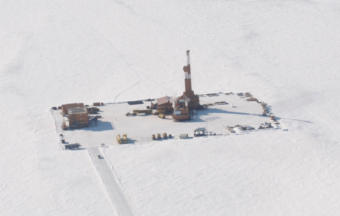
ConocoPhillips’ undeveloped Willow prospect, pictured here, is still being explored. The company is selling a one-fourth stake in Willow and other projects in Alaska. (Photo from ConocoPhillips)
ConocoPhillips wants to sell a stake in some of its Alaska oil projects, in hopes of offsetting risk and sharing the expense of costly investments it’s planning in the state over the next decade, the company announced this week.
The package for sale includes old, new and unbuilt projects that represent most of Conoco’s holdings in Alaska, with the notable exception of the company’s 36% share of the massive Prudhoe Bay field, America’s largest.
Among the assets on the block: the Kuparuk River Unit, which is Alaska’s second-largest oil field and has been operating for decades; the newer Alpine unit to the west, which is still expanding; and the undeveloped Willow prospect in the National Petroleum Reserve-Alaska.
Sometimes oil companies sell off projects if they aren’t measuring up to expectations. Earlier this year, BP announced it would sell all of its Alaska assets to a smaller company, Hilcorp. But Conoco’s sale is not about a lack of confidence in its Alaska projects, according to spokeswoman Natalie Lowman. Instead, she said it stems in part from Conoco’s plan to invest billions of dollars to expand and develop an array of projects in Alaska.
The company aims to spend $11 billion on its core assets in Alaska over the next decade, not including the estimated $5 billion that would be needed to bring the major Willow project into production.
“We have a lot of exciting work that we are planning to do on the North Slope, and it costs a lot of money,” Lowman said in an interview Wednesday. “So what we’re looking for is a co-venturer, a company that shares our vision for increasing production on the North Slope.”
Conoco currently owns 100%, or close to it, of the assets up for sale, and the company says it’s unusual for it to own that much of a stake in its projects. Oil companies often split project ownership into chunks to help share costs: Conoco owns about one-third of the Prudhoe Bay field, America’s largest, with BP and ExxonMobil also holding stakes, for example.
The company is not looking to sell more than one-fourth of the assets, Lowman said, which will leave it in control. And it wants to find a buyer that will be similarly enthusiastic about making the investments needed to move the projects forward.
The announcement did not make a big splash in Alaska’s oil industry, and one analyst said the move does not signify much of a change in Conoco’s view of the state. Some of Conoco’s holdings in Alaska that started as “bite-sized” projects have now grown into bigger undertakings, said Rowena Gunn, who works with energy research firm Wood Mackenzie, in an email.
“Alaska represents a good chunk of ConocoPhillips’ global portfolio, so I think they have taken this decision in order to spread the risk and cost of these projects,” she said. “They will still retain being the largest shareholder and operator of assets.”
Gunn declined to speculate on which oil companies could be interested customers, but she did say that the sale could bring a new player to the North Slope.
The asking price is not going to be made public, Lowman said.
“This is a large commercial negotiation,” Lowman said. “And I think those people who are interested will know how to find us.”
ConocoPhillips’ CD5 drill site, which is linked to its Alpine development that opened in 2000, is 9 miles from the North Slope village of Nuiqsut. (Photo by Elizabeth Harball/Alaska’s Energy Desk)
A major proposed North Slope oil project is running into local opposition from residents of the village of Nuiqsut, who are already partially surrounded by development and wary of more.

After hearing residents’ concerns at a North Slope Borough planning commission meeting that ran past midnight earlier this month, the commissioners declined to support a rezoning proposed for the Nanushuk project — a development that could produce 120,000 barrels of oil a day at its peak, or about one-fourth the amount that currently flows through the trans-Alaska pipeline.
The 4-2 vote isn’t binding, and the borough Assembly will take up the question at a meeting next month. But the decision highlights how the balance between development and subsistence is becoming increasingly fraught in Nuiqsut, a village of 450 that’s found itself in the middle of the oil industry’s resurgence on the North Slope.
Eight miles north of the village is ConocoPhillips’ Alpine project, a $1.3 billion development that opened in 2000 and is still expanding, with sites to the south and west. Another big new Conoco project, Willow, proposes to establish a gravel mine 7 miles west of Nuiqsut, with as many as 250 wells at the site of the development farther away.
Then there’s Nanushuk, pushed by Papua New Guinea-based Oil Search. The company plans to build one of its drill sites 7 miles northeast of Nuiqsut, with a processing facility — to separate out oil from natural gas and water — farther away.
Some of Alaska’s elected leaders have touted the developments as a major boost to the state’s oil-dependent economy. And many Nuiqsut residents support continuing oil development, citing the ample financial benefits and quality-of-life improvements the industry has brought to the village’s residents — particularly those who are shareholders in the village’s Native corporation.
But Sam Kunaknana, Nuiqsut’s representative to the borough and an outspoken critic of oil development’s impacts on the village, said that the other commissioners — who represent different North Slope communities — were persuaded to vote against the Nanushak resolution by testimony from Nuiqsut residents.
People are concerned about development’s impacts on the fish they’re catching and the caribou they’re hunting, Kunaknana said in a phone interview. Already, oil development has affected as much as one-third of Nuiqsut’s traditional subsistence range, according the local Native village corporation.
“It’s not just one project,” Kunaknana said. “It’s everything that’s going on around this area.”
Oil Search’s Nanushuk project and Conoco’s Willow project could, if built, together produce 250,000 daily barrels of oil at their peak, or roughly half the amount of oil that currently flows down the trans-Alaska pipeline. The companies’ management would have been watching the planning commission’s meeting closely, said Tim Bradner, a former BP employee and journalist who’s long followed Alaska’s oil industry.
“And they would be very concerned about making sure that their relationships are good with the local people up there,” he said. “Because unlike in a lot of places, the North Slope is a place where the local people really do have clout.”
Oil Search has been expanding its footprint in Alaska and recently hired Joe Balash, formerly a top official in the U.S. Interior Department; the company recently moved into office space in BP’s Midtown Anchorage headquarters. Spokesperson Amy Jennings Burnett declined to comment.
The planning commission’s vote comes as the Trump administration pushes to loosen restrictions on oil and gas development in the area. Later this week, the Bureau of Land Management plans to release an environmental review of a new land-use plan for the National Petroleum Reserve in Alaska, where the Willow project and others are located — and it’s expected to revoke some of the environmental safeguards contained in a previous, Obama-era version.
The challenge of balancing resource extraction and subsistence exists across the North Slope, but that tension has escalated in Nuiqsut amid the increasing development nearby.
“I can’t think of anywhere in the state where the juxtaposition of these issues comes to roost as it does in Nuiqsut,” Bradner said. “You have to feel some sympathy for the people — they’re surrounded by all this and they worry about their community kind of becoming a truck stop for the industry. On the other hand, there are people in the community who see a lot of upside to this.”
Nuiqsut sits in the biologically-rich delta of the Colville River, just south of where it flows into the Beaufort Sea, and it was founded amid passage of the Alaska Native Claims Settlement Act in the early 1970s. At the time, the oil industry’s focus was 50 miles east, where the Prudhoe Bay field had been discovered. But in the decades since, development has crept steadily west.
Since Alpine opened in 2000, Conoco has linked its central facility with several additional sites, with pipelines and roads now stretching nearly 180 degrees around Nuiqsut; a new connected drill site, Greater Mooses Tooth 2, is under construction.
The village of Nuiqsut in June 2018. (Photo by Elizabeth Harball/Alaska’s Energy Desk)
Oil Search’s Nanushuk development is proposed northeast of Nuiqsut. And Conoco’s new proposed Willow project, to the west, is currently undergoing federal environmental reviews.
Conoco has a “long-term relationship with Nuiqsut, which goes back over 20 years with our Alpine development,” spokesperson Natalie Lowman said in an emailed statement.
“We are actively engaged with the community on our Willow project to identify concerns and seek collaborative solutions,” she said. “It is our goal to assist the community and ensure the North Slope Borough and all the NPR-A villages have the opportunity to benefit from our activities in the NPR-A.”
In February, Nuiqsut’s tribal government sued the federal government over its approval of Conoco’s exploratory drilling program for the previous winter.
But Nuiqsut’s Native village corporation, Kuukpik Corp., has taken a different approach, often partnering with the oil industry to bring cash and infrastructure improvements to shareholders and residents.
Kuukpik’s shareholders receive as much as $30,000 a year in dividends, thanks in part to royalties from oil pumped from some of Kuukpik’s lands that are part of the Alpine project. Alpine also is the source of a natural gas line that runs directly to Nuiqsut, allowing residents to heat their homes for a fraction of the cost in other rural Alaska villages.
Kuukpik has fought for, and received, concessions from oil companies to protect the village’s subsistence harvests and health. For one project, Conoco agreed to move the location of a proposed bridge away from an area where residents fish; for another, it used lower-emission generators to power a drill rig, reduced noise levels and boosted air and water quality monitoring.
The Nanushuk project also included a list of mitigation measures in the resolution that the planning commission rejected this month.
Oil Search, the company pushing the project, would have been required to hire a “subsistence representative” and conduct an array of studies on fish, caribou and the “cumulative impacts” of development in the area. It also would have been required to host an annual job fair in Nuiqsut, and to the extent possible, involve local students in their studies and hire local boat and snowmachine drivers.
The company has also agreed to build a boat ramp on the Colville River, along with a road to it, to improve residents’ access for subsistence.
“The corporation still thinks that Oil Search will be a genuine and viable partner in the Colville delta,” Lanston Chinn, Kuukpik’s chief executive officer, said in a phone interview this week. “And we’ll see where it goes from there.”
The North Slope Borough Assembly is scheduled to consider the Nanushuk rezoning at its meeting Dec. 3. The borough’s chief administrative officer, Deano Olemaun, said he could not comment on the project “until all the final processes have been completed.”
Bradner, the journalist, said he expects the Assembly to balance the planning commission’s position with the project’s potential to add to the North Slope’s tax base. Most of the borough’s $400 million budget is paid for with property taxes on oil infrastructure, and “as the industry matures on the North Slope, its existing tax base is depreciated,” he said.
“They need new projects to keep their tax base active and renewed, to maintain all the public services that they support up there,” said Bradner. “So there’s two sides to this issue, and it’s a complicated question.”
A bowhead whale and a calf in the Arctic on May 29, 2011. (Photo by Corey Accardo/NOAA)
Whalers in Alaska’s northernmost town of Utqiaġvik have finally landed their first bowhead of the season, after what some veterans said was an unprecedented absence of the marine mammals amid record-setting air and water temperatures.

Social media postings from the North Slope hub community show members of the successful crew standing in the dark in front of the 25-foot bowhead.
Utqiaġvik’s whalers weren’t even spotting bowheads early in the season, and scientists flying aerial surveys found bowheads much farther offshore than their normal range — although other North Slope villages farther east did manage to land whales.
Utqiaġvik and the ocean that surrounds it have experienced record warmth this past summer and fall. Experts, including whalers and scientific researchers, theorize that the whales may have moved offshore in search of food or cooler water.
A preliminary National Transportation Safety Board investigation into a fatal PenAir crash in Dutch Harbor on Oct. 17, 2019, includes this photo of damage to the left side of the plane. One propeller blade was found inside the plane, and another was found hanging from cabin insulation. (Photo courtesy National Transportation Safety Board)
The PenAir flight that crashed at the Dutch Harbor airport last month, killing a passenger, landed amid unfavorable, shifting winds, according to an initial federal report released Friday. It was also captained by a pilot with relatively little experience at the controls of the Saab 2000 plane he was flying, the report said.
The captain told National Transportation Safety Board investigators that he had spent about 14,000 hours flying in Dash 8s, another smaller, slower plane that’s also used by RavnAir Group, PenAir’s parent company. But he had just 101 hours in a Saab 2000, he said.
The first officer’s type of experience was similar: 1,450 total flight hours, of which 147 were in a Saab 2000.
The flight crew said the plane touched down about 1,000 feet down the runway, then started reverse thrust and “normal wheel-braking” before using “maximum braking,” the report said.
The flight crew told investigators that they steered the plane to the right as it approached the end of the runway to avoid going into the water, and the Saab 2000 came to rest tilting downward on a rocky embankment on shore.
A 5-foot-long propeller blade was found inside the plane’s cabin, and another was “loosely stuck” in the structure outside the fuselage, the report said.
A 38-year-old Washington man, David Oltman, was killed in the accident, and about 10 more were injured. It was the first fatal passenger accident this year among all U.S. airlines, which are more stringently regulated than the flight services that operate in Alaska’s smaller rural communities.
Friday’s NTSB update is a detailed, seven-page statement of facts about the flight and the investigation, with sections on the runway, the flight recorders, the plane and its engines. It does not assign a cause to the crash; that could come a year or more from now, in a more in-depth report.
After last month’s crash, Alaska pilots and the family that owned PenAir before it was bought out of bankruptcy last year both questioned the pilot’s decision to land with what weather data suggested was a strong tailwind, contradicting standard guidance for pilots. Friday’s report adds new weight to those questions.
As the plane flew its second approach to the runway after an aborted landing, a local weather observer reported winds out of the northwest at 28 mph. The Saab 2000 landed flying roughly the same direction, on what’s known as the runway’s “13” orientation, rather than the other direction, known as runway “31.”
“Transmissions between the weather observer and another airplane indicated that winds favored runway 31 but could shift back to runway 13,” the report said.
Dutch Harbor’s runway, with a mountain on one side and water at both ends, is shorter than normal and notoriously difficult to land on. PenAir’s previous owners say they had guidelines that required pilots to have at least 300 hours of experience in the Saab 2000 plane the airline uses before they could captain a flight to the airport, though management could waive that standard.
PenAir has stopped flying the Saab 2000s into Dutch Harbor, and regularly scheduled air service with a Dash 8 resumed Thursday, nearly a month after the crash. The Dash 8s are widely used by RavnAir Group, PenAir’s parent company, which also flies from Anchorage to Fairbanks and rural Western Alaska.
While scheduled service was canceled for the past month, RavnAir and other companies had been flying charter service in and out of the community, with the city of Unalaska helping to coordinate flights. But residents and people who work in Dutch Harbor’s major commercial fishing industry have complained of steep prices, logistical problems and delays.
City officials are now asking whether they can take legal action against the airlines that were involved in last month’s flight that crashed — which includes not just PenAir but Alaska Airlines.
Alaska Airlines, through a longstanding relationship that predated PenAir’s bankruptcy, marketed PenAir’s flights to Dutch Harbor and sold tickets, allowing Alaska Airlines passengers to accumulate frequent flier miles and enjoy the flexibility of the company’s loyalty program.
A week after the crash, Alaska Airlines said it would not resume marketing scheduled service into Dutch Harbor in Saab 2000s until reviewing preliminary findings from the NTSB and the plane’s manufacturer. On Friday, the company said flights to and from Dutch Harbor that it had marketed were canceled through May 31, 2020. Passengers who booked PenAir flights through Alaska Airlines are being rebooked on Ravn flights at no charge, the company said.
“Currently, there are no plans for Alaska Airlines to market service to and from Dutch Harbor on Ravn or any other carrier,” it said in a blog post.
Hilcorp’s Anna Platform in Upper Cook Inlet. (Photo courtesy Kirk Johnson/LightHawk)
Alaska Republican Gov. Mike Dunleavy’s administration is joining a legal battle against environmental organizations, in support of a company that’s searching for oil in Cook Inlet.
In September, Cook Inletkeeper and the Center for Biological Diversity challenged federal regulators’ decision to allow oil company Hilcorp to incidentally harass whales and other marine mammals as it uses seismic airguns to search for underwater oil formations in Cook Inlet.
Now, Dunleavy’s administration has asked a federal judge for permission to intervene in the lawsuit in defense of Hilcorp’s exploration program.
“Unjustified efforts to stop or delay such exploration and development have a direct negative economic impact on Alaska and its citizens in the form of lost employment and tax revenues,” Dunleavy’s administration said in a 21-page motion to intervene filed Wednesday. “Alaska’s Constitution imposes a duty on the state to responsibly manage and develop Alaska’s natural resources for the maximum benefit of its people. Plaintiffs’ claims interfere with this duty and set a precedent that may adversely impact future oil and gas exploration and development.”
A spokesperson for the Department of Law, Maria Bahr, did not immediately respond to a request for comment on the filing.
The decision by Dunleavy’s administration to join the lawsuit comes at a time when Hilcorp is the focus of new public scrutiny, as it seeks regulatory approval for its acquisition of BP’s assets in Alaska, which would make it one of the state’s largest oil companies.
Bob Shavelson, Cook Inletkeeper’s advocacy director, drew a connection between the administration’s effort to join the lawsuit and a $25,000 donation to a political group that supports the governor that Hilcorp made in January, two months after Dunleavy was sworn in.
“Why would somebody donate that money to something supporting Dunleavy after the election if it wasn’t to have political influence?” Shavelson said. “And this is exactly the type of influence you get when you make those donations.”
The state’s motion to intervene must still be approved by the federal judge overseeing the case, Sharon Gleason. She issued an order allowing Hilcorp to intervene in the case last month.
A voter leaves the booth as election workers at Northern Light United Church assist other voters during municipal elections on Oct. 1, 2019, in Juneau. (Photo by Rashah McChesney/KTOO)
An organization funded by media mogul Rupert Murdoch’s daughter-in-law has donated more than $500,000 to a campaign to overhaul Alaska’s elections and make it easier to elect independent candidates.
Unite America, a Colorado-based group that’s trying to reduce polarization and partisan gridlock, made a $500,000 contribution last week to Alaskans for Better Elections, which is trying to put its initiative on the ballot next year. A separate $100,000 contribution from Unite America came last month.
The Alaska initiative, its supporters say, is designed to make the state’s elections more fair, transparent and open. If approved, it would formally call for an amendment to the U.S. Constitution to allow greater restrictions on campaign fundraising and spending, since some restrictions have been invalidated by the U.S. Supreme Court.
The initiative also contains three major policy changes in Alaska.
First, it would install a system of ranked choice voting, in which voters rank candidates in order of their preference. One of the system’s effects is giving voters more freedom to support independent and third-party candidates, since a vote for those candidates becomes less likely to spoil the chances of the Democrat or Republican that might be that voter’s second choice.
A second piece of the initiative would block Alaska’s political parties from limiting participation in their primary elections. Currently, the Alaska Republican Party’s primary allows only GOP members, nonpartisans and unaffiliated voters to participate, which favors more conservative candidates since registered Democrats can’t vote. Supporters of the initiative say that the primary should be open because it’s publicly funded, and doing so would increase voter turnout.
The initiative’s third major piece would strengthen the state’s financial disclosure laws for elections, barring groups from making campaign contributions larger than $2,000 without identifying the “true sources” of the groups’ money.
The campaign is one of several being supported by Unite America, which is also backing an anti-gerrymandering effort in Pennsylvania and a ranked choice voting initiative in Massachusetts. Another ranked choice voting campaign backed by Unite America, in New York City, was approved by voters earlier this month.
Of the $2.5 million that Unite America raised in the first six months of the year, according to federal financial disclosures, $1.65 million came from Kathryn Murdoch, who’s known as one of her family’s most liberal members.
Rupert Murdoch accepts the Hudson Institute’s 2015 Global Leadership Award in November 2015. (Creative Commons photo by Hudson Institute)
She’s the wife of James Murdoch — the younger son of Rupert Murdoch, the Fox News co-founder — and has stepped up her public presence and activism this year, saying that climate change demands a more urgent response and that such solutions require a fix to partisan gridlock.
“We must take urgent action to address our increasingly polarized and gridlocked system that is at present incapable of putting the needs and aspirations of citizens and their communities first,” she said in a March statement announcing the donation to Unite America.
Unite America’s contribution to Alaskans for Better Elections represents a major boost for the campaign. By comparison, the “Yes for Salmon” campaign to pass a fish habitat protection initiative in last year’s election spent less than $2 million overall. Alaska does not place limits on the size of contributions that groups supporting or opposing initiatives can accept.
Critics of the elections initiative have pointed to the fact that nearly all of its funding has come from Outside groups. Republican political blogger Suzanne Downing earlier this year described Alaskans for Better Elections as an “astroturf,” “fake grassroots” campaign.
The campaign’s application was initially rejected by state elections officials based on a recommendation by Attorney General Kevin Clarkson, who said the initiative was too broad to comply with a state law requiring that initiatives address a single subject.
That ruling was overturned last month by an Anchorage judge, in a decision that elections officials appealed to the Alaska Supreme Court.
While the case is pending, the initiative sponsors can begin collecting the 28,000 signatures they need to place their question on the ballot next year. The campaign reported a $315,000 debt to a Texas-based signature gathering company, Advanced Micro Targeting, in a financial disclosure earlier this month.
The campaign has also reported a $25,000 debt for legal fees, and $6,000 in debts to former Anchorage state Rep. Jason Grenn for three months of “communications, social media and marketing strategy.”
Jason Grenn testifies before the House Judiciary Committee on Jan. 27, 2017. Grenn was an Alaska state representative at the time. (Photo by Skip Gray/360 North)
Unite America supported several independents in Alaska in 2018’s election cycle — former Gov. Bill Walker, along with four state legislative candidates: Grenn, Paul Seaton of Homer, Chris Dimond of Juneau and Dan Ortiz of Ketchikan. All of them lost, except Ortiz; Grenn is now chairing the Alaskans for Better Elections campaign.
Since then, said Unite America Executive Director Nick Troiano, the group has shifted its approach to supporting broader changes to the election system instead of focusing on individual candidates.
“We thought the way to get there was supporting independent candidates,” Troiano said in a phone interview Monday. “And we realized there need to be fundamental changes to the system to allow new competition.”
The Murdochs’ donations to groups like Unite America have been criticized as an effort to distance themselves from the “taint” of the polarization driven by Fox News. But Kathryn Murdoch, in interviews with The New York Times earlier this year, said her philanthropy was driven largely by the urgency of the problems created by climate change.
“I’m not saying I have all the answers — I don’t,” she said, “But what I know and what I feel very strongly is that sitting around not doing anything is the wrong answer.”
Troiano described Murdoch as “an independent-minded woman stepping up to fill a void.” She and his group’s other major donors, he added, “are choosing to stick their necks out in a hostile political environment to do what they think is right for the country, and not for their own purposes.
“It’s much easier to go into philanthropy to put your name on a college dorm or build the next wing of the hospital than it is to get involved in politics,” he said.
Close
Update notification options
Subscribe to notifications
Subscribe
Get notifications about news related to the topics you care about. You can unsubscribe anytime.