Nat Herz, Alaska Public Media

Opening the Arctic Refuge brought Alaska’s largest Native corporation $22.5M from BP and Chevron

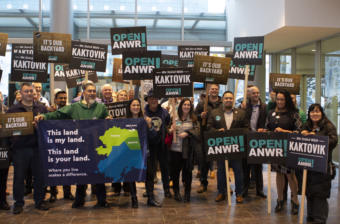
Arctic Slope Regional Corp. leaders and supporters held a press conference outside an Anchorage public meeting on oil leasing in the Arctic National Wildlife Refuge on Feb. 11, 2019. (Photo by Elizabeth Harball/Alaska’s Energy Desk)

The Alaska Native regional corporation for the North Slope collected $22.5 million from a pair of oil companies after Congress opened the Arctic National Wildlife Refuge’s coastal plain to drilling in 2017, according to corporate documents.

Arctic Slope Regional Corp., whose 13,000 Alaska Native shareholders own the oil rights to 140 square miles along the coastal plain, has long been one of the most aggressive advocates for opening the refuge to oil development. The payment, referenced in ASRC’s latest annual report, underscores just how much the corporation had to gain from the congressional action. It stands to benefit further if the oil companies, BP and Chevron, ultimately find and produce petroleum on its property.

ASRC’s 92,000 acres, along with the 1.6 million acres of federal lands in the coastal plain, were all off-limits to drilling until late 2017, when Congress passed the tax overhaul that opened the area to development. ASRC previously confirmed that a payment had been made under an existing, decades-old lease agreement with the oil companies, but it declined to reveal the amount.

ASRC is the largest Alaska-owned business, with annual revenues exceeding $3 billion and more than 15,000 employees inside and outside the state.

The corporation is heavily invested in oil and gas, with its own refineries and an oil-field services business; it also collects royalties from oil production on some of its lands outside the Arctic Refuge.

Those holdings have proven valuable to its owners: ASRC’s most recent annual dividend was $7,000 for each shareholder with the standard 100 shares. But the corporation’s pro-development position has recently caused tensions with other Alaska Native groups, whose members say they’re threatened by global warming. And ASRC recently withdrew its membership from the Alaska Federation of Natives.

ASRC spokesperson Ty Hardt declined to comment on the payment from the two oil companies. A Chevron spokesperson, Veronica Flores-Paniagua, and a BP spokesperson, Meg Baldino, each confirmed that the payment had been made, but declined to comment further. Officials at Hilcorp, which is acquiring BP’s stake in the Arctic Refuge lease in a pending business deal, declined to comment.

ASRC’s shareholders are descendants of the Iñupiat people who originally inhabited the North Slope, and the corporation acquired roughly 5 million acres of land through the 1971 Alaska Native Claims Settlement Act. The act granted a dozen Alaska Native regional corporations a total of $960 million and 44 million acres, or a little more than 10% of the state’s total area. In exchange, Alaska Native groups set aside their aboriginal land claims, which had delayed construction of the trans-Alaska oil pipeline.

When the act passed, ASRC was barred from claiming potentially valuable oil-bearing lands in the Arctic Refuge and the National Petroleum Reserve in Alaska, because those areas had already been set aside by the federal government. But a decade later, ASRC struck a deal with President Ronald Reagan’s administration to trade 101,000 acres of the corporation’s land within Gates of the Arctic National Park for 92,000 acres of subsurface rights within the refuge — around the village of Kaktovik.

The land trade set the stage for a 1984 lease between ASRC, BP and Chevron, and it also gave them the right to drill the only exploratory test well ever placed in the Arctic Refuge. The results from the well are still one of the oil industry’s most tightly-guarded secrets, though a New York Times report last year suggested that they were not promising.

After the well was drilled, both the corporate and federal lands along the coastal plain remained closed to actual oil production until Congress’ 2017 vote. ASRC had allowed Chevron and BP to suspend their lease payments while the closure remained in place, said Teresa Imm, an ASRC resource development executive, in an interview last year.

ASRC was a major participant in the lobbying campaign to open the refuge to oil development, nearly doubling its federal lobbyist spending in 2017 to $590,000, according to figures compiled by the Center for American Progress, a Washington, D.C.-based liberal advocacy group.

ASRC’s lands along the coastal plain are far from existing oil infrastructure, meaning development there could still be decades away. But drilling opponents are already questioning how the ASRC-controlled area fits into the Trump administration’s plans to open the refuge’s federal lands to development, and they want to know what environmental safeguards will apply.

“ASRC lands potentially being open to oil and gas is a major change in private land use that must be clearly addressed,” a coalition of more than two dozen opponents wrote in a March comment letter to the Bureau of Land Management, which is leading the environmental review in advance of drilling in the refuge. The groups added: “BLM must be clear on this point.”

BLM officials pointed to the agency’s written response to the letter, which was published as part of a 2,100-page document that addressed the thousands of unique public comments on the Trump administration’s draft environmental review.

That review, BLM wrote, “is not intended to address ASRC’s management of oil and gas exploration and development on its lands.” Restrictions and environmental safeguards adopted by BLM, the agency added, “will only apply on federal lands within the coastal plain.”

Any development on ASRC’s land would still have to comply with national environmental laws like the Clean Water Act and Marine Mammal Protection Act, which could trigger permitting and other requirements for individual projects. And the 1983 land trade also gave the U.S. Fish and Wildlife Service authority to review proposed oil development on ASRC lands, and includes a list of specific environmental safeguards that companies must follow.

As Alaska warms, residents of its biggest city adjust to winters defined by ice as much as snow

High school skiers compete in the annual Lynx Loppet race at Kincaid Park in Anchorage in December, 2019. The park has 30 miles of trails, but competitors were limited to a one-mile loop of manmade snow. (Photo by Nat Herz/Alaska’s Energy Desk)

The Lynx Loppet is a staple event on Southcentral Alaska’s high school cross-country ski racing circuit.

Teams drive hours to compete at Anchorage’s Kincaid Park, a near-wilderness setting packed with moose and traversed by 30 miles of ski trails.

Except by mid-December, when the race took place, most of the city’s snow had melted, leaving behind a messy mix of ice and grit. Hundreds of racers took turns skiing around a mile-long loop of manmade snow that one finisher, Max Beiergrohslein of Chugiak, called a “gerbil loop.” He and his teammates warmed up for their race not by skiing but by jogging around bare areas next to the course.

“It’s not the best, going to bed at night thinking, ‘Oh, there’s not going to be snow tomorrow’,” Beiergrohslein said after finishing fourth. But, he added “Normal now is kind of like this: On again, off again, there is snow and then there isn’t.”

For many in Anchorage, winter and its accompanying outdoor opportunities are something to relish rather than escape. But as Alaska’s fast-warming climate starts to disrupt typical seasonal patterns, residents of the state’s largest city are being forced to renegotiate their relationship with winters that now seem defined by ice as much as snow.
An elementary school principal has suggested that students wear helmets at recess, to keep them safe on an icy playground. Anchorage’s street maintenance department recently started using salt, along with sand, to help clear certain roads. And the Assembly earlier this month voted to shorten, by two weeks, the season in which Anchorage drivers are allowed to use studded tires.

Though temperatures have dipped sharply in the past week, Anchorage is still certain to experience its warmest year on record. And Alaska is warming at twice the rate of the global average, according to last year’s National Climate Assessment.

Scientists are now researching how much of a change there’s been in what are known as “rain on snow” events, which create ice — and they’ll use that data to predict what may happen in the future. But they already know that it’s staying warmer later into the fall and taking longer for snow to build up.

On average, the first autumn week to average below 25 degrees has pushed 12 days later since the 1950s, from early to mid-November, according to the Alaska Center for Climate Assessment and Policy (ACCAP).

“These kind of poor snow years we would expect, in a warming climate, to become much more common,” said Rick Thoman, an ACCAP climatologist.

One caveat to that idea is that warmer air holds more moisture, which could actually allow for more snow during the coldest parts of winter. That means Anchorage’s total winter snowfall may not end up being that much less — it just could fall during a more compressed season, Thoman said.

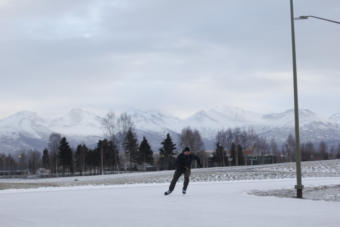
John Blees skates around a speedskating loop in Midtown Anchorage in December, 2019. Sports that require less snow, like ice skating and fat-tire bicycling, have become increasingly popular in the city as its climate changes. (Photo by Nat Herz/Alaska’s Energy Desk)

While the changing conditions have made it more challenging, Anchorage residents are still finding ways to preserve their winter-based connections to the outdoors. The city is seeing a boom in winter activities that require less snow, like fat-tire bicycling. Backcountry ice skating, where people traverse ice on remote lakes and creeks, has also become increasingly popular.

“We’re not seeing more people waiting for winter to end so that they can do their summer activities,” said Brian Brettschneider, an Anchorage-based climatologist with the International Arctic Research Center. “They still want to do their winter activities, because winter is part of the core identity of Alaska.”

Less early-season snowfall can actually allow thicker ice to form on lakes, according to Brettschneider, since snow, when it does fall, insulates the water from colder temperatures.

“It’s kind of a paradox,” he said. “Our warmest, least-snowy winters tend to be our best backcountry ice skating winters.”

Runners are adjusting, too. Earlier this month at Skinny Raven Sports, a downtown Anchorage running store, John Clark demonstrated how employees drill short, hardened screws into the soles of sneakers — a cheap way to get better traction on icy streets and trails. The store orders 30,000 screws a year, enough for more than 1,000 pairs of shoes.

For customers willing to spend more money, Skinny Raven stocks a dozen different types of shoes and boots with studs already built-in, with names like “Icebugs” and the “Spikecross 5.”

As Anchorage’s winters have changed, demand for those shoes has increased and the store now sells more than 1,000 a year, up from several hundred a decade ago, Clark said — though he added that some of the increase stems from improvements in the shoes’ technology.

John Clark, purchasing manager at Skinny Raven Sports in downtown Anchorage, poses for a photo with a running shoe that he’s drilled hardened screws into, to help boost traction on icy trails and streets. (Photo by Nat Herz/Alaska’s Energy Desk)

“We’re just trying to find ways to make it easier for people to enjoy the winter,” he said.

Until this week, the conditions were particularly challenging for Anchorage’s cross-country skiers, who saw a record-high snowfall and temperature for the same mid-November day (8.4 inches and 45 degrees), followed by a thaw that left trails largely bare of snow for more than a month.

Beiergrohslein, the high school skier, is from Chugiak, where there’s no manmade snow, so his team has been driving 40 minutes a few days a week to find usable trails at Kincaid Park or Hatcher Pass. They’ve also been running, which is “not fun,” Beiergrohslein said.

But the team is still growing, rather than diminishing, he added.

“When we were first having bad snow years, a lot of people would quit,” Beiergrohslein said. “But now, it’s kind of all they know.”

Not everyone in Anchorage has reached the acceptance phase, however. Brettschneider, the local climatologist, is also an avid winter hiker and ice skater, and he said he’s still hoping that the warming trend can be stemmed. He’s affixed a “make Alaska cold again” slogan to the top of his Twitter page, and he said he and his family have taken steps to curb their emissions.

Alaska, he said, is very different from Outside, where people may not be as enthusiastic about cold temperatures or snow.

“We want the cold,” Brettschneider said.

“Everyone wants winter here in Alaska,” he added. “Because if you have enough winters where it’s not really winter, then you’re not going to have Alaska anymore.”

Polar bear protections delayed oil exploration in the Arctic Refuge. A new study could help.

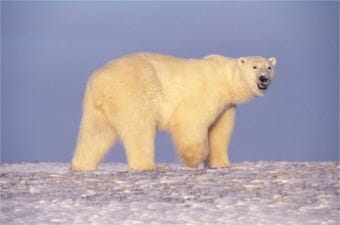
A polar bear in Arctic Alaska. Subsistence harvest levels of Chukchi Sea polar bears have just been raised, based on new data about the population’s health. (Photo Credit: Terry Debruyne/USFWS)

Last year, a company asked the Trump administration for permission to take the first steps toward oil drilling in the Arctic National Wildlife Refuge: running a convoy of special oil-detecting trucks along the refuge’s coastal plain, to determine how much petroleum lies below.

But the Trump administration never gave the go-ahead, with the U.S. Fish and Wildlife Service saying that the initial proposal didn’t comply with federal rules under the Marine Mammal Protection Act. That rule limits harm to polar bears, which are listed as threatened under the Endangered Species Act. A government shutdown also delayed work on the application from the company, Houston-based SAExploration, which has never said publicly exactly why the project did not move ahead.

Now, a newly-published study by the Fish and Wildlife Service and the U.S. Geological Survey shows what kinds of precautions companies could take to obtain federal approval to explore for oil in sensitive polar bear habitat. By using heat-sensing cameras to detect dens, and accepting strict limits on when to survey specific areas of the coastal plain, the study says that polar bear disturbance can be dramatically reduced – from as many as eight dens if no restrictions are applied, to one or less using the most conservative approach.

“A carefully-designed survey can reduce your potential impacts to the bears pretty far – to the point where you might be getting to a place where you may be able to meet determinations under the Marine Mammal Protection Act,” said Ryan Wilson, a Fish and Wildlife Service polar bear biologist and one of the two authors of the study, published in the Journal of Wildlife Management.

The study offers a window into the push and pull between the competing stakeholders and statutes that are shaping the future of the Arctic Refuge – the top Trump administration appointees and oil industry pushing to access the coastal plain after Congress passed a law opening the area to drilling in 2017, the environmental organizations fighting them and the Fish and Wildlife Service employees charged with enforcing the Marine Mammal Protection Act, which was enacted in 1972.

Wilson once worked for an environmental organization, The Wilderness Society, and he said in an interview that the study was not influenced by Trump administration political appointees, who have pushed to expand oil development across Alaska’s North Slope.

Ryan Wilson, a biologist with the U.S. Fish and Wildlife Service, poses for a photo in his Anchorage office. A polar bear skull sits on the shelf behind him. (Photo by Nat Herz/Alaska’s Energy Desk)

The study’s findings offer a basic blueprint for how the oil industry might move forward with what’s known as a seismic survey across the coastal plain. But, they do not equate to authorization or approval for a specific project.

An Anchorage-based official with one environmental group, Defenders of Wildlife, noted that such a survey is only an initial phase of oil development. If the results are promising, companies would move ahead with test wells and then permanent infrastructure, which would bring additional impacts. And even with the precautions suggested by the study, the survey’s risk of disturbing polar bears would not be reduced to zero, said Defenders of Wildlife’s senior Alaska representative Pat Lavin.

“Even with extensive restrictions and making favorable assumptions about the impacts that would follow, the risk of injury or death to polar bears cannot be eliminated,” Lavin said. “And that’s without building anything.”

The study grew out of the 2018 proposal from SAExploration, which specializes in seismic surveys. The company, working with three Alaska-based Native corporations, wanted to run its survey across the entire coastal plain, with its dozen trucks running along grid lines spaced 200 meters apart.

The effort would have run 24 hours a day, supported by dozens of additional vehicles and at least one camp that would accommodate 150 people.

Those plans were complicated by the Southern Beaufort Sea population of polar bears, which number about 900 and are vulnerable to declining sea ice caused by global warming.

The Marine Mammal Protection Act bars disturbances to polar bears and other species, but it allows the Fish and Wildlife Service to authorize occasional incidental impacts, including in cases where development has a “negligible impact” on a population. One metric commonly used by the federal government is known as “potential biological removal,” and using that measure, Alaska Natives’ annual subsistence harvest – which has a higher priority under the act – already exceeds that level for the Southern Beaufort Sea bears. And that means that the Fish and Wildlife Service has little wiggle room to authorize accidental impacts on the bears from oil exploration.

That dynamic creates complications for companies like SAExploration.

The oil industry does its exploration work during the winter, when its vehicles won’t damage the Arctic tundra – and that’s the same season in which polar bears den. Disturbances can make it less likely for cubs to survive, since they can be exposed to the Arctic winter if they leave their dens, or use more energy if they stay.

The new study assumes that just 20 dens will be scattered across the entire coastal plain in a given winter. But the Fish and Wildlife Service assumes that industry activity within a mile could cause a disturbance, creating potential conflicts for every den, given SAExploration’s proposal to run its trucks along grid lines separated by just 200 meters.

Wilson was working with the Fish and Wildlife Service to analyze SAExploration’s initial survey plans, and determined its impacts would likely be too big to comply with the Marine Mammal Protection Act’s restrictions, he said. But through discussions with company officials, he added, they developed a revised plan, in which earlier in the winter, when cubs would be more likely to remain inside their dens, SAExploration would avoid areas with denser dens.

To help assess the impacts of the different plans, Wilson created a computer model, which is the basis for the newly-published study, co-authored by George Durner, an Anchorage-based zoologist for the USGS.

The study looked at five different types of proposed surveys, with different timing and area limitations like the ones contemplated by Wilson and SAExploration, and it used the computer model to run 1,000 different simulations of each one. It also assessed how the use of the heat-sensing cameras, to detect heat rising from polar bear dens, could help reduce impacts.

Wilson demonstrates the model that formed the basis for his recent paper in the Journal of Wildlife Management. (Photo by Nat Herz/Alaska’s Energy Desk)

Without the heat-sensing cameras or any restrictions on the time and space of the survey, the study predicted that industry activity would cross the one-mile threshold of roughly eight dens before the bears had emerged – though that number fell to roughly 2.5 dens if companies used the heat-sensing technology.

The most restrictive plan, by contrast, divided the survey area in 28 different blocks, then set specific dates when the work could begin for each one, leaving the most important denning areas until later in the winter. It also split the survey into two years, allowing the work to start later in the winter and reducing the likelihood of encountering a den with bears still in it.

The study predicted that with those limitations, the survey would impact, on average, 0.5 dens – and using the heat-sensing technology reduces that to 0.2.

Wilson reiterated that those findings do not necessarily mean that a proposal incorporating those timing and area restrictions will necessarily be approved by the Fish and Wildlife Service.

“It’s not making judgment calls or anything,” he said. “It’s trying to help inform decision-makers, applicants and the general public about what we need to be considering if if we really are going to try to find this balance between development and conservation of polar bears.”

One big question that the study leaves unanswered is whether agreeing to the timing and area limits would make the seismic survey too expensive, or logistically complex, for the oil industry to undertake. SAExploration officials declined to comment, and Kara Moriarty, the head of the Alaska Oil and Gas Association, said she did not want to speculate.

Moriarty’s group, which advocates on the oil industry’s behalf, supports using the “best available science” to minimize impacts on wildlife, she said.

But she also argued that the study gives a kind of “worst-case scenario” look at development – and that companies would likely take precautions to reduce risks below the levels the study assumes.

“We do have really good management techniques at play now, and that are effective at identifying, mitigating, minimizing any type of impact to the bear,” she said. “Because that’s the last thing we want.”

There’s no seismic work planned inside the refuge this winter. But it’s likely that new surveys will be proposed after the federal government holds its first lease sale for the coastal plain, which is expected some time in 2020.

Longstanding tensions underlie Arctic Slope Regional Corporation’s withdrawal from AFN

The Arctic Slope Regional Corporation’s corporate headquarters in Utqiaġvik, Alaska. January, 2018. The corporation announced its withdrawal from the Alaska Federation of Natives in December, 2019. (Ravenna Koenig/ Alaska’s Energy Desk).

Long before Arctic Slope Regional Corporation (ASRC) announced its withdrawal from the Alaska Federation of Natives (AFN) last week, there were signs of a schism between Alaska’s largest Native corporation and most influential Native advocacy group.
At the center of it: oil, ASRC’s responsibilities to its shareholders, AFN’s wider responsibilities to its member groups and growing pressure caused by climate change’s impacts on infrastructure and subsistence.

Tensions between ASRC and AFN appeared to be building in recent years. In a hard-fought U.S. Senate race in 2014, AFN took the rare step of endorsing a candidate: incumbent Democrat Mark Begich, who delegates praised for his connection to rural Alaska and his support for Natives’ subsistence traditions.

Board members of ASRC, meanwhile, endorsed Begich’s Republican opponent, Dan Sullivan, citing his support for “responsible energy development.” And while AFN endorsed Democrat Hillary Clinton in 2016, ASRC’s executives celebrated at the Trump White House a year later, after Congress approved the legislation opening part of the Arctic National Wildlife Refuge to oil development.

ASRC is charged with representing the business interests of some 13,000 Inupiat shareholders. It explained its withdrawal from AFN last week by saying only that the corporation intends to focus on the needs of the North Slope. An ASRC spokesman, Ty Hardt, declined to be interviewed or answer questions about the decision.

Since the corporation’s announcement, some have speculated that the split stems from AFN’s convention in October, where an ASRC leader clashed with delegates who were pushing for more action on climate change.

But ASRC says the decision was under consideration for more than a year. And in fact, North Slope Native organizations have long had a fraught relationship with AFN, stemming in part from members’ unique homeland, which lies atop billions of barrels of oil.

A more complete explanation of ASRC’s decision, according to people who have worked with the corporation, is that global warming has put new pressure on the existing fault lines among the different institutions that look out for Alaska Natives’ well-being.

Alaska’s 12 regional corporations, including ASRC, are big for-profit businesses, with a relatively narrow focus on generating revenue to support cash dividend payments to shareholders. Tribal governments and nonprofits, meanwhile, are more focused on providing services and supporting Natives’ social welfare.

Climate change threatens to pit those interests against each other in new ways. Tribal governments and nonprofits say they’re being saddled with climate change’s costly impacts, while some regional corporation leaders see greenhouse gas regulations as a potential threat to their bottom line.

“On one side, you have monetary impact, and on the other side you have even greater impact on the planet itself,” said Roy Huhndorf, the former chief executive for Cook Inlet Region Inc., the Native regional corporation for Southcentral Alaska.

“I think Native corporations are the same, in a microcosm, as the Exxons and BP’s of the rest of the world who don’t want to abandon oil production now because it hurts them financially,” he said. “On the other hand, you can understand where the rest of the world is wanting to go.”

Native corporations are some of Alaska’s largest and most influential businesses, with ASRC at the top of the heap.

ASRC’s revenues last year exceeded $3 billion, with dividends of $7,000 paid to each shareholder with 100 shares, according to the corporation’s annual report. It has more than 13,000 employees spread across Alaska and beyond, working in six major areas of business.

Among ASRC’s holdings is PetroStar, which owns oil refineries in Valdez, and near Fairbanks in North Pole. It sold a record 356 million gallons of oil products last year and generated $885 million in revenue. ASRC also owns an oilfield services company, with more than 2,300 workers in Alaska, that does engineering, construction and permitting for some of the world’s largest oil and gas companies, in both Alaska and the Gulf of Mexico.

The corporation also benefits directly from oil development on its own land entitlement of nearly 5 million acres on the North Slope — an area almost the size of New Jersey. It collects royalties from oil production in the Colville River Unit, home of ConocoPhillips’ Alpine field, and reported natural resource earnings averaging $50 million a year over the past three years.

ConocoPhillips’ Alpine facility on the North Slope. Conoco’s Scott Jepsen said a new processing facility in NPR-A would be about the same size. (Photo by Elizabeth Harball/AED)
ConocoPhillips’ Alpine facility on the North Slope, which pays oil royalties to Arctic Slope Regional Corp. (Photo by Elizabeth Harball/Alaska’s Energy Desk)

At AFN’s convention in October, when two teenage delegates were pushing for approval of a statement declaring an emergency on climate change, ASRC’s board chair, Crawford Patkotak, pushed back. He asked to add language to preserve Natives’ “rights to the resources,” saying that the declaration risked inviting “unnecessary regulation” with devastating economic effects.

Patkotak wasn’t the only regional corporation leader who was concerned: Gail Schubert, chief executive of the Nome-based Bering Straits Native Corp., also urged delegates to be cautious. Native corporations, she said, “were charged with creating economies, delivering dividends and other benefits to our shareholders.”

“I understand and accept and have said publicly that we are experiencing climate change,” Schubert said. “But I also want to make sure that we don’t do something, as a body, that allows outside groups to come in and basically dictate what we can do and can’t do in terms of both our natural and our subsistence resources.”

Several other delegates argued against Patkotak’s proposed language before it was rejected, including Esau Sinnock, a young man from the village of Shishmaref, on the Chukchi Sea coast in western Alaska. Rising sea levels are forcing residents there to consider relocation.

“My one and only home is being eaten by the sea,” Sinnock said. “It’s very important to talk about climate change urgently, right now, because it affects so many indigenous people.”

Diverging interests among regional corporations like ASRC and other Native organizations are not new — they date back to the 1971 Alaska Native Claims Settlement Act, which created the corporations.

But in addition to those institutional fissures, the North Slope is also unique as a region. When AFN voted overwhelmingly to urge President Richard Nixon to sign the 1971 legislation, representatives of the Arctic Slope Native Association vehemently disagreed.

They objected to the settlement because it allowed the state of Alaska — not ASRC — to keep the North Slope’s most valuable oil-bearing lands. And it also required ASRC to share its oil revenues with other regional corporations, though those other corporations would also have to share their resource revenue with ASRC.

“They’ve got a righteous argument in saying they should have been able to select lands that they traditionally used ahead of the state, but they weren’t — the state had already finished selecting the land by the time ASRC had come into existence,” said Huhndorf, the former CIRI executive. “They feel that they were used from all sides.”

ASRC, in its announcement last week, said it intends to focus “on the various needs within Alaska’s North Slope, where there is an increased degree of alignment as well as additional efficiencies related to shared geography and other interests.”

The corporation’s perspective won’t be completely lost from AFN, because some of the corporation’s shareholders will still belong to the federation, as delegates from the North Slope’s regional nonprofit, village corporations and tribal councils.

“They’re still Native people, so it doesn’t end cooperation and talking or working together on things,” said Julie Kitka, AFN’s president. “We don’t second guess them, we don’t attribute motives to them — we take them at face value.”

Karlin Itchoak, an ASRC shareholder who directs the Anchorage office of The Wilderness Society, an environmental organization, said that the urgent challenge posed by climate change makes it an especially important time for Alaska Native organizations to work together.

“Stopping all dialogue at AFN is not being a part of the solution,” he said. “It would be better if folks could just get along and work together and agree to disagree. Stay at the table and continue to have a dialogue on how we can mitigate the adverse environmental impacts of climate change that are directly related to extraction.”

No corporation goes forward with development without considering the environmental consequences and impacts on villages — and without doing everything possible to make sure it’s safe, said Georgianna Lincoln, a board member of Doyon Ltd., the regional corporation for Interior Alaska.

But the debate around climate change will “absolutely” force other Native corporation boards to have similar conversations to the one ASRC’s must have had before its decision to withdraw from AFN, she added.

“We have to reassess where we are,” Lincoln said, “because times have changed.”

Alaska utility regulators ask Hilcorp, BP for more details on $5.6B deal

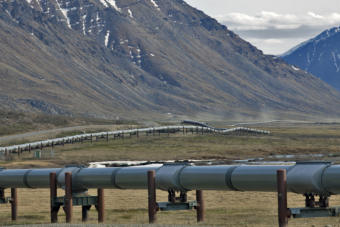
An above-ground section of the Trans-Alaska Pipeline System near the Toolik Lake Research Station in the North Slope Borough. (Photo by Rashah McChesney/Alaska's Energy Desk)
An above-ground section of the Trans-Alaska Pipeline System near the Toolik Field Station in the North Slope Borough. BP is seeking to sell its 48 percent stake in the pipeline, along with its other Alaska assets, to the privately-owned oil company, Hilcorp. (Photo by Rashah McChesney/Alaska’s Energy Desk)

The state agency overseeing BP’s proposed sale of its Alaska oil assets to independent company Hilcorp wants more information from the two companies about their $5.6 billion deal.

The Regulatory Commission of Alaska, which regulates the state’s public utilities and pipelines, issued a two-page, unsigned order Thursday that asks the companies for five new sets of documents. They include the purchase and sale agreement, charts detailing the companies’ corporate ownership and operating structures, and additional financial statements.

Hilcorp has already filed financial statements for the company that handles its Alaska operations, Hilcorp Alaska. But the RCA is now asking for the statements of its larger affiliate, Texas-based Hilcorp Energy Company, along with more information from BP.

BP spokeswoman Meg Baldino said the company would comply with the request. Hilcorp representatives did not respond to a request for comment.

Hilcorp is privately-owned, and it’s asked the RCA for permission to keep its previously filed financial statements confidential. The RCA has not yet ruled on that request, and some public interest advocates and groups have asked the RCA to require disclosure.

The companies are asking the RCA to approve BP’s transfer to Hilcorp of its “certificate of public convenience and necessity,” and its 48 percent interest in the trans-Alaska pipeline system. They’re also asking the RCA to issue an order finding the transfer of the pipeline to be in the public’s best interest.

A Colorado wildcatter found a huge new North Slope oil field. Now it’s buying up new federal leases in Alaska.


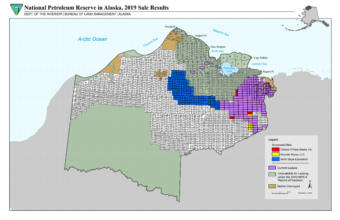
A map of the Dec. 11, 2019, lease sale shows North Slope Exploration’s winning bids, in blue. (Courtesy Bureau of Land Management)

Armstrong Oil and Gas, the Denver-based independent oil company, is pushing into a big new swath of federal oil leases on the North Slope, after making one of Alaska’s biggest discoveries in years.

North Slope Exploration, a newly-formed company managed by Armstrong, was the biggest bidder in a federal lease sale Wednesday in the National Petroleum Reserve in Alaska, the Indiana-sized area west of Prudhoe Bay.

North Slope Exploration bid roughly $10.5 million to win more than 80 leases in a swath across the middle of the reserve. They total roughly 1 million acres, an area larger than the state of Rhode Island.

ConocoPhillips and another company, Emerald House, each bid on a few more tracts. The total area bid on by companies was the most since 2004.

Critics blasted the sale as a “carbon bomb” that would worsen global warming while granting companies cheap access to federal resources. But President Donald Trump’s administration, which has pushed aggressively to increase oil production on the North Slope, praised the results.

“This, we believe, reflects the continuing interest in developing resources in the largest single block of federally-managed lands in the United States,” said Ted Murphy, a top Alaska official with the Bureau of Land Management, which conducted the lease sale.

The reserve had been neglected by industry for years until a pair of major new discoveries were announced in 2017 in a rock formation, the Nanushuk, that extends across the reserve. Companies had drilled dozens of wells into the Nanushuk but largely missed its potential until those two fields were found — one by ConocoPhillips that it’s calling Willow, and another by Armstrong known as Pikka.

The search for Pikka was recounted in a recent Wall Street Journal profile of the company’s chief executive, Bill Armstrong, which described him as the last of a dying breed — one of the “wildcatters” who search for new and undiscovered oil fields.

Bill Armstrong, president and CEO of Armstrong Oil and Gas, testifies at a state legislative hearing in 2016. (Photo by Skip Gray/360 North)

While wildcatters were the “longtime stars” of the industry, today’s oil companies are now spending less on exploration and are discovering fewer new deposits, the profile said. It labeled Armstrong “the last prospector” — a quirky Texan who wears jeans and Armani shirts, and dribbles a basketball around an indoor court in his Denver office. He sold his stake in the Pikka field for $850 million to a Papua New Guinea company, Oil Search, that’s now trying to bring the project into production.

Pikka is projected to produce up to 120,000 barrels of oil a day, or about one-fourth of the trans-Alaska pipeline’s current flow.

Armstrong didn’t respond to a request for comment Wednesday.

Trump administration critics quickly attacked the lease sale results on both environmental and fiscal grounds. The left-leaning, D.C.-based Center for American Progress noted that Alaska is already the country’s fastest warming state, and pointed out that the leases were sold for an average of roughly $11 an acre.

“Oil speculators are getting a sweetheart deal and taxpayers are getting the shaft,” Senior Fellow Matt Lee-Ashley, who worked in the U.S. Interior Department during the Obama administration, said in a statement. “Today’s bargain basement lease sale is just the latest example of the Trump Administration selling off America’s public lands for pennies on the dollar.”

Lee-Ashley also noted that the bid amounts undercut predictions about how much oil revenue will come from development in the Arctic National Wildlife Refuge, to the east.

When lawmakers passed the 2017 tax reform package that opened the refuge’s coastal plain to development, the Congressional Budget Office said it expected $1.8 billion in gross revenue from leasing over the following decade.

With roughly 1.6 million acres available for leasing, as the Trump administration has tentatively proposed, meeting the CBO’s projections would require the average price per acre to exceed $1,000.

Site notifications
Update notification options
Subscribe to notifications