Nat Herz, Alaska Public Media

Alaska state lawmaker wants to name new icebreaker ‘Polar Bear’

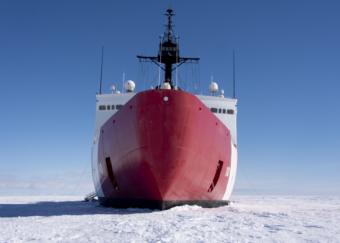
The Coast Guard Cutter Polar Star in fast ice on Jan. 2, approximately 20 miles north of McMurdo Station, Antarctica. (Public domain photo by Senior Chief Petty Officer NyxoLyno Cangemi/U.S. Coast Guard)

An Alaska state representative wants the federal government to name one of its new polar icebreakers the Polar Bear.

Chris Tuck, an Anchorage Democrat, introduced a formal resolution Monday calling on U.S. Coast Guard to use the name, which would honor the historic Revenue Cutter Bear. That’s a renowned ship that served in both world wars and once spared hundreds of iced-in whalers from starvation when their vessels became marooned off Alaska’s northern coast.

One of the reasons Tuck knows the history is because he once claimed a picture of the original Bear when it was being removed from the Capitol’s legislators-only cafeteria.

View of the USS Bear in the Antarctic , circa 1933-1935. (Public domain photo)

“I have the thing hanging in my office all this time. So the Bear stares at me,” Tuck said. “So it was knowing that we were having some new icebreakers on the way that I thought, ‘You know what? What better way of honoring the Bear?’” he said.

The Coast Guard is building three new polar security cutters — their term for heavy icebreakers. In April, the federal government awarded a $750 million contract for the first one’s construction to a shipyard in Mississippi.

The Coast Guard’s current icebreaking fleet consists of two vessels: a heavy icebreaker called the Polar Star and a medium icebreaker called the Healy. There’s a second heavy icebreaker called the Polar Sea, but both it and the Polar Star were built in the 1970s and are well beyond their expected lifespans — the Polar Sea broke down in 2010 and has since been used for spare parts.

The U.S. has begun playing catch-up to Arctic rivals that have far bigger icebreaking fleets. Russia, for example, has at least 46, several of which are nuclear powered. Finland has 10 and Canada has seven.

Correction: The Healy came online in the 1990s, not the 1970s, as this story initially said.


Anxiety creeps into oil-dependent Alaska as banks step back from Arctic investment

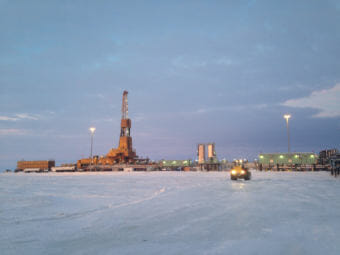
A ConocoPhillips drill site within the National Petroleum Reserve in Alaska in January 2017. (Photo by Elizabeth Harball/Alaska’s Energy Desk)

As he pitches a new North Slope liquefied natural gas project to investors, Mead Treadwell, the businessman and former Alaska lieutenant governor, is keenly aware of his project’s location.

Development in the Arctic is booming as the global climate warms and ice melts. But environmental opposition has come along with it, making some big banks more reticent about investing.

Barclays and Goldman Sachs, for example, have effectively ruled out investments in new Arctic oil and gas projects, after environmentalists raised concerns about impacts on ecosystems, indigenous people and the global climate.

Many other investors remain. But an aggressive advocacy campaign against their involvement in Arctic oil means that Treadwell’s company, Qilak LNG, and others like it face more obstacles to raise the cash they need.

Qilak has adapted to this new investment climate by playing up the fact that its LNG project would connect to infrastructure that already largely exists on the North Slope — not to new oil fields, which conservation groups say would extend the world’s dependence on climate-warming fossil fuels.

Qilak is also making the case that LNG often displaces dirty coal-fired power plants, though the environmental benefits of that change are disputed by some scientists. And it’s highlighting the jobs the project would create for indigenous residents of the North Slope and other areas of Alaska.

Mead Treadwell says he would draw from his business and government experience if he's elected governor. (Photo by Wesley Early/Alaska Public Media)
Mead Treadwell. (Photo by Wesley Early/Alaska Public Media)

“I still believe that we will have billions of dollars in annual investment in the Arctic. But I will say that we’re an easier target, because it’s easier to show up at an annual meeting in some place like London or Brussels wearing a polar bear suit — there’s not a similar symbol for Louisiana or Texas,” Treadwell said. “We definitely have to be aware of that, and make sure we’ve got a good story.”

Alaska’s economy is driven by the production of the fossil fuels that contribute to global warming, which makes the state especially vulnerable to the campaign to transition away from oil. And Alaska policymakers and oil executives say they’re getting increasingly concerned as advocates turn their focus to forcing big financial institutions out of the industry.

The movement has been targeting Arctic oil and gas projects in particular, with groups arguing that development in the area poses unique environmental and social risks. The release of Goldman Sachs’ new environmental policy in December — which said the bank would refuse to finance drilling in the Arctic National Wildlife Refuge and elsewhere in the Arctic — underscored the stakes for Alaska. But the campaign doesn’t end there.

Last month, 15 Democratic U.S. senators wrote to 11 more banks asking them to follow Goldman’s lead by “shifting toward a U.S. financial sector that effectively analyzes and plans for climate risks.”

A similar letter followed Thursday from more than two-dozen House Democrats. On Friday, environmental organizations touted a new policy released by a big British bank, Lloyds Bank, that rules out financing of oil and gas exploration and production in the Arctic, and in the Arctic Refuge in particular.

On Tuesday, megabank JPMorgan Chase was set to announce its own restrictions on investment in Arctic drilling.

Andy Mack DNR Commissioner
Former Alaska Natural Resources Commissioner Andy Mack at a press conference in Anchorage on June 28, 2016. (Photo by Graelyn Brashear/Alaska Public Media)

“One position by one large company I don’t think changes a lot,” said Andy Mack, a former Alaska natural resources commissioner who helped lead the state’s push to open the Arctic Refuge to drilling. “But if you see two or three or four large companies make these types of announcements, it’s certainly something that (oil) companies will all have to take into account. And that’s why the state needs to pay attention.”

Several big Arctic oil projects are still under development on Alaska’s North Slope. But there’s a growing acknowledgment among Alaska oil industry players that environmentalists’ lobbying of financial institutions is having an effect.

“‘Arctic’ seems to have turned into a four-letter word, in the minds of a lot of these financial institutions,” said an Alaska oil executive, who asked not to be named to avoid drawing attention to his particular company.

To understand the anti-Arctic campaign’s challenge to Alaska’s oil industry, residents can look to Alberta. There, financial institutions and major insurers have distanced themselves from projects in the province’s oil sands.

One reason environmental advocates have focused their opposition on Alberta is that historically, extraction from oil sands generated more greenhouse gases than conventional oil production.

Earlier this month, BlackRock, the world’s largest asset manager, announced it would exclude companies with oil sands projects from a fast-growing, sustainability-oriented fund that it runs.

In December, The Hartford, a major insurer, said it would stop investing in and insuring companies that generate a large share of their revenues from tar sands.

Alaskans who follow the oil industry have noticed.

“Alberta is the canary in the coal mine,” said Brad Keithley, a retired oil and gas attorney who closely watches Alaska politics.

Alberta’s premier, Jason Kenney, has responded forcefully, launching a $30 million “energy war room” to rebut criticism of Canada’s oil industry.

Gov. Mike Dunleavy, R-Alaska, speaks to reporters in the Capitol in Juneau, Jan. 31, 2020. (Photo by Andrew Kitchenman/KTOO and Alaska Public Media)
Gov. Mike Dunleavy speaks to reporters in the Capitol in Juneau, Jan. 31. (Photo by Andrew Kitchenman/KTOO and Alaska Public Media)

In Alaska, Gov. Mike Dunleavy reacted to Goldman Sachs’ announcement by firing the company from a group of Wall Street firms it had chosen to help the state borrow money. The decision could cost Goldman Sachs between $200,000 and $300,000 in compensation, state officials said.

In an interview, Dunleavy suggested another way to punish banks that refuse to invest in Alaska oil projects: cutting them off from managing the assets of the $67 billion, state-owned Alaska Permanent Fund, which was originally created with oil revenue. Goldman Sachs manages some $400 million for the fund, which paid the firm a total of $17 million in fees over the past three years.

“Some of these groups that don’t want to do business in Alaska still want Alaska business,” Dunleavy said. “They probably are going to come out a loser on that one.”

The Alaska Permanent Fund is run by an independent board. Earlier this month, Chair Craig Richards said board members were not interested in making its choices of investment managers subject to political considerations.

But Dunleavy said he thinks the subject will be unavoidable for the board.

Alaska Permanent Fund Chair Craig Richards at a state legislative committee hearing in June 2016, when he was the state’s attorney general. (Photo by Jeremy Hsieh/KTOO)

“I have to believe that the board members and those that are running the permanent fund have seen what some of these lending institutions have said about Alaska,” he said. “And I’m sure they’re having discussions in their boardroom as to how they should approach this.”

In Washington, D.C., the members of Alaska’s GOP Congressional delegation have sent their own letters to banking executives, asking them to disregard the Democratic lawmakers’ request that they avoid investing in the Arctic Refuge.

U.S. Sen. Dan Sullivan also dispatched personal letters to his Democratic colleagues saying he was disappointed that they didn’t discuss the issue with him directly before writing to financial institutions.

“I can tell you for a fact I have never signed on to a letter that would specifically target investment opportunities in another colleague’s state, to shut that down,” U.S. Sen. Lisa Murkowski said in an interview.

Sen. Lisa Murkowski at a Senate committee hearing. (Photo by Liz Ruskin/Alaska Public Media)

She and other Alaska politicians note that there’s support for continuing Arctic oil development among the North Slope’s indigenous Iñupiat leaders. The North Slope Borough’s mayor, Harry Brower, wrote his own opinion piece in the Wall Street Journal criticizing Goldman Sachs’ new investment policy — he called it “subtly racist,” and argued that blocking drilling would have the effect of denying modern amenities to the region’s isolated villages.

Representatives of the groups fighting Arctic oil development say their biggest focus is investment in projects in the Arctic National Wildlife Refuge — not as much on Alaska projects more broadly. And they note that their advocacy campaign around the Arctic Refuge is aligned with the Gwich’in, a different indigenous group that opposes development there because of risks to the caribou that they subsist on.

“The community has specifically been a part of the advocacy work, saying they do not want the continued drilling,” Ruth Breech, who organizes corporate accountability campaigns for the Rainforest Action Network, said in an interview. “But I do agree that there is a broader piece around Arctic oil, and there could be more engagement and discussions about what that means for the different impacts on the communities throughout Alaska.”

Keithley, the retired attorney, said there’s a new argument that Alaska leaders could use to make their case to financial institutions: The state’s oil industry uses comparatively little energy to produce its fossil fuels, according to a newly-presented analysis from the Climate Leadership Council, an international group pushing a carbon fee and dividend program as a way to reduce emissions.

Officials from the council visited Anchorage this month and told a policy group that producing oil in the state is “really carbon cheap” compared to other major oil-producing regions, the Alaska Journal of Commerce reported. That’s in part because of Alaska’s restrictions on flaring natural gas and the industry’s “consolidated and efficient infrastructure” in the state, spokesperson Carlton Carroll said in an email.

The group hasn’t released details of its analysis yet, saying it’s not complete. But if its calculations are accurate, Keithley said, Alaska’s carbon advantage is a “story that’s not being well-told.”

“And it’s a story that needs to get out there,” he said.

Those who are working to push financial institutions out of the oil industry, meanwhile, argue that Alaska’s political leaders should be doing more to prepare the state for an economic future that’s less dependent on fossil fuels.

“There’s an opportunity to plan ahead,” said Breech. “That’s why the leadership is important now.”


Alaska oil, mining education group alleges former director stole at least $187,000

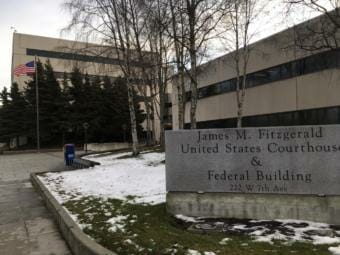
The United States Courthouse and Federal Building in downtown Anchorage. (Photo by KDLG)

An organization that promotes the oil, gas, mining and timber industries in Alaska’s schools is suing its former executive director, alleging she embezzled at least $187,000.
Alaska Resource Education filed suit against Michelle Brunner, who worked for the organization for a decade ending in 2017, on Wednesday in federal civil court.

The group, with a roughly $300,000 annual budget, helps teach students about Alaska’s natural resources, distributing curriculum to K-12 schools. Modules include “Trees, a Renewable Resource,” and “Fossil Fuel Hunt.”

The group’s board of directors includes employees of some of Alaska’s biggest players in the natural resource industry, including ConocoPhillips, Usibelli Coal Mine and Hilcorp, along with Alaska Airlines and the Alaska Railroad.

In a 29-page complaint, Alaska Resource Education alleges Brunner stole money through unauthorized payroll transactions and bonuses, credit card charges for personal expenses and direct bank transfers, and hid some of the actions by describing them as payments to legitimate vendors.

It says Brunner falsified emails from the organization’s employees and consultants to qualify for a mortgage for, and then buy, an Arizona home. She also shredded documents and ultimately deleted her email account after leaving her job, though Alaska Resource Education hired a consultant that partially restored it, the suit says.

“We want to reassure our donors, our educational partners and the public that we have done everything possible to ensure the organization’s financial integrity and fiduciary responsibility going forward,” the group’s new director, Ella Ede, said in a prepared statement.

Brunner did not respond to a message sent to her Facebook account Thursday.

A new fish processor is buoying King Cove’s fishermen. But now the town’s finances are sinking.

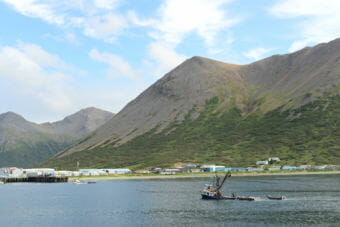
King Cove. (Photo courtesy Aleutians East Borough)

For the fishermen of King Cove, the 900-person town near the tip of the Alaska Peninsula, the construction of a new fish processing plant in a nearby village came as welcome news.

King Cove has long been a company town. For decades, its fishermen were frustrated by Peter Pan Seafoods, Inc., the private company that runs King Cove’s own massive processing plant. Especially vexing were the limits: While another processor in the region was buying far more salmon, Peter Pan would only buy 35,000 pounds from each boat, each day, said A.J. Newman, a King Cove city council member who skippers the 58-foot Lady Lee Dawn.

“It’s hard to watch your friends catch double what you caught,” said Newman. “Peter Pan had too many boats, and they couldn’t handle all the fish. And we just didn’t feel like they were hearing us — for years, we told them our concerns and they just didn’t really listen.”

Newman now sells his fish to the new plant, operated by Silver Bay Seafoods LLC., in the tiny village of False Pass, 45 miles west. And he’s not the only fisherman who broke up with Peter Pan — more than half of King Cove’s seine fleet switched to delivering their salmon to False Pass last summer.

The competition among processing companies is making things “way better” for King Cove’s fishermen, Newman said. But it’s also causing new problems.

The migration of the town’s fishermen to the Silver Bay plant in False Pass has left King Cove with a massive budget hole. And a possible realignment of Alaska’s seafood industry is threatening the future of the Peter Pan plant and viability of King Cove itself.

Silver Bay Seafoods’ chief executive, Cora Cambell, declined to comment. But King Cove officials say they hold no grudge against the company for opening up the competing plant in False Pass, and they note that it’s taken steps to soften the impact, like opening a new marine parts store in King Cove.

But the financial blow has been undeniable, and a solution remains elusive.

In a typical year, King Cove’s fish tax revenues are some $1.5 million, or a little more than half of its $2.8 million in general fund revenue. With last year’s opening of False Pass’ competing plant, King Cove officials estimate that they’ve lost of some $650,000 in revenue, or nearly 25 percent of their yearly total.
Graphic by Hannah Lies/Alaska Public Media

Even worse, potentially, is this month’s news that Peter Pan Seafoods is being put up for sale by its Japanese owner, the seafood conglomerate Maruha Nichiro Corp. After the construction of the new False Pass plant and reconstruction of a fire-damaged plant not far away in Port Moller, experts say there’s now far more processing capacity than necessary along the Alaska Peninsula — making a shakeup likely that could end with players or plants shutting down.

“Everybody is wondering: why such an arms race in a place where you really don’t have enough resource?” said John Fiorillo, executive editor of the trade publication IntraFish Media. He added: “Somebody’s going to be a casualty.”

Peter Pan’s chief executive, Barry Collier, didn’t respond to requests for comment, and the company hasn’t said anything publicly about the King Cove plant’s future. It’s not clear exactly what will happen to the plant or who might buy it.

In the meantime, King Cove’s city council is trying to sort out which services they’re going to have to cut. That could include hours at the town’s teen and rec centers, along with a program that helps seniors pay for their utilities.

“To pick on kids, and to pick on seniors, that’s a lot of emotions,” said Gary Hennigh, King Cove’s city administrator. “This is really what the mayor and the council are struggling with — that we know the value and the pride and the reasons that we have done these things, but the times are changing and we can’t afford them.”

The city council is trying to be careful not to cause a panic, Hennigh said. But the history of the isolated fishing towns of the Aleutians and the Alaska Peninsula is also at the back of people’s minds. A resolution passed by King Cove’s city council last month noted the “disappearance” of other communities, when their fish processing activities and plants shut down.

“The city must, and will do, everything within our ability to not let history repeat itself in this regard, and to sustain our quality of life and socioeconomic and cultural identity and well-being,” the resolution said.

King Cove isn’t the only village in the region that’s suffering amid a downturn in the region’s fishing industry: Another plant in the nearby town of Sand Point closed for the winter amid a crash in cod stocks linked to global warming.

“We’ve got to start educating our fellow citizens that things are happening that we really don’t have control over,” Hennigh said. “With a little bit more time and hopefully a little bit more good news, maybe we’ll end up being okay. But we’re certainly not close to that now.”

There have been a few pieces of good news amid the bad news about Peter Pan, like Silver Bay Seafoods’ new marine parts store and a $100,000 grant to King Cove from the local borough, Hennigh said.

But until the village finds out what’s happening to Peter Pan’s processing plant, Hennigh says, King Cove will have to be very careful about how it spends its money.

New Dunleavy consultant has ties to national conservative figures Pence, Bachmann

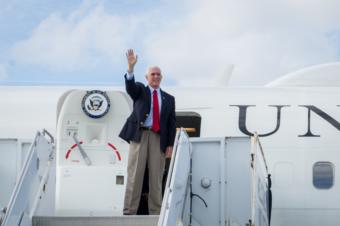
Vice President Mike Pence waves to a crowd of spectators on board Naval Air Station Oceana, Nov. 2, 2019. (Public domain photo by Mass Communication Specialist 3rd Class Mark Thomas Mahmod/U.S. Navy)

Gov. Mike Dunleavy has hired a former aide to Vice President Mike Pence as a new communications consultant.

Mary Vought, who worked for Pence when he was a member of the U.S. House of Representatives, was hired in November under a $4,000-a-month contract, according to Brett Huber, a top Dunleavy advisor.

Vought’s company, Vought Strategies, is based outside of Washington, D.C., but she comes with Alaska credentials: She grew up in the state and once had Sarah Palin’s father, Chuck Heath, as her substitute teacher at Colony Middle School in Palmer.

Now, Vought appears to be well-connected in Washington’s conservative Republican circles.

Vought’s husband, Russ Vought, is acting director of the White House Office of Management and Budget. Mary Vought, in addition to working for Pence, was a spokesperson for Michele Bachmann, the former GOP representative from Minnesota who once ran for president.

And Vought also works as executive director of Senate Conservatives Fund, a group that sometimes targets Republican incumbents, like Senate Majority Leader Mitch McConnell, that it deems not conservative enough. In that capacity, Vought — along with dozens of other national right-wing figures — signed a public memo in November from the Conservative Action Project that endorsed Dunleavy for being “fiscally responsible.”

Vought is helping Dunleavy’s administration with its in-state communications strategy; she’s also helping to connect the governor’s office with national outlets, according to Huber.

“Her role is to help both make our communications stronger within Alaska, and projecting the governor’s ‘open for business’ message through the national media in an effort to create better relationships and more jobs for our state,” Huber said.

Vought could not be reached for comment.

Dunleavy’s press office has seen significant turnover in recent months, as he fights back against a recall campaign against him.

Dunleavy’s first communications director, Mary Ann Pruitt, no longer works for the governor, according to Huber. Dunleavy’s original press secretary, Matt Shuckerow, is gone too.

Meanwhile, the governor hired a former conservative talk radio host, Dave Stieren, as a community liaison late last year.


Goldman Sachs, in Arctic drilling tiff with Dunleavy, hires veteran Juneau lobbyist

Alaska Gov. Mike Dunleavy speaks at a news conference at his Anchorage office on Friday, Sept. 27, 2019.
Alaska Gov. Mike Dunleavy speaks at a news conference at his Anchorage office on Sept. 27, 2019. (Photo by Nat Herz/Alaska Public Media)

In December, investment firm Goldman Sachs said it would no longer do business deals that support oil drilling in the Arctic — and in Alaska’s Arctic National Wildlife Refuge in particular.

In response, Alaska Gov. Mike Dunleavy suggested he could cut off the millions of dollars a year that the state pays to the Wall Street firm. Now, Goldman is playing defense: Last week, it hired a lobbyist, Wendy Chamberlain, to represent its interests in the state.

Chamberlain, one of Juneau’s most successful lobbyists, will advocate for Goldman on “issues relating to financing, investment strategies and advisory activities in Alaska,” according to a report she filed with state regulators.

Chamberlain and a Goldman spokesperson, Andrew Williams, both declined to comment. But Chamberlain’s hiring should help the company preserve its business in Alaska, said Larry Persily, a former deputy revenue commissioner for the state.

“They’re an investment house — it is a smart investment,” Persily said. “They’re not going to change their policy on Arctic, oil and gas, green energy, renewables — that’s something they’ve decided they’re going to stick with. But for $75,000, they can make sure they don’t make too many enemies up here that would cost them a lot of money.”

Goldman’s new environmental policy says it will “decline any financing transaction that directly supports new upstream Arctic oil exploration or development,” including in the Arctic Refuge.

The policy says climate change — which scientists agree is driven by the consumption of oil and other fossil fuels — is “one of the most significant challenges of the 21st century.” And it cites potential impacts of Arctic drilling on habitat for endangered species and Indigenous people’s subsistence livelihoods.

Producing oil from the Arctic Refuge has long been a goal of Alaska’s political leaders and the oil industry, and Congress formally opened the area to leasing in 2017. After Goldman’s announcement, Dunleavy told Fox Business that the policy is “unfortunate,” adding that Alaska is an “oil state.”

“We do a lot of business with Goldman Sachs,” he said. “We’re going to have to reevaluate that, have a discussion with them.”

https://www.facebook.com/FoxBusiness/videos/460656537927465/

The next day, Dunleavy’s administration fired Goldman from a group of Wall Street firms it had hired to help borrow money to pay off state tax credits owed to oil companies. The borrowing plan has been stalled by a lawsuit, but if it moves ahead, the decision could cost Goldman between $200,000 and $300,000 in compensation, said Deven Mitchell, the state’s debt manager.

Far more valuable, however, is Goldman’s relationship with the Alaska Permanent Fund, a $67 billion pool of state-owned investments originally seeded with state oil revenue. The fund, managed by the Alaska Permanent Fund Corp., generates the cash used to pay Alaskans’ annual dividend checks.

Over the past three years, the corporation has paid Goldman a total of $16.9 million in fees for managing a chunk of the permanent fund’s assets. The firm currently manages some $400 million for the fund.

Goldman’s management fees declined last year as one of the permanent fund’s investment programs was discontinued. But beyond that, the fund’s relationship with the company doesn’t appear to be in jeopardy, and Dunleavy does not appear to be pushing the fund’s board of trustees to take any action, according to Craig Richards, the board’s chair.

“I’ve had no conversations with the governor or the governor’s staff at all on the subject,” Richards said. “There’s been no proposal, that I’m aware of, to act in any way. My personal point of view is that there’s a very strong sense of not getting involved in politics.”

After Dunleavy referenced his desire to have a “discussion” with Goldman on Fox Business, he did have an hour-long phone call with the company’s chief executive, David Solomon, according to Dunleavy’s public schedule. Dunleavy’s spokesperson, Jeff Turner, did not respond to a question about what was discussed.


Site notifications
Update notification options
Subscribe to notifications