Nat Herz, Alaska Public Media

Alaska leaders have taken drastic measures to slow the coronavirus. The ‘$1M question’ is whether they’re enough.

This transmission electron microscope image shows particles of SARS-CoV-2, the coronavirus that causes the disease known as COVID-19. (Image courtesy of National Institute of Allergy and Infectious Diseases Integrated Research Facility)

Alaska still has one of the lowest coronavirus case counts of anywhere in the country, with roughly three dozen. And experts say the disease’s relatively late arrival in the state, combined with its isolation, could give Alaska an advantage over areas that had less time to prepare.

But as the number of new cases ticks upward — eight on Saturday, 10 on Sunday, four more Monday — uncomfortable questions lurk in the background: Will the restrictive measures already adopted stop the virus’ growth from taking off exponentially, and avert a surge of patients that could overwhelm Alaska’s hospitals?

Or, should we do more?

As the coronavirus inflicts huge damage on the state economy, there’s increasing discussion about how far public health mandates should go, and how long they can be sustained. At the same time, doctors and some community leaders are pushing for even more aggressive social distancing measures and limits on travel.

Some Alaskans following the pandemic argue that in general, it’s better to err on the side of caution. And they say that if more restrictions are necessary, it’s best to adopt them soon, to reduce the risk that cases start growing at a rate that can’t be contained.

Rep. Jonathan Kreiss-Tomkins, D-Sitka, speaks during a House floor session in the Capitol in Juneau on March 16. (Photo by Skip Gray/KTOO)

“At least in the short term, there’s really only one choice, which is to act aggressively, and to act in the interest of public health. Because if you don’t, or if you dawdle, or if you dither, or if you go halfway, the exponentialism of this thing will just completely overwhelm us,” said Rep. Jonathan Kreiss-Tomkins, a Sitka Democrat who, with engineers and designers, created an online model of the coronavirus’ spread designed to inform policymakers nationwide. “There’s really, morally, one choice we have.”

Experts say it’s probably too soon to judge the effectiveness of some of the initial steps taken to fight the virus, like bans on large gatherings and the closure of in-person food and drink service. That’s because it takes as long as two weeks for people to develop symptoms of COVID-19, the disease caused by the coronavirus.

But doctors, in particular, have been pushing for a ban on nonessential travel in and to Alaska, and for tighter restrictions on social contact. They argue that the longer the state can stave off widespread transmission of COVID-19, the disease caused by the coronavirus, the more time policymakers and providers will have to prepare and learn from the experiences of harder-hit areas.

“We really are moving quickly towards a period where we don’t have an opportunity to limit the spread of this illness. Once it’s endemic in our communities, we do not have that opportunity any more,” Dr. Nathan Peimann, who leads the Alaska chapter of a national emergency room doctors organization, said in an interview last week. “The longer you can wait, the better you can apply those lessons in a way that’s meaningful and helpful to patients.”

At a news conference Monday, Gov. Mike Dunleavy announced a new round of health mandates. Those include a required two-week quarantine for people coming into Alaska, along with closures of hair salons, barbershops and other businesses where social distancing is not possible.

Dunleavy had already closed schools, shut down in-person food and bar service statewide and banned gatherings of more than 10 people. Asked at the news conference whether the response was enough, Dr. Anne Zink, the state’s chief medical officer, said that was the “$1 million question.”

Dr. Anne Zink, Alaska’s chief medical officer, speaks at a news conference Monday. (Creative Commons photo by Office of Gov. Mike Dunleavy)

“That’s the real challenge of what we’re trying to figure out. We have a disease that silently spreads with very mild symptoms for a week or more. We have limited ability to test for it,” Zink said. “We are learning as fast and as much as we possibly can.”

Dunleavy’s administration still expects a surge in COVID-19 patients to come at some point, said Adam Crum, the state health commissioner. But its goal remains pushing that surge as far into the future as possible, he said in an interview.

“We want to get to a point that, when our surge does come, it’s something that we can hold within our health-care system,” Crum said.

Crum said Zink has been assessing the effectiveness of the state’s preventative measures through daily conversations with Jay Butler, a former chief medical officer for Alaska who now works as a top official at the U.S. Centers for Disease Control and Prevention.

Alaska officials so far lack a published model of COVID-19’s potential spread around the state that could help guide policymakers’ response, Crum added. But his department is developing one with the help of one of its epidemiologists, Jared Parrish, and data could be released within a couple of days, Crum said.

Dunleavy’s administration has, so far, resisted doctors’ requests that he order residents to shelter in place, though many communities, including Anchorage, have enacted versions of the measure. He’s also resisted instituting a full-blown ban on nonessential travel into and within the state. A spokesman for Dunleavy, Dave Stieren, said travel restrictions are still under consideration as the state’s efforts to fight the spread of the coronavirus evolve daily — though he added that it’s unclear whether the governor actually has the authority to restrict air traffic.

Anchorage Mayor Ethan Berkowitz, who’s imposed his own “hunker down” order inside city limits, said he’s waiting to hear from city attorneys about whether he has the authority to adopt such travel restrictions himself at the state-run Ted Stevens Anchorage International Airport.

Anchorage Mayor Ethan Berkowitz at a COVID-19 news conference on March 12. (Photo by Hannah Lies/Alaska Public Media)

Berkowitz said he’s “incredibly mindful” of the impacts of the COVID-19-related restrictions on workers and the economy. But he said his response is guided by health experts.

“It is unfair,” he said. “But the public health considerations are of paramount concern right now.”

The balance between more aggressive public health measures and the pandemic’s devastating effects on the country’s economy have become the subject of increasing debate at the national level in recent days. And some conservatives, including President Donald Trump, have suggested that public health mandates be relaxed soon.

“We cannot let the cure be worse than the problem itself,” Trump said at a news conference Monday.

Dunleavy, at his news conference Monday, said the coronavirus could cause a recession or even a depression, “if we’re not careful.” The economy, he added, won’t function unless people can go to work, and buy products and services.

“I don’t want anyone out there thinking that what I’m saying is the economy is worth more than somebody’s life,” Dunleavy said. But, he added: “It’s going to be an interesting conversation, over the next few weeks, on how we pull ourselves out of this and how we get back to living normal lives.”

One particular challenge for policymakers is that it’s hard to measure the effectiveness of their choices, because the restrictions they put in place are supposed to stop things from happening, said Kevin Berry, a University of Alaska Anchorage economist who’s studied pandemic disease and response.

While Alaskans are painfully aware of the costs of closing schools and businesses, they don’t have a clear understanding of the number of people whose lives might be saved by those steps.

“If things go well, the peanut gallery will have a fine time criticizing everybody as, ‘You overreacted, you did too much,’” Berry said. “But the problem is, if we do less and the truly bad situation occurs, it’s not something anybody really wants to think about.”

He added: “You can write all sorts of criticisms about these policies — which is why this is definitely a moment that calls for political courage.”


Some Alaskans still struggling to access coronavirus testing, even if providers think they might have it

This scanning electron microscope image shows SARS-CoV-2 (in yellow) — the coronavirus that causes COVID-19 — isolated from a patient in the U.S., emerging from the surface of cells (in blue/pink) cultured in a lab. (National Institute of Allergy and Infectious Diseases – Rocky Mountain Laboratories)

The World Health Organization’s top official earlier this week urged countries to “test every suspected case” of coronavirus. But as the United States lags in its testing ability, that still doesn’t appear to be happening yet, including in Alaska.

Mitchel Howell lives in the Matanuska-Susitna Borough, and a couple weeks ago, he started having a tough time breathing, he said in an interview.

Earlier this week, he woke up with a sore throat, too, and then he came down with a fever. So he called a nurse’s hotline at Mat-Su Regional Medical Center, and they told him to come in, he said.

“They did X-rays to check for pneumonia, did a few other tests to rule everything out,” he said. “And they came back and said I’m ‘suspected confirmed.’”

But Howell said he was told the medical center is only testing people in high-risk groups, or if they’re quarantined at the hospital.

“They gave me a note with quarantine procedures on it and told me to go home and come back if it gets worse,” he said.

The note given to Mitchel Howell by his medical provider at Mat-Su Regional Medical Center after Howell says he was told he was a “suspected confirmed” case of the coronavirus.

Howell is not the only person with a story like this.

In Fairbanks, a woman named Sarah Seifert said she called Fairbanks Memorial Hospital’s hotline and was told by a doctor that based on her symptoms, she most likely had COVID-19 and should stay home.

She said she subsequently went to the emergency room when her symptoms worsened and was ultimately tested; the results are pending.

In Southeast Alaska, Courtenay Kinkade went to her health care provider in Ketchikan with a respiratory illness and was given a note saying that she could be sick with the flu or a common cold, but added that “the novel coronavirus is also a concern.”

“Please understand that testing is limited and we will not be able to test everyone for the coronavirus to rule out this as a cause of symptoms,” her doctor wrote in a note.

Experts say testing is crucial in fighting the coronavirus because it helps health officials understand where to focus their efforts.

“You cannot fight a fire blindfolded. And we cannot stop this pandemic if we don’t know who is infected,” Tedros Adhanom, the WHO’s top official, said at a virtual news conference this week. “We have a simple message for all countries: test, test, test.”

When it comes to the Alaskans who weren’t tested, providers are still telling them to isolate themselves as if they have COVID-19.

But Howell works at a grocery store. And if he does have the coronavirus, he could have spread it to other people before he isolated himself.

Those people, if they’re showing symptoms, would also need to be quarantined to prevent further spread.

State health officials say they’re not tracking cases like Howell’s – when a provider makes the decision not to test someone that they think could be infected with COVID-19. But they also say they’re in constant conversations with providers about what they’re seeing from patients, beyond just the basic testing numbers.

“We are getting a lot of information from providers who are really paying attention to what they’re seeing in front of them, as far as the symptoms and the exposures, and asking really good questions about travel and contact,” said Louisa Castrodale, a state epidemiologist. “I think that’s really coming from across the state.”

Health officials point out that they’ve loosened restrictions on testing that were in place earlier in the pandemic. At this point, public and private labs will conduct tests on samples from any patient that, in a provider’s judgment, needs one, they said.

“We have opened it up. We are not limiting the providers,” Adam Crum, the state health commissioner, said at a news conference Wednesday. “If the provider wants to provide a sample and send that in, we will run that test.”

That said, health officials acknowledge that they’d still like to be doing more testing, and they say it’s possible some of the limitations might be at the provider level. One problem right now is that there aren’t enough of the swabs providers use to collect samples, Anne Zink, Alaska’s chief medical officer, said at Wednesday’s news conference. A day later, she asked communities to look in their clinics to see if they had extra swabs that could be used.

In the cases in the Mat-Su and Fairbanks, it’s hard to know exactly why the patients weren’t tested because the hospitals wouldn’t say. The Fairbanks hospital didn’t respond to requests for comment, and the Mat-Su hospital, in a prepared statement, said it can’t speak about specific cases and is following state guidelines.

“Our medical staff is working in collaboration with the State of Alaska Department of Health, closely following their recommendations and the U.S. Centers for Disease Control and Prevention’s screening guidelines for patients with upper-respiratory ailments that could potentially be identified as a COVID-19 case,” spokesman Alan Craft said. “If the physician determines a patient meets the appropriate risk criteria for COVID-19, the patient is tested.”

Two dynamics likely affecting testing are the infrequency of pandemics, and a response by providers and agencies that’s evolving daily, said Castrodale, the state epidemiologist.

“Things aren’t going by the book, because the book was just theoretical,” she said. “And so there are quite a few things that I think everybody learns every day.”

The state has so far prioritized tests for people who’ve been traveling, and health officials acknowledged that could make it more difficult to detect a big problem: When the coronavirus starts spreading among people in Alaska who haven’t been traveling.

But Castrodale said that the focus on travel-related transmission does not mean that the state is ignoring other possible COVID-19 cases. She noted that more than 500 tests have been run in Alaska on people whose results were negative — including dozens at out-of-state private labs, which are used for sick people who don’t have an obvious potential link to the disease.

“We’re still actively looking for COVID-19 and trying to really chase down the cases that we have and make sure we’re not going to allow this virus to take hold in our community,” Castrodale said.

While Alaskans may be tempted to blame providers or state officials for the lack of more widespread testing, they should really be focused on the federal government, said Kevin Berry, an economics professor at University of Alaska Anchorage who has studied pandemic disease.

“Most of the testing elsewhere is run, basically, by national governments,” he said. “This is something that should have been stockpiled by the federal government beforehand.”

But developing ways to test more people more quickly is more important than assigning blame, Berry said. For now, he added, Alaskans should follow public health officials’ advice: Isolate yourself if you’re sick and keep your social distance from other people.

Alaska COVID-19 count jumps to 9 cases, with patients in Anchorage, Seward

This highly magnified, digitally colorized transmission electron microscopic image reveals details of a single Middle East respiratory syndrome coronavirus, or MERS-CoV. It’s a relative of the novel coronavirus identified in Wuhan, China, in December 2019. (Public domain image courtesy National Institute of Allergy and Infectious Diseases)

Alaska health officials confirmed three new cases of the coronavirus in the state Wednesday, bringing the total count to nine.

Two of the new cases were in Anchorage and one was 75 miles south in the Kenai Peninsula town of Seward. All were travel-related — two were in people who’d been in the Lower 48 and another was in a person who had traveled to Europe, said Chief Medical Officer Dr. Anne Zink.

The patients in Anchorage were described as “older individuals,” while the Seward case was described as “younger,” Zink said. None of the patients are hospitalized.

The state also reported 400 negative tests midday Wednesday.

Anchorage bar, restaurant closure throws thousands of workers into limbo

Rita Aleck, 35, served cocktails at McGinley’s Pub in downtown Anchorage. Along with the city’s other bars and restaurants, McGinley’s has been closed to in-person service by Anchorage Mayor Ethan Berkowitz. (Photo by Nat Herz/Alaska Public Media)

Thousands of Anchorage residents who had jobs on Monday woke up without them Tuesday morning.

That’s after Mayor Ethan Berkowitz, seeking to contain the spread of the coronavirus, ordered bars and restaurants to close to sit-down service. Now, business owners and workers are trying to figure out what’s next, after seeing their incomes cut off indefinitely with less than a day’s notice.

“Decisions were made politically that they had their reasons for. But for us, it was a complete blindside,” said Jack Lewis, who co-owns and runs seven different Anchorage area restaurants. “Nobody really was prepared for it, or saw it coming.”
On Tuesday, Lewis said he was stuck with some $50,000 in perishable food, some of which was delivered Monday morning.

He hopes to sell as much as possible in takeout and delivery orders. But he and others in the service industry, including employees, say they’re still waiting to see what kind of assistance will be available to them.

Berkowitz’s closure order runs for two weeks, but it’s far from certain that people will be able to return to work at that point.

Gov. Mike Dunleavy also expanded to closure late Tuesday to cover restaurants and bars statewide.

“I’m like, ‘OL, what can I sell?’” said Rita Aleck, a cocktail server who, until Monday, worked at one of Lewis’ businesses, McGinley’s Pub in downtown Anchorage. “I’m going to do the best I can to take care of myself. But I think the biggest thing is all the question marks in all the different directions. … It’s hard to know how to feel when you don’t know what’s going to come next.”

In the space of a single day, nearly an entire workforce in Anchorage found itself in a similar predicament to Aleck. What’s known as the “eating and drinking” sector is responsible for yearly payroll of about $250 million and some 11,500 jobs in Anchorage, or about 8% of the total, according to Neal Fried, an economist with the Alaska Department of Labor and Workforce Development.

The bar and restaurant closure is also the latest coronavirus-related blow to a state economy already reeling from low oil prices and an expected big hit to Alaska’s tourism industry.

The big question around the closure is its timeline, Fried said.

“If it’s two weeks, obviously the impact would probably be pretty small,” he said. “Most people believe it might be longer than that. But it’s just the uncertainty, I think, that creates the greatest difficulty. We just don’t know how long this could last.”

Restaurant owners said the uncertainty is one of their biggest concerns, too.

Lewis — whose businesses include BurgerFi, Krispy Kreme and Firetap Alehouse — said he hopes to get some relief, whether it’s on his existing, government-backed small business loans or his utility bills, or from his bank. What he really wants to know from policymakers soon is what that relief will look like, so he can work out his own plans.

“Tell us what you’re going to do quickly. Make a decision. How do you ease the pain? Because you can carry us a little bit,” he said.

The number of jobs that vaporized Monday from Lewis’ businesses alone are stark. On Tuesday, he normally would have had 140 workers on the job, but instead, he had about 35 handling takeout.

Another business owner, Matt Tomter, said he had 12 workers between two of his Matanuska Brewing Co. pubs, down from nearly 150 across several locations before the closures.

Laid-off workers can seek unemployment benefits from the state, which is urging people to file online.

But the program is capped at about $1,500 a month — less than half of what many veteran service staff earn. And because many bar and restaurant workers don’t report all their cash tips, a big chunk of their income may not factor into their benefits.

To help workers affected by the coronavirus, Dunleavy’s administration is coordinating with Alaska’s congressional delegation and state lawmakers to try to create tax credits for sick and family leave, and to loosen some of the strict qualifying standards for unemployment, said Cathy Muñoz, deputy commissioner at the Department of Labor and Workforce Development. Congress is eyeing a stimulus package that could include direct cash relief payments of $1,000 or more to each American.

“This is an all-hands-on-deck effort,” Muñoz said. “We are going to get through this, and we are pulling together and getting all of the resources together to help the employer community and help the employees that are directly impacted.”

Carolyn Hall, a spokesperson for Berkowitz, said in a statement that the mayor was also in touch with state and federal leaders to encourage “swift action” in response to the economic havoc caused by the coronavirus pandemic.

She also pointed to announcements that city electric and water utilities had suspended shutoffs, the suspension of eviction proceedings by Anchorage courts and an “Economic Resiliency Task Force” that Berkowitz created.

Aleck said she’ll be okay if Berkowitz’s order doesn’t extend past its two-week time frame. Beyond that, though, she said she’s uncertain — she’s got rent and credit card payments to make.

With two decades of service experience, Aleck said she normally would have no trouble finding another job. But what if her chosen industry doesn’t exist for months?

“My resume looks great to anyone in any restaurant, bar,” she said. “But the rest of the world is like: ‘What can we do with you?’”

Aleck did not object to the decision to close down restaurants and bars. She said she just wants elected officials to make sure they follow through and take care of the people affected.

And right now, based on the level of fear and anxiety she sees at grocery stores and on city streets, she said she’s not sure that’s happening yet.

“There’s a bunch of people out here who really need to know that things are going to be handled — that we’re not going to be shut out, that we are going to be considered,” she said. “That now that they made a decision to go ahead and cut us off from each other, that they are going to help get through that decision by backing up their plan and making it work for all of us.”


Alaska’s chief justice shuts down all new jury trials

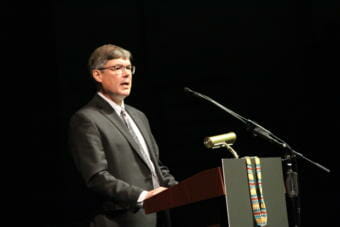
Alaska Supreme Court Chief Justice Joel Bolger addresses the Alaska Federation of Natives convention on Oct. 18, 2019. (Photo by Wesley Early/KOTZ)

Alaska Supreme Court Chief Justice Joel Bolger on Sunday ordered that all new jury trials be suspended, building on a directive last week that led to the suspension of trials in half of the state’s judicial districts out of concern over the spread of the novel coronavirus.
In his second special order in three days, Bolger cited last week’s disaster declaration by Alaska Gov. Mike Dunleavy and the national emergency declaration by President Donald Trump, along with Dunleavy’s mandate closing all public schools through the end of the month.

“These emergency declarations may affect the availability of court staff, attorneys, and jurors to begin new jury trials,” Bolger wrote in his order Sunday.

Jury trials already underway will continue. But the court system, in a pair of tweets Monday morning, urged defendants in pending new trials not to report to previously scheduled hearings.

“If you are scheduled for a state pre-trial conference today 3/16 at 9:30 a.m. before Judge Hanley in courtroom 38, Boney courthouse, DO NOT COME to court,” the court system wrote. “There will not be a bench warrant issued for people who do not show. Talk to your lawyer at a later time to discuss next steps.”

New trials had previously been suspended in two of the state’s four judicial districts, including the Third District — which covers Anchorage, Palmer, Kenai and other areas — and the Second District, which includes the northern Alaska hub towns of Kotzebue, Nome, Unalakleet and Utqiaġvik.

On Thursday, the Alaska Supreme Court is set to consider an emergency order that could loosen court rules in response to the coronavirus’ spread.

The court system says “essential functions” will continue and that it will ensure due process.

Those essential functions include domestic violence and emergency mental health proceedings, and bail and emergency child welfare hearings. The court system also says courthouses statewide have taken steps to reduce COVID-19 transmission, including social distancing measures.


Oil companies are screening employees for fever before flying them up to Alaska’s North Slope

BPfacility_Harball
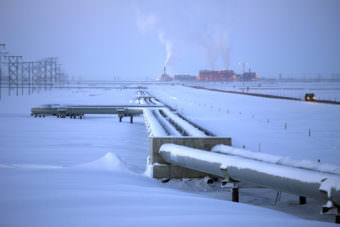
Pipelines lead to one of BP’s facilities on the North Slope. (Photo courtesy BP)

Alaska’s major oil companies are screening workers for fevers before they fly to remote operations on the North Slope, in an effort to fight the spread of coronavirus.

The companies met last week and agreed to start screening all of their workers when they check in in Anchorage, says Heidi Hedberg, Alaska’s public health director.

BP operates the North Slope’s largest oil field, Prudhoe Bay, and is conducting those screening measures, a spokeswoman says. Another major North Slope operator, ConocoPhillips, is checking passenger temperatures as they board planes headed north, a spokeswoman says.

The companies are also reviewing their contingency plans in the event a case is discovered on the North Slope.

The North Slope’s oil patch employs thousands of workers in an isolated area nearly 400 miles north of Fairbanks, the nearest big city. Most workers travel there by plane, and live and eat in shared spaces.

The major companies operating in the area have released few specifics about how they’re working to prevent a coronavirus case there, or how they’d respond if one was discovered. A BP spokeswoman said in an email last week that the company is closely monitoring the spread of the virus, along with the guidance from the World Health Organization and the U.S. Centers for Disease Control and Prevention.

Both BP and ConocoPhillips say they’re prioritizing the safety and well-being of their employees.

Site notifications
Update notification options
Subscribe to notifications