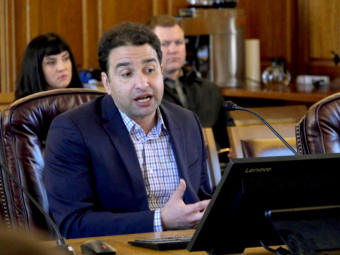
Nat Herz, Alaska Public Media

Economists say more cash aid from the state makes sense, but it may not be as simple as another PFD

Sen. Bert Stedman, R-Sitka, walks onto the House floor before Gov. Mike Dunleavy’s State of the State address on Jan. 27 in Juneau. Stedman, co-chair of the Senate Finance Committee, says he wants to see what needs remain after federal coronavirus aid arrives in the state before committing it to another PFD. (Photo by Rashah McChesney/KTOO)

As Alaska lawmakers prepare to reconvene, some are pushing for an extra permanent fund dividend payment, which would come on top of the $1,000 that the Legislature already budgeted for dividends earlier this year.

Lawmakers are already planning to spend what they deem to be the maximum sustainable amount from the $62 billion fund, or about $3 billion, in the fiscal year that starts July 1. The cash will pay for dividends and government services.

Spending more than that risks reducing the fund’s overall value, leaving less money for future generations of Alaskans.

But some lawmakers, led by Gov. Mike Dunleavy, say the dire, once-in-generations nature of the coronavirus pandemic requires drastic measures in response. And a number of of Alaska economists agree — though they stress that extra spending from the Alaska Permanent Fund should done carefully, and that it comes with trade-offs.

Ralph Townsend, an economics professor and director of University of Alaska Anchorage’s Institute of Social and Economic Research, said he’s “deeply worried” about arguments against extra permanent fund spending on the basis that will leave less money available for Alaskans’ descendants.

“I would not hesitate to withdraw from my retirement account for expenses to help my brother get through cancer treatment, even if it means my children will have a smaller inheritance,” Townsend wrote in an email. “My kids have plenty of time to adjust to that smaller inheritance and they would agree with my choice. That is exactly our situation today.”

More than 60,000 workers, or about 19% of the state workforce, have active or pending claims for unemployment benefits. But the pandemic is also hitting Alaska’s budget by devastating the oil and tourism industries and depressing the overall value of the permanent Fund, which determines the amount available for government spending each year.

In an interview Monday, Dunleavy again called on lawmakers to approve additional spending from the permanent fund’s earnings reserve account, which he described as a rainy-day fund.

“If this is not raining, I don’t see how you could ever say something will rain,” Dunleavy said. “To put dollars into the hands of individual Alaskans so that they can pay for their bills, their food, their gas, I can’t think of a better approach at this stage in the game.”

But Dunleavy’s ideas face skepticism from some legislative leaders. Sen. Bert Stedman, R-Sitka, and co-chair of the Senate Finance Committee, said he wants to see what needs remain after federal aid arrives in the state. And he noted that lawmakers are getting dire forecasts about shortfalls in next year’s budget.

“I do recognize that there are resources in the permanent fund. But I have a serious concern about what’s coming at us next winter,” Stedman said. “We have crippling oil prices and revenue projections right now for the state, and I’m not so sure that the most difficult time upon us is here today.”

Economist Mouhcine Guettabi gives a presentation about Alaska’s economic outlook to the House Finance Committee, March 7, 2019. Guettabi is an associate professor of economics at the Institute of Social and Economic Research, University of Alaska Anchorage. (Photo by Skip Gray/KTOO)

Economists endorse more permanent fund spending

While a number of economists have pushed Alaska lawmakers to bring revenues in line with spending over the past few years, many now agree that setting aside normal fiscal discipline during the pandemic is justified.

Concerns about future generations and opportunity costs are valid, but those arguments assume the state’s economy will be okay through the current crisis without intervention from policymakers, said Mouhcine Guettabi, an associate professor of economics at ISER.

“I just don’t think that’s true,” Guettabi said. “You’re going to have to fight to get the economy going, or at least to make sure that it’s stable enough and be there to fight another day, or in a year or two years.”

Anchorage economics professor Matt Berman endorsed the idea of paying the already-budgeted dividend “as soon as feasible,” arguing that “now is when people need the cash.”

The question of a second PFD, however, prompted skepticism from economists. Several of them agreed that additional state aid from the permanent fund is merited — but they pointed out that the dividend is a blunt instrument, because it’s paid equally to all qualified residents regardless of income or status.

That means paying one during the pandemic would likely put cash in the hands of many people who don’t need it.

“The current suffering is not spread equally,” Roger Marks, an economist in Anchorage, wrote in an email. “The wealthier half of Alaskans that receive half the dividends do not need it. People who have not lost their jobs do not need it.”

Gov. Mike Dunleavy speaks at a press conference in front of Wasilla Middle School in 2019. (Photo by Wesley Early/Alaska Public Media)

Tradeoffs between speed and efficiency

Dunleavy’s response to this argument is that Alaskans need extra cash now, and that setting up a more focused aid program would take time. “Every day we’re shaving off gross domestic product, and people are being laid off,” he said.

Several economists agreed that there’s a tradeoff between the speed at which policymakers move and how precisely they can focus aid programs.

The best policy right now would be targeted towards people who have lost jobs or had to close businesses — measures like loans, expanded unemployment insurance, food stamps and assistance payments, said Kevin Berry, an assistant economics professor at ISER.

Economists also said policymakers should try to coordinate state support with the array of federal aid programs passed by Congress. But, Berry said, targeting policy takes time and risks missing people.

“Something broad like a PFD is potentially more politically feasible,” Berry said. Shuttered businesses and people without much money in their savings accounts might not have time for lawmakers to negotiate a more focused package, he added.

A few economists expressed interest in the idea of making smaller payments, perhaps on a monthly basis, suggested by former U.S. Sen. Mark Begich and former Gov. Sean Parnell, who are leading Dunleavy’s economic recovery efforts.

Research suggests that smaller, regular payments — perhaps monthly — are more likely to be used for short-term goods like food and fuel, while a larger payment is more likely to be spent on durable goods like a car or big appliances, said Jonathan King, an Anchorage economist.

“If you’re worried about people’s quality of life during what is likely a medium-term event, smaller monthly payments makes more sense than a one-time larger, extra PFD,” King said in an email.

Institute of Social and Economic Research Director Gunnar Knapp
Gunnar Knapp, former director of ISER, delivers a presentation to the Houses Finance Committee, Feb. 25, 2016. (Photo by Skip Gray/KTOO)

Dividend spending leaves less for other programs

After the next fiscal year, even if lawmakers decide to pay no dividend at all, they’re still likely to face a budget deficit, which means that cash will be at a premium.

“We absolutely have no money to spare,” said Gunnar Knapp, a retired ISER economist.

If a larger PFD leaves less cash available for government services, cuts to education, the university system or public safety would “make economic development and growth in the long-run less likely,” said Berry.

A crash in tourism-related tax revenue is also likely to cause budget shortfalls for a number of Alaska’s cities and boroughs, which could need state assistance.

“There’s an argument to be made that helping these communities maintain core services during this unprecedented crisis, via a municipal stabilization fund, is a better use of money than an extra PFD,” said King.

An aid package could help preserve jobs and services, like education and health care, that could otherwise disappear or be left to the state, King added. Townsend said that the state and municipalities should also weigh the need for major investment in public health initiatives to help manage the pandemic over the next 18 months.

One other problem: There’s a finite amount of money available in the earnings reserve account, which is available for spending by a simple majority vote by the Legislature. If lawmakers spend too much, there might not be enough left for essential government programs.

“This account will be needed for public services,” said Marks. “Even without dividends it will be extremely stressed next year. Paying dividends will drain it more.” He and three other economists said taxes would be needed to help fill Alaska’s deficit.


Some conservatives are pushing to reopen Alaska’s economy. But elected officials, doctors and economists urge caution.

Anchorage streets are noticeably emptier, as many businesses have closed or reduced operations during the COVID-19 pandemic. (Photo by Abbey Collins/Alaska Public Media)

Dan Sullivan is losing patience.

The former Anchorage mayor co-owns a downtown bar, McGinley’s Pub, that was shuttered by public health mandates imposed to contain the spread of COVID-19.

As restaurants’ losses mount, Sullivan, in a Facebook post earlier this week, said he’s worried the industry has been “assassinated.” And in a follow-up interview, he said he thinks it’s time for McGinley’s to reopen, with appropriate social distancing measures and strict hygiene measures in place.

Restaurants at Alaska airports are exempt from the health mandates, and if they can safely operate, McGinley’s can, too, Sullivan said.

“Think about this: Who’s going to invest in a bar or a restaurant if every time there’s a new flu out there, you basically have to shut your doors?” Sullivan said.

Sullivan’s voice is one in a growing chorus of political conservatives at both the state and national level who are calling on policymakers to quickly relax some of the social distancing measures that have helped contain COVID-19’s spread.

Alaska, with 300 confirmed cases, has one of the lowest rates of infection in the country.

But officials describe that status as hard-won and tenuous. At a news conference Wednesday, leaders from Anchorage hospitals pleaded with residents to keep up social distancing and other precautions, in order to maintain Alaska’s modest numbers and avoid a spike in transmission like the ones that overwhelmed health-care infrastructure in New York City and Seattle.

“We need you to continue your hunkering down so that we can keep you safe until we have both treatments and vaccinations that work,” said Dr. Keri Gardner, Alaska Regional Hospital’s chief medical officer. “Please, continue to stay socially isolated. Your health care is better if people can get sick in small numbers that the hospitals can handle.”

Public health experts say it will take months to slowly reopen Alaska’s economy without inviting serious risks. And so far both Gov. Mike Dunleavy, a conservative Republican, and Anchorage mayor Ethan Berkowitz, a Democrat, appear to be governing accordingly.

After shutting down schools, non-essential businesses and non-essential travel around the state in the space of two weeks in March, Dunleavy issued his first order Wednesday easing those mandates — but it applies only to the provision of non-essential health-care that requires “minimal protective equipment.”

A day earlier, Berkowitz extended Anchorage’s “hunker-down” order by three weeks with only a few modifications, like easing restrictions on sewing, quilting and fabric stores and allowing shuttered businesses to bring in a second employee for maintenance and mail orders — up from the one that was allowed before.

“Every day, we get a little bit closer to being able to maybe open some retail businesses, maybe have outdoor dining and restaurants,” Berkowitz said at a news conference Wednesday. “But we have to get there, and we have to maintain the discipline we’ve had. Because if we don’t, all of the sacrifice, all the gains we’ve made will have been for nothing — because the disease is still there.”

Epidemiologists have outlined key benchmarks for post-pandemic economic recovery: widespread testing, public health capacity to trace and contain confirmed cases and enough health-care infrastructure to care for people who are infected. But because generations can go by without a pandemic of life-threatening disease like this one, the detailed playbook for reopening the economy “is being written by everybody right now,” said Dr. Jared Baeten, vice dean of the School of Public Health at the University of Washington.

Policymakers’ strategies, Baeten said, should be aimed at limiting individuals’ contact with other people and opening things up in a “stepwise fashion” — rather than moving from social distancing measures straight to allowing huge concerts, for example.

Opening small businesses could be an initial step because of the one-on-one interactions that take place there, possibly followed by restaurants opening at half capacity. And as contact increases, public health officials will have to monitor infection rates.

“Each one of these steps, you have to flip the switch, hold your breath, watch what happens over weeks before you decide if it was okay and you flip the next one,” Baeten said.

That process is just beginning in Alaska, however. And in the meantime, social distancing measures are wreaking havoc on the state’s businesses, which in turn has prompted increasing pushback.

The calls to reopen Alaska’s economy are popular on social media and among some elected officials. But there does not yet appear to be a major, organized campaign led by businesses themselves.

Members of the Alaska Chamber are excited to get back to work when it’s safe to do so, and they want to be part of the conversation about how that happens, said President Kati Capozzi. The group is also adamant about the need for financial support for businesses affected by the pandemic, she said. But it’s not “actively advocating for the reopening of Alaska,” she added.

“We understand how important it’s going to be for that to be a very measured approach,” she said. “You cannot just flip a switch and turn the economy back on.”

Even among those making more aggressive calls to ease health mandates, most acknowledge the need to balance businesses’ needs with public health safeguards.

The Kenai City Council, at a meeting Wednesday, unanimously passed a resolution that “respectfully encourages” Dunleavy to revoke or change his orders closing restaurants and bars, shuttering barbers and hair salons, limiting travel and banning gatherings of more than 10 people. But Robert Peterkin, who sponsored the measure, said he still supports Dunleavy’s step-by-step approach.

“I don’t think we should just open it up, wide open,” Peterkin said. “I think we should still be cautious — this is a terrible disease and we need to open things responsibly.”

But a few political conservatives are making more pointed arguments.

Screen shot taken on April 16, 2020, of a Facebook by Tuckerman Babcock suggesting the COVID-19 “emergency is over.”

Tuckerman Babcock, Dunleavy’s former chief of staff, declared the emergency “over” in a Facebook post Wednesday, saying healthy people should be free to “live, work and recreate.” State Sen. Mike Shower, R-Wasilla, said he thinks social distancing has done more harm than the virus. In Anchorage, a few dozen members of a Facebook group plan to drive their cars downtown next week to protest what they describe as “draconian lockdown measures” put in place by Berkowitz.

Shower said there are thousands of residents in his district who have lost jobs, and hundreds of closed businesses, even though the virus “has not proven to be the zombie apocalypse.” He said he thinks all businesses could be reopened at this point, as long as that happens slowly and with appropriate precautions, like social distancing and the use of masks and gloves.

“A doctor would shut down the economy to save 10 people. That’s what they do — it’s noble, that’s their oath,” Shower said. But now, he added, “the cure is becoming worse than the disease.”

By one measure, though, the social distancing steps taken nationally at the pandemic’s onset have saved money in the long run.

That’s according to an analysis by a group of University of Wyoming economists, who estimate that the lives saved by reducing contact between people produces a $5.2 trillion benefit, even after accounting for the economic cost of social distancing measures. (Their model assumes that each life saved is worth $10 million, which is roughly consistent with federal agency guidelines.)

Generally speaking, economists are in agreement with epidemiologists that “we are doing the right thing by being locked down,” said Kevin Berry, an economics professor at University of Alaska Anchorage’s Institute of Social and Economic Research.

The problem, Berry added, is that while the benefits of social distancing are spread broadly across society, the costs are being felt acutely by business owners and employees who have lost jobs. Rather than abandon health mandates, the appropriate response from policymakers is to better support those businesses and workers with low-interest loans, unemployment insurance and direct payments, said Berry, who’s studied the economics of infectious disease.

“The stimulus checks, right now, are not coming quickly enough. They’re probably not big enough. Definitely more needs to be done, and everything needs to be done fast,” Berry said. “This is a situation where it’s better to err on the side of doing too much, too quickly.”

Sullivan, the bar owner and former Anchorage mayor, wasn’t enthusiastic about turning to the government for additional support.

The $2 trillion federal coronavirus package adds to the national debt; social distancing comes with social costs, like suicide and depression, Sullivan said. And, he added, “you’re relying on a political solution.”

“Depending who’s in leadership of any level of government, there’s no guarantee that there’s going to be that kind of relief,” he said.

Alaska is exempting some businesses from health mandates. But it’s keeping their plans secret for now.

Anchorage streets are noticeably emptier, as many businesses have closed or reduced operations during the COVID-19 pandemic. (Photo by Abbey Collins/Alaska Public Media)

Alaska Gov. Mike Dunleavy’s administration has required hundreds of essential businesses to draft formal plans detailing how they’ll keep operating during the COVID-19 pandemic without jeopardizing public health.

So far, though, the state is refusing to release those plans publicly, even as municipal leaders press for access to them to aid their development of local restrictions and ensure companies are complying with state health mandates.

The Dunleavy administration has also denied a formal public records request filed by CoastAlaska, a consortium of public radio stations.

The administration intends to release the documents after reviewing them for information exempt from the state public records act that needs to be redacted, Angela Hull, Dunleavy’s public records specialist, said in an email last week. But with more than 700 plans submitted, the state is focused on reviewing the documents and deciding whether to approve or deny them, she added. She did not provide a time frame for when the plans would be released.

Officials at the Department of Health and Social Services declined to be interviewed or answer specific questions about how the plans were being vetted, saying they couldn’t talk about them until the state finished its response to CoastAlaska’s public records request.

“If you have filed a public records request we need to let that process work its way through the system,” Clinton Bennett, a department spokesperson, wrote in an email.

Asked about the plans at a news conference last week, Commissioner Adam Crum said the administration assembled a team to review whether companies’ proposals meet the intent of Dunleavy’s order.

In at least one case, the state rejected changes to a proposed plan: BP, the major oil producer, initially wanted to fly out-of-state workers directly to the North Slope after they self-quarantined outside the state. But Dunleavy’s administration rejected that idea, forcing the company to quarantine its out-of-state employees at an Anchorage hotel for two weeks before they could fly to Prudhoe Bay.

“There has been feedback, particularly on the North Slope,” Crum said. “We had a lot of contact, along with contractors that work up there, the health care providers up there, working on their plans, talking about their quarantine procedures.”

Alaska Health and Social Services Commissioner Adam Crum, left, speaks at a news conference with Gov. Mike Dunleavy on April 9, 2020. (Creative Commons photo by Alaska Governor’s Office)

Dunleavy last month issued an order requiring anyone arriving in Alaska to self-quarantine and work from home for two weeks, in an effort to slow the spread of the coronavirus. He also ordered the closure of all businesses except those in “critical infrastructure” industries, or those that provide “essential services.”

Essential workers are still required to observe the two-week quarantine order. But they can be exempted from the requirement to work from home if their employer submits a plan to Dunleavy’s administration detailing protective measures that will avoid spreading COVID-19 and jeopardizing the lives of people in the communities where they operate. Those include plans for screening workers for COVID-19 infection, along with steps taken to limit quarantined workers’ contacts with colleagues and the general public.

The state says that violators of Dunleavy’s quarantine order can be fined up to $25,000 and imprisoned for up to a year.

But as of March 31, no “enforcement mechanism” had been identified, Tom Koloski, a top state emergency response official, wrote in an email to a Bristol Bay Borough official. Troopers and local police lack the manpower to “ensure wide-spread enforcement,” Koloski added.

The state is currently focused on education and “providing businesses with guidelines and tools so they can comply with the mandates,” Jeremy Zidek, a state emergency response spokesperson, wrote in an email.

“We are working with several industries to develop industry specific guidance,” Zidek said. “Overall, Alaskan businesses have shown a great willingness to comply with the mandates.”

Initially, businesses eligible for exemptions included those in health care, natural resource extraction, banking, grocery stores and maintenance of infrastructure like airports and telecommunications systems, among others. A few days after issuing the order, however, Dunleavy’s administration expanded the list considerably: It now includes “all other businesses that can maintain social distancing requirements and prohibit congregations of no more than 10 people in the business at a time.”

The state has not publicly released a list of the names of companies that submitted plans. But in addition to the close scrutiny applied to the oil industry’s plans, Dunleavy’s administration has also had “robust discussion” with fish processing companies, Crum, the health commissioner, said at the news conference.

Those processing companies have drawn attention from local leaders in isolated Alaska villages and hub communities, who want to know what precautions are being taken to protect residents from the potential of contracting COVID-19 from plant workers and fishing crews who come from outside the state.

So far, Dunleavy’s administration has rejected requests from municipal leaders’ to view companies’ plans, causing some frustration.

“It’s up to a local government to interpret, look at compliance, try to work out its own process and emergency procedures in relation to those state mandates,” said Nils Andreassen, executive director of the Alaska Municipal League. “And it’s just a very challenging process when you don’t have access to that information that, right now, is held at the state level.”

A number of processing companies, however, have agreed to share their plans publicly.

Spin drier sits at the Trident fishmeal plant
A 50-foot, 60,000-pound spin drier sits at the center of the Trident Seafoods fishmeal plant in Naknek. (Photo by Matt Martin/KDLG)

In Bristol Bay, home to the world’s largest sockeye salmon run, some residents have questioned whether the fishery should be shut down in an effort to protect local residents and avoid overwhelming the region’s limited health-care capacity. But as that debate continues, the local borough has posted more than a half-dozen plans on its website — including the 18-page document shared by Trident Seafoods, one of the world’s largest seafood companies.

The document lays out quarantine and reporting plans for boats, a ban on processing workers leaving company property and restrictions on contact with fishermen, like requiring that paperwork be handled by people wearing gloves. Releasing the plan helps build trust in the company’s plans, its chief executive, Joe Bundrant, said in a prepared statement.

“The health and safety of our communities, our fishermen and our employees is our No. 1 priority,” Bundrant said. “We believe that open communication is essential in helping the public understand our plans and trust that we are prioritizing their safety.”

Andreassen said local leaders’ concerns are generally more focused on smaller processing companies.

“The larger processors, I think they have good plans in place,” he said. “The concern or the unknown maybe is all the independent or smaller operators who just have less capacity to process those plans or implement some of the measures necessary that larger companies can.”

Other industries that could pose challenges for local officials trying to manage the coronavirus threat include construction and tourism, Andreassen said.

In the oil patch, one of Alaska’s four major companies, ConocoPhillips, has published its own two-page plan online, which includes a required two-week quarantine inside Alaska before out-of-state workers can travel to the North Slope.

BP isn’t releasing its plan, but spokesperson Meg Baldino emailed a list of steps that company has taken to reduce the risk of spreading coronavirus, including quarantines, more aggressive cleaning and disinfecting and extending crew shifts from two weeks to at least three weeks.

Hilcorp declined to release its plan, and an ExxonMobil spokesperson did not respond to a request for comment.

Biden wins Alaska Democratic presidential primary, claiming 8 of 15 delegates

Ballots from the Alaska Democratic presidential primary sitting at the party’s counting facility Saturday, April 11, 2020. (Courtesy Alaska Democratic Party)
Ballots from the Alaska Democratic presidential primary sitting at the party’s counting facility Saturday. (Courtesy Alaska Democratic Party)

Joe Biden won the Alaska Democratic primary election Saturday, collecting 55 percent of votes and eight of 15 delegates — narrowly edging out Bernie Sanders, who collected 45 percent and seven delegates.

Each candidate also received one alternate delegate.

Saturday’s Democratic presidential primary in Alaska was the first since Sanders announced earlier this week that he was dropping out of the presidential race.

This year’s Alaska Democratic primary abandoned the traditional caucus in favor of a by-mail and in-person primary. Democrats mailed 71,000 ballots to every registered party member in February and were scheduled to hold “last-chance” in-person voting at 60 polling places across the state on April 4.

As the coronavirus pandemic took hold, the party announced in late March that it had canceled in-person voting, and pushed back the mail-in ballot deadline from a March 24 postmark to an April 10 arrival.

“We are proud that holding a party-run primary allowed us to make decisions as events unfolded and shift to all vote-by-mail, while maintaining the health and safety of our team,” said Lindsay Kavanaugh, the party’s executive director.

The party had already received the vast majority of the ballots before Sanders dropped out Wednesday: Three days before his announcement, Democrats said 16,300 had been mailed back. The party counted 19,800 ballots Saturday, which it said was nearly double the turnout in the 2016 primary.

Democrats used a “ranked-choice” voting system, in which party members ranked their top five candidates in order of preference.

Candidates had to receive 15% of the vote to receive any of the 15 delegates at stake in the primary. Those below the threshold had their votes redistributed to second-choice candidates, and that process was repeated until the remaining candidates each had at least 15% of votes.

There were eight candidates on the Alaska Democratic ballot. But the party only counted votes for “active candidates” and those who had suspended their campaigns but still wanted to be included in the tally, which it said included only Biden and Sanders.

As of last week, Democrats represented 13 percent, or 75,500, of Alaska’s 573,000 registered voters. Most Alaska voters are registered as nonpartisan or undeclared.

Ravn is $90M in debt and could be forced to shut down for good, court docs say

A Ravn Alaska De Havilland airplane at Ted Stevens Anchorage International Airport. (Creative Commons photo by Sunnya343)

Alaska’s largest rural airline is $90 million in debt and could be forced to sell its assets and shut down permanently, putting rural travel and supply lines in peril unless the government or new investors come to the aid of the bankrupt company, according to documents filed in federal court.

As the coronavirus pandemic batters the aviation industry, the teetering RavnAir Group may have obtained a $12 million loan that leaves “some hope that there may still be a rescue,” Tobias Keller, a Ravn attorney, said Tuesday at a bankruptcy hearing in Delaware.

“Ravn is actively working with government officials to secure funding. And if funding were obtained, we may be able to come up with a restructuring,” Keller said. But without relief, he added, the loan will give Ravn a “brief runway” to prepare for an “orderly liquidation.”

The developments at Tuesday’s hearing raise new questions about the fate of Ravn, and about what might replace it in the more than 100 Alaska communities it served before the pandemic.

Ravn provided the only scheduled passenger service to more than 20 of its destinations, and dozens of its communities lack any road access. Its 72 planes are grounded, and its workforce of 1,300 has shrunk to 39.

The company is majority-owned by a pair of East Coast private equity companies and often criticized by customers and leaders in rural Alaska, who say Ravn was rarely responsive to local concerns. Officials with Ravn and the private equity companies, J.F. Lehman & Co. and W Capital Partners, did not respond to requests for comment.

Some of Ravn’s communities, meanwhile, are in limbo, sorting through immediate, serious problems as they wait to see if the company will resume service, or whether it will have to be replaced by other airlines.

On the Bering Sea island of St. Paul Thursday, for example, there was a woman pregnant with twins who needed to fly to the mainland. But the only way to Anchorage right now was chartering a plane at a cost of $9,000 or more, said Amos Philemonoff, the president of the local tribal government there.

“I think everybody’s feeling apprehensive without any air service out here, and apprehensive as well about what the future holds,” Philemonoff said. “All we’ve got is conjecture at this point. I don’t know what to believe at this point, without sitting in the bankruptcy proceedings.”

A ‘liquidity crisis’

At stake is a company with more than $200 million in annual revenue. Ravn’s bigger planes flew from Anchorage to a network of regional hubs, and then its smaller ones would fly from those hubs to remote villages. Destinations ranged from the North Slope to the Yukon-Kuskokwim Delta to the major Aleutian fishing port of Dutch Harbor.

Ravn was formed out of several smaller Alaska airlines during an era of industry consolidation that was hastened, in part, by legislation championed by former U.S. Sen. Ted Stevens.

The company’s statewide breadth offered customers the convenience of booking tickets on its different airlines through a single platform, and it also gave the company access to what appeared to be a diverse, resilient market: If demand dropped off in one region of the state, the company could count on others to sustain it.

But when the pandemic hit, Ravn’s reach became a vulnerability, as the spread of the disease prompted Gov. Mike Dunleavy to restrict travel across the entire state. Another issue was Ravn’s dependence on passenger service, which generates 54% of the company’s revenue, according to bankruptcy filings.

The coronavirus arrived at a time when Ravn was already vulnerable, according to filings: The company tends to run at a loss during the winter and spring, and strong financial performance in the summer and fall tourist season is “essential” to Ravn’s survival, Chief Financial Officer John Mannion said in a sworn statement.

As concern about the pandemic spread, bookings dropped sharply and rural hubs and villages started telling Ravn, along with other airlines, to stop carrying passengers in an effort to limit the spread of the coronavirus, Mannion said. By mid-March, the company faced a “liquidity crisis,” he added.

At the end of March, even after two rounds of layoffs and service cuts, the company didn’t have enough cash to make its payroll. It also couldn’t find investors, given reduced demand combined with uncertainty about when the pandemic would relent, Mannion said.

No government aid yet

Before filing for bankruptcy, the company spoke to “high-ranking representatives” of the state and federal government for help, Mannion said.

While Dunleavy administration officials had contact with Ravn, “the governor’s office can’t approve loans or offer any financing,” Jeff Turner, a spokesperson for the governor, wrote in an email.

Turner said Ravn, like any other business, would have to approach the state’s economic development agency, the Alaska Industrial Development and Export Authority, for financing. AIDEA spokesperson Karsten Rodvik said the authority has not received a formal application or request from Ravn.

At the federal level, grants under the recently passed relief bill, the $2 trillion CARES Act, can only go toward paying workers — not to pay down the company’s debt. For that reason, Ravn had initially appeared uninterested in seeking such grants, according to U.S. Sen. Dan Sullivan.

“At the end of the day, the investors and bank syndicate and private equity group that ultimately owned Ravn didn’t seem to want any additional help,” Sullivan told participants in an online Alaska Chamber conference last week. “That might be a lesson for all of us Alaskans: Don’t count on the Wall Street guys to look out for our concerns.”

Ravn ultimately did apply for CARES Act relief last week. It also held an hour-long phone call late last month with aides to Alaska’s Congressional delegation and representatives from the U.S. Department of the Treasury, according to a letter by the delegation to Treasury Secretary Steven Mnuchin.

But it’s uncertain when Ravn’s federal aid applications could be granted or how soon money could be released, Mannion, Ravn’s chief financial officer, said in his statement.

A spokesperson for Sullivan, Mike Anderson, said in an email that the senator and his staff have worked “relentlessly” to make sure Ravn and other Alaska airlines can take advantage of the federal assistance to pay employees.

“His primary concerns are that rural Alaska is provided necessary services, and that Alaskans keep their jobs,” Anderson said. “He continues to hope that during this national crisis, Ravn is able to find a way to rehire the Alaskan employees and serve Alaskans who most need their services.”

Lenders wanted liquidation

By the time the pandemic arrived, Ravn had borrowed $91 million from its group of unnamed lenders, according to the company’s bankruptcy filings. That debt is looming over the bankruptcy proceedings, where many of the lenders think they would be better off if Ravn’s assets were sold immediately, David Neier, an attorney for the lenders, said at Tuesday’s hearing.

That’s in part because Ravn’s property that can be sold to pay back the $90 million is only worth about one-third of that amount, Neier said.

Adding another $12 million loan on top of that — which the judge authorized at Tuesday’s hearing — “was extremely difficult and extremely contested” among the lenders, Neier added. The lenders were troubled by the fact that half of the money was going toward paying wages that had already been earned by Ravn employees’, rather than protecting the value of Ravn’s assets that could be sold to pay down the company’s $90 million debt, Neier said.

While the bankruptcy buys Ravn time to plan its next steps, even that process is being complicated by the pandemic itself: Two people working with the company can’t get to Alaska because the state requires travelers to quarantine themselves for two weeks after arriving, Neier said.

“There’s very little information that’s been able to get collected,” he added.

As the bankruptcy case plays out, state and federal officials say they’re committed to restoring flights to the places that have lost them. In the Yukon-Kuskokwim Delta, remaining air carriers have been working to replace Ravn’s service, but that’s had the effect of reducing flights in other communities that weren’t immediately impacted by the company’s shutdown, Tiffany Zulkosky, a spokesperson for Yukon-Kuskokwim Health Corp., said in an email.

It could take weeks or a month for other airlines to add the planes and pilots needed to keep up with demand, she added. In the mean time, YKHC has chartered flights to move patients and supplies, though that option is “cost-prohibitive and not a long-term solution,” Zulkosky said.

In the long run, residents of communities served by Ravn should expect service to return — whether it’s provided by Ravn or a successor company, said Danny Seybert, who used to run PenAir, one of Ravn’s airlines, before PenAir went through its own bankruptcy. The aviation industry is defined by turmoil, Seybert added.

“Alaska is littered with failed airlines. And for every failed airline that goes away, somebody else steps up and starts another,” he said. “In every single case, the market comes back with people who step in and step up and take care of the markets — some sooner than others.”


Meet the team of Alaskans trying to trace and contain every case of COVID-19

Anchorage School District nurse Elida Spiro sits in an empty room at the Anchorage Health Department Tuesday, March 31, 2020 as she makes contact with a person that has been quarantined due to possible exposure to Covid-19.

One of Alaska’s first positive cases of COVID-19 was a person who’d been to a grocery store while they were infectious.

Normally, this wouldn’t be cause for concern, given the need for prolonged exposure to significantly increase a person’s risk of getting sick. But in this case, a long wait at the checkout kept the infectious person in line for more than half an hour — potentially exposing the people behind and ahead of them to a deadly disease.

It fell to Drew Shannon, a nurse employed by the Anchorage Health Department, to find those unwitting “close contacts.” Armed with a receipt supplied by the sick person, he worked with the store to reach the two other people from the checkout line, then made sure they were quarantined to keep the disease from spreading further.

Both have now finished their quarantine without developing symptoms.

Shannon’s work is known as “contact tracing,” and it’s a critical piece of public health officials’ battle against COVID-19. The task entails finding, quarantining and monitoring people exposed to a disease, along with identifying the infection’s original source.

In Alaska, the job falls to a network of trained workers, many of whom are epidemiology staff and public health nurses from the state Department of Health and Social Services. In Anchorage, eight city nurses take on many of the cases, with support from school nurses who were reassigned after classes were canceled. One former city nurse even came out of retirement to help.

While public health experts say contact tracing is crucial to keeping COVID-19 in check, the nurses’ regular phone calls and check-ins also bring a measure of humanity and comfort to one of the groups of Alaskans with the highest risk of developing the disease.

“It’s nice to have somebody checking to see if you’re okay,” said Robert Bowles, a 60-year-old Juneau man who tested positive for COVID-19. “The fact that they were calling every day felt good.”

Contact tracing is part of what epidemiologists call “containment” — the essential work of determining where the virus already is so that further spread can be slowed.

In Wuhan, the Chinese city where the COVID-19 pandemic began, more than 1,800 teams of epidemiologists, each made up of at least five people, traced tens of thousands of contacts a day, according to the World Health Organization. Up to 5% of contacts were subsequently confirmed to have the disease.

Containment is not the only front on which authorities fight COVID-19. But the work is particularly important in Alaska because of its dispersed and remote villages that lack advanced health care infrastructure, said Joe McLaughlin, the state’s top epidemiologist. That means Alaska will continue its focus on containment even if the number of cases escalates to the point where “widespread community transmission” tests its tracking capacity, McLaughlin said.

Anchorage School District nurse Bethany Zimpelman looks at informationwith Anchorage Health Department’s Michael Fritz during her shift at the Anchorage Health Department Tuesday, March 31, 2020.

For now, officials say they have enough manpower to handle the cases confirmed each day.

State nurses were checking in with more than 60 people in Ketchikan and 20 in Juneau in recent days, according to Sarah Hargrave, a Juneau-based state nurse supervisor. Anchorage city and school nurses, plus support staff, were tracking 126 close contacts and 56 confirmed cases of COVID-19 on Saturday, according to the municipal health department. (Anchorage’s figures may not include people in the city who have recovered or are being monitored by other agencies, like the military.)

Contact tracing starts with a positive test result, which is assigned to an individual nurse or trained public health official for an investigation.

Many of the state and city public health nurses have similar experience investigating other illnesses, such as tuberculosis and sexually transmitted infections like syphilis or gonorrhea. But many of those cases are easier to track than COVID-19, which can be transmitted through sometimes-invisible respiratory droplets.

“Gonorrhea, for example, the mode of transmission is pretty clear,” said Shannon, the Anchorage nurse. “With COVID-19 respiratory droplets, that could be a lot more people.”

The investigator starts by calling the patient with a series of questions about their travel and who they’ve spent time with.

In countries without the U.S.’s privacy protections, public health authorities have reviewed cellphone data, surveillance camera footage and credit card transactions to help with their contact tracing.

In Alaska, nurses can use Facebook or other social media to locate a contact, or they might ask for help from a business. And the U.S. Centers for Disease Control and Prevention has a system to find people who sat on a plane near someone later diagnosed with COVID-19.

Otherwise, information comes mostly from patients, who are generally eager to cooperate, said McLaughlin, the state epidemiologist. Their close contacts, he added, are “their friends, their family members, their co-workers.”

“They really want to help protect them,” he said.

Close contacts are defined as people who spent more than 5 or 10 minutes within six feet of the patient during their infectious period; they’re asked to quarantine for two weeks. After developing a list, nurses and support staff will then call each patient and close contact once or twice daily, asking for temperature readings and other symptoms.

Once a nurse has established a rapport, they might switch to email or texting, or even the Whatsapp messaging program. Some of the Anchorage nurses have been speaking in Spanish with families, and they’ve also enlisted a Hmong translator.

But the work goes beyond collecting data on symptoms. Nurses have helped get food to people’s homes if they’re stuck in quarantine, and they can support people emotionally at a time when they’re isolated, vulnerable or afraid.

“Some people are scared. They’ve heard the horror stories,” said Hargrave, the state nurse supervisor. “A really important part of getting through this is having some social connection and support, and to not feel alone. And we’re happy to provide that when we can.”

Site notifications
Update notification options
Subscribe to notifications