Nat Herz, Alaska Public Media

Will the oil price crash disrupt the BP-Hilcorp deal? Alaska state regulators want to know.

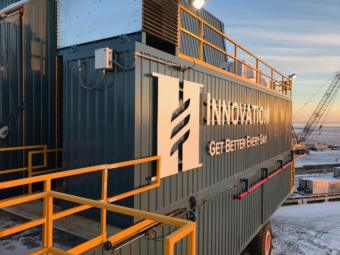
Hilcorp’s Innovation drilling rig on the North Slope. (Photo courtesy of Hilcorp)

State regulators have asked Hilcorp, the independent oil company buying BP’s Alaska assets, to disclose whether and how the pandemic-driven crash in oil prices will affect its ability to seal the $5.6 billion deal.

In an 18-page order Thursday, the Regulatory Commission of Alaska asked BP and Hilcorp affiliate companies to answer 32 different questions, including whether “recent changes in financial markets” have affected Hilcorp’s ability to finance the deal.

“If market conditions have not impaired access to capital, please explain the sources of capital for this acquisition,” the order said.

Hilcorp’s finances have become an increasing area of focus for those following the deal amid a historic crash in the price of oil last month — driven by both plummeting demand and a feud between Saudi Arabia and Russia over whether to further reduce production in response. Alaska North Slope crude prices have plummeted from $50 a barrel in early March to $22 by Friday.

Hilcorp has not said exactly how it plans to raise the full $5.6 billion, but ratings agencies have said that heavy borrowing could cause them to reduce the company’s credit rating.

Two watchdog groups also say they’re concerned about whether Hilcorp’s debt levels could affect its ability to operate safely.

In a letter to the RCA before the order was issued, the Prince William Sound Regional Citizens’ Advisory Council said the commission should require Hilcorp to file “new and updated financial statements” to reflect the “current investment environment.”

“Much has changed since Hilcorp submitted its initial financial statements and sales agreement with BP. The changes are of a magnitude that the analysis of Hilcorp’s financial fitness might be affected,” wrote Donna Schantz, the director of the council, which was created after the 1989 Exxon Valdez oil spill.

“The council is not opposed to this transaction,” she wrote. “It just wants to be sure the state conducts its due diligence responsibilities and that Hilcorp is fit and able to carry-out its significantly increased and critically important responsibilities associated with this transaction, including the prevention of oil spills and the capacity to respond if one should occur.”

The Alaska Public Interest Research Group sent a similar letter to the RCA on Friday. It praised the commission for its request for additional information about the effects of the oil price crash. But it argued that Hilcorp should still be required to provide complete updated financial statements, which the RCA has not asked for.

“Without requiring updated financials, the RCA will be evaluating a company whose past financial statements bear little relationship to reality,” said the letter, written by the research group’s policy analyst, Phil Wight.

A Hilcorp spokesperson, Luke Miller, declined to comment. The company’s founder, Jeff Hildebrand, participated in a White House meeting between President Donald Trump and oil company executives Friday, where he told the president he was there representing “the family-owned businesses that are in this industry.”

BP, in an announcement Wednesday, said its broader asset sale initiative that includes the Hilcorp deal “remains on track,” though the timing of when it receives the money from the sales “may be revised as transactions complete, particularly while volatile market conditions persist.”

“This includes the sale of our Alaskan business to Hilcorp, which we continue to expect will complete during 2020, subject to regulatory approvals,” the announcement said. “We will provide further information on this transaction going forward, as appropriate.”

In its order Thursday, the commission said it wants the additional information from BP and Hilcorp “to assist us in our analysis of whether Harvest Alaska’s proposed acquisition of BP’s Alaskan assets meet our statutory standards.” Other questions involve liability and insurance, along with the operations of pipelines that a Hilcorp affiliate is acquiring stakes in, including the trans-Alaska pipeline.

The companies’ responses are required by May 4.


Dozens of Alaska villages to lose air service as Ravn announces huge cuts

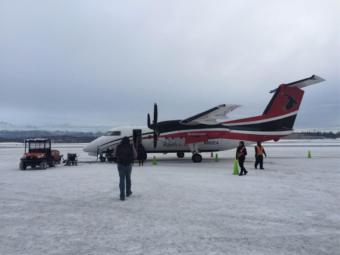
In Anchorage, passengers board a RavnAir Group flight bound for Unalaska. Ravn and Alaska Airlines suspended their partnership for the Unalaska-Anchorage route following Ravn’s fatal PenAir plane crash on Oct. 17, 2019. (Photo by Laura Kraegel/KUCB)

Alaska’s largest rural air carrier, RavnAir Group, says it’s cutting its service by 90% amid a coronavirus-driven crash in revenue — a move that could leave dozens of rural villages with deeply diminished air service for passengers and no other reliable link to the road system.

The company, until this week, served 115 communities across nearly the entire state, from the North Slope to the Yukon-Kuskokwim Delta to the Aleutian Islands.

In a prepared statement, RavnAir Group said it’s shrinking its fleet of planes from 30 to three.

“RavnAir Group today announced that due to the dramatic and continuing 90% reduction in passenger revenue bookings resulting from the COVID-19 coronavirus, it has been forced to take further actions to drastically cut costs,” the statement said.

In a prepared statement. Gov. Mike Dunleavy said that “the aviation industry is working cooperatively to ensure essential passenger service, bypass mail and freight service is maintained to their communities during these uncertain times.”

“This morning, I also spoke with officials from the United States Postal Service and they assured me they are working with contract carriers to maintain scheduled service to rural areas,” he said. “The importance of the supply chain to rural Alaska communities is a priority for my administration.”

The coronavirus pandemic is devastating Alaska’s budget, and it could cost you your PFD

Alaska State Capitol main entrance. January 23, 2017. (Photo by Skip Gray/360 North)

Alaska lawmakers returning to Juneau next year will face an unprecedented fiscal crisis: Even if they pay no permanent fund dividend whatsoever, the state still won’t have enough cash in its primary savings account to cover the remaining budget deficit.

The Legislature approved a budget last weekend that’s predicted to drain 70% of the cash left in that savings account, the Constitutional Budget Reserve. And things could be even worse unless there’s a substantial increase in the price of oil, which has crashed amid the coronavirus pandemic but could still fall further.
The CBR will hold $1.4 billion at the start of the coming fiscal year, July 1, and $1 billion will be needed to fill the state deficit, according to the Legislature’s nonpartisan budget analysts. But even that projection could be optimistic: It assumes oil prices will average $35 a barrel over the next year, and no disruption in production.

Prices are currently below $25 a barrel, less than half of what they were a month ago. Experts say they could still drop further and that companies may have to impose production cuts as the pandemic causes demand to plummet.

In recent years, lawmakers have covered Alaska’s substantial deficits with money stashed away when oil prices were higher. Just six years ago, the state had more than $15 billion deposited in the CBR and another account, the Statutory Budget Reserve.


(Credit Valerie Kern / Alaska Public Media)

By the end of the next fiscal year, in June 2021, the Statutory Budget Reserve will be completely empty, and the Constitutional Budget Reserve will hold just $400 million — and lawmakers will almost certainly be forced to make decisions that they’ve long resisted.

“The things we thought would keep us from hitting the edge of the fiscal cliff — oil prices rebounding, production coming up dramatically — those prospects look awfully dim right now,” said Pat Pitney, the Legislature’s chief budget analyst, who previously worked as budget director to former Gov. Bill Walker. “None of us knows the future. But the signs are way less optimistic than they were just a few short months ago.”

Another problem: Lawmakers remain deeply divided about how to address the deficit. They also disagree sharply about whether the pandemic’s devastating economic effects justify an extra payment to residents from the $60 billion Alaska Permanent Fund.

The Legislature is already planning to pull $3 billion from the fund to pay for government services and a $1,000 dividend check for residents — and that $3 billion is the maximum amount that can be withdrawn sustainably, according to a 2018 law that guides the fund’s management. Some conservative lawmakers, including GOP Gov. Mike Dunleavy, are still pushing for an additional “stimulus” payment from the fund.

That idea faces opposition from the leaders of the majority caucuses that control the House and Senate.

But there’s consensus across the political spectrum that when lawmakers return to Juneau for their next session, they’ll no longer be able to put off the politically difficult questions about how to balance the budget — whether through deeper reductions to the permanent fund dividend, painful cuts to government services, levying taxes or some combination.

“This is an election year, so who knows who is going to be in the majority next year? But it’s not going to be a pleasant experience for anybody who has that burden,” said Rep. Ben Carpenter, R-Kenai. “The reality is, our hand that’s going to be dealt this next session is going to force these conversations.”

Carpenter’s Republican minority was one of the factions of lawmakers that has pushed, unsuccessfully, for the coronavirus stimulus payments.

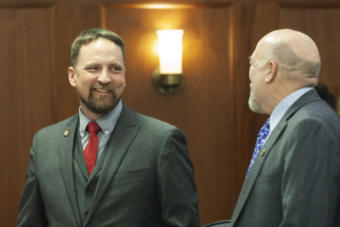
Rep. Ben Carpenter, R-Nikiski, talks to Rep. Adam Wool, D-Fairbanks, on Tuesday, January 21, 2020 in Juneau, Alaska. (Photo by Rashah McChesney/KTOO)

An extra $1,000 check for each resident would require another $700 million from the fund — in addition to the $3 billion in permanent fund earnings that lawmakers have already put toward the state budget.

The largely-Democratic House majority and mostly-Republican Senate majority have both rejected the idea of going beyond the $3 billion limit; members say doing so would come at a cost to future generations of Alaskans.

Even without the stimulus payment, one House majority member, Anchorage GOP Rep. Chuck Kopp, said this year’s budget and its $1,000 dividend will drain Alaska’s savings accounts to perilously low levels. But the dividend was needed to secure support from enough House minority members to reach a 30-vote supermajority required to pay for the full budget, Kopp said.

“A thousand-dollar dividend this year was completely irresponsible, but politically necessary to get out of Juneau,” Kopp said. “There was no amount of persuading and logic that was going to walk them back.”

Boosters of the stimulus concept — who continue to push the idea even though lawmakers have left Juneau — argue that the coronavirus pandemic is an unprecedented crisis that demands an unprecedented response.

“This is once in several generations. When’s the last time that we had something this dramatic and this damaging to our economy?” said Carpenter, the Kenai Republican. “Fifty years from now we’ll look back and say: ‘Totally justifiable. I get it.’”

Without specifically endorsing the stimulus concept, one Alaska economist said he thinks that spending extra money from the permanent fund to prop up the state’s sputtering economy will be unavoidable. The account is a rainy day fund, said Mouhcine Guettabi, associate professor of economics at the Institute of Social and Economic Research.

“It’s pouring,” said Guettabi, whose initial analysis of the pandemic’s effects says the state could lose 50,000 jobs. “The economy is just halted right now. And the state is going to have to intervene by spending money over the next year. I just don’t see any way around it.”

That spending could take the form of aid to local governments, who face revenue shortfalls from a crash in tourism-related taxes, Guettabi said. Or it could be a backstop for businesses or individuals who need more help than is available in the recently-passed federal relief package.

That federal package contains at least $1.25 billion for Alaska, and some policymakers see the money as a cushion that could soften the coronavirus’ impacts on the state budget. But the outlook will still be bleak when lawmakers return to Juneau, whether that’s next year or even sooner.

Even if oil prices rise to match projections and lawmakers pay no dividend at all next year, the remaining deficit would be $100 million more than the state has in the Constitutional Budget reserve, according to legislative budget analysts.

A drop in oil production would make the problem worse. So would a lasting downturn in financial markets, since the size of the sustainable draw from the permanent fund is tied to investment performance.

“We’ve had our oil and our endowment and the depletion of our savings as our revenue source,” said Pitney, the legislative budget analyst. “We have now depleted our savings. And our oil revenue and our endowment revenue is not sufficient.”

Anchorage officials: City needs COVID-19 protective gear, including homemade masks, ‘immediately’

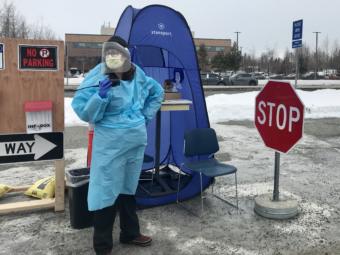
Trish Siza was the first health care provider to greet people in Anchorage seeking COVID-19 testing earlier this month at a drive-thru testing location. (Photo by Casey Grove/Alaska Public Media)

Anchorage officials are again asking people, businesses and medical providers to donate protective equipment “immediately,” including homemade masks, because of a shortage amid the coronavirus pandemic.
“Despite generous community donations so far, Anchorage continues to face a shortage of personal protective equipment and medical supplies,” the Anchorage Office of Emergency Management said in a plea to residents Saturday morning.

The city issued a similar message a week ago. Since then, its needs have grown to include “non-contact thermometers” — ones that can take people’s temperature without touching them, like with infrared technology. It’s also looking for “universal transport media,” which are the tubes used to stabilize test samples.

The city is also looking for gloves, masks, gowns and face shields. Open and expired equipment are acceptable, as long as it’s not used.

The city also said the Anchorage Fire Department needs homemade masks, as long as they’re made of a “single layer of tightly-woven material,” like dish towels, bed sheets or anti-microbial pillowcases.

Those masks will be used for patients that the department’s first responders are picking up — not for the responders themselves, who are still using traditional medical equipment, said Audrey Gray, a spokesperson for the city’s emergency operations center.

“Right now, they’re using medical-grade surgical masks, and they’re running low. So they just want to make sure they’re conserving those for actual medical use, instead of using them on patients,” Gray said. “It’s not ideal, but it’s what times are calling for at this moment.”

Homemade masks must be able to be washed and dried on high heat, and people should wash their hands and keep things clean when making them — don’t make them if you have any symptoms of respiratory illness, the city said. Packs of 25 or less can be placed in a clear zip-close bag.

All donations can be dropped off at CrossFit Alaska, 9191 Old Seward Highway, between 9 a.m. and 5 p.m., seven days a week.


Alaska health officials still want you to go outside. Just keep your distance.

Denali and hiker backpacker
A backpacker looks at Denali in the distance in a photo dated Jan. 11, 2016. (Public domain photo by Kent Miller/National Park Service)

One of the biggest casualties of the coronavirus pandemic is fun — there are no sports, no going out to bars or movies.
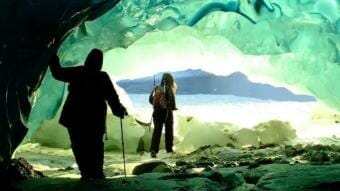
But Alaska is one of the world’s premiere places for outdoor recreation, and public health officials here say that residents don’t have to stop going outside, as long as they’re careful.

“I don’t think there should be any risk, as long as people are adhering to the social distancing,” said Dr. Joe McLaughlin, the state epidemiologist. “It’s really important that people stay healthy and stay fit.”

Even McLaughlin, who’s at the forefront of the state’s response to the pandemic, is still carving out time for recreation — including a bike ride Thursday night.

“That was so, so helpful for me to just maintain my inner equilibrium,” he said. “But it’s been a little bit more difficult, recently.”

McLaughlin isn’t the only Alaskan turning to the outdoors amid the pandemic. Officials in Anchorage and other cities and towns have ordered residents to “hunker down” in their homes, but those measures still allow people to blow off steam on trails and in other public spaces. Even Gov. Mike Dunleavy’s shelter-in-place order announced Friday includes a carve out for exercise, as long as people stay six feet away from each other.

Officials said they’ve seen droves of people turning out to state parks in the past week, with the most pressure on popular trailheads in the Anchorage area like at Glen Alps, Prospect Heights and Hatcher Pass.

“I have never, ever seen it so busy, where you couldn’t find a parking spot. It was insane traffic, where people were just waiting outside to see if they could get a parking spot,” said Wendy Sailors, a state parks spokeswoman, who drove to the Prospect Heights trailhead Sunday. “There were bikes, there were skiers, there were families with kids, there were walkers, there were dogs.”

The state parks division issued a press release Friday saying that workers are doing the best they can to keep up with demand. “But they need help from the public,” it said.

Instead of picking one of the Anchorage area’s busier trailheads, Sailors suggested residents take a slightly longer drive to a place like Eklutna Lake, or to one of the many trails on the Turnagain Arm. She also said the parks are quieter early in the morning.

Meanwhile, in interviews, public health officials outlined a number of best practices and precautions that people should follow when going outside.

First, as much as it might be frustrating, they said they don’t want kids using playgrounds during the pandemic. One of the two likely ways the coronavirus spreads is on contaminated surfaces, and that’s a particular concern for children, who can be infected without showing symptoms.

“Kids have trouble social distancing — the little ones, they want to play, they don’t understand what’s going on,” said Darcy Harris, who manages the environmental health section of Anchorage’s health department. “Sharing playground equipment right now is probably not the best choice.”

It’s also not a good time to carpool to a trailhead, at least with people outside your family, given the guidelines for at least six feet of social distancing.

And McLaughlin said people should be very careful about using public bathrooms at trailheads, like Glen Alps. Those bathrooms have what epidemiologists call “high-touch surfaces” — their term for spots that lots of people can touch and potentially spread germs. And the coronavirus has also been found in poop.

After using a public bathroom, people should wash their hands; if that’s not possible, use sanitizer with at least 60% alcohol, McLaughlin said.

People should also be aware of wiping their noses with their mittens or hands while they’re outside, and try to take off their gloves before opening the door to their houses. And people should avoid spitting, or anything else that involves depositing bodily fluids directly into the environment.

“Please do not do the snot rockets and blow your nose when other people are around,” McLaughlin said. “We want people to be really mindful of how this virus transmits — and just be conscious of the ways you can prevent exposing yourself, and ways you can prevent exposing others.”

One piece of good news? Health officials don’t see pets as a source of infection. But they note that they can still carry germs, so be careful about touching your face if you’re going to play with somebody else’s dog or cat.

Other than from surfaces, the main risk of getting COVID-19 comes from “close contact” with infected people — generally defined as spending five or 10 minutes within six feet. So just remember to keep your distance when you’re outside, officials said, particularly if you see someone coughing or sneezing.

And if you have to pass someone on a narrow trail?

“If you can’t get six feet away, just sort of turn away and pass quickly,” McLaughlin said. “Whatever you can do to minimize the risk of transmission of the virus through those respiratory droplets.”

State proposes $100M loan guarantee program as Alaska businesses seek approval for out-of-state workers

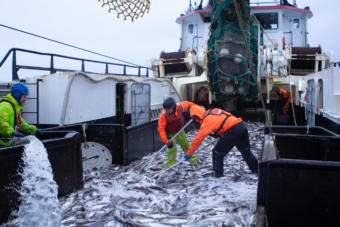
Crew members Brian Hagen, left, and Derrick Justice shovel pollock on the deck of the Commodore on Thursday, January 24, 2019. (Photo by Nathaniel Herz / Alaska’s Energy Desk)

Some 600 business entities have filed plans with the state outlining how they’ll safely bring out-of-state workers into Alaska to support “critical infrastructure” amid the coronavirus pandemic, officials said Wednesday.

Starting Wednesday morning, Gov. Mike Dunleavy is requiring people arriving in Alaska from out of state to self-quarantine for two weeks to prevent the spread of COVID-19, the disease caused by the coronavirus. People who disobey the order can be fined up to $25,000 or imprisoned for a year.

Exemptions are possible, however, for businesses in what Dunleavy’s administration calls “critical infrastructure.” Those include the oil, logging and mining industries, health care, grocery stores, airlines and fishing.

Businesses in those industries who have workers coming to Alaska before May were required to file pandemic plans with the state by Tuesday afternoon. The plans call for procedures for safely bringing in workers from out of state, and for protecting other employees and the surrounding community.

Dunleavy’s administration said that to the greatest extent possible, incoming workers should still self-quarantine once they get to Alaska. But in cases where that’s not possible, businesses were asked to explain why, and to outline their alternative to quarantining.

The deadline for businesses to submit the plans originally came less than 24 hours after Dunleavy announced the travel restrictions, which forced some of them to scramble.

“I was hearing from fishermen who were relaying through their processors that they’re out on the ocean right now fishing, and what are they supposed to do?” said Frances Leach, executive director of the United Fishermen of Alaska.

Leach said the state allowed different fishing industry associations, like the ones representing crabbers or cod harvesters, to submit general plans for their vessels and captains, which made the process easier.

She said members have had a hard time keeping up with the information and protocols they’re supposed to be following amid the pandemic. But they also recognize that these are unprecedented times, she added.

“You know, we’re all in this together. We’re all trying to quickly get up to speed,” Leach said. “And so far, I have found that most everybody has been really patient and understanding. And they get the severity of this.”

Jeremy Zidek, a spokesperson for the state’s unified COVID-19 command, couldn’t give a timeline for how long it would take the state to review all of the businesses’ response plans. Leach said the state is allowing vessels that have turned in their action plans to continue their operations as if the plans have been approved.

Meanwhile, Alaska’s economic development agency is proposing a loan guarantee program of up to $100 million to support the state’s businesses as they fight for survival amid the coronavirus pandemic.

If approved by the Alaska Industrial Development and Export Authority board at an emergency meeting Friday, the program would work with banks, not directly with businesses. Businesses that have established borrowing relationships with banks would be able to add up to $1 million to their existing loans, and AIDEA would guarantee the extra amount.

The program would be called the Sustaining Alaska’s Future Economic Guarantee Program, or “AK SAFE,” and it would last as long as Dunleavy’s coronavirus emergency proclamation. The initial proposal is to budget $50 million for the program, which could rise to $100 million if state lawmakers approve.

A spokesman for the authority, Karsten Rodvik, declined to share additional information about the proposal.

The pandemic of COVID-19 has devastated Alaska’s economy. The price of oil, the state’s major industry, has crashed amid lower demand and a standoff between some of the world’s major producers. Tourism is also facing a barren summer as people curtail their travel, and in-person service at restaurants and bars is closed indefinitely.

AIDEA’s agenda at its Friday meeting underscores that economic havoc. One item is a request by an oil company BlueCrest Energy, to delay principal payments on a $13.2 million state loan for a year due to the pandemic.

“The collapse in oil prices due to actions of foreign governments, exacerbated by the economic downturn from the COVID-19 pandemic, has resulted in the borrower encountering severe cash flow problems, and oil prices are not expected to recover in the immediate future,” the proposal said.

A second agenda item asks board members to add $2.5 million to an existing loan to the Blood Bank of Alaska. The request cites Dunleavy’s order that health care providers stop performing elective procedures for three months to free up capacity for COVID-19 patients.

“Elective procedures are approximately 50% of the blood bank’s revenues,” the authority’s staff wrote in a memo to board members.


Site notifications
Update notification options
Subscribe to notifications