Nat Herz, Alaska Public Media

Listen: This Anchorage resident’s elderly parents were stuck on the coronavirus cruise

Robert Jackson, 84, and Karrold Jackson, 81, were passengers on the Grand Princess, the cruise ship held for days off the California coast after passengers tested positive for coronavirus. (Photo courtesy Erin Jackson)

Imagine this: Your parents are in their 80s. They both have chronic health conditions. And they’re stuck on a cruise ship with people who have the coronavirus — and they can’t get off.

For Anchorage resident Erin Jackson, this isn’t a nightmare — it’s reality. Her parents were on the Grand Princess, the cruise ship kept at sea for days off San Francisco as officials debated what to do with the passengers.

Jackson said her parents had heard about the virus before leaving on the trip to Hawaii and Mexico, but without a stern warning from federal health officials, they decided to go anyway.

Jackson’s parents were supposed to leave the ship Tuesday, but she doesn’t know whether or where they may have to be quarantined.

If you need to be tested for coronavirus in Alaska, it’s likely free

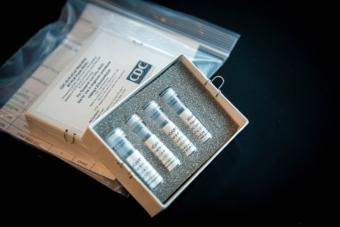
COVID-19 diagnostic panel. (Public domain photo from Centers for Disease Control and Prevention)

If you need to be tested for coronavirus in Alaska, it’s likely free.

The Alaska Division of Insurance is barring the companies it regulates from charging people for COVID-19-related testing, as long as it’s medically necessary. It’s also asked that companies waive any payments for the office visit associated with testing.
Alaska’s health department has been doing all the state’s testing free of charge, but private testing providers are starting to ramp up to ease a supply crunch.

“We want people, certainly, if they are presenting symptoms, to be able to go to their physician or their provider and not have to worry about the cost-sharing,” said Lori Wing-Heier, Alaska’s insurance director.

Wing-Heier’s division has also asked insurers to allow members to get early refills of their prescriptions, in case they’re required to isolate themselves at home.

About 50,000 people are in plans impacted by the directives — those who get their insurance through the individual marketplace or a small group plan. If your plan is through a large employer, a public agency or a union, Wing-Heier recommends asking your insurer for details about testing costs.

At least two of Alaska’s private insurers, Premera Blue Cross Blue Shield and Moda Health, say they’re complying with the state’s order to provide free testing. They’re also following the recommendation that fees for office visits be waived.

“We don’t want to have any barriers to access for testing or any other related expenses to get in the way of people getting tested and treated for this,” said Jim Grazko, the top Alaska executive at Premera, which has about 150,000 members in the state.

Grazko spoke from his home office in the Seattle area, as Premera employees try to avoid infection amid more than 260 diagnosed coronavirus cases in Washington state.

The free coverage applies to both in- and out-of-network providers, Grazko said.


Dunleavy urges calm as a volatile economy adds to coronavirus anxiety

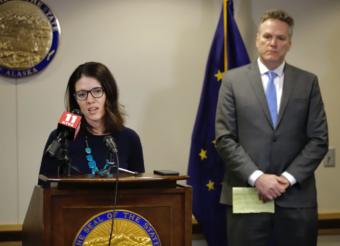
Alaska Chief Medical Officer Anne Zink talks to reporters at a press conference about the coronavirus on Monday, while Gov. Mike Dunleavy looks on in the background. (Photo by Joey Mendolia/Alaska Public Media)

As the coronavirus continued to upend the global economy Monday in ways that threaten the stability of Alaska’s budget, the Alaska Permanent Fund and the tourism industry, Gov. Mike Dunleavy called a news conference to soothe Alaskans’ anxiety.

“I just want to reassure Alaskans that we’re on this,” he said to reporters gathered in his Anchorage office. “We’ve got this.”

Alaska still has no confirmed cases of the virus. The state reported that 32 people had been tested by Monday afternoon. Nine of the tests were pending, but the rest were negative.

In Washington state, the center of the epidemic in the U.S. and a hub for travelers heading to and from Alaska, officials confirmed 162 cases of the virus, including 22 deaths.

Across Alaska, businesses and local officials were making emergency plans. The Municipality of Anchorage partially activated its Emergency Operations Center, allowing staff to work longer hours and draw support from other agencies. The University of Alaska said it had formed an “incident team” to plan for outbreaks on its campuses, while the Anchorage School District began its emergency planning before spring break. Dunleavy also canceled a series of community meetings to focus on the state’s response to the virus.

State health officials said they have loosened limits on who can be tested for the coronavirus, as their capacity to test ramps up. The state can now test as many as 500 people, up from 200 or fewer last week, health officials said.

Before Friday, the state was prioritizing tests for people in the hospital with an unexplained fever and “severe, acute lower respiratory illness,” like pneumonia. Now, that criteria has been broadened slightly to include any respiratory illness requiring hospitalization, not just pneumonia.

Louisa Castrodale, a state epidemiologist, said the change was “to really give providers a little more leeway in saying, ‘Yeah, this person’s sick, but they’re not in that really intensely severe category.’”

She stressed that sick patients who weren’t tested under the tighter criteria have still been followed by their healthcare providers.

“We definitely have providers who say, ‘My plan is to continue to have a conversation with this patient — and you might hear from me tomorrow,’” she said.

One other thing that’s helping to stretch test supplies, Castrodale said, is new federal guidance allowing labs to mix together some of the multiple swabs it collects from each person. Previously those swabs had to be tested individually.

Meanwhile, politicians, economists and tourism officials were pondering what the coronavirus-related volatility in the national and global economy means for business and Alaska’s budget.

Benchmark oil prices crashed some 20% Monday, which could erase hundreds of millions of dollars in state revenue unless that trend reverses.

Meanwhile, federal officials warned against traveling on cruise ships, which are a lynchpin of Southeast Alaska’s tourism economy. The cratering stock market has also stripped more than a billion dollars in value from the Alaska Permanent Fund, which pays for residents’ permanent fund dividends and part of the state budget.

If Monday’s drop in oil prices persists for the long-term, it could cost the state some $300 million in revenue. But Dunleavy said he has no immediate plans to change his budget proposal.

“I would say this is definitely a momentary bump in the road for Alaska. Our oil patch is in it for the long haul,” he said. “With regard to the stock market I, too, believe that the underlying fundamentals of the U.S. economy is pretty strong.”

Not everyone is as optimistic. Mouhcine Guettabi, an economist at University of Alaska Anchorage, said he’s far less certain that the downturns will be temporary, pointing to the cancellation of classes at Ivy League schools as one example. At the University of Washington in hard-hit Seattle, meanwhile, classes are shut down until the end of the spring semester.

“I wish I could tell you, ‘Three months is the maximum amount of time we will be dealing with this,’ or, ‘It’s a two-year situation,’” Guettabi said. “I honestly don’t know.”

Guettabi noted that some 90% of the state’s revenue comes from oil and the permanent fund’s investments, and he said the state can’t hide from that.

“The thing that it exposes is just how vulnerable Alaska is,” he said. “Because it’s the perfect storm of sorts — there’s exposure, from a budgetary standpoint, to the two big sources of money.”

Alaska’s Energy Desk editor Julia O’Malley contributed to this story from Anchorage.


Hilcorp revived this declining North Slope oil field. Can it do the same for Prudhoe Bay?

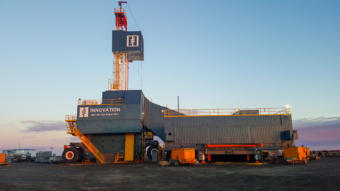
Hilcorp has used its Innovation drilling rig as part of its program to revitalize oil production at the Milne Point field on Alaska’s North Slope. (Photo courtesy of Hilcorp)

For three decades, the overarching story of Alaska’s big North Slope oil fields has been one of decline, with production gradually sinking as companies pumped out the most easily-accessible crude.

But over the past few years, at one of the basin’s oldest developments, something unusual happened: Production actually increased, and not just by a little.

In 2018, the Milne Point field pumped slightly less than 21,000 barrels a day. In January, it was up to nearly 32,000 barrels daily — a difference that, at today’s prices, is worth an extra $3.5 million a week.

The architect of that turnaround is Hilcorp, the privately-owned oil company that bought a 50% stake in Milne Point in 2014. Now the company is poised to acquire a much bigger prize as part of its $5.6 billion deal with BP: a piece of the massive Prudhoe Bay field.

The oil industry is the biggest private-sector driver of Alaska’s economy, and the source of one-third of the state’s revenue. That means observers of the industry will be closely watching to see if Hilcorp can engineer the same turnaround at the much larger Prudhoe Bay field as it did at Milne Point — where it says it created hundreds of jobs and invested more than a half-billion dollars.

“This is a big leap for a company of this size,” said Mark Myers, a former Alaska natural resources commissioner.

Myers, a petroleum geologist, said that redevelopment opportunities exist at Prudhoe Bay. But because of the “size of the prize” there, Prudhoe Bay’s owners have been more aggressive about extracting oil, he added, compared to the history at Milne Point before Hilcorp took over.

An oil rig contracted by BP looms on the horizon at Prudhoe Bay. (Photo by Elizabeth Harball/Alaska’s Energy Desk)

“Prudhoe has been worked a lot harder. So I think those opportunities are going to be more difficult,” he said. “They’re bigger in scale, but they’re more difficult.”

Prudhoe Bay is the largest field on the North Slope and remains one of North America’s most productive, pumping about 230,000 barrels of oil daily. When the deal closes, Hilcorp will assume BP’s 26% stake in the development and take over as operator.

It’s too soon to say whether the company will be able to boost production at the field, said Jason Rebrook, Hilcorp’s president. But he noted that Prudhoe Bay’s geology and structure are similar to Milne Point’s, which gave the company confidence in striking its deal with BP.

“We’re in the process of looking at the field hard. But our goal is always the same,” Rebrook said in an interview. “It is the biggest legacy field that we know of. And our goal is to come in there and extend the field life.”

Both Prudhoe Bay and Milne Point have been producing oil for more than 30 years, making them attractive targets for Hilcorp.

The major companies that built those fields have higher overhead costs and more layers of management, which can be helpful in bringing a big new project online on schedule and under budget. But those same qualities can make it harder to efficiently deliver the smaller projects and incremental improvements needed to wring more oil from fields where production has already peaked.

Hilcorp, a so-called “independent” oil business, has become known for reviving aging infrastructure that’s no longer attracting investment from its original developers. In its first Alaska business deal in 2012, it bought out Chevron assets in Cook Inlet, near Anchorage, that included decades-old offshore oil platforms.

Two years later, Hilcorp announced it was buying its first North Slope projects, which included a 50% stake in Milne Point and interests in three other fields.

Milne Point, about 25 miles northwest of Prudhoe Bay, was developed in the mid-1980s, with BP taking over as operator in 1994. Within a few years, the company was pumping more than 50,000 barrels a day. But decline quickly set in by the mid-2000s, with production down by more than half over the following decade.

A BP spokesperson declined to comment. But the company has, in the past, described technical challenges at the field, like poor pump performance in some of its wells. It has also said that some of the projects contemplated for Milne Point wouldn’t have paid off well enough to merit investment.

(Map by Hannah Lies/Alaska Public Media)

For Hilcorp, BP’s challenges presented an opening.

“It’s a large field. It hadn’t had as much capital spent on it,” Rebrook said. “We had a pretty good sense that there was a lot of upside there.”

Hilcorp has drilled new wells, reworked existing ones and ultimately created a new drilling platform called Moose Pad.

Hilcorp says the pad was the first one built at the field since 2002, and it took half the time and cost one-third as much as traditional pads on the North Slope.

BP, having kept a 50% stake in the field, also invested in those projects, saying that Hilcorp’s leaner business model made the proposals more attractive.

“We saw them deliver a new pad faster, more efficiently and more effectively than, frankly, we would have — or than we did for many years,” Damian Bilbao, a BP executive, said at a legislative hearing last month.

While Hilcorp has tested unconventional extraction techniques at Milne Point and focused on different pools of oil, its overall strategy at the field was not especially innovative, according to industry experts and its own executives.

Much of Hilcorp’s success there comes from the basics: drilling new wells and building the new pad. Between 2006 and 2013, BP drilled 30 wells, according to data from the Alaska Oil and Gas Conservation Commission. Hilcorp has drilled 61 in the past five years, including 24 in 2019.

“The biggest impact has been with the drilling of new wells, and developing the reservoir into areas that hadn’t been developed,” said Steve Moothart, an Alaska Department of Natural Resources petroleum geologist.

Hilcorp’s work at Milne Point has brought money and jobs to the state: The company says it has spent $700 million at the field, and grown the workforce to as many as 400 from 90 when it took over.

Hilcorp has more pads planned at Milne Point, and the company expects production to reach 40,000 barrels a day by the end of the year, up from some 32,000 in January.

“We feel pretty confident that we can maintain that, and look to grow that over time,” said Rebrook.

Next, the company will turn its attention to Prudhoe Bay. Hilcorp will be working with two other partners in ExxonMobil and ConocoPhillips, which each own a roughly one-third stake in the field.

(Graphic by Nat Herz/Alaska’s Energy Desk)

Those companies will have to agree to pay their share of any of Hilcorp’s proposed projects.

ExxonMobil didn’t respond to a request for comment. In a prepared statement, ConocoPhillips spokesperson Natalie Lowman said the company is looking forward to working with Hilcorp.

“Hilcorp has a reputation and strong track record in Alaska of reducing operating costs and increasing production in older fields,” Lowman said. “We will be working with Hilcorp, much as we did with BP, to manage the field and develop investment opportunities.

Rebrook, Hilcorp’s president, said Prudhoe Bay will take time for the company to study, and he noted that its deal with BP still hasn’t been approved by regulators. But the company does aim to boost the number of drilling rigs working there, he added.

“Our goal is to come in there and extend the field life,” he said. “We obviously think there’s a lot more opportunities to drill and develop.”


Kaktovik is crawling with polar bears. Now a man is going to prison for wasting one.

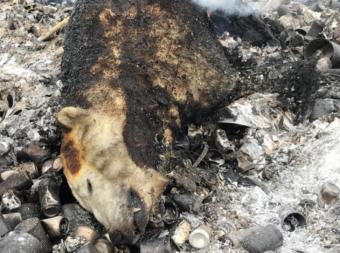
The remains of the polar bear shot by Chris Gordon sit in the Kaktovik dump, as shown in a prosecutors’ memorandum filed in federal court. (Photo courtesy of U.S. Attorney’s Office)

At the southern edge of Kaktovik, a tiny village on Alaska’s North Slope, the polar bear came around Chris Gordon’s yard on a winter night in 2018. He’d left whale meat out that was being prepared for a village feast — a common practice.

The bear wouldn’t go away. Gordon shot and killed it. Polar bears are a federally-protected marine mammal listed as “threatened” under the Endangered Species Act.

“Got put down tonight,” Gordon wrote in a Facebook post, which showed the bear’s carcass lying in his yard next to a snowmachine. He added later: “I did what I know is right. I can’t let a bear feast on what’s going to be shared.”

An image from a Facebook post by Kaktovik resident Chris Gordon showing the dead polar bear that he shot outside his house, where it was trying to eat frozen bowhead whale meat. (Image courtesy of U.S. Attorney’s Office)

On Feb. 28, a federal judge sentenced Gordon, 36, to pay a $4,500 fine and serve three months in prison — not for killing the bear, but for what he did afterward.

As a coastal-dwelling Alaska Native, Gordon was entitled to kill the bear by the Marine Mammal Protection Act, but only if he did so without wasting the animal. But instead of harvesting its meat or salvaging the bear’s skin, Gordon left the carcass in his yard for five months before having it moved to the village dump and burned, he acknowledged in a plea agreement filed in December.

“We know that the parties were preparing muktuk in the traditional fashion. That’s all part of village life, and that’s fine,” Judge Ralph Beistline told Gordon at sentencing on Feb. 28. “We’re not criticizing shooting the bear. We’re criticizing the manner in which it was dealt with once killed.”

Gordon’s criminal prosecution, for a single violation of the Marine Mammal Protection Act, is unusual. But his case underscores the tensions that arise as polar bears increasingly disrupt village life in Kaktovik, where climate change is melting nearby sea ice and driving the bears ashore.

Some villagers have capitalized on the bears’ presence by becoming tour guides, charging visitors thousands of dollars to travel to Kaktovik and see the bears from the safety of boats. But other residents argue that the tourism boom is making the bears more comfortable around people, and risking everyone’s safety.

In the last tourist season, there were two “close encounters” with polar bears that “almost killed some people,” Edward Rexford, the president of Kaktovik’s tribal government, told Beistline at the sentencing hearing.

“We are getting a lot of negative impacts from that tourism. Polar bears are getting habituated to humans and causing human health and welfare problems,” Rexford said. “This is a very dangerous community that we live in.”

Gordon’s case, which grew out of a late December evening in 2018, underscores some of those dangers, even as his response drew community condemnation.

In addition to his federal prison sentence, Kaktovik’s tribal government and a polar bear management council jointly imposed additional penalties on Gordon: three years of probation, $1,000 in restitution, 300 hours of community service, a public apology to the village and a year-long ban on subsistence polar bear hunting.

Chris Gordon, center, sits during a meeting about polar bear management in Kaktovik in June 2019. (Photo by Nat Herz/Alaska’s Energy Desk)

Gordon, a captain of one of Kaktovik’s whaling crews, had left small portions of bowhead whale meat spread around his yard in the sub-zero temperatures. Bowhead is an important subsistence food source for Kaktovik; Gordon was preparing the meat for a village feast in a traditional style that keeps the chunks from freezing together, his attorney wrote in a sentencing memorandum last week.

The North Slope’s borough government runs a polar bear patrol program in Kaktovik. But that night, members weren’t working, Gordon and Rexford both said at the Feb. 28 hearing. Gordon also said he tried called an emergency number.

“I didn’t want to kill it. Really,” Gordon said. But he’d run out of nonlethal ammunition and, Gordon added: “That thing just kept coming back.”

Prosecutors noted that Kaktovik has bear-resistant food storage lockers available that Gordon chose not to use.

After the shooting, a member of the U.S. Fish and Wildlife Service, which manages the nearby Arctic National Wildlife Refuge, told Gordon “multiple times” that he needed to tag and report the bear. But he did neither, according to prosecutors.

Gordon told USFWS agents in an interview that he didn’t harvest the bear’s meat because he didn’t want to spill its blood around the frozen whale, prosecutors said.

“I did what I wanted to do to stop it from eating my muktuk,” Gordon said, according to prosecutors’ sentencing memorandum. “I asked a few people if they wanted it, they said ‘no.’”

As the dead bear languished in Gordon’s yard, it drew attention and dismay from other Kaktovik residents — including one unnamed witness who posted a video about it on Facebook. At the sentencing hearing, prosecutors played the clip, in which a woman describes the scene outside Gordon’s house over the sound of an idling four-wheeler.

“Here we have a dead nanuq (polar bear), because this family refused to put their food away properly and be shepherds of this blessing. I am so upset right now. Kaktovik, we need to come together and stop this,” the woman said. “This is not okay, and it’s crossed a line.”

After the woman posted the video, prosecutors said that the Alaska Eskimo Whaling Commission — a group that Gordon belongs to — pressured her to take down her post. The group told her it “could potentially harm their subsistence and whaling rights,” prosecutors said.

The commission’s executive director, Arnold Brower, did not respond to a request for comment.

A few weeks after the bear was killed, it was hit by a snow removal vehicle, ripping off one of its paws. Then, in May, Gordon had another village resident take the carcass to the village dump, where workers were burning trash. USFWS agents later found the bear’s “charred remains” there, prosecutors wrote in their sentencing memorandum.

“The single paw, ripped off by the snow removal vehicle, remained on defendant’s lawn,” prosecutors wrote in their sentencing memorandum. “The next day, the defendant told federal agents that they could take the polar bear’s paw because it would ‘save me a trip to the dump.’”

Parts of the polar bear killed by Kaktovik resident Chris Gordon, as shown in a prosecutors’ memorandum filed in federal court. (Photo courtesy of U.S. Attorney’s Office)

In Gordon’s own sentencing memorandum, his attorney, Brian Stibitz, argued that the federal government’s case against him demonstrated a misunderstanding and ignorance of Alaska Native “custom and cultural practices” — in particular, by suggesting that Gordon was irresponsible for leaving the bowhead meat in his yard. That method “is a traditional method of preparing muktuk, and is encouraged among whaling captains,” Stibitz wrote.

Stibitz’s argument echoes a separate one also made by village residents: That USFWS, which manages the neighboring Arctic Refuge, prioritizes the well-being of polar bears and tourists over the safety of Native people who live in Kaktovik.

“We know and respect the interest that the urban people seem to have in protecting the endangered species of animals and plants here. What about us?” Fenton Rexford, a Kaktovik elder, asked USFWS officials at a June community meeting.

Federal authorities said they did not pursue the case against Gordon lightly, or out of a lack of sensitivity to the impact of polar bears on his village. Gordon’s violation of the Marine Mammal Protection Act, prosecutors argued in their sentencing memorandum, was “brazen.”

In a prepared statement, a top USFWS official said that the agency has been “working closely with Kaktovik residents, leaders, and other partners for over a decade to address human-bear conflicts.”

“We understand the challenges bears pose to the community,” the statement quoted Steve Berendzen, the Arctic Refuge manager, as saying. “Together, we’ve taken some positive steps, including food-storage locker installation and local polar bear patrols. We’ll keep working with our partners to look at additional solutions.”


Alaska Supreme Court chief justice recuses himself from Gov. Dunleavy’s recall case

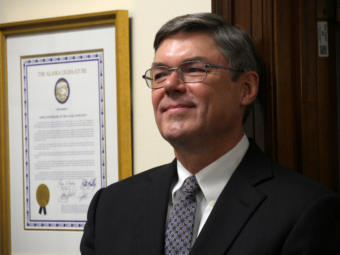
Alaska Supreme Court Chief Justice Joel Bolger waits outside the House Chambers in Juneau before delivering the annual State of the Judiciary Address to the Alaska Legislature on Feb. 20, 2019.
Alaska Supreme Court Chief Justice Joel Bolger waits outside the House Chambers in Juneau before delivering the annual State of the Judiciary Address to the Alaska Legislature on Feb. 20, 2019. (Photo by Skip Gray/360 North)

Alaska Supreme Court Chief Justice Joel Bolger has recused himself from the ongoing case that will decide the legality of the campaign to recall Republican Gov. Mike Dunleavy.

Bolger, in a two-page notice Monday, said he has made “public statements that could suggest a strong disagreement with the governor’s conduct on some very fundamental issues affecting the judicial branch, conduct that forms part of the basis for the recall petition under consideration.”

“In other words, this is a case where a reasonable person might question whether my judgment is affected by my overriding public responsibilities to the justice system,” he wrote. “I therefore recuse myself from further proceedings in this case.”

Dunleavy’s allies had criticized Bolger’s participation in the case because of statements the justice had made about issues connected to the recall campaign’s legal grounds for recall. Whether those grounds are legally sufficient is one of the questions that the Supreme Court will consider in the case, which is on appeal from Anchorage Superior Court.

One of the grounds cited by the recall campaign is Dunleavy’s refusal last year to appoint a judge to a position on the Palmer Superior Court within a legally-required 45-day window.

Bolger heads the Alaska Judicial Council, which nominates judges for the governor to select from. In response to Dunleavy’s refusal to select from the list of names submitted by the council, Bolger issued a statement saying that Dunleavy’s office didn’t seem to understand the Alaska Constitution’s requirements around the appointment of judges, and added that “the governor must appoint one of the candidates nominated by the council.”

Another of the recall campaign’s grounds is that Dunleavy violated the state’s “separation of powers” doctrine by using his line-item veto to cut the judiciary’s budget, in response to a decision by the Alaska Supreme Court that upheld protections for abortion. Months later, Bolger gave a speech at the Alaska Federation of Natives’ annual convention where he asked participants to push back against “political influence” of the courts.

“It’s absolutely essential that judges maintain independence to make decisions based on the law and facts and not on political or personal considerations,” Bolger said at the convention.

In an initial letter to attorneys involved in the recall case, Alaska Appellate Courts Clerk Meredith Montgomery wrote last month that Bolger “does not have any personal bias or prejudice concerning the parties or attorneys involved in this case, or personal knowledge of any disputed evidentiary facts.”

“And he knows of no other reason why he cannot render a fair and impartial decision in this matter,” Montgomery said.

Since then, though, attorneys have submitted the full record of the lower court’s previous consideration of the recall case, giving Bolger the chance to rule on his disqualification “with a better understanding of this record,” he wrote in his letter Monday.

“It is clear to me that the issue raised in this case —the adequacy of the grounds for recall of a sitting governor — mandates serious consideration of any potential disqualifying circumstances to maintain the public’s faith and confidence in the justice system,” Bolger wrote Monday.

Bolger will be replaced by a retired Supreme Court justice, Robert Eastaugh.

This story has been updated.

Site notifications
Update notification options
Subscribe to notifications