Nat Herz, Alaska Public Media

Alaska plans to more than triple its workforce of COVID-19 contact detectives

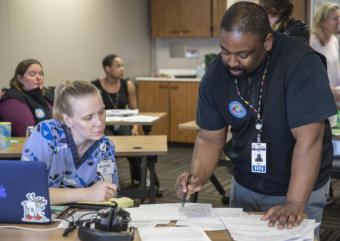
Anchorage School District nurse Bethany Zimpelman looks at informationwith Anchorage Health Department’s Michael Fritz during her shift at the Anchorage Health Department Tuesday, March 31, 2020. (Photo courtesy of Robert DeBerry/Anchorage School District)

As the nation’s economy reopens, experts say that one of the core strategies to contain the spread of COVID-19 is detective work: tracking and quarantining the contacts of people infected with the disease.

The State of New York is hiring as many as 17,000 people to do what’s known as “contact tracing,” and the Johns Hopkins Center for Health Security says that more than 100,000 tracers are needed nationally.

Alaska already has a group of 145 tracers that includes public health and school nurses, and officials say that they have enough tracking capacity for the 38 cases in the state that were active as of Thursday.

But with Gov. Mike Dunleavy moving to fully resume economic activity in the state, public health authorities are making a push to train hundreds more tracers, with the goal of hitting 500 in the next few weeks.

“We currently have the staff available. But we also don’t want to be in a place where we need them next week and we don’t have anybody who’s trained or engaged for that purpose,” Tari O’Connor, deputy director of the Division of Public Health, said in a phone interview this week.

Contact tracers are something like public health paramedics. When a new case of COVID-19 is confirmed, they’re assigned to call the infected person and interview them about who else they might have exposed to the disease. Those people are then contacted and asked to quarantine themselves, and they’re monitored daily for two weeks to see if symptoms develop.

Usually the work is straightforward, but sometimes it can involve more intense investigation, like earlier this year when an Anchorage public health nurse used a grocery store receipt to track down customers who stood next to a sick person in line.

To coordinate its new army of trackers and guard the confidentiality of the data they collect, the state health department has purchased new software called CommCare for $150,000 — a tool that’s also being used by public health agencies around the world, and in places like New Jersey and San Francisco.

It’s also launched a formal partnership with University of Alaska Anchorage’s College of Health to recruit and train the new group of tracers.

More than 175 people have already filled out an interest form, and the college aims to launch an online course in early June, said Gloria Burnett, director of the college’s Area Health Education Center.

Participants will be paid between $100 and $400 to take the course, depending on their level of health-care experience. Those who are then brought online as contact tracers will earn between $17 and $27.50 an hour, Burnett said.

It’s too soon to say how many contact tracers will be needed and how much the full program will cost; that will depend on the number of COVID-19 cases, said O’Connor.

“We’re trying to expand our capacity in a way that’s scalable and responsive to our actual needs,” she said. “We don’t want to commit a bunch of resources, up front, to contact tracing when they might be needed for testing or they might be needed for something else.”

Hiring decisions will be made partially based on health-care experience, said Burnett.

But the work of contact tracing also requires a human touch, since investigators have to make personal phone calls to people who may be infected with a deadly disease. That means recruiters will also be looking for a level of regional familiarity, Burnett said.

She’s encouraging people from rural and remote communities to fill out the college’s interest form even if they lack specific experience.

“We want to make sure we have as many people as we can turn to that are interested in this kind of thing, from as many communities as possible,” she said.

Public health officials are also talking with the state education department about recruiting more school nurses to help with the tracing effort. And they’re examining platforms developed by tech companies that could allow for contact tracing using people’s cell phones — though O’Connor said the state has not signed onto those efforts so far.

The goal of 500 trained tracers is roughly in the midpoint of estimates by various national groups about the number of workers needed based on an area’s population, O’Connor said. One group, the National Association of County and City Health Officials, says communities should have 30 tracers for every 100,000 people, which translates to just 220 tracers in Alaska.

Alaska already scores well on non-governmental assessments of states’ tracking bandwidth, said Sitka Democratic Rep. Jonathan Kreiss-Tomkins, who’s been working on national COVID-19 response initiatives.

But he said he’s still pleased to see the state boosting its workforce.

“It makes sense to have extra contact tracing capacity so that if there’s a surge in disease, we’re prepared, and can respond and contain,” he said. “This is the kind of move that all expert guidance suggests we should be taking.”

Alaska faces a deficit crisis. But its platform for publicly tracking the state budget is broken.

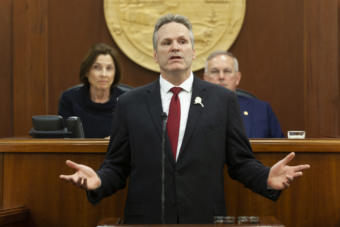
Alaska Gov. Mike Dunleavy speaks about the state's COVID-19 response from the Atwood Building in Anchorage on March 23, 2020.
Alaska Gov. Mike Dunleavy speaks about the state’s COVID-19 response on March 23, 2020, from the Atwood Building in Anchorage. (Creative Commons photo courtesy Alaska Governor’s Office)

As Gov. Mike Dunleavy’s administration is dealing with a huge budget deficit and a big windfall of federal coronavirus relief money, it has no timeline for fixing the broken portal that Alaskans can use to examine how state cash is spent.

The Sarah Palin-era “Checkbook Online” system has been broken for a month, and people at the state agency charged with maintaining it — the Department of Administration — say the department lacks the cash to fix the portal and is busy with financial software upgrades and responding to the COVID-19 pandemic.

Asked about the status of the Checkbook, a special assistant at the department, Kelly Hanke, responded with a one-page letter saying the system has been “removed from the web, until further notice,” and needs to be re-evaluated.

“It has become apparent that there is a need for internal controls and quality assurance measures to be put in place, as well as an auditing peer review process, before we can put it back online,” Hanke wrote.

She added that “checks and balances” are missing and said that there may be “errors in the coding” that can’t be fixed until the software upgrade is finished.

“At that time, we will then review the options for a Checkbook Online program,” Hanke wrote. “We do not have an expected date set for the online checkbook to be reinstated, nor do we have funding authority to properly address this item.”

The Checkbook system, launched by Palin’s administration in 2008, included records of state agencies’ payments to state contractors and grant recipients. It was updated monthly; watchdogs and reporters regularly reviewed the postings, and occasionally used them to point out payments to politically-connected recipients.

In mid-April, the Department of Administration stopped updating the platform and yanked nearly a year’s worth of state spending data off the internet, saying the data was being reviewed.

It wasn’t the first time the Checkbook system had gone down: Problems with another financial software upgrade took it offline for about six months in 2015, under former Gov. Bill Walker.

There’s currently no law that requires Dunleavy’s administration to maintain the system, though Anchorage Democratic Sen. Bill Wielechowski has proposed legislation to do that.

Senate Bill 180 would expand the Checkbook system to make sure it includes data from state authorities and corporations, not just agencies. The legislation is endorsed by the conservative group Americans for Prosperity, as well as by the more liberal-leaning Alaska Public Interest Research Group.

The Senate State Affairs Committee, chaired by Anchorage Republican Josh Revak, held a hearing on the bill in March, but it didn’t advance the legislation. Revak, in a phone interview Thursday, said he likes the bill and that lawmakers simply ran out of time to move legislation when the COVID-19 pandemic took hold.

Wielechowski, in a phone interview, said he wasn’t convinced by the Dunleavy administration’s explanation for why the Checkbook system was taken offline.

“We’ve had this system in place for 13 years,” he said. “And it just seems really odd that all of a sudden, it’s gone.”

Dunleavy will pick from three Anchorage judges, one attorney to fill Alaska’s open Supreme Court seat

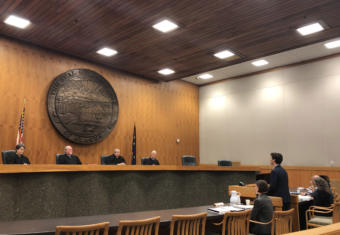
Attorney Andrew Welle argues before the Alaska Supreme Court in October 2019. (Photo by Elizabeth Harball/Alaska’s Energy Desk)

The Alaska Judicial Council has winnowed eight applicants for a vacant state Supreme Court seat to four, and now it’s Gov. Mike Dunleavy’s turn to choose.

The candidates are three Anchorage Superior Court judges — Dani Crosby, Jennifer Stuart Henderson and Yvonne Lamoureux — and Dario Borghesan, who works as a chief assistant attorney general for the Alaska Department of Law in Anchorage. Dunleavy will make his first appointment to the five-member Supreme Court from those four candidates.

Eight attorneys had applied to fill the seat that will open when Justice Craig Stowers retires June 1. The Alaska Constitution requires the nonpartisan judicial council — which consists of three attorneys appointed by the Alaska Bar Association, three non-attorneys appointed by the governor, and the chief justice of the Supreme Court — to screen candidates and nominate at least two people to fill judicial vacancies, whom the governor must choose from.

Henderson earned the highest overall rating — 4.4 out of 5 — on a survey of Alaska Bar Association members.

Crosby was rated at 4.3, Borghesan at 4.2 and Lamoureux at 4.1. The council passed over Palmer Superior Court Judge Jonathan Woodman, who scored 4.3, and Margaret Paton Walsh, a chief assistant attorney general in Anchorage, who scored 4.2.

Alaska’s quarantine order has helped thwart COVID-19 but devastated tourism. Will Dunleavy keep it?

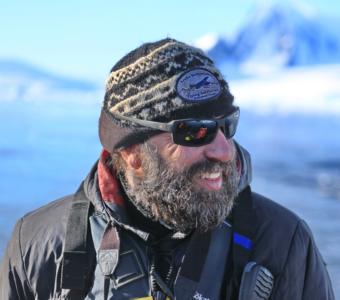
Michael Wald owns the guiding company Arctic Wild, which runs trips each summer to Alaska wilderness destinations like the Arctic National Wildlife Refuge and Katmai National Park and Preserve. (Photo courtesy Michael Wald)

Since late March, Arctic Wild has been in a deep freeze.

The guiding business normally takes clients to some of Alaska’s most spectacular wilderness destinations, like the Arctic National Wildlife Refuge and Katmai National Park and Preserve.

But two months ago, Alaska Gov. Mike Dunleavy said that all travelers coming into the state would have to quarantine themselves for two weeks — which effectively shut down Arctic Wild and an array of other tourism businesses.

“People aren’t going to come to Alaska and sit in a hotel room for two weeks to go on a 10-day vacation,” Wald said. “That’s a nonstarter.”

Public health experts have credited measures like the quarantine order with holding Alaska’s COVID-19 case count below every other state in the country, and at least one warns that revoking it could cause a flare-up.

Dunleavy’s order was set to expire May 19. On Friday, the governor announced the required two-week quarantine for people arriving in Alaska will remain in place through June 2.

Tourism advocates and leaders in industries like oil and gas and fishing, which depend on out-of-state workers, say they have not actively lobbied Dunleavy to drop the order; they say the decision is best left to public health officials. But they also note that the quarantine mandate has come with major costs for businesses.

Wald’s business has already lost 40% of his yearly income, and may have to return clients’ deposits, he said. And, Wald added, he’s eager for more details from the state about what kind of tourism will be possible in Alaska over the remainder of the season.

“We’re really anxiously awaiting some guidance from the state,” Wald said. “I’ve got clients calling and emailing every day: ‘Hey, what’s going on with our trip?’ And I don’t have an answer for them.’”

A spokesperson for Dunleavy did not respond to a request for an interview. An Alaska health department spokesman, Clinton Bennett, declined to make officials available for an interview, saying the state is evaluating data and aims to announce any changes this week.

The state has good reasons to proceed cautiously.

One of the hallmarks of COVID-19’s spread across the world has been travel, said Jared Baeten, an epidemiology professor and vice dean at University of Washington’s School of Public Health.

“The most connected places in the world — New York, for example — have had the most substantial outbreaks,” Baeten said. “The places that have been more isolated, particularly ones that have been able to seal themselves off, often have been able to contain the virus.”

If Alaska officials loosen the quarantine requirements, Baeten said, they should be simultaneously standing up different tools for containing the coronavirus and monitoring for its presence.

That could include systems like ramped up contact tracing, which is a technique to track who’s been exposed to infected people. Another option is fever screenings for people arriving in Alaska, or possibly some testing of incoming travelers, Baeten said.

Then, officials should assess the data every week to see if or how cases rise. They should also set thresholds ahead of time that, if crossed, would prompt the state to pull back.

“You’ve got to lay out all the public health strategies that can have impact, and then try to layer them together,” he said.

Some health care professionals remain skeptical about changing the quarantine mandate.

If it’s dropped, residents should expect a jump in cases, given a lack of capacity for widespread COVID-19 testing and contact tracing, said Ben Shelton, an Anchorage doctor who works with an advocacy group for emergency room physicians.

“We’re going to introduce it into the community,” he said. “And the way Alaskans are handling this, not wearing masks and not being cautious, it is going to flare up again.”

Officials in two major Alaska industries that rely on seasonal and out-of-state workers said that companies haven’t been pushing to have the quarantine mandate lessened, in spite of the fact that it’s added substantial costs to their operations.

Oil companies have been housing workers at Anchorage hotels during their two-week quarantines before they fly to shifts on the North Slope.

“It’s just the reality of the situation,” said Kara Moriarty, president of the Alaska Oil and Gas Association.

Seafood processing businesses have been going a step further, placing their workers under the watch of security guards to make sure they abide by the two-week quarantine.

Some companies are spending millions of dollars to comply with Alaska’s health mandates, but they see the quarantine as an important precaution and will keep it regardless of any changes to the state’s requirements, said Nicole Kimball, vice president at the Pacific Seafood Processors Association. The state has indicated that quarantine requirement specific to the processing industry will more likely be tightened than loosened, she added.

“I don’t see the seafood sector removing that part of their plans,” Kimball said. “It’s necessary to keep communities safe.”

Wald, with the guiding company, said the challenge for his business has been the uncertainty. He said he’s used to scheduling each day of his summers more than a year in advance, and now he can’t plan even two weeks ahead right now.

He said he’s waiting anxiously to see whether the two-week quarantine is going to stretch into the summer. And he also said he’s frustrated by how the country hasn’t used the past two months of social distancing measures to set up better alternatives to contain the virus, like widespread testing.

“If you could get people tested before a trip, you could operate, and then the economy would be functioning,” he said. “As it is, we can’t responsibly take people out, and it seems like a real failure of leadership. So I’m angry.”

This story has been updated to reflect that the governor’s mandate requiring a two-week quarantine for travelers arriving in the state has been extended until June 2.

Dunleavy will leave quarantine mandate in place for two weeks

A sign reminding people arriving in the region that the City of Dillingham has a 14-day self quarantine mandate in place. (Photo courtesy Sam Gardner/KDLG)

The required two-week quarantine for people arriving in Alaska will remain in place, Gov. Mike Dunleavy announced Friday.

Dunleavy’s quarantine mandate has been credited with helping to keep Alaska’s COVID-19 case count the lowest of any state, and it was set to expire Tuesday.  Alaska Department of Health and Social Services Commissioner Adam Crum said the mandate would be extended through June 2 during a press conference Friday evening. 

The required quarantine has posed a challenge to tourism businesses in particular, who say it’s unlikely that visitors will pay to spend two weeks in a hotel in Alaska before starting their vacations.

Complying with the mandate has also cost millions of dollars for businesses in oil and gas and fishing that rely on seasonal workers, who have been housed in hotels before flying to jobs on the North Slope and at seafood processing plants.

But representatives from each of those industries say they have not been lobbying officials to overturn the mandate, acknowledging the decision is best left to public health officials.

Alaska could be empty of tourists this summer. For residents, there’s an upside.

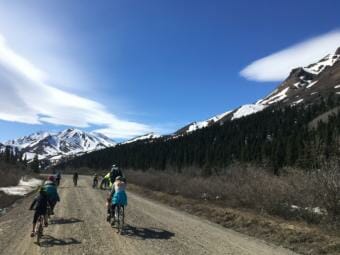
Bicyclists pedal up toward Sable Pass on the Denali Park Road on a Saturday in May 2020. (Nat Herz/Alaska Public Media)

After a spring of grim coronavirus headlines, Alaska faces a near-apocalyptic outlook for its summer tourist season, with few out-of-state visitors likely to follow through on plans to travel to the state this year.

But for a moment at Denali National Park and Preserve on a Saturday in May, a handful of tailgaters contemplated a few possible upsides: Resident discounts. Busy fishing holes transformed into blissful calm. Open roads normally clogged with RVs. Cruise destinations with no ships in sight.

“Think of how much fun Talkeetna is going to be when there aren’t hordes of people in the middle of the street!” said Rebecca Pottebaum, referring to the touristy town just south of Denali.

“That’s why we’re going to go to Juneau!” said her friend Julie Sweetin. “Juneau’s epic without cruise ships.”

The pandemic has all but vaporized Alaska’s tourism industry this year, with social distancing measures and quarantines effectively eliminating the normal summer deluge of out-of-state visitors. And questions linger about how comfortable people already in Alaska will feel about stepping aboard a chartered fishing boat or a park shuttle bus.

But some residents, businesses and land managers still see a possible silver lining in the devastation: A spring and summer in a world-class tourist destination — without the tourists.

On Saturday, Pottebaum, Sweetin and a few of their friends got a preview of options that could be open to them over the rest of the summer, when they parked at a gate 30 miles along the Denali Park Road and rode their bicycles deeper inside.

“One thing great about here in Alaska is we have these wide open spaces where you can be with your family or a single household, and then also social distance when you need to,” said Sarah Leonard, chief executive of the Alaska Travel Industry Association, the state’s leading tourism advocacy group. “This is a great time — if you can do it safely and you’re right here in Alaska — to visit a place that you might not have visited before.”

ATIA last month sent Gov. Mike Dunleavy a request for $25 million in federal COVID-19 relief, which it would put toward a national campaign to market Alaska “as a safe destination, when travel restrictions loosen.”

But before that happens, the group also wants an extra $1 million for an in-state campaign. The idea is to remind Alaskans that they can take stay-cations this summer, as most out-of-state visitors remain at home.

Dunleavy’s office referred questions about the request to the governor’s economic recovery team. Co-chair Mark Begich, the former U.S. senator, said the team has endorsed the idea and passed it along to Dunleavy.

There’s pent-up demand from Alaskans for the kinds of experiences that tourism businesses want to sell this summer, and the industry could use the boost, Begich added.

“We’ve been kind of cooped up for a little long here, right?” he said. “There’s going to be Alaskans who will want to take that road trip that they haven’t been able to do in years because they never could get a reservation, or they couldn’t get access, or the tour was sold out.”

Some tourism businesses are already trying to pivot to Alaska residents. On the Kenai Peninsula, Alaskan Fishing Adventures is offering 50% off “locals’ specials” trips, starting later this month.

The company, which runs boats out of Seward and Homer, usually offers similar discounts this time of year, said owner Mark Burner. But because of social distancing mandates, he’ll put fewer people on this spring’s charter trips and run the boats farther out from the harbor, likely making for better fishing.

“We’re not going to fish close. We’re actually going to take them out fishing and treat it as if it were a fully-paid charter,” Burner said. “It’s a hell of a deal.”

Charter operators have also formally asked federal fisheries managers to loosen restrictions on the size and number of halibut that customers can catch, saying the move would grant Alaskans and other fishermen already in the state “an opportunity to bring halibut home in these challenging times.”

In Denali, meanwhile, the National Park Service is still developing its plans for socially distant summer recreation opportunities.

The area typically sees heavy traffic from cruise ship passengers, and as many as 90 buses can drive the restricted 100-mile road into the park each summer day. But nearly all of Alaska’s cruise season has been canceled.

The park service still hopes to run a limited bus service into Denali, with fewer people and safeguards like plexiglass shields and masks, said Denice Swanke, the park’s acting superintendent. It’s getting ready to unveil a separate, new program for businesses to offer smaller-scale tours, like with a guide and a single family driving the park road in separate cars.

The Denali Park Road curls around a mountainside near the Polychrome Overlook on Sunday, May 3, 2020. (Nat Herz/Alaska Public Media)

And with fewer tour buses on the road, the park service is also planning to allow more access for private vehicles. During the summer, cars are normally blocked from continuing past Savage River, 15 miles along the route; this year, the park service is likely to grant access to private vehicles, through a reservation system, every other weekend, Swanke said.

“It’s going to be a good summer,” she said in a phone interview. “It’s just going to be a different summer.”

While business from Alaskans could soften the pandemic’s punch, it won’t be a panacea: The state’s entire population of 730,000 represents just half of the 1.4 million cruise ship passengers expected this summer before the coronavirus outbreak.

Plus, with tens of thousands of Alaskans out of work, tourism businesses aren’t expecting residents to have abundant disposable income.

“If they don’t open the restrictions, the locals aren’t going to have any money anyways,” said Burner, the charter operator.

Burner said one reason he’s able to offer his discounted early-season trips is because his business received Paycheck Protection Program aid from the federal government. Unless that continues, “the price is going to have to go up,” and he’ll likely have to pull all but maybe one of his six boats out of the water.

Burner said he’ll have ample hand sanitizer and require customers to wear masks, and people will likely have to have their temperature taken as they enter his business’ lodges.

But those types of steps still may not be enough to convince Alaskans to leave the isolation of their family units. Back at Denali, Pottebaum, one of the tailgaters, considered the risks that would come with a chartered fishing trip.

“I trust my friends — we could go as a household. But the captains are potentially exposed to different groups all the time,” she said. “And if they’re not taking two weeks between every trip, is it worth the risk?”

Site notifications
Update notification options
Subscribe to notifications