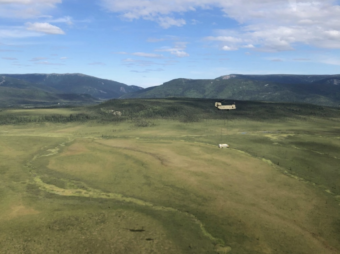
An Army National Guard Chinook helicopter carries a dilapidated Fairbanks bus away from its former resting place near the Teklanika River, close to Denali National Park. (Alaska National Guard)
An Army National Guard heavy-lift helicopter has removed the old Fairbanks city bus from the spot near Denali National Park where it once housed Christopher McCandless, the subject of the popular nonfiction book “Into the Wild.”
Photos posted to Facebook on Thursday show a twin-bladed Chinook helicopter carrying the bus away from the remote site it occupied near the Teklanika River, where it attracted numerous tourists who had to be rescued after the book’s publication.
The old Fairbanks city bus made famous by “Into the Wild” has become a tourist attraction. (Photo courtesy of Friends of the Stampede)
The Alaska departments of transportation, natural resources and military and veterans’ affairs were all involved in the operation, which came at the request of the Denali Borough, said Mayor Clay Walker. The bus had been abandoned since the 1960s, he said.
“I know it’s the right thing for public safety in the area, removing the perilous attraction,” he said. “At the same time, it’s always a little bittersweet when a piece of your history gets pulled out.”
Twelve National Guard employees helped remove the bus; they cut holes in its ceiling and floor to attach chains, the agency said in a prepared statement. The crew also “ensured the safekeeping and safe transportation of a suitcase that holds sentimental value to the McCandless family,” the statement said.
The effort was called “Operation Yutan,” in a reference to Yutan Construction, said National Guard spokeswoman Candis Olmstead. That’s the company that left the bus behind in the 1960s, after it housed workers building a mining road.
Walker said the bus is temporarily being moved to “safe storage,” but wouldn’t reveal its exact location. He said he doesn’t know where it will ultimately end up, but the state’s statement said it’s exploring putting the bus on display.
“We encourage people to enjoy Alaska’s wild areas safely, and we understand the hold this bus has had on the popular imagination,” Department of Natural Resources Commissioner Corri Feige said in a prepared statement. “However, this is an abandoned and deteriorating vehicle that was requiring dangerous and costly rescue efforts, but more importantly, was costing some visitors their lives. I’m glad we found a safe, respectful and economical solution to this situation.”
There were 15 bus-related search and rescue operations by the state between 2009 and 2017, according to Feige’s department.
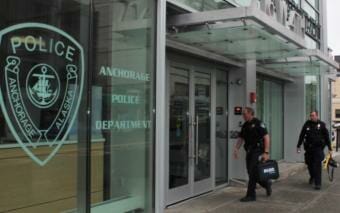
Anchorage police officers enter the downtown headquarters on Tuesday, June 9, 2020. (Lex Treinen/Alaska Public Media)
As advocates across the country push for an overhaul to policing, one area they’ve focused is the diversity of police forces.
In Anchorage, leaders of the police and firefighters say they’ve tried to boost the ranks of minority employees. But both departments remain disproportionately white, according to data released by Mayor Ethan Berkowitz’s administration Wednesday.
Anchorage’s population is 64% white overall, and so is about 67% of the city’s “working age” population, according to the administration.
Just nine fire department employees, or 2%, are Alaska Native or American Indian, compared to 13% of Anchorage’s population, and four, or 1%, are black, compared to 9% of the population. Out of the department’s 327 firefighters and emergency medical responders — not including dispatchers and other staff — two are black and eight are Alaska Native or American Indian.
A police spokesman said Chief Justin Doll was unavailable for an interview Wednesday. But at a community briefing that evening, Berkowitz said that the more diverse a police department is, the stronger it is. And he and Doll said the city needs help making that happen.
“It is not something that APD can do by itself. APD can recruit, but the community has to make sure that people who are members of various subsets of the community are engaged in law enforcement,” Berkowitz said.
Doll added: “We can do all the recruiting we want, but if all the various groups that make up the community aren’t encouraging their members to step forward and accept a career in law enforcement, then no amount of recruiting is going to make that happen.”
Police salaries start at $71,000 a year, while new firefighters, once they finish a probationary period, can earn as much as $100,000.
The fire department plans to hold new clinics and launch a focused recruiting effort in advance of its next test for applicants, aiming to recruit more women and minorities by advertising the attractiveness of the career field, Chief Jodie Hettrick said. A more representative workforce of firefighters and paramedics, she added, would better serve Anchorage residents.
“It’s very beneficial when the people who are responding on calls can understand the cultural differences and understand gender differences and understand, just, life experience differences for the patients that they’re responding to,” she said. “Eye contact is a different thing. Body language is a different thing. We can provide training on how to look at those differences and how to accept those differences, but unless you’re from that particular community, you miss a lot of things.”
Hettrick said her department’s recruitment efforts have been hindered by financial limitations.
“Not as an excuse, but the history of how we got here and why we’re not in better shape is because we haven’t been able to put resources toward it,” she said. She added: “We feel that it’s important that we much more closely reflect our community in our own department. We’re just struggling to get there.”
Hettrick said the fire department hopes to more narrowly target younger and minority recruits by advertising on newer social media platforms like TikTok and Instagram. But others say that the city’s recruiting efforts need to go deeper.
“Just bringing flyers to new places is not necessarily the strategy,” said George Martinez, a former special assistant to Berkowitz who’s running for mayor next year.
Martinez, who has black and Latino heritage and used to work on city diversity initiatives, said one way to recruit more minority Anchorage residents to the fire and police departments is by targeting them sooner.
“We need to invest in the pipeline of our workforce here from our school district, by bringing in experiential workforce opportunities earlier on,” he said. “Into high school, into the vocational and technical schools and into pathways that give us a recruitment base.”
The Anchorage Assembly’s public safety committee will look into the issue of police diversity at a meeting next month, said Co-chair Kameron Perez-Verdia.
Alaska State Troopers, meanwhile, have not released information about their demographics, and they have not responded to a public records request for the data filed earlier this week.
Hundreds of Alaskans marched in downtown Anchorage in June 2020 in protest of police brutality. The “Your Voice Matters” rally was organized by the Party for Socialism and Liberation Anchorage. (Tegan Hanlon/Alaska Public Media)
As activists across Alaska press for police reform following the death of George Floyd, law enforcement agencies in Alaska say that they’re listening.
While demonstrations continue, it might be helpful to see Alaska-specific answers to some of the big questions that have circulated in the public discussions since Floyd’s death, and in the years leading up to it.
What do the data show about police shootings and use of force in Alaska, and how often it’s used on black and Alaska Native people? What policies govern use of force by the police? What do we know about how officers are disciplined for violating those policies? And does the ethnic makeup of Alaska law enforcement agencies mirror the communities they police?
We posed those questions to two of Alaska’s largest police forces — the Anchorage Police Department and the Alaska State Troopers — and also sought information from other sources. Some of the answers proved elusive, but here’s what we learned.
What data exists about use of force and shootings involving Alaska police?
There’s no authoritative state or federal government database that publicly tracks police shootings or use of force in Alaska, though at a national level, departments can voluntarily disclose fatal shootings to the FBI.
APD and the troopers say they’re submitting data to a new FBI pilot program that tracks fatal and non-fatal shootings, plus any other use of force that causes death or “serious bodily injury.” That program is voluntary, and the FBI says that only about 40 percent of departments are participating nationwide.
But the FBI isn’t releasing any data until this summer. And last week, APD and the troopers declined to release the information they’ve already submitted, saying such a step would require a formal public records request.
In response to questions, APD did provide a list of all officer-involved shootings since 2010. Five of the 28 involved an Alaska Native or American Indian, which means that Natives were disproportionately involved in shootings compared to their population in Anchorage — about 18% of shootings, compared to 13% of the population. The numbers are also disproportionate for black people, who were involved in 18% of shootings but represent 9% of Anchorage’s population.
The troopers would not release data on officer-involved shootings, saying it had to be obtained through a formal records request.
But statewide, there have been 39 fatal shootings since 2015 involving all Alaska law-enforcement agencies, according to a Washington Post database that tracks those incidents. Nine of the people killed, or 23%, were described as Alaska Native or American Indian — a higher proportion than the statewide Native population of 20%. Three of the people killed, or 8%, were black, compared to 5% of the statewide population.
A 2013 study of two decades of Anchorage police shooting data also found that black people are overrepresented, along with Pacific Islanders.
Data on police shootings, however, represent a “little, tiny slice” of the “most extreme outcome” of law enforcement’s use of force in Alaska, since they exclude the far more numerous incidents that didn’t result in officers firing their weapons, said Brad Myrstol, director of the University of Alaska Anchorage Justice Center.
Myrstol cautioned against drawing many conclusions from the shooting data. But he also said that they can serve as a foundation for discussion.
“Grounding the conversation in data puts it in a place where people can talk about facts, rather than suppositions or hunches,” he said. “And I think that’s always the best place to start a meaningful conversation — particularly around what can be done to remedy disparity, if it exists.”
What do we know about APD’s and troopers’ use-of-force policies?
Neither the troopers nor APD have publicly released their full policy manuals for officers, though there’s an old version of the Anchorage police’s that’s archived online. APD says it’s trying to finish updating the manual and plans to release a new version soon.
Anchorage police also last week released their 13-page “response to resistance policy” that’s contained within the much lengthier manual. A troopers spokesperson, Megan Peters, said her agency’s policies would have to be obtained through a public records request, though she provided basic information about them in response to questions.
Where do the agencies’ policies stand? One national activist group, 8 Can’t Wait, has been pushing police to adopt eight different changes to the ways they use and track force, and at a community briefing last week, APD Chief Justin Doll described how his department’s policies align with each proposal. Here’s how APD’s and the troopers’ policies measure up.
Ban chokeholds and strangleholds.
APD has not completely banned chokeholds; it says they’re allowed only in extreme circumstances, when officers would be allowed to use “deadly force.” Troopers say their policy is similar: Officers are taught a neck hold that can only be used in situations where deadly force is justified, Peters said.
Require de-escalation, where possible, by communicating with subjects, maintaining distance and otherwise eliminating the need to use force.
APD says that de-escalation — which means working to reduce a conflict’s intensity — is required and an essential component of officers’ jobs and training. De-escalation requirements are not specifically stated in the department’s 13-page “response to resistance policy,” though the term is defined in that section.
Troopers say their academy for new recruits includes a number of lessons on de-escalation, which are reinforced through field training.
Require a verbal warning from officers before using deadly force.
APD policy requires officers, when “tactically feasible,” to issue verbal commands and warnings before using force. Warnings are not required in circumstances when an officer has to make a “split-second decision,” or if the officer thinks that issuing the warning would put them or others in jeopardy.
Peters, the troopers spokeswoman, said warnings before shooting are required “when feasible.”
Require officers to exhaust all other alternatives before using deadly force.
At last week’s community briefing, APD Chief Justin Doll said that there are some “obvious concerns” with this proposal, given the possibility for police to encounter someone who’s actively shooting at people, among other situations.
“I think that most people can understand that if there is a person who is actively attempting to kill other people, we expect our law enforcement to engage and to stop that immediately,” he said. “To the extent that it’s possible, we expect our officers to use whatever techniques and tools that they have available, that they’ve been given and trained on, to try to do things other than resorting to deadly force.”
Peters, the troopers’ spokesperson, said that “each incident has its own merits.”
“While we aim to de-escalate situations and have a desire for all parties involved to end an encounter alive and uninjured, we can’t require a checklist before deadly force can be utilized,” she said.
Require officers to intervene and stop excessive force used by other officers, and report these incidents immediately.
APD policy requires officers to submit a report whenever they use force against a suspect beyond “compliant handcuffing and escorting.” And officers who witness uses of force in violation of APD policy are required to tell a supervisor and submit “required supplemental reports.”
Peters said she wasn’t able to answer questions about the agency’s internal reporting of its use of force.
Ban officers from shooting at moving vehicles in all cases.
APD policy only allows officers to shoot at a moving vehicle when something beyond the threat posed by the vehicle itself justifies the use of deadly force — though there is an exception for “extenuating circumstances.” Doll, the chief, said officers are also barred from putting themselves in a position where firing at a moving vehicle would become necessary, and APD’s policy adds that officers will be “rigorously scrutinized” when such shootings take place.
Peters didn’t have information on the Troopers’ specific policies around firing at moving vehicles, and she added that “each situation has its own merits.”
Establish a “force continuum” that restricts severe force to extreme situations, and creates clear policy restrictions on the use of each police weapon and tactic.
APD’s leadership doesn’t support this proposal, saying it can be counterproductive by encouraging officers to ratchet up conflicts, rather than de-escalate them.
Peters said troopers judge each incident on its own merits.
Require officers to report each time they use any type of force or threaten to use force against civilians, including pointing a gun at someone.
APD policy requires officers to report all uses of force beyond “compliant handcuffing and escorting,” which includes pointing a gun at a person. Doll, the chief, also said last week that his agency supports a new program requiring officers to use body cameras that would document their interactions with suspects.
Peters, the troopers spokesperson, said there’s supposed to be a record of any interaction that results in a trooper using force at a level “above putting somebody in handcuffs,” though she did not provide details or the written language of the department’s policy.
What do we know about the racial makeup of the Anchorage police and state Trooper forces?
Some experts say that police agencies are more effective when their officers look like the community they serve.
Neither APD or the Troopers released demographic breakdowns of their officers last week. APD said it’s working on a response, while Peters, the troopers spokesperson, said she does not believe statistics are tracked, adding that it would require a public records request to find out.
APD has disclosed this data in the past, however. In 2015, 83% of APD’s sworn and unsworn officers were white, compared to about 67% of the city’s population, according to the Anchorage Daily News.
At the community briefing, Doll, the chief, said those numbers still “are not where they should be.” He asked for help in recruiting people from more segments of the city to help make the force more representative.
Does the public have the right to know when Anchorage police officers or state troopers are punished for breaking use-of-force policies?
Advocates say it’s important to have open access to police disciplinary records that could call an officer’s integrity or professionalism into question.
But generally speaking, these records are kept secret for state troopers and Anchorage police.
At the state level, this remained the subject of legal debate until April, when the Alaska Supreme Court released a decision in a lawsuit filed against the troopers by Kaleb Lee Basey, a man who was once stationed at Fort Wainwright in Fairbanks before being convicted of distribution and transportation of child pornography.
Basey, who represented himself without the help of an attorney, had filed a public records request seeking the disciplinary records of two troopers involved in his case. The state rejected the request, and Basey took his case all the way to the Alaska Supreme Court. In April, the Supreme Court released a unanimous decision agreeing with the troopers, saying that disciplinary records are considered part of state employees’ confidential personnel files under a state law called the State Personnel Act.
The Supreme Court did, however, leave open a possibility that the Legislature could change the law and make those disciplinary records public. The state had argued in Basey’s case that in addition to the personnel act, the Alaska Constitution’s privacy clause also barred the release of Troopers’ disciplinary records. But the Supreme Court did not agree, saying it didn’t have to address the question because its decision was already guided by the State Personnel Act.
That means that state legislators could vote to allow access to troopers’ disciplinary records by changing the law — though such a move could still be subject to a legal challenge on the same constitutional grounds that the Supreme Court left unresolved.
Anchorage police disciplinary records are governed by municipal code that exempts any personnel files from a disclosure that would “constitute an unwarranted invasion of privacy.” The Anchorage Assembly has the power to change the code, though Mayor Ethan Berkowitz’s administration asserts that the Constitution’s privacy still limits the release of police disciplinary records. While the Supreme Court explicitly declined to agree with that position in the Basey case just two months ago, Doll, the Anchorage police chief, said at last week’s briefing that the Constitution’s privacy clause bars his agency from releasing disciplinary records. And a city attorney expanded on that argument in an email Friday.
“It is not just the privacy rights of APD officers that are at issue in the disclosure of disciplinary files. These investigations contain personal and oftentimes very intimate details about victims, witnesses and suspects, as one might expect in investigations of police activity. All of these individuals also have an expectation of privacy that their personal information will not be disclosed,” wrote Assistant Municipal Attorney Blair Christensen. “The courts have acknowledged that the balancing of an individual’s right to privacy against disclosure must be done on an individual basis that takes into account the specific facts of each case.”
Isn’t there an oversight board that looks into police misconduct in Alaska?
Yes. When APD, the troopers or any other Alaska law enforcement agency fires an officer, forces them to resign or disciplines them for “serious misconduct,” they’re required to report to the Alaska Police Standards Council — a 13-member commission appointed by the governor.
After receiving such a report, the council does its own investigation. If the results lead council members to believe that the officer’s state-issued police certificate should be revoked, then they send the officer a letter giving them two options.
One option is for the officer to return their certificate voluntarily. If that happens, their name is still entered into a national index that shows their certificate has been revoked, which should keep them from getting another job as a police officer elsewhere, said Bob Griffiths, the council’s executive director. But if the officer chooses that option, the allegations against them remain a secret — the only documentation released publicly is a two-page “consent agreement” that waives their right to a hearing and acknowledges the loss of the certificate, without admitting guilt. One caveat is that there are other ways for allegations against those officers to become public — namely, if the alleged misconduct they’re involved with leads to criminal charges against them.
The other option is for an officer to fight the council’s move to revoke their certificate. If that happens, the council prepares an accusatory document that becomes available to the public, and the case is subsequently argued at a public hearing before an administrative law judge. Afterward, the judge issues a formal recommendation to the council, which then can take final action on the officer’s certificate. The council’s decisions can be appealed in state court.
This massive seal of the state of Alaska hangs on April 19, 2018, behind the dais where Alaska Supreme Court justices hear cases in the Boney Courthouse in Anchorage. (Photo by Jeremy Hsieh/KTOO)
The Alaska Supreme Court has unanimously rejected an attempt by Attorney General Kevin Clarkson to quash a citizens initiative to revamp the state’s elections.
The decision released Friday morning upholds a lower court decision that allowed the initiative’s sponsors to collect the signatures needed to place the measure on the ballot. And it marks Clarkson’s second high-profile Supreme Court defeat in the space of one month, after he also lost an effort to block the campaign to recall Gov. Mike Dunleavy.
The initiative would institute what’s known as “ranked choice voting” in Alaska — a method aimed at giving people more freedom to vote for third-party candidates. It also would block parties from limiting their primary elections only to voters not registered with another party, and it would require more transparency about the funders of independent campaign groups — the Alaskan equivalent of Super PACs.
When the initiative’s sponsors originally proposed the measure to the Alaska Division of Elections, the agency rejected it based on Clarkson’s advice, saying it violated a state constitutional requirement that initiatives be limited to a single subject.
After the initiative’s sponsors filed suit, Anchorage Superior Court Judge Yvonne Lamoureux ruled that Clarkson was wrong and that the initiative’s focus was limited to the single subject of “election reform.” The Supreme Court upheld that decision in its ruling Friday.
“This initiative’s provisions are properly classified under ‘election reform’ as a matter of both logic and common sense,” wrote Justice Daniel Winfree. “They all relate to the elections process and share the common thread of reforming current election laws. We can logically conclude that the various initiative provisions substantively change (or reform) the state’s elections.”
While the initiative does make three different changes to Alaska election law, two of them — ranked choice voting and the opening of party primaries — are related “because they together ensure that voting does not revert to a two-candidate system,” Winfree wrote. And the third provision boosting transparency and voter knowledge “logically relates to election reform,” he added.
The initiative is set to appear on the ballot in November.
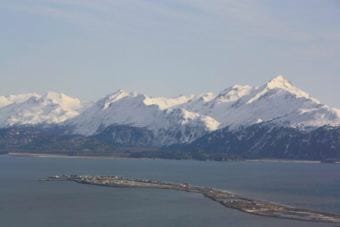
A view of the spit in the southern Kenai Peninsula town of Homer. Homer is one of multiple Kenai communities where cases of COVID-19 have spiked in recent weeks. (KBBI)
COVID-19 has spread quickly in recent weeks on the Kenai Peninsula, which now has a per capita infection rate that’s three times the one found in Anchorage and 62 active cases as of Tuesday, according to state data.
While the Kenai transforms into a tourism and fishing hub during the summer, officials there don’t blame the high case rate on any particular factor — though they say some cases are tied to residents who continue to gather in group settings in spite of public health recommendations against that.
In recent weeks, state health authorities have been forced to enlist workers from other parts of Alaska for the painstaking work of tracking and monitoring the close contacts of sick people on the Kenai, said Leslie Felts, a state nurse manager. As of Wednesday, the state was monitoring 300 people there, she added. (That number includes both confirmed cases and the “close contacts” of those people.)
“Early on, Ketchikan had a lot of activity when we first started down this road with COVID,” Felts said. “Then there was some activity up in the Fairbanks area. Now, it seems like it’s our turn down here on the Kenai Peninsula.”
At 16,000 square miles, the Kenai Peninsula Borough is roughly the same size as Massachusetts and New Jersey combined, with rural fishing communities, Alaska Native villages, tourism destinations and decades-old oil and gas infrastructure.
The Kenai’s infections appear to be concentrated on the southern part of the peninsula, where Homer has 18 active cases — a half-dozen of which appear to stem from the recent landing of the state ferry Tustumena, which had an outbreak of infections among crew.
There are 19 more active cases that the state lists in the “other South” portion of the peninsula. That’s a catch-all category for communities in the southern part of the borough that have fewer than 1,000 people.
The state says that identifying those small communities with active cases could jeopardize people’s privacy, and officials wouldn’t release any details or even make broad characterizations about those “other” cases. But health-care providers chose to run pop-up testing sites in several southern Kenai locations last week.
Those include the village of Seldovia, across Kachemak Bay from Homer, as well as Nikolaevsk, another isolated village inhabited largely by members of a sect of the Russian Orthodox Church known as the Old Believers.
Seldovia’s city manager didn’t respond to a request for comment Wednesday. In Nikolaevsk, “the village is choosing not to comment on the situation,” Nikki Place, the president of the local community council, said in a text message.
Health officials and emergency managers say that they haven’t seen any consistent themes connecting the cases spread across the Kenai, though late last month, Alaska’s chief medical officer, Dr. Anne Zink, said there were clusters that appeared to be associated with “some celebratory gatherings that took place.”
“We have pockets from people in their work setting, in church settings, restaurants, indoor and outdoor gatherings,” said Felts, the public health nurse manager. “It’s pretty broad.”
Another thing that could help explain the southern peninsula’s higher caseload is more widespread testing.
At the early part of the pandemic, Homer’s South Peninsula Hospital was only testing patients with symptoms, at a rate of about six or seven a day, said Ryan Smith, the hospital’s chief executive.
As commercial fisheries started ramping up about two weeks ago, the state sent a Cepheid testing machine, which has good accuracy and can process about four tests an hour.
That’s allowed the hospital to cast a much broader net, and it’s now collecting about 150 samples a day, Smith said. That includes testing patients with symptoms, plus those in the emergency room, along with employees — six of whom have tested positive, said Smith.
The hospital has also worked with partners to offer off-site testing, said Smith. Tests have been collected on Homer’s spit, at a site out the road leading east from town, and in the community of the Anchor Point to the north — and each of those efforts has yielded positive tests, he added.
“We’re going to where the people are, versus forcing them to come, to drive up to the hospital to get tested,” he said.
By contrast, the Central Peninsula Hospital in Soldotna, which serves about two-thirds of the Kenai’s population, has only been able to collect about 35 samples a day, said spokesman Bruce Richards.
The hospital has struggled to put widespread, reliable testing in place, and lacks a machine onsite that’s reliable, Richards said.
The Kenai Peninsula Borough, which owns the hospital, is planning to buy a $400,000 “high-capacity” testing machine with its $37.5 million share of federal coronavirus relief money. But delivery is expected to take at least four months, and in the mean time, the hospital has to have its test kits driven three hours to Anchorage for processing there.
Those current hurdles to widespread testing suggest to Richards, the hospital spokesman, that the central Kenai has less of a window into the spread of COVID-19 than the southern part of the peninsula.
“Are there people walking around that are positive? There are. The only way to find out is rapid, ubiquitous testing and that’s what our goal is,” he said. “The more testing you do, the better a picture you’re going to find.”
For now, in spite of the Kenai’s sharp rise in cases, health-care professionals aren’t calling for a return to stricter social distancing mandates.
As of Wednesday, there were no COVID-19 patients hospitalized in either Kenai or Soldotna. And Smith, the Homer hospital executive, said his facility has spent three months equipping itself for when cases do start to arrive.
“I don’t think there’s any level of panic, and going back to any kind of a lockdown doesn’t seem realistic,” he said. “We feel like we’re pretty well prepared to deal with the activity that we’re seeing right now.”
Alaska Gov. Mike Dunleavy stands with his wife, Rose, at his inauguration in 2018 in Kotzebue. Rose’s grandfather died of the flu in the 1920, which Dunleavy says has influenced his decision making around the COVID-19 pandemic. (Office of the Governor)
As Alaska Gov. Mike Dunleavy faced his first set of decisions around the COVID-19 pandemic, a handful of memories swirled in his mind — including a century-old one that was unique to rural Alaska.
Dunleavy grew up in Pennsylvania. But his wife, Rose, is Inupiaq, raised in the Northwest Alaska village of Noorvik, and her mother once told Dunleavy a story that connects to the state’s traumatizing experience in the 1918 Spanish flu pandemic.
“She was a young girl. Her father and she were sick at the same time — literally in bed next to each other,” he said. “And he died, from that flu.”
Dunleavy’s mother-in-law never told him what strain of flu killed her father, and his death came in the 1920s, after the pandemic strain had weakened. One expert said it would be hard to tell which particular virus was responsible.
“I think this is not something one can easily speculate on. People also die of the regular flu,” Peter Palese, a microbiology professor and flu expert at the Icahn School of Medicine, wrote in an email. “If the relative of the governor’s wife lived in a remote village, which had little prior exposure to flu, then infection by the 1918/19 pandemic virus or by a later, seasonal 1920s strain could have been lethal.”
Regardless of which virus it was, Dunleavy, in a phone interview, said he’s kept that history in mind while making decisions around the COVID-19 pandemic, which has evoked Alaska’s deeply traumatic losses during the Spanish Flu pandemic.
The so-called Spanish flu in 1918-1919 killed more than half of adults and elders in villages across Alaska. Here, two orphans who survived the pandemic stand outside in Bristol Bay. (Courtesy: Tim Troll via Alaska State Archives)
The worldwide death toll was more than 50 million people. The disease hit rural Alaska particularly hard: It killed as much as 8% of the Alaska Native population, according to one estimate.
Now, citing their remoteness and limited health-care infrastructure, Native villages have put in place some of the state’s most aggressive measures to contain COVID-19 in Alaska. The disease has killed 10 people and infected more than 500 in the state.
Dunleavy, who spent six years as a teacher in the village of Koyuk, said those vulnerabilities are not lost on him.
“I don’t have to read about that, or think or imagine it. I’ve lived it,” he said in a phone interview from his Anchorage office. “I’ve literally lived, living out there. And I understand the difference between the ability to deal with the health-care issue there, as opposed to here.”
Dunleavy was credited by health-care professionals with taking aggressive initial steps to contain the spread of COVID-19 in Alaska, like imposing a two-week quarantine on people arriving from out of state.
Those measures were successful in keeping the disease from overwhelming Alaska’s hospitals. But infection rates are now rising as Dunleavy has relaxed health mandates, saying there’s enough health-care infrastructure to handle more cases.
While a few positive tests have been recorded in rural Alaska, infections have been mostly concentrated in more urban parts of the state. And Noorvik, the 700-person village where Dunleavy’s wife grew up, has not seen a single case yet, said Elsie Sampson, an elder and resident.
Some residents there are getting impatient for new information about the disease, and frustrated with how long it’s persisting, Sampson, a cousin of Dunleavy’s wife, said in a phone interview Thursday.
But the village, she added, has been working with state medical professionals, and she said Dunleavy’s experience in the region helps him grasp what its residents are facing.
“Every little bit of information helps,” Sampson said. “With this information he has — and because he’s lived in our region and been in our region — he’s made the time to listen to our people and be around us long enough to understand where we’re at, and give us the opportunity to share what we think.”