Nat Herz, Alaska Public Media

Alaska fishing communities feared getting COVID-19 from industry. They haven’t.

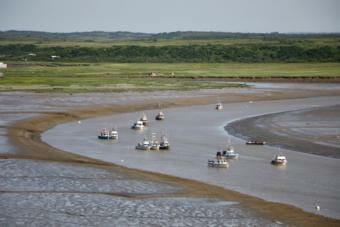
Several fishing boats in Bristol Bay
Fishing boats in Bristol Bay last year. (Alex Hager/KDLG)

As this year’s summer fishing season approached, local leaders across Alaska issued dire warnings about the thousands of plant workers and fishermen headed to their communities.

They feared the workers could bring COVID-19 in with them, quickly overwhelming small local hospitals and clinics. In Bristol Bay, home to the world’s largest sockeye salmon fishery, some residents called on Gov. Mike Dunleavy to cancel the season, citing the region’s traumatic experience with the 1918 pandemic flu, which killed at least 30% of its population.

In the month since the Bristol Bay season kicked off, some seafood companies have experienced isolated cases among workers in their processing plants. And other outbreaks have infected dozens of seafood workers elsewhere in the state — most recently, 85 crew members on board a Bering Sea factory trawler.

But midway through summer, with the Bristol Bay season winding down, seafood company executives and public health authorities can point to a remarkable fact: The industry has been almost completely successful in keeping its seasonal workers and fishermen from infecting Alaska residents.

“We haven’t seen any evidence of jumping the fence from the seafood industry to the community,” Bryan Fisher, a top state emergency response official, said in an interview earlier this month.

In the Bristol Bay Borough, home to the region’s largest concentration of fish processing plants, there have been dozens of cases of COVID-19 among nonresident seafood workers — but just one case among residents.

Gene Sanderson lives in the borough year-round, and his house is on the grounds of a processing plant, where he works as a watchman during the winter.

When thousands of fishermen and processing workers started arriving to the area for this summer’s salmon season, Sanderson and his wife left for their cabin.

Sanderson, in a phone interview, said he was initially skeptical that the fishing industry would be able to keep the virus confined to boats and processing plants. But after a month of calm, he and his wife returned to their home early.

“It’s gone amazingly — knock on wood,” he said. “Fishermen are starting to come out of the water, and they’re starting to head out of town.”

Now that it’s almost over, Sanderson says he’s happy the Bristol Bay season went forward, bringing its yearly boost of jobs and tax revenue to the region.

Across Alaska’s fishing towns, local leaders have similar messages to share, as officials report that almost all cases of the virus among seasonal workers have been successfully contained. The only exception is at a processing plant in Juneau which, unlike many of the other plants across the state, employs some resident workers.

Fishing industry players say this did not happen by accident. The state of Alaska, under pressure from the leaders of concerned fishing communities, imposed strict quarantine mandates and required companies to draft rigorous COVID-19 containment plans.

Those companies enacted comprehensive testing regimes and barred processing workers and fishermen from leaving company property or even getting off their boats.

Dan Martin, the Commodore’s captain, drives the boat out of the port of Dutch Harbor on Wednesday, January 23, 2019. (Photo by Nathaniel Herz / Alaska’s Energy Desk)

“It is, seriously, like prison,” said Dan Martin, the skipper of a vessel that fishes for pollock out of Dutch Harbor, the Aleutian Island fishing port.

Typically, crew members get to stretch their legs every few days after each fishing trip; they can go for hikes, rent movies or catch a ride into town for dinner at the Norwegian Rat saloon.

This year, in the six weeks Martin has spent on his vessel so far, he got off just twice — once to help another crew with some electronics, and a second time to fly home for a break.

Martin said he’s proud of his fellow fishermen for the lengths they’ve gone to protect residents of Dutch Harbor and neighboring Unalaska. But he also said the restrictions are driving them a little crazy, especially because the fishing this summer has not been good.

“It’s almost an untenable situation — slow fishing and all these things compounded, and you’re in each other’s face 24/7 and it goes on and on and on,” he said. “I can definitely see people getting onto the ragged edge by the end of the season.”

So far, though, officials have praised companies for staying vigilant even as the fishing season and pandemic drag on. In the Southeast Alaska town of Petersburg, Karl Hagerman, a local emergency response official, said he watched as the crab season kicked off, straining one processor’s capacity as it waited for more workers to finish quarantine.

While more workers would have been useful to the company, he said, “they’re sticking with their quarantine.”

“They’re protecting the workers that are on the line right now, as well as the workers that are going to be on the line as soon as they’re done with their quarantine. And they’re protecting the community,” Hagerman said. “I’ve got to hand it to them — they’re doing a great job.”

Outside of Bristol Bay, there are still months left in the salmon season, and there are winter fisheries for other species. Which means that no one — from public health authorities to the fishing companies themselves — is declaring victory yet.

“We fully recognize, as an industry and as a company, that we have a long way to go. We are not done adjusting our plans and learning from what we know of COVID,” said Julianne Curry, a spokesperson for Icicle Seafoods. “Every single day, we incorporate new things that we learn into our plans.”

Icicle, which processes pollock on a massive ship docked in Dutch Harbor, has already been absorbing lessons from the events of the summer, Curry added. She said the company’s early experience showed how important it is to swiftly isolate not just infected workers, but also their close contacts — those who hadn’t tested positive for the virus but who had spent time around someone who had.

Early on, two to four close contacts of an infected person might still have been quarantined in a room together, Curry said. Now each one is isolated in their own room.

Health-care experts, emergency response officials and seafood industry leaders all said open communication was a key factor in the apparent success of their containment efforts. Fisher, the state official, said that local pressure for tight mandates and enforcement was important, too.

“The community concern about bringing in out-of-state, out-of-country workers really helped us all focus on that,” he said. “They were valid concerns, we took them to heart, and industry certainly did, too.”

At White House event, Alaska Gov. Dunleavy lauds Trump deregulation as restoring “American dream”

Alaska Gov. Mike Dunleavy speaks at a White House event celebrating President Donald Trump’s deregulation agenda on Thursday, July 16, 2020. (Joyce N. Boghosian/White House)

Alaska Republican Gov. Mike Dunleavy flew to Washington, D.C. to play a supporting role at a White House event Thursday that celebrated President Donald Trump’s deregulation initiatives, including a new overhaul of a bedrock environmental law.

The event was held on the White House lawn, where a huge crane appeared to be lifting a set of weights out of the back of a pickup truck — a symbol of the Trump administration’s efforts to lift the weight of federal regulations.

“Before I came into office, American workers were smothered by merciless avalanche of wasteful and expensive and intrusive federal regulation,” Trump said.

The president has loosened rules for banks that were originally imposed after the 2008 financial crisis. He’s made it harder to set aside critical habitat for endangered species. And he’s reduced the number of waterways covered by the Clean Water Act.

The White House says 20 of the administration’s major deregulation actions should collectively save American consumers and businesses more than $220 billion a year.

Dunleavy used his two minutes at the podium to praise Trump for expanding elderly Americans’ access to telehealth through the Medicare program. He also touted the president’s efforts to scale back review of resource development projects, which includes Thursday’s release of a 73-page overhaul of the National Environmental Policy Act.

“What you’ve done is, when the land owner goes and decides that they want to do a little landscaping on their property: Do they have to look over their shoulder and wonder if big government is watching them? Can they do what they need to do on their private property?” Dunleavy said. “You’ve restored the hope that they can realize the American dream.”

Not everyone agreed with the governor, as environmental groups, including those that work in Alaska, roundly criticized Trump’s proposed revisions to NEPA.

“It’s very disturbing to hear the governor of Alaska speak about how rolling back NEPA achieves the American dream,” said Brian Litmans, legal director at Trustees for Alaska, a law firm that fights for environmental protections in the state.

NEPA was passed Congress and signed by President Richard Nixon in 1970.

It sets out required reviews for federal actions that could have environmental effects, and it has huge implications across the country and in Alaska in particular — it applies to both the Pebble Mine and the Willow project, the next major oil development proposed by ConocoPhillips on the North Slope.

Underscoring the stakes for the state, dozens of Alaska entities, interest groups and individuals weighed in on the administration’s preliminary NEPA revisions, from the Alaska Oil and Gas Association to The Audubon Society’s local outpost to Dunleavy’s administration itself.

The Trump administration said Thursday’s proposal will speed reviews of projects that developers often criticize as too slow.

But conservation groups point out that the revisions will allow projects to escape analysis of their climate change impacts, by deleting a requirement that agencies study indirect and “cumulative” environmental effects.

And the effort to expedite reviews will undermine the original vision for NEPA, which is to draw out the range of possible impacts of projects, Litmans said.

“We are now left with projects where we won’t know if our salmon runs will be destroyed. We won’t know if our water’s going to be polluted,” he said. “And our governor is standing next to our president applauding that — applauding an outcome that can destroy the very resources of Alaska that we all treasure.”

Litmans noted the huge number of Trump administration deregulation initiatives that have been rejected as illegal by the courts. And he argued that numerous aspects of the NEPA overhaul conflict with the legislation itself, leaving it vulnerable to a likely lawsuit.

In addition to the event on the White House lawn, a spokesman for Dunleavy said the governor attended a roundtable meeting with Trump’s economic advisor, Larry Kudlow. He did not release additional details about Dunleavy’s itinerary in Washington.

Two Alaska independents out-raise Republican incumbents

Independent Alyse Galvin standing in front of her campaign bus
Independent Alyse Galvin is challenging GOP U.S. Rep. Don Young, and raised substantially more cash than he did in the second quarter of this year.(Liz Ruskin/Alaska Public Media)

As national opinion turns against President Donald Trump and threatens to trickle down to Republican Congressional candidates, two Alaska independents have continued to out-raise the GOP incumbents they’re challenging, according to new figures released Wednesday.

Alyse Galvin, an independent who got 46.5% of votes when she ran against GOP U.S. Rep. Don Young two years ago, raised $690,000 between April 1 and June 30, leaving her with $1.4 million in her accounts.

Young raised $260,000, and has $960,000 in the bank. He also was substantially out-raised by Galvin in the first three months of the year.

In Alaska’s U.S. Senate race, incumbent Republican Dan Sullivan raised $1.2 million, compared to the $1.6 million raised by independent challenger Al Gross.

Gross’ figures include a $100,000 donation from himself on the last day of the three-month fundraising period, and since his campaign began, he’s spent a total of $720,000 of his own money.

While both Galvin and Gross are independents, they’re both seeking the nomination of the Alaska Democratic Party in its primary election next month.

Galvin, in a prepared statement Wednesday, touted recent polls showing her in a close race with Young and said she was grateful for Alaskans’ support.

“It is clear Alaskans are ready for new leadership that listens to our communities and fights for what we need: good-paying jobs, lower health care costs and a strong education system,” the statement quoted her as saying.

Young’s campaign manager, Truman Reed, said Galvin’s focus is raising money from Outside “liberal extremists,” including “environmental extremists that want to turn our state into a national park, gun control advocates who want to trample the Second Amendment and people pushing a socialist agenda.”

“She’s simply too liberal for Alaska,” Reed wrote in an email. “Alaskans still want Don Young in Washington because he’s effective and gets the job done.”

Gross’ campaign released a prepared statement that attacked Sullivan for not objecting to Trump’s management of the COVID-19 pandemic, branding him “Yes-Man-Dan.”

“We’re building a movement in Alaska to bring an independent voice to Washington, and I’m proud of the support our movement has drawn from all over Alaska,” the statement quoted Gross as saying.

Sullivan’s campaign manager, Matt Shuckerow, noted that Gross still hasn’t made it through the Democratic primary, in which he faces two other candidates, Edgar Blatchford and Chris Cumings.

Shuckerow said that Sullivan only recently formally launched his campaign with four events across the state that had more than 400 co-hosts, and he added that 1,200 volunteers have been recruited.

“The senator is very excited about the support and energy his campaign’s receiving,” Shuckerow said. “We’ll see who our opponent is after the August primary, and we look forward to having a discussion about the important policy issues facing our state and our country.”

Note: This story has been updated with the additional comment from Al Gross’ and Sen. Dan Sullivan’s campaigns.

Last-minute deal will keep some Ravn planes and service in Alaska

A RavnAir plane sits on the tarmac at Ted Stevens Anchorage International Airport. (Courtesy RavnAir)

A last-minute deal has emerged to keep RavnAir Group’s core assets in Alaska.

After a failed bankruptcy auction Wednesday, Ravn’s big planes appeared on track to be flown to California and sold off in a liquidation process, to the disappointment of Alaskans who depended on Ravn’s regional service.

Ravn attorney Jane Kim described what happened next at a hearing Thursday morning.

“However, after the auction was concluded, we received two new bids, which is the reason for all of the last-minute scrambling,” she said.

At least one group of Alaskans, which included transportation executive Jim Jansen and former Ravn executive Bob Hajdukovich, was vying for Ravn’s planes.

In the end, Ravn agreed to sell six of its big Dash-8s, plus the operating certificates for Corvus and PenAir, to a Southern California company called Float Shuttle.

Float Shuttle stands for “Float Over All Traffic,” and its current business is carrying California commuters who want to avoid being stuck in their cars. Which is a pretty different universe from the rugged and foul-weather flying that Alaska operators are often forced to do.

“I think they’re in for a pretty rude awakening, flying a float service out of Southern California and coming into Alaska,” said Dennis Robinson, vice mayor of Unalaska, the Aleutian Island fishing port that’s famous for its rough weather and flight cancelations. Since Ravn declared bankruptcy and shut down, residents and fishermen there have had to depend largely on chartered planes, loosely coordinated through a Facebook group.

“My question would be: Do they know what they’re up against?” he said. “Because I don’t believe they do.”

Robinson’s reaction, upon hearing about Float Shuttle’s winning bid, was similar to other Alaskans who live in the rural hub communities that Ravn used to serve.

One thing that Robinson says would put him more at ease is if Ravn’s new owners have experience in the Aleutians and in Alaska. And it turns out that they do, to an extent.

Rob McKinney, who’s going to be Ravn’s new chief executive, spent six years running a Southeast Alaska airline called Wings. A second Float executive also spent five years in Alaska working for Ravn, McKinney says.

“So, we think that not only do we bring a depth of aviation knowledge — we feel confident that we’re Alaska-specific, as well,” said McKinney.

The new Ravn is keeping its name for now, and it intends to use a $32 million COVID-19 payroll grant that’s been provisionally made available by the Trump administration.

Float Shuttle only bought six of Ravn’s nine planes that were up for sale. But they plan to lease three more to get the fleet back up to full size, and will be keeping all the planes in Alaska, McKinney says.

“We are 100% focused on Alaska and serving Alaskans,” he said.

The major investor for the new Ravn is what’s called an incubator — a company that helps startups get off the ground. This particular incubator is called HMC-INQ — its companies have to have at least one owner who’s a graduate of Harvey Mudd College, a California liberal arts college that focuses on engineering, science and math.

In this case, that’s Tom Hsieh, one of Float Shuttle’s co-founders. He says the incubator will be much more hands-off and community-minded than the private equity companies that owned the old Ravn, who rural residents often criticized for being unresponsive.

“We were actually really aware of that frustration. And that is certainly something that our team is dead set on rectifying and changing,” Hsieh said. “We want to be the hometown airline.”

The sale to Float Shuttle has been cleared by federal bankruptcy court, the company says, and the new owners aim to have federal approval to resume flying in about a month.

Ravn, which had 72 planes and 1,300 employees, served more than 100 communities before its bankruptcy and was Alaska’s largest rural air service. Dozens of its smaller planes were sold at an auction Tuesday.

RavnAir cancels auction for remaining planes, calling rural hub service into question

Nearly 20 communities in the Yukon-Kuskokwim Delta have no regular air service since Ravn went bankrupt. In July 2020, dozens of RavnAir Group’s planes have been sold as the company nears the end of the bankruptcy process. (Katie Basile / KYUK)

Alaska’s largest rural air carrier, the bankrupt RavnAir Group, aborted a planned auction Wednesday for its remaining core assets, casting doubt over the fate of the company’s 1,300 employees and the future of flight service to the array of communities it once served.

Ravn wanted to sell nine of its big Dash-8 planes, which were used to fly from Anchorage to Fairbanks and rural hub communities like Dutch Harbor, Homer, Kenai, St. Mary’s, Aniak and the island of St. Paul. It was also planning to sell the federal “Part 121” operating certificates held by two of its subsidiary airlines, Corvus and PenAir.

Ravn had set a minimum bid of $19 million. But after more than five hours of delays and discussions with potential customers, a Ravn attorney, Jane Kim, told a teleconference full of aviation executives that none of the preliminary bids that the company had received were “acceptable,” and that the auction was off.

In a prepared statement issued afterward, Ravn’s chief executive, Dave Pflieger, called the cancelation “disappointing.” But he said that the auction process won’t formally finish until Ravn’s lenders decide to end a formal, court-approved sales process and place the company’s remaining assets into a “liquidating trust.”

“Given those facts, we remain optimistic that a new owner will still be able to step in and restart one of more of our two Part 121 airlines,” Pflieger said.

Kim, the attorney, said Wednesday that any planes left unsold by Ravn would be moved to California.

In another auction the previous day, Ravn sold off several buildings, along with dozens of its smaller planes. Those sales must still be approved by a federal bankruptcy judge at a hearing Thursday morning, which is also likely to clarify the fate of the larger planes and operating certificates.

Four potential bidders had called into Wednesday’s auction before it was called off: Anchorage-based Ryan Air, which hauls freight and passengers to and from communities in Western Alaska; a Southern California-based company called Float Shuttle; Connecticut investment firm Wexford Capital; and a group of unidentified Alaskans represented by bankruptcy attorney Cabot Christianson.

Ryan Air President Lee Ryan said that Ravn’s $19 million asking price for the larger planes and certificates was “not feasible” for his company, given the ongoing pandemic.

“There’s a lot of unknowns” involved with flying bigger planes in Alaska right now, given the pandemic, he said.

Ryan also chairs the Alaska Aviation Advisory Board, a state commission that’s examining how to fill gaps created by Ravn’s disappearance. He acknowledged that Wednesday’s canceled auction is cause for concern for the rural communities served by Ravn, but he also pointed out that the company isn’t currently operating and that other airlines’ planes are still flying.

“It’s kind of disheartening and unnerving and unsettling for Alaskans in general, especially those off the road system that are in rural communities that needed this asset to fly them back and forth,” Ryan said.

But, he added, “people are going to figure out a way to conduct business in the state.”

“It’s just a matter of it being pieced back together, somehow, and I think that’s what the advisory board is trying to figure out,” he said.

Before the COVID-19 pandemic, Ravn was Alaska’s largest rural air service, with $200 million in annual revenue, 1,300 employees and 72 planes that flew to more than 100 communities.

Ravn, which was majority owned by a pair of East Coast private equity firms, operated three different companies.

Most of Ravn’s destinations were served by the bush plane service, Hageland Aviation, which operated 57 planes under a less tightly-regulated “Part 135” certificate issued by the Federal Aviation Administration. Hageland largely flew small planes between rural hub communities and remote villages.

Many of Hageland’s planes were sold in Tuesday’s auction.

Wednesday’s auction included the larger planes and certificates held by Ravn’s two airlines, PenAir and Corvus, which operated under much more stringently-regulated “Part 121” FAA rules.

PenAir and Corvus both flew those larger planes between Anchorage and rural hub communities in the Aleutian Islands, Bristol Bay, the Kenai Peninsula and other rural parts of the state, often connecting passengers to the hub-to-village routes served by Hageland Aviation.

Before the COVID-19 pandemic hit, Ravn’s statewide breadth allowed customers the convenience of booking flights on all three airlines through a single platform. Ravn also had access to what appeared to be a diverse, resilient market: If demand dropped off in one region of the state, the company could count on others to sustain it.

But COVID-19 arrived at a time of year that Ravn was already vulnerable: The company tended to run at a loss during the winter and spring, before being buoyed by strong financial performance in the summer and fall tourist season, Chief Financial Officer John Mannion said in a sworn statement in the bankruptcy proceedings.

The pandemic caused a 90% drop in passenger revenue across its three airlines, at a time when Ravn already owed more than $90 million to 13 different lenders. Those lenders include American, French and Italian banks, an array of investment firms and GSO Capital Partners, an arm of The Blackstone Group, the huge New York City-based investor.

As Ravn navigated the bankruptcy process, its managers advertised to find a buyer who could purchase the whole company and keep it intact. But the 13 lenders pushed Ravn to sell off its assets so that the company could pay back its debts.

Residents of the remote communities once served by Ravn have been closely following the bankruptcy process.

After Ravn stopped flying, people from the Bering Sea island of St. Paul initially had to pay for chartered planes to get to Anchorage for medical treatment and other business. Now, another company, Grant Aviation, has started service from the island to either Cold Bay or Dutch Harbor, said Amos Philemonoff, the president of St. Paul’s tribal government.

Once in Cold Bay or Dutch Harbor, residents then must catch one or even two more flights to reach Anchorage, and the entire journey can take two to three days, Philemonoff said.

“That’s the hurdle,” he said.

Everyone is anxious to see what St. Paul’s air service will look like for the interim, and for the long term, residents need restoration of a direct flight to Anchorage, he said.

As law enforcement agencies diversify, Alaska State Troopers remain nearly 90% white

An Alaska State Trooper cruiser parked on Seward Street in downtown Juneau, 2016 07 18. (Photo by Jeremy Hsieh/KTOO)

Nearly 90% of Alaska State Troopers are white, according to new data released by Gov. Mike Dunleavy’s administration, which show that the primary statewide law enforcement agency is substantially less diverse than Alaska’s population.

About 87% of the state’s 355 troopers are white, the agency said in response to a public records request, compared to 65% of Alaska’s population. Alaska Natives and American Indians have the next-largest representation among troopers, at 5%, compared to some 20% of the population overall.

Law enforcement agencies across the country have pushed to diversify their ranks in recent years amid protests over police violence, particularly against Black people. Experts say that more racially mixed police forces can reduce misconduct by officers and make them more approachable to minority groups.

Nationally, departments have become more diverse over the past few decades, but they’re still disproportionately white because that change has moved more slowly than the nation’s demographics, the Washington Post reported last month. In Anchorage, the police department is currently 79% white, down from 83% in 2016.

Numbers for the Alaska State Troopers, however, have not changed significantly in recent years, though “our efforts have been significant,” spokeswoman Megan Peters wrote in an email.

The Department of Public Safety, which oversees the troopers, declined to make leaders available for an interview. But Peters, in response to emailed questions, acknowledged that boosting diversity could make troopers more effective.

The troopers are confident that their hiring process is fair, but “we can’t hire people if they won’t apply, and it is in this area where the deficit lies,” Peters said. One of the biggest barriers is that people generally interact with troopers when they’re having a “really bad day,” which means that most contacts are negative contacts, she added.

“In order to create a relationship with a potential trooper that results in a job application, we must have significant contact with the applicant in a positive way, and that isn’t happening often enough,” Peters wrote. “When it does occur, it’s most often when someone spends time with a trooper off-duty. These positive contacts are extremely resource-intensive to create during the duty day. Funds to support programs that would help in this way are hard to find.”

Instead, the agency plans to continue recruiting heavily among the military branches, as well as giving extra time to applicants from diverse groups and targeting through advertising, Peters said.

Those recruitment efforts should continue, but the troopers need to make more “systemic change” so that people from diverse backgrounds want to work there, said Charlene Apok, director of gender, justice and healing at Native Movement, a Native advocacy group.

“What happens if they actively hire and recruit people of color into a violent system? They’re not going to be able to retain them,” Apok said in a phone interview. She added: “They need to do their part with the active recruiting and hiring. But it needs to be paired with trainings across the institution, so that it doesn’t only perpetuate violence.”

Apok, who read Peters’ email, said she found the troopers’ statements about its diversification efforts to be “defensive,” and an effort to “perpetuate the way that they’re doing their work right now.”

“And that isn’t the goal of what the community is asking from them,” she said.

One former public safety commissioner, Walt Monegan, said he’d “probably kick myself” for not making more concerted efforts to diversify the state troopers before leaving his position in 2018.

Monegan, who’s part Alaska Native, said he was brought into law enforcement through a positive interaction like the ones that Peters described.

The idea had never occurred to him before he was working a temporary desk job in a state office building in Bethel, after serving in the Marine Corps. He was pouring himself a cup of coffee when he ran into a couple of troopers.

“They said, ‘Walt, you just got out of the Marines. You ever thought about being a trooper?’” he said. “And I looked at them and I said, ‘No, not really. I don’t think anybody likes you guys.’”

More than a year later, Monegan was looking for jobs in the newspaper, saw that the Anchorage Police Department was hiring, remembered his conversation with the troopers and applied. He eventually became APD’s chief.

The biggest obstacle to recruiting people from minority groups is that they don’t feel they’re qualified, Monegan said.

“We don’t reach out enough to say, ‘We believe in you. We need you,’” he said. “When you look at the obviously white, male makeup of any department, it’s like, ‘Why should I join them? It looks like it’s a white man’s club.”

One thing that has made the problem less dramatic, Monegan said, is that law enforcement agencies in Alaska are generally trusted.

“If you’re doing well with the communities you serve, then what’s the big hurry?” he said. “Because what we’re doing is working.”

Apok, with Native Movement, said she respects Monegan’s experience, but questions his conclusions. She said that members of minority groups don’t always feel empowered to give forthright opinions when asked by police officers or troopers to share them.

“I think they’re missing a whole bunch of the community’s realities, maybe only seeing it from the uniform side,” she said. “Because in my experience and working as a community organizer and at a grassroots level, I wouldn’t say we share the same ideas and perceptions of the reputation of the state troopers in our communities.”

Site notifications
Update notification options
Subscribe to notifications