Nat Herz, Alaska Public Media

As Arctic warming accelerates, permafrost thaw hits Red Dog mine with $20 million bill

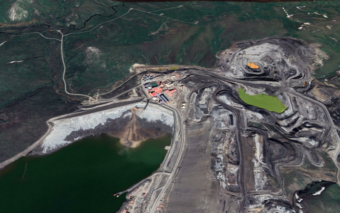
This satellite image of the Red Dog Mine shows the tailings reservoir at bottom left, the main pit on the center right and the active Aqqaluk pit (with orange color at the bottom) above. (Google Earth, data from CNES/Airbus and Maxar Technologies).

The multinational company that operates the massive Red Dog Mine in Northwest Alaska says thawing permafrost linked to global warming has forced it to spend nearly $20 million to manage its water storage and discharge.

The problems at Red Dog, one of the world’s largest zinc mines, show how climate change poses a challenge not just to residents of Arctic Alaska, but also to the economy of the region, which is warming at triple the rate of the global average.

Vancouver-based Teck Resources Ltd. says that permafrost thaw in the watershed surrounding Red Dog is releasing higher natural levels of dissolved minerals and other particles into streams. That, in turn, has limited the mine’s ability to discharge its own treated wastewater into a nearby creek, causing water to back up in its tailings reservoir.

This photo, taken from a helicopter in the summer of 2019, shows turbid water flowing into the Wulik River from Ikalukrok Creek, which drains from the same watershed as the Red Dog Mine. (Alaska Department of Fish and Game)

Red Dog can only discharge from the reservoir when the creek’s naturally occurring levels of “total dissolved solids” are below a certain threshold, said Wayne Hall, community and public relations manager for the mine. That threshold, he added, had never been exceeded before the summer of 2019, which saw record high warmth.

“In 30 years of Red Dog operation, this is the first time that we’ve ever seen background levels in the creeks to the point where it precluded us from discharging,” Hall said in an interview.

Last week, following the construction of a new wastewater treatment system that uses reverse osmosis, Red Dog resumed discharging.

But while the system was being built, Teck had to take an array of steps to keep water levels in the reservoir from getting too high.

Those steps included pumping hundreds of millions of gallons of water out of the reservoir into the bottom of Red Dog’s active mining pit, which forced Teck to mine lower-grade ore toward the top of the pit rather than the higher-grade ore at the bottom.

Red Dog also removed tens of millions of gallons more from the reservoir by freezing it into an icefield and accelerated a planned boost to the height of the dam.

Hall declined to say precisely how much Teck was spending on those measures. But in a call with investors last month, a Teck official said the cost was in the range of $19 million.

This satellite image of the Red Dog Mine, taken this month, shows the tailings reservoir (bottom left), the flooded Aqqaluk pit (top right), and the main pit just below. (Sentinel Hub/European Space Agency)

The challenges at Red Dog mark the latest example of how climate change is disrupting the resource development projects that are economic engines in parts of Arctic Alaska.

Last year, amid record high river levels on the North Slope, the company that operates the trans-Alaska oil pipeline had to spend more than $10 million on flood repairs. And oil companies are contending with shorter winters that threaten the ice roads needed to allow work on sensitive tundra.

NANA Regional Corp., the Alaska Native-owned corporation that leases the mine property to Teck, says the challenges at Red Dog could also hold lessons for Northwest Alaska residents and their local infrastructure — like if villages encounter similar problems with their drinking water.

“We need to be thinking about what these impacts may mean for communities,” said Liz Cravalho, NANA’s vice president of lands. “I think there are lessons to be learned in this situation that can be shared.”

Red Dog started up in 1989, in a unique partnership between NANA and Teck. It generated $1.6 billion in revenue last year and $700 million in gross profits, according to Teck.

The mine is 80 miles north of the Northwest Alaska hub town of Kotzebue. Since it began operating, it’s been credited with bringing economic activity and jobs to the region and to NANA’s indigenous shareholders.

NANA shareholders have earned a combined $500 million working at Red Dog, the corporation says. And payments in lieu of taxes from the mine account for between 80% to 90% of the Northwest Arctic Borough’s annual budget.

At the same time, conflicts have periodically erupted around the mine’s wastewater discharge, which was the subject of a 2002 lawsuit by residents of the village of Kivalina, 50 miles away. Water from Red Dog Creek ultimately drains into the Wulik River, which Kivalina residents use for subsistence fishing and drinking water.

The new discharge-related problems at Red Dog come as temperatures in the surrounding Northwest Arctic Borough have risen sharply. The borough’s annual average temperature was about 20.5 F in 1990. It’s risen about 5 degrees since, according to Rick Thoman, climate specialist at the Alaska Center for Climate Assessment and Policy.

The warming appears to be causing permafrost to thaw, which releases more sediments and minerals into the watershed upstream of Red Dog, said Hall, the mine official. And that theory aligns with what one Alaska permafrost expert says scientists are observing in the region.

During the summer, soil is thawing to deeper and deeper depths, while during winters, it’s freezing at shallower levels, said Vladimir Romanovsky, a professor at the University of Alaska Fairbanks’ Geophysical Institute. Scientists think that’s allowing more water to flow through the soil and move sediments into creeks and streams and rivers, he said.

This satellite image of the Red Dog Mine, taken this month, shows the tailings reservoir (bottom left), the flooded Aqqaluk pit (top right), and the main pit just below. (Sentinel Hub/European Space Agency)

Sediments also move much more easily when they’re not frozen, Romanovsky added.

“I think that’s the natural process happening because of steadily warming climate, and deeper and deeper thawing permafrost,” he said.

Recent state helicopter surveys of the watershed surrounding Red Dog have documented unusual levels of cloudy water in area streams that, in one case, interfered with fish counts by the Alaska Department of Fish and Game.

While global warming appears to present an increasing threat to both Alaska communities and businesses, with public infrastructure costs projected in the billions of dollars, Gov. Mike Dunleavy’s administration has downplayed the significance of the problem. Last year, the governor disbanded a task force charged with guiding Alaska’s response to climate change — though the state departments of environmental conservation and natural resources have closely tracked Red Dog’s water problems and issued weekly status reports.

Teck announced in February that it aims to be carbon neutral by 2050. And the company, on its website, says that climate change “requires decisive global action to address.”

“Personally, I think there’s things that we can all do,” Hall said. “And I’m quite proud of a company that’s willing to put their commitments down in writing about what we’re doing to try to combat climate change.”

U.S. investigates ‘unprofessional interactions’ after Russian military confronts Bering Sea fishermen

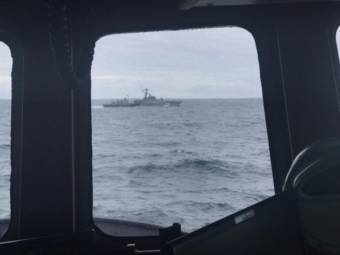
A Russian vessel participating in military exercises on the Bering Sea steams past the pollock trawler Vesteraalen on Wednesday. (Courtesy Steve Elliott)

Steve Elliott’s trawler, the Vesteraalen, was fishing for Bering Sea pollock Wednesday afternoon when he and his crew started hearing voices speaking Russian on their ship’s radio — an unusual development, given they were 80 miles from the U.S.-Russian maritime boundary.

Soon after, though, the voices switched to English, with a stern message to Elliott’s boat and the dozen others fishing within a few miles: Move.

“Three warships and two support vessels of theirs were coming and would not turn,” Elliott said, in an interview over the Vesteraalen’s satellite phone. “And they came marching right through the fleet.”

Other vessels reported getting buzzed by Russian aircraft and ordered out of the area on a specific heading. The incident has now drawn the attention of both of Alaska’s U.S. senators as well as an investigation by three federal agencies into what they’re calling reports of “unprofessional interactions” by the Russian military.

The altercation interrupted fishing for several boats, and some industry players say they’re worried about continuing impacts of exercises that, according to a federal notice, could run into September. This year’s summer pollock season has already been challenging, with slower fishing and added precautions due to the COVID-19 pandemic, and vessels only have until Nov. 1 to catch their limit.

A map of the close encounter between American fishing boats and Russian military vessels on the Bering Sea on Wednesday, August 26, 2020. (Valerie Kern/Alaska Public Media

“We were caught by surprise,” said Stephanie Madsen, executive director of the At-Sea Processors Association, a trade group of 13 large vessels that catch Bering Sea pollock and process it in onboard factories. “It caused a disruption in our fishing operations for at least the 24- to 36-hour period where we were trying to get the facts about what was happening. And then it’s unclear what impacts could continue through the time that the Russians have given us notice the exercises will be underway.”

Elliott said that in three decades of fishing, he’s never seen anything like what he experienced Wednesday. But experts say this is unlikely to be the last encounter between Russian and American vessels in the Bering Sea, as the warming Arctic becomes an area of increasing military and economic focus for global powers.

“Welcome to the future,” said Heather Conley, an Arctic expert at the Center for Strategic and International Studies. “Unfortunately, I think we’re going to see more of this type of exercising and significant military presence in the Arctic — we just haven’t seen it for a long time.”

The pollock trawlers were operating within the U.S. “exclusive economic zone” — an area that reserves fishing rights for American boats but doesn’t block international vessels from entering or operating, said Kip Wadlow, a Juneau-based U.S. Coast Guard spokesman.

While the Coast Guard called the exercises “pre-planned” and said that a notice about them was published earlier this month, fishing industry representatives argued that it was useless to them because it was issued through a system they don’t regularly monitor.

In interviews, Bering Sea fishermen and executives described a chaotic and unsettling run-in with the military assets, which the Russian government now describes as part of “massive drills” happening for the first time ever in the region, with missiles, submarines and dozens of warships and planes.

The Blue North, which was fishing for cod to the northeast of the trawl fleet, was buzzed six times by a Russian aircraft that, by radio, ordered the ship out of the area on a specific course at “maximum speed,” according to Mike Fitzgerald, a crew member.

“I won’t say we were fearful, because we’re Bering Sea fishermen. But this goes beyond anything when you really know what happened,” Fitzgerald said. “We had Russian military aircraft threatening us: ‘Danger area. Missile area. Proceed out of here.’ That’s unheard of, and it’s really wrong that we haven’t gotten more protection out here.”

Fitzgerald also provided a photo, sent by another fishing vessel, that appeared to show what fishermen thought was a Russian submarine surfaced close to the shore of St. Matthew Island, which is part of the United States. But one defense analyst on Twitter, H.I. Sutton, said the photo actually showed a U.S. naval submarine, not a Russian one.

Republican U.S. Sen. Dan Sullivan said in a prepared statement that the exercises are a “stark reminder of why we need a strong U.S. military presence in the Arctic.”

This photo shows a submarine surfaced not far from the shore of U.S.-owned St. Matthew Island, in the Bering Sea. Fishermen thought the submarine was Russian, but defense analysts say it’s a U.S. naval vessel. (Courtesy Mike Fitzgerald)

“In recent months, Russian provocation has only increased. Our commercial fishing fleet encountered a frightening situation, with huge safety implications,” the statement quoted Sullivan as saying. “Clearly, there was a communications breakdown among our military agencies, and we are working to get to the bottom of it — so that this type of incident, which caught our fishermen off guard, does not happen again.”

Republican U.S. Sen. Lisa Murkowski also released a statement saying she’d been briefed by Coast Guard and NORAD officials in an effort to understand what happened, and to ensure that maritime interactions are conducted “lawfully, peacefully and with due regard for the safety of those at sea.”

On Thursday, military officials said only that they were monitoring the situation, and that the Russian military exercises were taking place in international waters “well outside the U.S. territorial sea.”

But on Friday, the Trump administration released a sharper statement, saying that the three federal agencies are investigating reports of “unprofessional interactions by Russian military forces with U.S. fishing vessels in the Bering Sea.”

“Initial indications are that these interactions stem from a Russian naval exercise,” said Larry Pixa, a spokesman for the U.S. Department of State, which is working with the U.S. Coast Guard.

Experts say that the incident comes as the U.S. — not just Russia — has also become more assertive in the Arctic. Conley said there’s been increasing American naval and air activity in the Barents Sea, near Norway, and that the two nations are “signaling to one another” about the strategic and military importance of the Arctic.

The fishing boats’ experience in the Bering Sea highlights the need for enhanced systems of communication as the Arctic becomes more crowded, and it should serve as a learning experience, said Mike Sfraga, director of the Wilson Center’s Polar Institute and a former vice chancellor at University of Alaska Fairbanks.

The Russian military wasn’t operating outside “international norms” in conducting its Bering Sea drills, and neither were the American fishermen, Sfraga said. But though it appears that certain parts of the U.S. government were made aware of the exercises in advance, that message didn’t get passed along to the pollock fleet, he added.

“This is what most of us worry about,” he said. “It seems to beckon for a higher, government-to-government level discussion about how we engage in the future, because this will not be the last time.”

National Public Radio diplomatic correspondent Michele Kelemen contributed reporting from Washington, D.C.

Trump administration appeals ruling that blocked Izembek road

The Alaska Peninsula fishing village of King Cove has pushed for construction of a road through the Izembek National Wildlife Refuge, which residents say would allow more consistent access to a jet runway in neighboring Cold Bay for medical evacuations. (Photo by Berett Wilber/KUCB)

President Donald Trump’s administration has appealed a federal judge’s rejection of a plan aimed at building a road through the Izembek National Wildlife Refuge on the Alaska Peninsula.

Two months ago, Judge John Sedwick threw out a land trade between the federal government and an Alaska Native village corporation aimed at advancing the road project. He said the trade was illegal because it violated two separate federal laws, the Administrative Procedure Act and the Alaska National Interest Lands Conservation Act.
The Trump administration issued a notice Friday saying it would appeal the ruling.

Residents of the isolated Alaska Peninsula village of King Cove, with support from Alaska elected leaders, have pushed for construction of the road for decades. They say a road would make it easier to reach the nearby airport in the town of Cold Bay for lifesaving medical evacuations.

Environmental groups argue that the road could still be impassable during the winter and foul weather and that construction and traffic could harm Izembek’s birds and wildlife.

This is the second time the Trump administration’s land exchange has been challenged in federal court. An earlier version was also thrown out by a different federal judge last year.

Seafood companies kept COVID-19 from infecting Alaskans. Now they’re trying to keep the virus out of their plants.

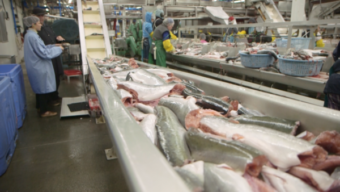
Workers processing fish at a salmon processing plant.
Seafood processors, like the ones pictured here at an OBI Seafoods plant in Kodiak, face elevated risk of catching COVID-19 because of their busy work environment. (Eric Keto/Alaska’s Energy Desk)

This spring, as Alaska hunkered down and kept COVID-19 rates low, residents of the state’s fishing towns raised strong objections to the arrival of thousands of fishermen and seasonal plant workers, fearful that the visitors could bring the virus with them.

Available state data appears to show that strict state and local mandates, plus tight restrictions imposed by seafood companies, ended up stopping those visitors from spreading the virus. The Bristol Bay Borough, Alaska’s salmon hub, had just one resident case of the virus through Monday.

And now, as infection rates rise among the Alaska public, the dynamic has flipped: It’s the seafood companies that have to protect their workers from Alaska residents.

Many of Alaska’s processing plants, particularly in Bristol Bay, are staffed exclusively by seasonal workers who live on company property. And this year, companies operating in the region have avoided major outbreaks by barring workers from leaving their property.

But other plants’ workforces are mixed, particularly in communities like Kodiak and in Southeast Alaska. Seasonal employees have been restricted to company property, but they work with resident employees who return home at the end of each day.

Those residents might still have close contact with family members or friends, exposing themselves to a deadly virus that, because of its ability to be transmitted before a person shows symptoms, can be brought back into a plant undetected.

That’s what officials say happened at Alaska Glacier Seafoods in Juneau. A resident worker was infected by COVID-19 outside the plant, then brought the virus in and 39 other workers caught it. In a phone interview, Vice President Jim Erickson stressed that the source of the outbreak was not seasonal employees.

“We successfully brought in between 100 and 110 people from out-of-state, COVID-free. Everybody passed two rounds of negative tests, plus quarantine,” Erickson said. “We did not bring the COVID in with out-of-state workers. Unfortunately, it was transferred to us by a Juneau resident that lives outside of company housing.”

If COVID-19 does make it into a processing plant, it can spread quickly there, given the busy factory environment and the potential for close contact between workers. Alaska processing companies say they’ve tried to reduce risk using daily symptom checks for employees, protective equipment and barriers installed in their plants, but two other major outbreaks have hit the industry in the past week.

One, with 96 cases, hit a plant this week in Seward that employs a mix of resident and seasonal workers, although authorities have not yet described the source of those infections. A third outbreak is aboard a massive Bering Sea trawler with a processing plant onboard.

Across Alaska’s fishing communities, local and industry leaders agree that the threat from the virus has evolved — from incoming seasonal workers at the start of the fishing season to resident workers now. And the risk from those resident workers has steadily increased as infection rates among the general public rose quickly in recent weeks.

“At the time that we were bringing workers into Alaska to support these fisheries, the virus was not circulating in a lot of smaller Alaska communities,” said Nicole Kimball, vice president of Alaskan operations for the Pacific Seafood Processors Association. “Now it is circulating higher in those communities, so that is a bigger challenge — and I think it’s the main challenge we have today in seafood processing.”

The shift became clear to Dr. Hannah Sanders in a recent phone call.

Sanders, chief executive of the hospital in the Prince William Sound fishing town of Cordova, had spent much of the spring working to make sure that COVID-19 wasn’t introduced into her community by seasonal workers.

Like many other Cordova residents, Sanders had objected to companies’ plans to import their workforce this year, and she even wrote a letter to the town’s mayor saying that there was no way to do so without “significant morbidity and mortality” among residents.

But two months into the season, no one has died or even been hospitalized with the virus in Cordova. And recently, Sanders found herself on the phone being asked whether her hospital could provide adequate protection from COVID-19 for a plant worker who needed an X-ray.

“It was hard. I had to kind of take a deep breath and not take offense to it. Because I’d been working so hard to keep them safe,” she said. “But I realized that we really have developed a symbiotic relationship.”

Companies, health-care providers and local leaders all acknowledge the increased risk posed by resident workers, and some are taking specific steps to manage it.

In Cordova, a few workers from each shift at each plant are being randomly tested each week, with the hope of catching a quietly-developing outbreak before it gets too large, Sanders said. And for processors that have resident workers coming and going each day, all of those employees are being tested on a monthly basis.

In Kodiak, Trident Seafoods has adopted a management plan that’s tied to the number of active cases in the community. If infections hit a certain level, essential resident employees may be asked to move into bunkhouses on company property.

And in the Southeast fishing town of Petersburg, the local borough is spending $178,000 in federal COVID-19 relief money on regular testing of resident processing plant workers.

But such measures haven’t been adopted or mandated statewide.

“Regularly testing all workers every couple weeks — that takes a lot of tests,” said Kimball, with the processors association. “That’s the challenge: ensuring we have enough testing supplies, specifically in communities that have a high resident workforce, where that sustained testing is going to be more and more important.”

Adelyn Baxter contributed reporting from KTOO in Juneau.

Southcentral Foundation fires senior executive and two dentists for falsifying health records

One of Anchorage’s leading tribal health care providers has fired a senior executive and two dentists after an anonymous complaint documented “falsified health records” and “serious compliance issues,” the provider said in a statement Tuesday.

Among those fired by Southcentral Foundation was Kevin Gottlieb, husband of the organization’s chief executive, Katherine Gottlieb. Kevin Gottlieb was the first dentist hired by Southcentral Foundation in 1982 and, after rising to chief of staff and vice president of resource development, earned $725,000 in 2018, according to tax filings.

The two other dentists fired were Thomas Kovaleski, identified as the “director of dental,” and Clay Crossett, identified as the “dental director.”

In a message to employees, Southcentral Foundation said the firings were the result of an independent investigation of the anonymous complaint.

“The investigation showed the dentists falsified health records by attributing one dentist as the provider of routine dental exams when that dentist did not actually perform the procedures,” the message said. “All procedures were performed by qualified dentists, and there was no impact to customer-owner safety.”

The message said Southcentral Foundation has “self-reported” the compliance problems to the U.S. Attorney’s Office and will comply with any subsequent investigations.

Southcentral Foundation is a powerhouse in Alaska’s world of tribal health care, with $400 million in revenue in 2018, according to tax filings. The organization, which has 2500 employees, cares for Alaska Natives from Anchorage and the Mat-Su, and it also provides support for residents of dozens of rural villages.

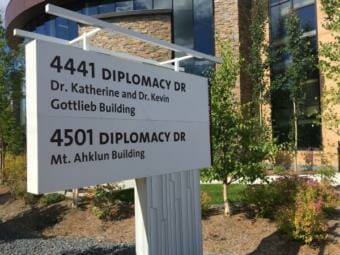
Katherine Gottlieb, the chief executive, has been recognized nationally for her leadership of Southcentral Foundation, and two years ago, the organization opened a new facility named for her and her husband: The Dr. Katherine and Dr. Kevin Gottlieb Building.

Seward salmon plant shuts down with 34 COVID-19 cases and more expected

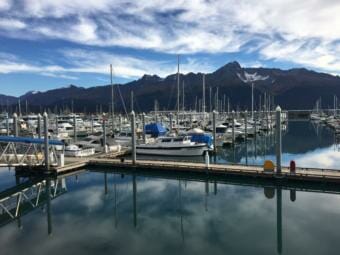
Seward small boat harbor. (Alaska Public Media file photo)

OBI Seafoods has shut down a salmon processing plant in the Kenai Peninsula town of Seward after at least 34 workers there tested positive for COVID-19, according to a local official.

The plant has about 260 workers, who are a mix of residents and nonresidents, according to Scott Meszaros, Seward’s city manager. He said 90 employees have been tested so far, and that more positives are expected as the remainder of the workers are tested.

All employees who tested positive are being moved to Anchorage, he added.

OBI Seafoods was created earlier this year from a merger between Icicle Seafoods and Ocean Beauty Seafoods — Icicle Seafoods owned the Seward plant before the merger. Officials with the new company didn’t immediately respond to requests for comment Wednesday.

Seward has suddenly become a hub for seafood industry COVID-19 cases, as a factory fishing vessel with 85 infected crew is expected to arrive in town later Wednesday from the Aleutian Islands. The crew from the American Triumph, operated by Seattle-based American Seafoods, will also be moved to Anchorage for isolation.

Meszaros said the city is doing “everything it can” to protect residents, and the crew from the vessel will be monitored by security.

He also praised OBI Seafoods for the efforts it made and the money it spent to protect its employees and to try to keep the virus out.

“They’ve given us their plans, they’ve followed their mandates,” he said. “I feel very secure in saying they’re doing it right and we are supportive of what they’re doing. In lieu of that, all it takes is one sick individual to come into that environment — and they can’t keep the people that live here out of the plant.”

This is a developing story and will be updated as information becomes available. 

Site notifications
Update notification options
Subscribe to notifications