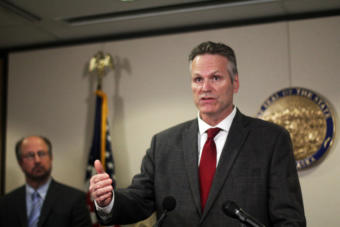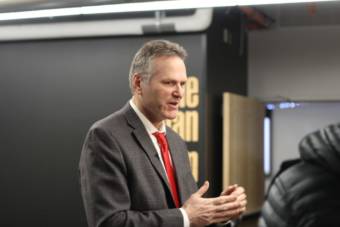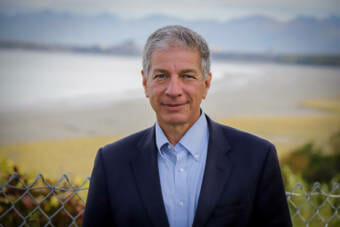
Mayor Ethan Berkowitz stands by the Coastal Trail in Anchorage on September 14, 2020. (Jeff Chen/Alaska Public Media)
Anchorage Mayor Ethan Berkowitz’s resignation was announced Tuesday, a day after acknowledging that he’d carried on what he described as a consensual, inappropriate messaging relationship with a television anchor.
Berkowitz’s chief of staff, Jason Bockenstedt, made the announcement at Tuesday evening’s Assembly meeting, where members were set to consider a request to extend the mayor’s emergency powers to manage the COVID-19 pandemic.
“It is with profound sadness and humility that I resign as the mayor of the municipality of Anchorage,” Bockenstedt said, reading from the statement.
Berkowitz’s resignation is effective Oct. 23, Bockenstedt said.
The mayor’s decision leaves a leadership void in Alaska’s largest city as economic stressors mount for businesses and the number of daily COVID-19 cases reaches record highs. Anchorage also remains deeply divided over the measures Berkowitz’s administration has taken to fight the pandemic.
In a vivid illustration of just how deep those divisions run, the audience at Tuesday’s Assembly meeting burst into boisterous cheers as Berkowitz’s resignation was announced. Many of those in attendance had gathered to oppose the extension of the mayor’s emergency powers, and their celebration interrupted Bockenstedt and prompted a rebuke from Assembly Chair Felix Rivera.
“This needs to end,” he said.
People in the audience at the Anchorage Assembly meeting erupted into applause and cheers on Tuesday, Oct. 13, 2020, after Anchorage Mayor Ethan Berkowitz’s resignation was announced. (Jeff Chen/Alaska Public Media)
The mayor’s resignation is the latest chapter in a scandal that publicly unfolded over the last several days. It began Friday when Maria Athens, an anchor for a small Anchorage television station, posted allegations on her Facebook page that Berkowitz, who is married, had shared inappropriate photos on an “underage girls website.” She then published a photo of a nude man, taken from behind, which she claimed was the mayor.
After learning of the allegations, Berkowitz’s executive team decided to create a “firewall” between the mayor and the rest of city government, Municipal Manager Bill Falsey said at Tuesday’s meeting.
Falsey said he told the city police chief to proceed “by the book,” adding that a subsequent investigation by Anchorage police and the FBI found “no evidence of criminal conduct on the mayor.” In its own statement Tuesday, the FBI said it found “no immediate evidence to support a violation of federal law; however, the FBI Anchorage Field Office continues to monitor the situation.”
Falsey said top city officials discussed the situation and came to the conclusion that “it would be untenable for the mayor to continue in his role.”
“The mayor independently arrived at the same conclusion,” he said.
Under Anchorage city code, the chair of the Assembly serves as acting mayor in the event of a vacancy.
While Rivera currently holds that position, Assembly members said in interviews Tuesday that it’s likely the Assembly would reorganize if Berkowitz resigned, and the body could choose a different chair to serve as acting mayor.
If the vacancy occurs more than 90 days before a regularly scheduled election, a special election would need to be held. Since the regular election isn’t until April, that’s likely the case here, but Rivera said he’s still waiting for a legal analysis to determine whether the Assembly could avoid holding a special election.
This story has been updated with more information.
Alaska Gov. Mike Dunleavy speaks at a news conference at his Anchorage office last year. (Nat Herz/Alaska Public Media)
Alaska Gov. Mike Dunleavy’s administration continues to assist the company behind the Pebble mining project as it drafts plans to satisfy federal permitting requirements, and the governor this week rejected calls to condemn Pebble and stop his administration’s work on it.
Since the release of the secretly recorded “Pebble tapes” last month, Alaska’s Republican U.S. senators have distanced themselves from the project, which opponents describe as deeply politically unpopular. But Dunleavy, who’s also a Republican, says he has a responsibility to pursue projects like Pebble — if they can be safely built — to help improve the lives of rural Alaska residents.
Pebble’s proposal, he said in an interview, could unlock hundreds of billions of dollars in wealth for the people of Bristol Bay, the region where the mine would be built.
“We’ve got to go through the study process, permitting process. But if we can, wouldn’t we celebrate that? That it would lift countless people out of poverty? That it would provide economic opportunity for a depressed region?” Dunleavy said. “As opposed to saying, ‘No, we don’t even want to look at the science. We want this whole thing to stop now.’ I think that’s not my role as the governor.”
One of Bristol Bay’s political leaders, House Speaker Bryce Edgmon, I-Dillingham, said that the region would welcome Dunleavy’s help to expand its economy. But residents do not want that help to come in the form of the mine because of the threat it poses to Bristol Bay’s huge sockeye salmon fishery, he added.
“I think the governor should be working with the region, as opposed to telling the region what it needs and what it should do,” Edgmon said in a phone interview.
House Speaker Bryce Edgmon, I-Dillingham (Skip Gray/360 North)
Edgmon, along with Kodiak GOP Rep. Louise Stutes, last week penned a letter to Dunleavy asking the governor to oppose Pebble’s development efforts, saying they’d been called into doubt when the company’s executives said on the secretly-recorded tapes that the project would be larger than they’d publicly indicated.
Dunleavy responded with his own sharply-worded message Tuesday, telling Edgmon that he “will not stop fighting for the people of the Bristol Bay region who continue to suffer from an acute lack of economic opportunity.”
“The American dream cannot be realized while constrained by dependence on government,” Dunleavy added.
Pebble is in the midst of developing a plan to meet federal requirements to offset the project’s environmental damage, and its executives said on the tapes that such a plan would require the use of state land. In theory, the state land would be protected to compensate for the project’s destruction of wetlands.
In his letter, Edgmon called on Dunleavy to reject Pebble “in deed or word if it seeks to use state land in any way” to fulfill the federal offset requirements.
But in a prepared statement, Dunleavy’s natural resources department said that in recent weeks, it’s still coordinated four meetings at Pebble’s request to discuss related state laws and regulations — though the agency stressed that it’s not providing any guidance to the company about how to meet federal standards.
A Pebble spokesman, Mike Heatwole, described its contacts with the agency as “preliminary conversations” to clarify the company’s understanding of state land management procedures and to make sure that its offset proposal to the federal government is accurate.
Dunleavy, in the interview, said the secretly-recorded Pebble tapes have not changed his mind about how the permitting process should work.
“Scratch off the name ‘Pebble’ and just leave it blank: Any and all projects in the state of Alaska should go through a rigorous process that has standards to ensure that the environment is protected and that the projects are viable or are not,” he said. “That hasn’t changed at all, and it shouldn’t change at all.”
The governor, a spokesman said in a follow-up email, had been “confused” by Edgmon’s letter, “because it did not reflect any interest in seeking out economic opportunities that can improve the quality of life for residents of the Bristol Bay region.”
“If they are steadfastly opposed to one proposal, what other resource opportunities do they support that create good paying year-around jobs?” the spokesman, Jeff Turner, said in an email.
While Alaska Republicans have long been enthusiastic supporters of natural resource development, Pebble has proven more polarizing because of the Bristol Bay region’s lucrative salmon fishery.
And now, Dunleavy’s refusal to condemn the Pebble is leaving him increasingly politically isolated on the issue.
Before the release of the tapes, both of Alaska’s U.S. senators said they don’t think the proposed project can be permitted. Afterward, Sen. Dan Sullivan went even further, saying he’s anti-Pebble amid attacks over the issue during his re-election campaign against independent Al Gross.
Given the project’s dwindling support, Dunleavy’s stance on the mine is one of the only things keeping it as a live political issue during a hotly-contested election season, according to one political strategist.
“It’s wonderful. He’s helping elect Al Gross,” said Jim Lottsfeldt, an Anchorage political consultant.
Lottsfeldt is working with a super PAC that’s running Pebble-related attack ads against Sullivan; he said voters see Gross as a more vocal mine opponent.
“If you truly believe Pebble is dead and buried, then you have less reason to support Al,” Lottsfeldt said in a phone interview. “But as long as Pebble stays alive, all the benefit accrues to Al Gross.”
Sullivan’s campaign manager, Matt Shuckerow, reiterated that the senator has already declared his opposition to the project, and has even tweeted: “No Pebble mine.”
With Alaska facing a billion-dollar budget deficit and a nearly-empty primary savings account, James Kaufman’s pitch sounded compelling: We can have better government for less money — or at least the same amount.
“As soon as you talk about a cost reduction, immediately people say, ‘Well, that equals slashing services,’ and all these overheated terms get used,” Kaufman, a Republican running for a South Anchorage state House seat, said at a debate last week. “I think there’s room in all of these systems to find way to do a better job of delivering, and with that, find a way to reduce or hold costs. That’s going to have to happen as we go into this funding problem that we’re going to have to crack.”
Kaufman isn’t the only candidate with this point of view. Robb Myers, a Fairbanks Republican running for state Senate, said he thinks the state could cut as much as one-fourth of its $1.3 billion public schools budget without meaningful reductions in quality that Alaskans would reject.
“We can still have our budget and have the services that we expect at a much lower rate, without really compromising quality, in most cases,” he said in an interview.
But veterans of state budget battles say that after years of spending cuts, it’s unlikely that further reductions can fill much of the deficit without major impacts to services like schools and the Medicaid system.
Those two programs together cost the state $2 billion a year. And if lawmakers decide to boost the Permanent Fund dividend to the level set by a historical legal formula, as Myer is proposing, they could eliminate every single other state agency — Fish and Game, Corrections and Transportation — and still face a budget gap.
“The easy choices are gone,” said House Speaker Bryce Edgmon, I-Dillingham, who’s served in the Legislature since 2006. “When I hear candidates casually talk about what they’re going to do to make ends meet down in Juneau as if the choices are very easy at hand, I have to shudder — because I don’t think they know what they’re talking about.”
Bryce Edgmon (Skip Gray/360 North)
For candidates seeking to cut Alaska’s budget, the level of spending on schools and Medicaid make those the two most obvious options to reduce.
Myers said he sees inefficiencies in the state’s complicated “foundation formula” used to decide how much money flows to each public school. The formula sets aside more money for each student in smaller schools, which makes sense in rural areas, but discourages consolidation in urban areas, Myers said.
He described that as a “seriously perverse incentive” that pushes school districts to spend more money that doesn’t make it into the classroom.
Administrators say that while consolidation of urban schools can save money on maintenance, it can also boost the cost and complexity of busing and run into problems with overcrowding. And while they acknowledge that there might be some tweaks to Alaska’s schools spending formula that could save small amounts of cash, they argue that it’s unlikely that thrifty lawmakers have been overlooking obvious money-saving reforms.
The state Legislature has been trying to reduce the state budget since 2014, when there was a crash in oil revenues, which once paid the vast majority of Alaska’s bills.
“What are we now, four, five, six years into this?” asked Mike Hanley, superintendent of two rural Alaska school districts and a former state education commissioner. “You’re not going to find a piece of that formula that says ‘Oh, click, look at that — millions of dollars.’”
Mike Hanley (Lisa Phu/KTOO)
Hanley said that targeting the complicated schools spending formula is a way for politicians to talk around a more transparent and realistic way of cutting the schools budget: simply reducing the amount of money set aside for each student.
But cutting that line item, known as the base student allocation, faces a different obstacle in the form of a constitutional requirement that the state maintain a system of schools open to all children. Education advocates have already sued over that requirement once, winning an $18 million settlement in 2012 after a judge found that the state had failed to provide enough support and oversight for chronically underperforming schools.
“I think if somebody were to go in and challenge the size of that funding formula, we will definitely see a challenge,” Hanley said. “Because I don’t think it’s hard to argue that school districts have lost ground in the course of the last several years.”
The $650 million that the state spends on Medicaid is also not easily reduced.
Lawmakers already passed a bipartisan, money-saving Medicaid reform package in 2016.
And the Legislature cannot just simply cut the budget for Medicaid, because spending is guided not by how much money is set aside for the program but by eligibility standards, the types of services offered and the amount that hospitals and providers are paid for care.
Changing those elements can require adjustments to state law and regulation, and negotiation with the federal agency that pays for a large portion of the program.
“The state of Alaska is in a contract with the federal government for Medicaid benefits, and it can’t break that contract. That’s why they can’t just cut funding to Medicaid,” said D.J. Wilson, who runs a health policy organization called State of Reform.
Lawmakers could save money on Medicaid by voting to make fewer people eligible for the program, shrinking the type of benefits available to recipients and further cutting payments to providers, which the state has already reduced in recent years, Wilson said.
Alaska could also cut costs by moving away from a system that compensates providers for each service, regardless of how successful it was, and toward a more coordinated and strategic system of care that rewards efficiency, he said. But, Wilson added, “none of this is easy.”
“It is super complex, and no state has figured it out yet,” he said.
Even some Republican leaders acknowledge the challenges that come with cutting Medicaid spending.
“This is going to be a very difficult year coming up,” Wasilla Republican David Wilson, the chair of the Senate’s health committee, said at a conference hosted by Wilson’s group last month. “States, we don’t really have many options to help constrain the Medicaid spending.”
Kerry Williams and Ceal Smith are climate activists who were among the 50,000 Alaskans to sign the application to recall the governor.
Nonetheless, all three found themselves on the phone in January. Dunleavy initiated the call after reading about Williams’ idea for a hydroelectric megaproject at Eklutna Lake, outside Anchorage, which would tie in with a huge expansion of wind energy across the state.
“We were quite surprised by how enthusiastic he was,” said Smith. “He said he even drove out to Eklutna to conceptualize it.”
Alaska is warming twice as fast as fast as the global average, and even as climate change threatens to impose steep costs here, Dunleavy and other elected officials have continued promoting the oil industry, which underpins the state’s entire economy.
But the plummeting costs and increasing availability of renewable power sources are making their adoption increasingly inescapable, and even major oil companies like BP have expanded into the industry.
Renewables make an especially compelling case in Alaska, where electricity costs nearly twice the national average. And the Eklutna hydroelectric concept isn’t the only renewable power idea to draw Dunleavy’s interest.
The governor has also quietly pitched Warren Buffett, the billionaire investor, on Alaska’s wind power potential, with Buffett responding in a letter that he hopes he can “join forces” with Dunleavy. Executives from one of Buffett’s companies, Berkshire Hathaway Energy, have held a series of meetings with the governor and senior administration officials.
“I know there’s a view, on the part of some, that a Republican governor that is supportive of Alaska’s resource extraction industries, including those around fossil fuels, would not want anything to do with renewables,” Dunleavy said in an interview Friday. “That’s not the case.”
Improvements in technology and decreasing costs of renewable power, he added, “open up some new and tremendous possibilities for Alaska.”
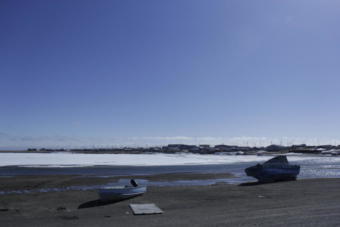
The Eklutna project is still more of a concept than a formal proposal, and neither the governor nor Berkshire Hathaway is talking about what could come out of their discussions. But alternative energy boosters say the governor’s interest reflects a growing political consensus around the benefits of renewable power.
“Things are shifting,” said Smith. “And this is a new place we’re in, that we haven’t been in before.”
The Eklutna hydroelectric project and accompanying wind power investments could cost $5 billion or more. But boosters say the project could supply most of Alaska’s road system communities with 100% renewable power and cut electric costs by a third over time.
The concept stems from an inherent problem with wind power: It isn’t consistent, because it rises and falls with the wind itself.
Eklutna Lake is tucked into the Chugach Mountains not far from Anchorage. (Abbey Collins/Alaska Public Media)
Williams and Smith want to use the project at Eklutna Lake, tucked in the mountains outside of Anchorage, as a kind of battery: When winds create more energy than Alaskans need, the extra power would pump water uphill to the lake and to two new reservoirs built even higher in the mountains.
Then, in times when more power is needed, the water would be drained downhill out of the reservoirs and through an existing hydroelectric plant that connects to the lake. It’s a system known in the energy industry as “pumped hydro.”
Supporters say extra water flowing out of Eklutna Lake could actually boost salmon runs in the Eklutna River downstream — a major difference from another major hydroelectric project that Alaska elected officials advanced in the past, in the Susitna River watershed.
And the Eklutna project faces no opposition from the region’s Indigenous people, according to Aaron Leggett, the president of Eklutna’s tribal government.
Dunleavy said he stumbled on the idea doing some late-night internet research and felt like “the concept had potential.”
“It makes total sense to explore pumped hydro, using wind as a main source of energy and the reservoir as the batteries,” Dunleavy said. “We have the topography to make this work.”
Alaska’s electricity costs are the second-highest of all 50 states. Dunleavy said he’d like to install more predictable energy sources, like renewables, as a means to recruit businesses to the state. He said Alaska could tap into not just wind and hydroelectric energy, but also tidal power, given the massive tides in Cook Inlet near Anchorage.
After discussing the Eklutna project with Williams and Smith, Dunleavy asked them to write a memo on their idea, which has since been published.
Dunleavy asked the Alaska Energy Authority, a state agency charged with reducing power costs, to review the proposal.
The authority has not published any of its own findings, but its preliminary analysis suggests that a pumped hydro project may have more potential near an existing state-owned hydroelectric dam at Bradley Lake, on the Kenai Peninsula, said Executive Director Curtis Thayer. He said the authority aims to produce more detailed recommendations within six months to a year.
The Eklutna project was what sparked Berkshire Hathaway Energy’s interest in Alaska, Thayer said. The authority hasn’t had detailed conversations with the company, but Berkshire Hathaway does have a copy of the memo about the project, Thayer said.
The company’s executives have held at least four phone calls with Dunleavy since he wrote to Buffett in May, according to copies of the governor’s schedules obtained through a public records request. A Berkshire Hathaway Energy spokeswoman, Jessi Strawn, declined to comment.
“I believe Alaska presents similar opportunities and would welcome the opportunity to discuss them with you,” Dunleavy wrote. “Transitioning Alaska to clean, reliable, inexpensive electricity is one of the greatest things we could do to attract additional investment, diversify and grow our economy and lower the economic burden on Alaskans in powering their homes and businesses.”
Chris Rose, who leads an advocacy organization called the Renewable Energy Alaska Project, said his group welcomes Dunleavy’s interest in efforts to make the state’s power grid more efficient.
But Rose said he wants to make sure that planning for renewable power projects is careful and strategic, not driven by political interest in megaprojects. That’s because many of Alaska’s road system utilities use relatively new power plants fueled by natural gas, and displacing them with projects that are too big could actually drive costs up, Rose said.
“We have to, I think, look at this a little bit more surgically and say, ‘We’re going to be displacing this much natural gas by putting in energy storage here, or by putting in a smaller wind farm over there,’ rather than thinking about much larger projects,” Rose said.
Rose said he’d also like to see the governor focus on efficiency efforts that might be “less sexy” than megaprojects but are already underway, like an initiative to better coordinate power generation and transmission between Alaska’s many different road system utilities.
Dunleavy said his administration is planning “a lot more” action on renewable power. And he cited his State of the State speech earlier this year, when he said he was pushing his departments to hit a 2025 goal for Alaska to produce half of its energy from renewable sources.
“I think Alaska has tremendous opportunity in this,” Dunleavy said. “Alaska is open to business, and the governor is trying to reduce energy dependence — and we’ll use any and all methods to get to that.”
Kaktovik sits on an island in the Arctic Ocean on Alaska’s northeast coast. Some Arctic residents are already changing their fishing techniques to target what they say are the increasing numbers of pink salmon arriving on their shores. (Photo by Nat Herz / Alaska’s Energy Desk)
Scientists like to say that climate change is creating winners and losers in Alaska: Some species will struggle, while others could benefit from warmer habitats.
One of those climate change winners could be pink salmon in the Arctic, according to a new paper published by U.S. and Canadian scientists in a journal called Deep Sea Research Part II.
The study provides new evidence that global warming could produce higher numbers of pink salmon in the region by making previously too-cold rivers and streams more hospitable for spawning.
The findings bolster reports by Alaska subsistence fishermen that the species’ numbers have been increasing as the Arctic warms at more than double the rate of the rest of the globe.
“Maybe in the past, they’d see a few adult pink salmon here and there every few years. Now they’re seeing them every year,” said Ed Farley, a federal fisheries scientists who works at the Auke Bay Laboratories in Juneau. “And so, the question becomes: Is this a signal for what might be happening for pink salmon in terms of their production for the future?”
Some Arctic residents are already changing their fishing techniques to target what they say are the increasing numbers of pink salmon arriving on their shores.
On Alaska’s North Slope, in the village of Kaktovik on the Beaufort Sea, Sheldon Brower said he normally fishes for Dolly Varden, a type of char; the mesh in his net is too small to catch salmon.
Next year, he said, he’ll use a net with larger mesh in hopes of snagging more pinks. Brower said he doesn’t normally eat much salmon, but he’s eager to catch some.
“I’ve had some salmon strips and smoked salmon — I want to start trying to make that,” he said. “So, I want to try to catch as much as I can.”
Farley’s paper examined temperature observations in the hub town of Nome, on the Bering Sea.
And the scientists found that when it’s warmer, young pinks do better — which in turn makes it more likely for a larger number of adult fish to spawn the following summer.
Nome is more than 500 miles southwest of Kaktovik, near the Bering Strait, where pink salmon are actually spawning. That’s not happening yet where Brower is catching them — those salmon are just “straying” up there periodically, Farley said. But, he added, that could change.
“It’s likely in the future we could see successful spawning — when that happens, you’re going to see more pink salmon in the High Arctic,” Farley said.
While Farley’s paper documents one particular species faring better in the Bering Sea as global warming continues, other populations have suffered.
Farther south, in the Gulf of Alaska, the marine heat wave known as “The Blob” hurt salmon and cod stocks. Farley said he thinks that farther north, there’s more room for ocean temperatures to warm before fish are harmed.
“The Bering Sea was a little cooler than the Gulf of Alaska, and with this warming, we seem to be moving into a sweet spot for salmon,” he said. “Whereas when we got really warm in the Gulf, we exceeded that sweet spot.”
Even in the Bering Sea, other species of salmon are not faring as well — namely, chinooks, Farley said.
The number of adult chinooks in the Bering Sea has declined over the past couple of years; there’s no obvious scientific explanation, but one possibility is that warming has negatively impacted a smaller fish called capelin that are an important prey for the chinooks, Farley said.
Farley said scientists are continuing to study warming in the Bering Sea, and their next focus is looking at how changes in the abundance of prey could lead to more salmon growth.
While Brower, the Kaktovik fisherman, said he’s looking forward to catching more pink salmon, he also said he doesn’t see the warming happening in the region as entirely positive. Residents of the coastal village are seeing foggier and rainier summers that are making hunting more difficult and pushing caribou farther away, he said.
“We used to see the big Porcupine herd going by right along the coast, but we rarely see that now,” he said. “We have to go a lot farther to hunt caribou — we’ll have to go inland.”
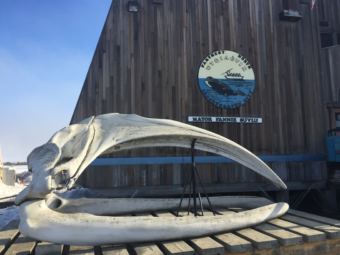
City Hall was one of a few places where Utqiaġvik has been incorporated into the official insignia. (Photo by Ravenna Koeniq/Alaska’s Energy Desk/KTOO)
As cases of COVID-19 spike in Alaska’s North Slope Borough, Mayor Harry Brower has issued a two-week “hunker down” order and mask mandate for the region’s hub town, Utqiaġvik.
Brower issued his emergency order Tuesday, requiring the town’s 5,000 residents to stay home except for getting or providing health care, shopping for groceries or other “critical goods” and getting “fresh air.” There’s an exemption for religious services — whether they’re held in cars, outside or in “properly-spaced and ventilated” indoor spaces.
In the order, Brower said he’s imposing the measures in response to “increasing numbers of COVID-19 coronavirus cases in Utqiaġvik.”
“Please encourage each other during this trying time,” the order said.
A borough spokesman said Brower was unavailable for an interview because he was busy butchering a recently-caught bowhead whale for his constituents. But in a prepared statement, Brower said the order was mostly directed at air travelers and private businesses.
“We trust folks will do the right thing and appreciate our business partners in all of our communities. But companies like Wells Fargo, our only bank on the North Slope, must provide the same safeguards they are using in larger Alaskan communities,” Brower’s statement said, suggesting free hand sanitizer and tele-banking for elderly and vulnerable residents who lack internet. He added: “We are far away from Anchorage, but our residents are still your customers. I will do everything I can to protect our residents. God bless you all and please stay safe.”
Utqiaġvik didn’t see its first case of COVID-19 until mid-July, according to state data. But since then, it’s registered 33 cases, including 11 in the past 10 days.
The local tribal health-care provider, Arctic Slope Native Association, said that four Utqiagvik residents tested positive for COVID-19 on Tuesday. All of those cases came from what’s known as “community spread,” ASNA said, which means the source of their infections couldn’t be determined.
Brower’s order says that all residents must wear masks or cloth face coverings when in “communal public spaces,” and when interacting with people they don’t live with.
Masks must be worn in “non-home settings, when unable to maintain a six-foot distance from others for any but a transient interaction.” The mask requirement also applies to taxis, cars and buses.
Close
Update notification options
Subscribe to notifications
Subscribe
Get notifications about news related to the topics you care about. You can unsubscribe anytime.