Nat Herz, Alaska Public Media

Trailing legislative Democrats pull ahead in Alaska ballot count; Sullivan and Young keep U.S. seats

Voting stickers are offered to voters at the Bethel polling site on Election Day. Nov. 3, 2020. (Photo by Katie Basile / KYUK)

A number of Alaska Democratic legislative candidates made up ground on their opponents Tuesday, as election officials released long-awaited tallies of nearly half of the estimated 150,000 ballots that remained uncounted.

A citizen’s initiative to overhaul Alaska’s elections, Ballot Measure 2, also gained ground in Tuesday’s count, while the races for president, U.S. House and U.S. Senate appeared almost certain to go to Republicans.

Early Wednesday, political data firm Edison Research called Alaska’s presidential race for GOP President Donald Trump and the U.S. Senate race for incumbent Republican Dan Sullivan. Later on Wednesday morning, the Associated Press called the U.S. House race for Republican Don Young.

Alaska’s uncounted ballots are mostly absentees, but they also include early votes and provisional ballots that are cast when poll workers have questions about a voter’s eligibility. The state’s decision to delay counting for a week after Election Day — which officials said was needed to protect against double-voting — has prompted confusion, speculation and impatience both inside Alaska and nationally.

While Republicans held onto their big leads in federal races as roughly 70,000 ballots were counted Tuesday, the results shifted an array of state-level races, including the one for Ballot Measure 2.

The election initiative would replace party-specific primary elections with a single race in which the top four candidates advance and institute a system of ranked-choice voting for the general election. It trailed by 24,000 votes after Election Night, and Tuesday’s count sliced that margin to less than 13,000. If the remaining uncounted ballots follow the same trend — which is not guaranteed — the results will be very tight.

That’s not the case for Alyse Galvin and Al Gross, the Democratic Party-endorsed independent candidates that are, respectively, challenging U.S. Rep. Don Young and U.S. Sen. Dan Sullivan, both Republicans.

Young and Sullivan held huge leads after Election Night, and while Galvin and Gross made up ground in Tuesday’s count, the incumbent Republicans will come out ahead if the remaining uncounted ballots follow the same trend.

Gross trailed by some 58,000 votes after Election Night, and had about 32% of votes to Sullivan’s 62%, but he still maintained that he would win the race. After Tuesday’s count of nearly half of the remaining ballots, Gross had only closed a little more than one-tenth of the gap, leaving him some 52,000 votes behind.

Galvin, meanwhile, trailed by 50,000 votes after Election Night, and reduced that gap to 42,000 on Tuesday. And Republican President Donald Trump saw his lead over Democrat Joe Biden shrink from 55,000 votes to 46,500. Both Galvin and Biden would have to win a far larger share of the remaining votes to claim victory.

Among the legislative races that flipped in Tuesday’s count: Democratic Party-endorsed Independent Calvin Schrage jumped into the lead in the hard-fought race for an Anchorage Hillside House seat, pulling ahead by 400 votes over Republican Rep. Mel Gillis, who was appointed to the seat last year by Governor Mike Dunleavy.

Longtime East Anchorage Democratic Sen. Bill Wielechowski pulled ahead of his Republican challenger, Madeleine Gaiser, moving from 121 votes behind to nearly 2,000 votes ahead.

In Fairbanks, two House Democratic incumbents who trailed after Election Night counts, Grier Hopkins and Adam Wool, both pulled ahead of their GOP challengers. Hopkins now leads Keith Kurber by 1,200 votes, or roughly 11%, while Wool leads Kevin McKinley by 500 votes, or 6%.

In the race for the East Anchorage state House seat currently held by Republican Gabrielle LeDoux, Republican David Nelson, who beat LeDoux in the GOP primary, now leads Democrat Lyn Franks by just 115 votes, or some 2.5%. That’s down from a 400-vote lead Nelson had at the start of the day.

In another East Anchorage state House race, Democratic Rep. Ivy Spohnholz pulled ahead of Republican Paul Bauer by nearly 1,000 votes, after trailing by 350 in the initial count.

West Anchorage Democratic Rep. Matt Claman also pulled far ahead of his Republican challenger, Lynette Largent, who trailed by just 50 votes after Election Night. And Democratic Rep. Chris Tuck, who represents a Midtown and South Anchorage district, pulled ahead of Republican Kathy Henslee, who led by more than 500 votes after Election Night.

In other competitive legislative races, state officials counted very few votes Tuesday. Additional counts are expected Wednesday.

In the races that did flip, a Democratic surge was expected, as progressive groups and campaigns pushed supporters to vote absentee ballots — which the state did not start counting until Tuesday.

This story has been updated.

Here’s why Alaska is the slowest in the nation when it comes to counting votes

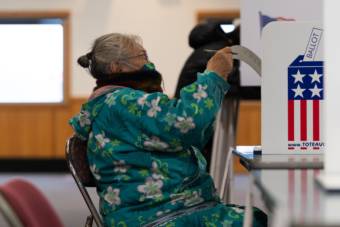
Edna Mathlaw of Bethel reads her ballot on Nov. 3, 2020 in Bethel, Alaska. (Photo by Katie Basile / KYUK)

Questions, confusion and speculation about Alaska’s vote-counting process have erupted as state officials wait to count more than 100,000 absentee and other ballots until next week — long after other U.S. states count the vast majority of their votes.

Alaska won’t start tallying its remaining ballots — at least 40% of the total — until Tuesday at the earliest, making the state stand out as a gray island in the ubiquitous red and blue electoral vote maps used by national outlets.

It’s the only state to have counted less than 60% of its votes, according to figures collected by The New York Times.

The timeline is one that Alaska has used before. But in past years, the absentee vote count has typically been an afterthought that affects only the closest of races.

This year’s massive, pandemic-driven absentee turnout has changed that.

State officials said the wait stems from Alaska’s huge size and complicated logistics: It has polling places in dozens of villages with no road access. Officials said they also need the extra week to finish the painstaking process of logging the names of each Alaskan who voted on Election Day, then cross-referencing with absentee ballots to make sure no one’s votes are counted twice.

But with other states finishing their counts and Alaska’s state legislative races and high-stakes U.S. Senate race still in limbo, some local and national political observers are increasingly questioning the schedule.

It’s also made the state and its lengthy timeline fodder for jokes, in a year when officials have already been called to rebut assertions that it delivers ballots by dog sled.

One user on the social video platform TikTok, in a post that’s drawn more than 1 million views, said the wait in Alaska means that “by the time that they’re done tallying all the votes there, we’re going to have had, like, seven new presidents and be fully submerged underwater.”

The New York Times skewered Alaska’s “glacial pace” of tabulation in its own post late Thursday. And Anchorage resident Stephanie Quinn-Davidson quipped on Twitter that “Alaska isn’t going to count the ballots until companies change their shipping policies and treat us like we’re part of the United States.”

@b.nwhiteacting like they don’t vote republican every year and have 3 electoral votes ##UnwrapTheDeals ##HomeOffice ##fyp ##foryou♬ original sound – ben

Sitka Democratic Rep. Jonathan Kreiss-Tomkins, who co-chairs the House State Affairs Committee with jurisdiction over elections, said he plans to review Alaska’s counting process once the dust settles on this year’s tally.

“Looking at the other states in the country, I do question: Why is it that we in Alaska don’t count our absentees that have arrived prior to Election Day, on Election Day?” Kreiss-Tomkins said in a phone interview. “It’s a question I’ve never asked before because in the past, absentees were not such a massive part of the vote total.”

Kreiss-Tomkins currently trails by 150 votes in his own re-election bid. But only 4,000 votes have been counted in his race, and he’s “cautiously optimistic” since more than 5,000 remain to be tallied next week that are expected to tilt Democratic.

Nonetheless, he’s received a barrage of messages from people around the state extending condolences for what the senders are interpreting as a defeat.

“I got a text this morning from a friend, a very average, normal, casual voter: ‘I’m so sorry! What a loss, un-smiley face. Thinking of you and hugging you super big,’” Kreiss-Tomkins said. “I think the delay in counting absentees, without a doubt, creates a lot of confusion.”

The delay has also left national pundits speculating about the outcome of the state’s U.S. Senate race, which has an outside chance of tipping control of the chamber to Democrats.

Democratic Party-endorsed candidate Al Gross trails incumbent Republican Dan Sullivan by nearly 60,000 votes and needs to win at least 70% of uncounted ballots to pull back into contention. Sullivan’s campaign and even some Alaska progressives say that’s unlikely, but Gross still claims that “victory is within reach.”

“I am starting to pay a little attention to the Senate race in Alaska, which I had ignored when the numbers showed Sullivan ahead of Gross almost 2-1,” Norman Ornstein, a scholar at the American Enterprise Institute, tweeted late Thursday.

If mailed-in ballots break like other states, Ornstein added, Gross could still win, “which would be earthshaking.”

Alaska counted some of its absentee votes on Election Day in both 2016 and 2018. But this year, it returned to a ballot-counting schedule used in previous elections in an effort to guarantee that no one votes more than once, according to Gail Fenumiai, the director of the Alaska Division of Elections.

The decision was made months before Election Day, officials added, and the timeline was shared with campaigns and media.

“The division strongly believes in the legal requirement of one person, one vote,” Fenumiai said. “This should always take a priority over counting ballots quicker.”

In this year’s primary election, Fenumiai added, more than 80 people voted more than once, though officials have said none of those double-votes was intentional and that all were detected and screened out.

Josie Bahnke, Alaska’s elections director in 2016 and 2018, declined to explain how, exactly, the state protected against double voting in those years. But Dermot Cole, a political blogger who’s questioned the state’s counting schedule, offered one idea in a column Wednesday: Why not review all the absentee ballots that have arrived at least week before Election Day, then distribute a list of those voters to polling places so that they can be turned away if they try to vote again?

That’s impractical, officials said, because voter lists for certain polling places must be printed at least two weeks before Election Day in order for them to arrive in time.

It’s also not possible to start the counting absentee ballots before next week because the state doesn’t expect to receive all the lists of Election Day voters from Alaska’s 441 polling places until this weekend, Fenumiai’s spokeswoman, Tiffany Montemayor, wrote in a follow-up email.

Once the lists arrive, workers have to record the identity of each person who voted on Election Day by scanning individual bar codes, one at a time, she said.

“Then we start voter history for the absentee ballots we received thus far and detect any duplicate votes,” Montemayor said. “All of those things cannot be completed in one day, two days or three days.”

Bahnke, the previous elections director, endorsed the state’s decision to return to the week-long wait before starting absentee vote-counting, given the degree of complexity of this year’s election.

In addition to the pandemic, the state debuted a new online system this year that can be used to request absentee ballots, as well as new vote-counting machines, Bahnke said.

“I think all of those decisions combined probably led to the decision,” she said. “Which is understandable and should be supported.”

Election administrators, Bahnke added, face a “real balancing act” between security and efficiency.

Nonetheless, elections officials are facing growing criticism from some Alaskans who characterize the week-long wait to start counting absentee ballots as a failure.
Cole, the politics writer, also cites a section of Alaska law that requires review of absentee ballots to start at least a week before Election Day — and requires counting of reviewed ballots to start Election Night.

Fenumiai, in her emailed response, said ballots are not deemed eligible for counting until “duplicate voter research has been completed.”

Asked about technological improvements that could speed up the absentee-counting process, or whether the state plans to give the issue some attention after this year’s election, Fenumiai reiterated her view that “the legal requirement of one person, one vote should always take precedence over counting ballots quicker.”

But Cole said he thinks that the increasing adoption of by-mail voting, both in Alaska and nationally, will force a deeper discussion.

“This has been a trend — it’s not just the pandemic year that has seen this increase in absentee ballots,” he said. “If this continues, which it will, we just need to have a better accounting system to provide both election security and prompt results.”

Correction: Based on inaccurate information shared by the Alaska Division of Elections, this story originally mischaracterized the process that the state uses to record the names of Election Day voters. The names are recorded by workers scanning bar codes, not by typing them in one by one, as the story initially said. The story also originally said that voter lists are sent to polling places “several weeks” in advance, but that’s only the case for certain rural precincts.

With more than 100,000 ballots still to count, Alaska campaigns cross fingers and crunch numbers

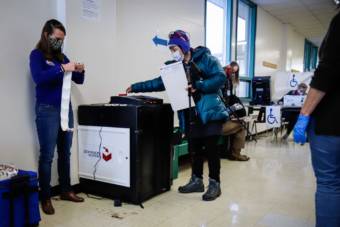
Election workers help a voter at Service High School in Anchorage on November 3, 2020. (Jeff Chen/Alaska Public Media)

More than a third of all the votes in Alaska’s election won’t be counted until next week at the earliest, and that means an array of candidates and causes are stuck in limbo.

But with nearly two hundred thousand votes counted Tuesday, campaigns and political operatives have already started crunching the numbers and making predictions about which races are still in play — and which ones aren’t.

Longtime Anchorage Democratic Senator Bill Wielechowski woke up the morning after Election Day trailing his Republican challenger by more than 200 votes. But does he have any anxiety about it? Not really.

“I have no doubt that when it’s done, I’m going to win by a significant margin,” he said.

Voters cast about 6,000 ballots in Wielechowski’s district on Election Day. But thousands more votes won’t be counted until next week at the earliest — part of a blizzard of early and absentee ballots that Alaskans voted this year, largely in response to the COVID-19 pandemic.

Political observers say they expect the uncounted absentee and early ballots to skew more strongly toward Democratic and independents since Republicans were more likely to vote in-person amid the pandemic. And Wielechowski says he expects those uncounted ballots to put a number of trailing Democratic candidates ahead of their rivals.

“I know people are freaking out, on the Democratic side — some people. But you literally counted the Republican ballots last night and you’re going to count the Democratic ballots next week. And you’re going to see change,” he said.

The big question is just how much change.

Republican U.S. Sen. Dan Sullivan speaks to supporters on Nov. 3, 2020, at the 49th State Brewing Co. in Anchorage. (Jeff Chen/Alaska Public Media)

Republicans did very well in the vote-counting from last night: At the state level, seven incumbent Democrats are currently losing their re-election bids. Leaders from both parties say they expect some of those results to change, but they have very different ideas about how much of a lead is too much to overcome.

Conservative news blogger Suzanne Downing’s headline Wednesday was that the Election Day results were a “huge victory” for Republicans and a “routing of the liberal agenda.”

“Most Republicans looking at last night’s results feel pretty comfortable that they’ve retaken the spirit of the House, in terms of it being dominated by Republicans. And, of course, they’ve retained the Senate — they did not lose any Republican seats,” she said.

Campaigns and political operatives now face a week-long wait before remaining absentee and early ballots are counted. But they already have a lot of information about those votes — they know the names and party affiliations of the people who cast them, along with other hints about their political leanings kept in proprietary databases.

Campaigns then use that data to make informed predictions about how the remaining votes will break down. And for Alaska’s U.S. Senate race, for example, both Republicans and a number of progressives say that it’s hard to see Democratic Party-endorsed independent Al Gross making up his nearly 60,000-vote deficit to incumbent Republican Dan Sullivan.

“This isn’t just a guess. This is a very informed analysis. Every vote will count, we think it should and it will,” said Sullivan spokesperson Matt Shuckerow. “But when we look at the numbers, we just can see that there’s no path to victory for the Gross campaign.”

Gross’ campaign wouldn’t go into its own analysis, but it released a video of Gross saying he still believes he’s going to win.

As for the two initiatives on the ballot, the proposed oil-tax increase trails by more than 50,000 votes. But the deficit for ballot measure 2, the election overhaul, is only half that, and Scott Kendall, an attorney working with that campaign, sees the race still within striking distance.

“When I look at the sheer number of outstanding ballots — a number that’s only going to grow — and our support for our measures among that group that voted by mail, I absolutely think the numbers are there,” he said.

Brett Huber, the manager of the opposition campaign for the election initiative, acknowledges that the COVID-19 pandemic has scrambled typical voting patterns. But he says he thinks it’s very unlikely that the results will flip as much as they’d have to for the Election Night counts to change for either initiative.

“Trying to get back to a win for either ballot measure is like putting your entire stack of chips on double zero on the roulette wheel. You’re going to get 36-to-1 odds because it never happens,” Huber said.

The state will start counting absentee and early votes beginning Tuesday. But any ballots postmarked by Election Day will still be counted as long as they arrive within 10 days, or 15 days for those sent from outside the country.

A torrent of Democratic absentee ballots could reverse Alaska’s Election Night vote counts

Voters wearing masks visit the Mendenhall Valley Public Library vote center for in-person voting and to drop off their ballots in Juneau’s first by-mail city election on Oct. 6, 2020. (Photo by Rashah McChesney/KTOO)

More than 75,000 Alaskans have already cast absentee ballots in this year’s election — nearly one-fourth of the total number of votes cast in the state in the last presidential election, in 2016.

State elections officials say they won’t start counting those absentee ballots until a week after Election Day — meaning that Alaskans could be in for a long wait before they learn the final results of Congressional and state legislative races.

But experts say there are some clues that should help lessen the suspense — namely the huge number of Democrats who, following a national trend, have cast their votes on absentee ballots amid the COVID-19 pandemic.

Alaska candidates and political consultants say that means the Election Day vote will likely skew more conservative than the final results, and that Republicans are hoping to be comfortably ahead in the early tally.

“This is not the year that you want to be waiting for those absentees to come in, if you’re a Republican candidate and you’re close or down on Election Night,” said Mike Dubke, a Washington D.C.-area consultant who’s working on GOP U.S. Sen. Dan Sullivan’s re-election campaign.

Democratic enthusiasm for early and absentee voting was on display early Tuesday morning at Anchorage’s Midtown Mall.

It was still dark and not even 9:00 a.m., but Leo Jenkins had already finished casting his early ballot. The 66-year-old detailer said he’s a die-hard Democrat who came out to vote for Biden.

“He’s my man — him and Kamala Harris, that’s who I’m voting for,” Jenkins said. “If you’re a Democrat on the ballot, you got voted for, by me.”

A voter with a face mask stands outside Anchorage's Midtown Mall
Leo Jenkins stands outside the Midtown Mall after early voting on Tuesday, Oct. 26, 2020. (Nat Herz/Alaska Public Media)

There were plenty of Republicans and independents at the mall, too. But publicly available data from the state show that registered Democrats make up a disproportionate chunk of both absentee voters and early voters this year.

In 2016, about 15% of people who voted in Alaska were Democrats.

This year, Democrats have returned 27% of the 75,000 absentee ballots that have been mailed back to the state so far, according to data released Tuesday morning. And Democrats also make up some 20% of the 25,000 Alaskans who have voted early.

One big question is whether that deluge of Democrats represents mostly voters who typically cast ballots on Election Day but are simply voting earlier this year because of the pandemic — or whether a significant chunk of those voters are newly registered or infrequent voters that have been recruited by political campaigns or motivated by their dislike for President Donald Trump.

If it’s the latter, that could suggest a surge of new Democratic votes that could tip the balance in closely-contested races.

But so far, the proportion of new and infrequent voters casting absentee or early ballots in Alaska is almost identical to figures from 2016 — 26% this year compared to 28% in 2016, according to data collected by a Democratic political data firm called Target Smart.

Nonetheless, the huge number of absentee ballots sets up what could end up being a painfully drawn-out vote-counting process this year.

Typically, most races are decided on Election Night, with only the tightest contests likely to shift as late-arriving absentee ballots are counted later.

But this year, experts warn that Alaskans should gird themselves for more widespread uncertainty for at least a week, since the state won’t even start counting absentee ballots before then.
“Sometimes Election Night feels like Christmas Eve. And this time around it feels like much earlier on the Advent calendar,” said John-Henry Heckendorn, an Anchorage political consultant who works with progressive candidates and causes. “It just seems like Election Night doesn’t really exist for the purposes of, like, getting to a concrete result in most races.”

While the Election Night vote count is unlikely to provide its usual finality this year, Alaskans won’t be completely in the dark about the tens of thousands of absentee ballots to be counted later.

That’s because so many more absentee ballots than usual are coming from Democrats.

Heckendorn said it makes sense to dampen Election Night expectations for left-leaning candidates, since many Democratic votes are expected to arrive later.

Even if races are just competitive after the initial count, that could bode well for progressives, he added, citing the East Anchorage state House race between Democrat Liz Snyder and Republican Rep. Lance Pruitt as an example.

“If Liz Snyder’s ahead in District 27 on Election Night,” Heckendorn said, “that would be a very bleak result for the Republican.”

Heckendorn noted that Republicans’ unusual reliance on Election Day voter turnout comes with a certain degree of risk this year.

“I am not hoping for inclement weather on Election Day — I’m hoping for a safe election with sunny skies and the ability for everyone who wants to to get out and vote,” Heckendorn said. But, he added: “I suspect a Republican consultant would be especially concerned about bad weather.”

Asked about his level of snowstorm-related anxiety, Dubke, the GOP strategist working with Sullivan, laughed.

“Because I know Alaskans, just like the Postal Service, can go through snow and ice and will get to their appointed round of voting on Election Day,” Dubke said. “I am not that concerned.”

For now, the National Weather Service’s Anchorage-based forecast office doesn’t see any big storms on the horizon for Election Day, said meteorologist Ray Christensen.

But given that it’s still a week away, Christensen added, that forecast comes with “pretty low confidence.”

One other possible Election Day complication is the quickly-rising rate of COVID-19 infections. Last week, the state closed an early voting site in Palmer after a poll worker tested positive.

And outbreaks have also forced several small villages into lockdown in Bush Alaska, which tends to vote strongly Democratic. Among them is the Southwest Alaska community of Chevak, where more than 65% of voters chose Democrat Hillary Clinton in 2016, and where more than 10% of the population has tested positive for COVID-19 this month.

The Alaska Division of Elections is monitoring all 441 precincts around the state, with a focus on rural sites, said spokeswoman Tiffany Montemayor. But, she added, “communications with Chevak indicate they are proceeding with having in-person voting on election day.”

Trump administration will eliminate roadless protections for Alaska’s Tongass forest

Portions of the Tongass National Forest can be seen from Ketchikan’s Rainbird Trail.
Portions of the Tongass National Forest can be seen from Ketchikan’s Rainbird Trail. (KRBD file photo)

President Donald Trump’s administration announced Wednesday that it is finalizing its plans to reverse roadless protections for more than 9 million acres of the Tongass National Forest in Southeast Alaska, or a little less than 15,000 square miles.

The administration last month, in an environmental review, had already signified its plans to exempt the Tongass from 2001 “roadless rule.” And Wednesday’s announcement, in a preliminary version of a government publication called the Federal Register, was broadly expected.

The roadless rule was originally established in the final days of the Democratic Clinton administration, and it barred logging and road construction on some 58 million acres of national forest lands, including big swaths of the Tongass.

Since then, it’s been the subject of lawsuits, as well as requests for an exemption from Alaska elected leaders, who claim the rule has harmed the state’s timber industry and made it harder to develop mining and energy projects in Southeast Alaska.

Wednesday’s decision stems from a 2018 petition to U.S. Secretary of Agriculture Sonny Perdue from former independent Alaska Gov. Bill Walker’s administration.

Environmental organizations quickly blasted the announcement, noting that 96% of public commenters supported preserving the roadless rule in the Tongass.

Advocates argue that reversing the roadless rule would harm Alaska Native subsistence traditions and Southeast Alaska’s burgeoning tourism industry. They also note that the reversal is unlikely to revive the region’s dwindling logging business, and say that it threatens the Tongass’ ability to absorb greenhouse gas emissions.

Environmental groups immediately called on Congress to reject the Trump administration’s decision, and the exemption could also be challenged in court.

This is a breaking news story and will be updated when more information is available. 

Gov. Dunleavy says he’ll vote no on oil tax increase, election overhaul initiatives

Alaska Gov. Mike Dunleavy speaks about the state's COVID-19 response from the Atwood Building in Anchorage on March 23, 2020.
Gov. Mike Dunleavy at the Atwood Building in Anchorage on March 23, 2020. (Creative Commons photo courtesy Alaska Governor’s Office)

Alaska Gov. Mike Dunleavy said Thursday that he’s voting against both citizen initiatives on this year’s general election ballot — one to raise oil taxes and another to overhaul state election laws.

In a brief phone interview from his home Thursday, Dunleavy said that Ballot Measure 1, the oil tax increase, “has the potential to hurt, not help.”

The measure could raise an estimated $200 million from oil companies next year, according to state projections, which amounts to about one-fifth of Alaska’s deficit. But companies say the tax increase would thwart investment in Alaska projects and hurt the state’s economy.

Dunleavy said he thinks the issue of taxation is better handled by state lawmakers than through the initiative process — echoing a complaint by resource development groups that initiatives are a major political threat to their projects.

“You get a better process if it’s done by the Legislature,” Dunleavy said.

Dunleavy also said he’s voting against Ballot Measure 2, which would tighten financial disclosure requirements, turn Alaska’s multiple partisan primary elections into a single nonpartisan race and adopt a system of ranked-choice voting for the general election.

Dunleavy said he thinks the 25-page, 74-section initiative is too complex and unnecessary.

“I believe the process that we have now is a little more transparent,” he said. “There’s folks on both sides of the aisle that believe that this is not a good thing for Alaska.”

Dunleavy’s opposition to Ballot Measure 2 was expected, as several of his top advisers are working on the campaign to defeat it.

Site notifications
Update notification options
Subscribe to notifications