Nat Herz, Alaska Public Media

Alaska Gov. Dunleavy’s administration says it’s ensuring ‘ethical transition’ of chief of staff to ConocoPhillips job

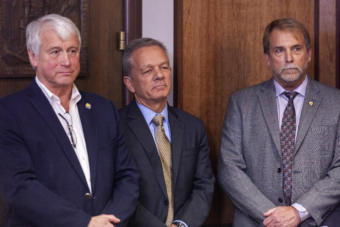
Gov. Mike Dunleavy’s Chief of Staff Ben Stevens talks to Senate Majority Leader Lyman Hoffman, D-Bethel, after Dunleavy's State of the State address on Monday, January 27, 2020 in Juneau, Alaska. (Photo by Rashah McChesney/KTOO)
Gov. Mike Dunleavy’s Chief of Staff Ben Stevens talks to Senate Majority Leader Lyman Hoffman, D-Bethel, after Dunleavy’s State of the State address on Jan. 27, 2020 in Juneau. Stevens served as Dunleavy’s chief of staff until recently, when he took an executive job at ConocoPhillips, Alaska’s largest oil producer. (Photo by Rashah McChesney/KTOO)

The oil company that hired Alaska GOP Gov. Mike Dunleavy’s chief of staff for an executive job is pledging to uphold state ethics laws that bar him from working on issues that were under consideration in the governor’s office — and Dunleavy’s administration also says it’s working to ensure an “ethical transition.”

Ben Stevens’ last day in the governor’s office was Friday, Feb. 26, and he started work as vice president of external affairs and transportation at ConocoPhillips the following Monday.

The company is Alaska’s largest oil producer and holds an array of state oil leases.

The Alaska Executive Branch Ethics Act bars public officials from working on matters under consideration by their agency for two years after leaving their state job. It also bars high-ranking officials from lobbying for a year after leaving the government.

After Stevens’ hiring by ConocoPhillips was announced last month, some of the Dunleavy administration’s critics questioned whether his new job would meet those standards. They also noted his longstanding ties to the oil industry — including during the VECO scandal more than a decade ago, when he was a state senator accused of taking bribes by two former oil industry executives.

Stevens didn’t respond to a request for comment. But a ConocoPhillips spokeswoman, Natalie Lowman, said the company is mindful of the ethics restrictions.

“We are fully aware of state prohibitions against lobbying and advocating on issues that Mr. Stevens may have worked on as the governor’s chief of staff,” Lowman wrote in an email. “We will, of course, comply with all applicable laws, and Mr. Stevens will not be working on or involved in any matter that might present a conflict of interest.”

A spokeswoman for the Alaska Department of Law, Maria Bahr, also wrote in an email that Stevens is “fully aware of his responsibilities under the ethics act” and has been working with her agency “to ensure an ethical transition to his new role.”

For his part, Dunleavy said he’s not concerned about Stevens’ move — nor about critics’ allegations that he’s trading in his public service for a private sector job.

“I don’t believe that’s going to be the case any more than if he left and worked for a union or if he left and worked for a hospital association,” Dunleavy said in an interview Friday.

Stevens’ predecessor at ConocoPhillips, Scott Jepsen, was not a registered lobbyist with the state, and Bahr said that Stevens would not be working as a lobbyist for the company.

But Jepsen’s job description did include working on government affairs for the company, and he’s been a vocal player in legislative and public debates around whether to raise oil taxes.

When Stevens’ hiring by ConocoPhillips was announced last month, the Alaska Public Interest Research Group questioned whether the state had issued a waiver under the ethics act that would allow Stevens to work on issues that had been under consideration by the governor’s office. Such a waiver is only allowed under the ethics act if it’s determined to be “not adverse to the public interest.”

But Lowman, from ConocoPhillips, said that there’s no need for such a waiver, as “we are not going to have Mr. Stevens work on any matters that were under consideration in the governor’s office while he was there.”

Judges block work at ConocoPhillips’ huge Alaska project, casting cloud over ‘North Slope renaissance’

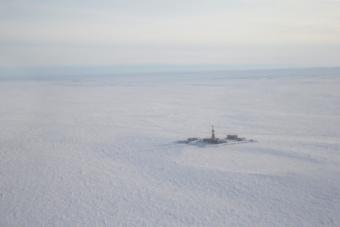
An aerial view of one of the exploration pads and wells that ConocoPhillips drilled during the 2018 exploration season at its Willow prospect. (Judy Patrick Photography / ConocoPhillips Alaska)

A federal appeals panel has halted work at one of Alaska’s biggest proposed North Slope oil fields, putting dozens of contractors out of work and costing ConocoPhillips, the project’s developer, millions of dollars.
The two-judge panel, from the Ninth Circuit Court of Appeals, issued its emergency order late Saturday.

It comes a week after a pair of Alaska Native-owned corporations hired by Conoco started building ice roads over frozen tundra to access the site of a proposed gravel mine to support construction of the oil company’s massive Willow project, according to court documents. And given the short length of the North Slope’s winter construction season, project opponents say the ruling appears to thwart Conoco’s development plans until next January.

The Willow development is one of the largest proposed projects in years on the North Slope, where total oil production has leveled off around 500,000 barrels a day after decades of decline.

At its peak, Willow, located in the National Petroleum Reserve in Alaska, could add another 150,000 barrels a day to that figure — if Conoco ultimately decides to invest the $2 billion or more needed to build it. But the court’s ruling Saturday is an indication of the new legal and political obstacles standing in the project’s way.

Just two years ago, industry boosters — including Conoco’s top Alaska executive — were hailing Willow as one of multiple promising projects in what they called a “North Slope renaissance,” buoyed by the Trump administration’s “energy dominance” agenda.

Today, Alaska’s oil industry is contending with a new presidential administration that’s pledging decisive action on carbon emissions and has already issued a temporary moratorium on all activity around leasing in the Arctic National Wildlife Refuge. And a pressure campaign by opponents of oil development in the refuge has convinced an array of banks and other financial institutions to rule out financing of drilling projects anywhere in the Arctic.

ConocoPhillips’ CD5 drill site in January 2017 (Photo by Elizabeth Harball/Alaska’s Energy Desk)

Now, Conoco’s Willow project faces new headwinds. In issuing its Saturday injunction temporarily halting work on the gravel mine and a related three-mile road extension, the Ninth Circuit judges noted that the project’s opponents, who requested the order, also have a good chance of winning their underlying lawsuit challenging the Trump administration’s environmental review of the full Willow project.

Project opponents hope that the judges’ decision Saturday will prompt the Biden administration to re-evaluate the costs and benefits of development in the petroleum reserve, according to Bridget Psarianos, an attorney with the environmental law firm Trustees for Alaska.

“It does come at a moment where it seems like we might have an administration that might question that business as usual approach,” said Psarianos, who’s working on the case. “I’m hoping that this gives us a lot of time to think clearly about the future of this case and the future of this project.”

A Conoco spokeswoman, Natalie Lowman, said the company is reviewing its options and will have more to add in the next few days.

Reserve’s future in question

The legal dispute over Willow marks an escalation in the fight over the future of the Indiana-sized petroleum reserve, which is still mostly undeveloped except its easternmost corner.

Environmental organizations, tourism interests and certain Indigenous groups are opposed to expanded development, citing impacts on the neighboring village of Nuiqsut, risks to fish and wildlife and the global push to reduce fossil fuel consumption.

They also note that while the reserve is named for its oil potential, it contains critically important habitat for caribou and birds, and the legislation that governs its management directs the Interior Department to keep environmental and scenic values in mind.

Oil companies, meanwhile, have pushed to advance development further west. And those efforts got a boost from the Trump administration, which approved major projects and also rewrote the overarching land use plan for the entire reserve to open more areas to drilling.

While Iñupiat-led corporations and political leaders have supported continued oil development balanced with mitigation measures, Conoco’s original plans for Willow provoked opposition among Nuiqsut residents and North Slope elected officials. And the company ultimately made major changes to its proposal in response to the initial backlash.

After the Trump administration approved the project in October, opponents sued in federal court. They claimed the decision violated several bedrock environmental laws, from the National Environmental Policy Act to the Clean Water Act.

A month later, the opponents asked U.S. District Court Judge Sharon Gleason to block Conoco’s work at Willow while the lawsuit played out.

Gleason initially rejected the request, saying the opponents had failed to file their lawsuit within a required 60-day window after the Trump administration’s approval of the project. But she then granted the request for two weeks to allow opponents to appeal to the Ninth Circuit.

The Ninth Circuit’s emergency ruling could ultimately be lifted. But opponents say the court’s briefing schedule will push a decision too late into April to allow construction to resume this year.

Conoco’s project manager, James Brodie, said in a sworn statement that any construction left unfinished by mid-April will have to wait at least until January 2022.

The company already had roughly 60 workers involved in Willow-related ice road construction and support, and it planned to employ double that number at the project’s peak this winter, Brodie said.

Conoco also had already started moving culverts from Fairbanks to the North Slope, and will have “wasted” nearly $4 million on contracts if its winter work is canceled, Brodie said.

Brodie downplayed the impacts of this winter’s plans at Willow, saying that the work was a “small portion” of construction in the petroleum reserve and noting that more than 500 people are working at a separate Conoco project nearby called GMT2.

“This GMT2 work will continue and maintain an industrial presence in the area regardless of whether the Willow gravel construction is allowed to proceed this winter,” Brodie said.

Conoco still has not made a final decision to build the Willow project, and this winter’s plans amounted to preliminary work, the company said.

But the project’s opponents argued that Conoco’s planned gravel mining and road extension would still cause “irreparable harm” to the reserve’s fish and wildlife, and to their members’ interests in subsistence hunting and fishing, tourism and research.

In a sworn statement, Nuiqsut resident and environmental advocate Rosemary Ahtuangaruak said she was concerned about the new infrastructure blocking subsistence wildlife, like caribou, from getting to the village’s hunting grounds.

“We won’t have the migration come to us,” Ahtuangaruak said. “There may be [a] smattering of animals that get through the infrastructure, but they will be unhealthy and highly stressed.”

Nuiqsut in June 2018. The village is near a growing number of oil developments in the western Arctic.
Nuiqsut in June 2018. The village is near a growing number of oil developments in the western Arctic. (Photo by Elizabeth Harball/Alaska’s Energy Desk)

Irreparable harm is one of several legal standards that must be met in order for courts to issue an injunction. In its ruling, the Ninth Circuit judges said they agreed with Willow’s opponents on that point — and also with their argument that they were likely to win their underlying case challenging the whole project, which is another requirement for an injunction.

The two judges cited a point made by Gleason, the lower court judge who initially rejected opponents’ request to block Conoco’s work at Willow based on the two-month time limit.

The project’s opponents argue that Gleason was wrong about the time limit. And if that’s the case, Gleason wrote in one of her orders, the opponents “could well be likely to succeed” in one of their underlying claims challenging the Trump administration’s environmental review of Willow.

Specifically, Gleason cited opponents’ argument that the Trump administration review violated the National Environmental Policy Act by inaccurately estimating Willow’s potential greenhouse gas emissions.

The Ninth Circuit’s ruling, handed down late Saturday, made a big splash on both sides; Psarianos, the attorney for Willow’s opponents, called it a “really big deal.”

But she also noted the broader context of many other legal disputes still playing out on the North Slope.

In addition to the lawsuit challenging Willow, drilling opponents have sued over the Trump administration’s new, less-restrictive management plan for the petroleum reserve, and over the Congressionally-created oil leasing program in the Arctic National Wildlife Refuge.

“We’re looking forward to continuing to work on this case, and just keep fighting it,” Psarianos said. “This is one battle in a long war.”

In Alaska, public health has a deep history of adventure and the COVID-19 vaccine is living up to it

A team of vaccinators from Maniilaq Association, Northwest Alaska’s tribal health care provider, sits in a sled before being pulled behind a snowmachine into the village of Shungnak in Dec. 2020. From left to right, nurse Heather Kenison, pharmacist Meredith Dean, nurse James Austin and Dr. Katrine Bengaard. (courtesy of Katrine Bengaard)

One of the biggest challenges for distributing the COVID-19 vaccine from drug companies Pfizer and BioNTech is keeping it cold.

But Dr. Ellen Hodges, contending with sub-zero temperatures on a remote Southwest Alaska airport tarmac last month, had the opposite problem as she prepared to vaccinate frontline health-care workers.

“It became immediately apparent that the vaccine was going to freeze in the metal part of the needle,” she said. “It was just kind of wild.”

Distributing the COVID-19 vaccine is hard enough on the road system. But the obstacles in rural Alaska are on another level.

Dozens of remote villages lack hospitals and road connections, and ultracold freezers are essentially nonexistent.

Those problems, however, have not thwarted the vaccine’s delivery. Instead, tribal health care providers have mobilized a massive effort that’s delivering thousands of doses to remote parts of the state.

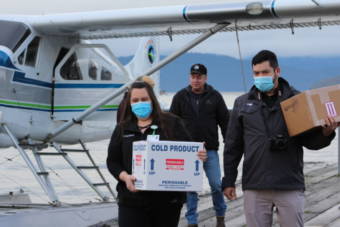
Vials have been airlifted to villages by a fleet of chartered planes. Others were driven through choppy seas on a water taxi. And in a nod to the serum run that delivered lifesaving diphtheria treatment to Nome a century ago, some of the clinicians giving shots in rural Alaska were even shuttled around villages on sleds, pulled behind snowmachines.
“We have these deep stories of Alaska adventure that are related to public health,” said Dr. Tom Hennessy, an infectious disease epidemiologist at University of Alaska Anchorage. “And here’s another one playing out right before our eyes.”

On windy Kachemak Bay last month, Curt Jackson used his 32-foot aluminum landing craft, the Orca, to ferry nurses and a load of vaccine to the village of Seldovia through heavy seas and a huge tide.

“It was definitely kind of creeping along on eggshells as we’re slamming through these waves, trying to be as careful as possible, knowing there’s this super special cargo on board,” Jackson said in a phone interview. “It’s been a rough year, like, I’m not going to lie — I got choked up realizing this was like this first little step towards victory.”

In Northwest Alaska, meanwhile, Dr. Katrine Bengaard and her colleagues flew into villages on bush planes, and were picked up at the airport by residents on snowmachines who pulled them into town by sled.

“Our job was to keep ourselves, as well as all of our luggage, in the sled as we bounced along through the snow,” Bengaard said.

Dr. Katrine Bengaard and her colleagues ride through a Northwest Alaska village to deliver COVID-19 vaccine in December. (courtesy of Katrine Bengaard)

She and her team performed many of their vaccinations at village clinics. But for a few elders who couldn’t make it, they paid home visits to deliver shots.

One went to a 92-year-old woman whom Bengaard said grew up fearing a pandemic after her parents lived through the 1918 flu, which decimated Alaska Native villages.

Hodges, the doctor with the frozen needle, is chief of staff at Yukon-Kuskokwim Health Corp., Southwest Alaska’s tribal health provider. She helped plan airborne vaccine distribution to some three dozen villages.

The effort was branded Operation Togo, a reference to one of the sled dogs that helped carry essential diphtheria serum to Nome during a 1925 outbreak.

Hodges said she asked to be on one of the first flights because she was thrilled to bring protection to villages’ frontline health aides, who have been at the “tip of the spear” during a pandemic that’s hit the region hard.

“I could hardly sleep the night before we went out,” Hodges said. “I was so excited.”

Before Hodges reached each village, YKHC made sure everyone eligible to be vaccinated was there to meet her plane on the tarmac.

Patients came on their snowmachines and four-wheelers, sometimes in a truck. After getting their shots, they’d wait 20 minutes to make sure they didn’t suffer allergic reactions. Then the vaccinators would fly to the next village.

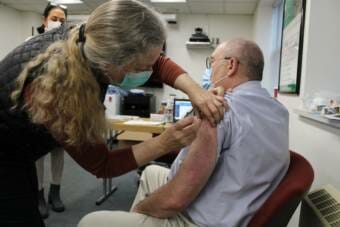
Hodges flew with the Pfizer vaccine in her lap for safekeeping. She solved the problem of the vaccine freezing by keeping doses tucked in her shirt until just before injecting them.

“Once we got that sorted out, it was pretty great,” Hodges said. “A lot of us felt the importance of it — of making sure we could get our health aides protected against this horrible, unpredictable disease.”

Alaska state Sen. Donny Olson (D-Golovin) gets his COVID-19 vaccine in the village clinic Wednesday, Dec. 30, 2020. (courtesy of Donny Olson)

One Alaska Native elder who received a plane-delivered vaccine was state Sen. Donny Olson, 67, who lives in the remote Western Alaska village of Golovin.

Olson is Iñupiaq and a father of six, including two young twins. He’s also a pilot: He has a radio at home tuned to air traffic so he can listen as planes approach.

When Olson heard the plane carrying the vaccine call in its approach, he said, “you could breathe a little easier that they’re here, that bad weather’s not going to stop them from coming.”

“And when they landed, and I got the steel treatment in the shoulder,” he said, “That was a great relief for us, as a whole family.”

Alaska will prioritize people 65 and up for next round of COVID-19 vaccine, breaking from federal guidance

SEARHC chief medical officer Dr. Elliot Bruhl receives his first dose of the COVID-19 vaccine. (SEARHC photo)

The state of Alaska is breaking from federal guidance by focusing its next round of COVID-19 vaccine on elders age 65 and over. And it’s asking frontline essential workers, teachers, prisoners and others in high-risk settings to wait until those elderly Alaskans can be vaccinated first.
The Department of Health and Social Services released the new guidelines Thursday afternoon. They outline which groups will receive the vaccine in what’s known as Phase 1b — after the frontline health-care workers, nursing home residents and staff emergency responders in Phase 1a.

A federal vaccine committee recommended earlier this month that Phase 1b be designated for elders 75 and over, plus frontline essential workers like teachers, postal service and grocery store workers and bus drivers.

The state is including all those groups in Phase 1b. But within Phase 1b, it’s prioritizing a larger group of elders by allowing those 65 and older to be vaccinated first, instead of 75 and older.

Chief Medical Officer Doctor Anne Zink says there are a few reasons for that. First is that Alaska’s elderly population is smaller than other states’. Second, there are relatively few nursing home beds in Alaska, meaning that fewer elders were vaccinated as part of that group.

“The third reason was just a real emphasis I think culturally on elders as a priority group in the state overall,” Zink said. “We heard that loud from many different components of the state.”

The Alaska-specific recommendations were first debated by a committee of medical experts, then tweaked by Republican Governor Mike Dunleavy’s administration — a process that was not easy, Zink says.

The state took testimony from more than 380 people and groups before issuing the new guidance.

“It was really hard. It was incredibly hard. We really appreciate all the feedback, and there are really good arguments and all sorts of ways to slice this,” Zink said.

Separately, the state announced on Wednesday that it will receive another 53,000 doses of COVID-19 vaccine from the federal government in January. That’s slightly down from the 62,000 doses allocated to the state for December.

Aside from tweet, U.S. Rep. Young, staff remain silent on COVID-19 diagnosis

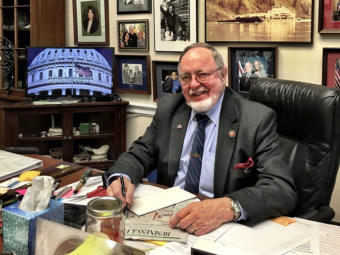
Rep. Don Young’s Washington office has trophies and mementos on just about every surface.
Rep. Don Young in his Washington office. (Photo by Liz Ruskin/Alaska Public Media)

A day after 87-year-old U.S. Rep. Don Young said he’d tested positive for COVID-19, the only information available about his condition remained the tweet announcing he’d been infected with the potentially life-threatening illness.

Young, the oldest and longest-serving member of the U.S. House, has proudly declared that he’s never used a computer and doesn’t use his cell phone. But in the tweet Thursday, Young’s official Twitter account said he was feeling strong and working from home in Alaska after testing positive for the virus.

The tweet was issued shortly after Alaska Public Media emailed questions to Young’s office asking whether he’d been diagnosed with COVID-19.

Young’s staff never directly responded to those questions or to phone calls, and they also did not respond to repeated requests for comment Friday.

Young’s opponent in last week’s election, Democratic Party-endorsed independent Alyse Galvin, said the Congressman’s staff could not reach him Friday when she wanted to call him to concede.

“Alyse had to leave a message on his wife’s phone,” said Galvin’s spokeswoman and daughter, Bridget Galvin.

One of the questions still unanswered by Young’s office is the date he tested positive.

That would shed light on when Young’s illness is likely to become most severe, since the most serious phase of the virus tends to come seven to 10 days after people first develop symptoms.

Young’s staff also has not said how many of his campaign or U.S. House staff have also tested positive for COVID-19.

A conservative news website, Must Read Alaska, reported Thursday that “several” people associated with Young’s campaign had tested positive for the virus.

Two others who attended a recent party with Young at an Anchorage restaurant — GOP state Sen. Josh Revak and Larry Burton, the chief of staff to U.S. Sen. Dan Sullivan — said Thursday that they were also getting tested. The Anchorage Daily News reported late Friday that Revak had tested positive.

While Young’s advanced age makes him much more likely than younger people to develop severe illness from COVID-19, it’s far from certain that will happen. There are plenty of nursing home patients in their 80s and 90s who have contracted the disease and never develop symptoms, said Dr. Ben Westley, an Anchorage infectious disease specialist.

The likelihood of severe illness depends on whether a person has pre-existing conditions known to contribute to worse outcomes from COVID-19 infection — like heart conditions or diabetes. Young’s staff has not released that information, either.

“It is certainly possible that he could have infection and remain asymptomatic and be just fine. And it’s certainly possible that he could get quite sick — the likelihood of getting sick does increase with increasing age,” Westley said in a phone interview Friday. “And that’s really all the information that any of us know.”

Westley also noted that research shows that people who routinely wear masks in public are less likely to develop severe cases of COVID-19 if they’re exposed to the virus.

Over the course of the pandemic, Young has been photographed numerous times without a mask, and he’s said he does not require them at events.

“I don’t require anything,” he said in a September radio appearance. “If they want to wear a mask when they come to my campaign events, that’s their business. That’s self-responsibility.”

Young also made headlines early in the pandemic for jokingly calling COVID-19, the disease caused by the novel coronavirus, the “beer virus,” though he later said he had underestimated its severity.

In Thursday’s tweet announcing his positive test, Young said he was working from home and asked for privacy “at this time.”

There’s no law requiring Young to disclose any details about his health, said Jerry McBeath, an emeritus professor of political science at University of Alaska Fairbanks.

For now, McBeath said, it’s clear from last week’s election results that Young continues to enjoy the trust of the majority of Alaska voters. And so far, McBeath added, the Congressman has been transparent by revealing his diagnosis — meeting a standard set by President Donald Trump when he announced last month that he’d tested positive for COVID-19.

“If he were to issue no information in the next couple of weeks, which are critical in the care for those with COVID-19, then there would be concerns,” McBeath said. “But we’re not there yet.”

Sarah Erkmann, a public relations consultant who’s worked with a number of Alaska Republicans, agreed, saying that Young took the “appropriate step” of disclosing his positive test on social media. She said it’s likely the congressman is still being evaluated and may not have more information about his condition yet.

“I still think we can let him have privacy and figure out exactly what his situation is with his doctors and his family. Obviously in the coming days, the public is going to expect to hear more,” she said. “He’s a public figure, he is our only Congressman, and we need him to be working. And so it’s reasonable to expect — and I would fully expect — his office to let Alaskans know how he’s faring.”

Initiative to overhaul Alaska elections jumps to narrow lead after Thursday’s ballot counts

A voter mails an absentee ballot in October 2020.
A voter mails an absentee ballot in October 2020. (Lex Treinen/Alaska Public Media)

new round of vote-counting Thursday put the citizens initiative to overhaul Alaska’s election system on track to win.

After officials counted another 35,000 votes, Ballot Measure 2 has a tiny lead of 500 votes, or less than 0.25%.

It’s not certain that the roughly 30,000 remaining uncounted ballots will follow the same trends as the ones counted Thursday. But if they do, the election initiative would win by thousands of votes.

Elections officials said they would continue counting ballots Friday.

The citizens initiative would reorganize Alaska’s election system.

It would do away with the state’s multiple partisan primaries, replacing them with a single nonpartisan race in which the top four vote-getters advance.

In the general election, people would pick winners using a new system called ranked choice voting.

The system redistributes last-placed candidates’ votes to Alaskans’ second choices if no one reaches 50 percent in the initial count. Australia, Ireland, San Francisco and New York City all use versions of ranked choice voting, which has become a popular cause among reformers seeking to reduce political polarization.

The initiative would also require more transparency about donations to certain political influence groups.

Another key race that tightened sharply is the one for the state House seat representing the North Slope and the Northwest Arctic Borough. Kotzebue independent Rep. John Lincoln, who currently holds the seat, did not run for re-election.

Democrat Elizabeth Ferguson of Kotzebue was 400 votes behind independent Josiah Patkotak of Utqiagvik after Election Night. And North Slope Borough Mayor Harry Brower Jr. published a Facebook post this week congratulating Patkotak on his apparent victory.

But when roughly half of the outstanding ballots in that district were counted Thursday, Ferguson cut her opponent’s lead by more than half, to 150 votes. If the rest of the uncounted ballots in that district follow the same trend, which isn’t guaranteed, the race would be close to a dead heat.

That race is the latest in which absentee and other late-counted ballots have dramatically shifted the results, in a trend that political observers predicted.

Election Night tallies strongly favored many Republicans, while absentee and other ballots counted in recent days have swung a number of races back toward Democrats. Candidates and political operatives said that Republicans were much more inclined to accept the risks associated with voting in-person on Election Day during the COVID-19 pandemic.

Site notifications
Update notification options
Subscribe to notifications