Nat Herz, Alaska Public Media

Federal fisheries agency to staff: Keep “COVID-19” and “pandemic” out of documents

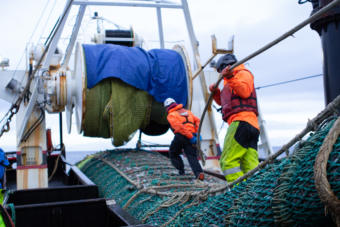
Crew members shovel pollock on the deck of a Bering Sea trawler last year. (Nathaniel Herz/Alaska’s Energy Desk)

A federal fisheries management agency has barred some of its employees from making formal references to the COVID-19 pandemic without preapproval from leadership, according to an internal agency document.

The National Marine Fisheries Service, part of the Commerce Department, manages federal fish stocks in partnership with appointed regional councils. Fishing crews and seafood businesses have been asking the agency to relax regulations as the COVID-19 pandemic has complicated their operations. There have also been outbreaks among industry workers.

The National Marine Fisheries Service’s guidance document, dated June 22, applies to the agency’s formal rules and management announcements. According to the document any reference to COVID-19 or the pandemic in publicly available documents must be approved by Sam Rauch, an attorney who’s NMFS’ Deputy Assistant Administrator for Regulatory Programs.

The four-page memo outlines the agency’s “preferred approach” is making “no reference to anything COVID related,” and it offers preapproved replacement phrases such as “in these extraordinary times.”

“This option assumes that the action can be supported by using facts, impacts, etc., that we would also use under normal circumstances,” the memo says. “No reference to any stay-at-home orders, travel restrictions, or anything COVID related is needed.”

The memo outlines a second option to be used on a “limited basis” when requests or comments require “some reference to the current situation.” It offers preapproved phrases such as “due to existing health mandates and travel restrictions,” though it says even minor changes require agency review.

A final option allows direct mention of COVID-19 or the pandemic on an “extremely limited basis” with leadership approval.

In a statement, National Marine Fisheries Service spokesman John Ewald said the memo is meant to “ensure timely and consistent rulemakings during COVID-19,” and he wrote the agency has been posting pandemic-related information on its website. He did not explain why the agency prefers to avoid mention of the pandemic.

One Alaska fisherman, Linda Behnken, said she finds the document “mystifying,” given how the agency has taken a number of actions in direct response to the pandemic. In her state, for example, it has waived requirements that federal monitors be on board some vessels to collect data and ensure compliance with regulations.

That announcement does mention the COVID-19 pandemic. But those words are omitted from a different, temporary rule that was formally announced in the Federal Register last week, in direct response to the disease.

The rule was adopted after a recommendation by the North Pacific Management Council, and it loosens limits on transfers of fisherman-owned harvest quota.

It’s aimed at reducing the risk of fishermen and crew spreading COVID-19 by traveling, according to testimony at the council meeting where the rule was discussed, and comments submitted beforehand. But the rule only refers to “government mandates and travel restrictions,” not the pandemic itself or COVID-19.

“Directions to not directly mention COVID-19, or the pandemic, in creating the rationale for those actions is hard to explain,” said Behnken, who runs a group of small-boat operators called the Alaska Longline Fishermen’s Association. “Other than, possibly, this administration is ready to move on and doesn’t really want to be focused on the pandemic any more.”

President Donald Trump has consistently played down the threat from the coronavirus, suggesting early on in the pandemic that it would “disappear.” He recently said he wants less testing for the coronavirus and has urged cities and states to open up despite a dramatic rise in the number of cases.

Mark Begich, a Democratic former U.S. senator from Alaska, said he was “shocked” by the memo, adding that he thinks it’s consistent with Trump administration efforts to downplay the impact of climate change by avoiding use of the words. Begich, who once chaired the Senate subcommittee with oversight of the National Marine Fisheries Service said minimizing the effects of the pandemic confuses the public and amounts to “denial.”

“Just saying it doesn’t exist does not mean that it’s not happening,” he said. “This is just putting people at risk, and not being honest and transparent about the situation we face in this country — which is getting more severe because of the lack of acknowledgement.”

Trump wants to bail out Maine lobster fisherman. Alaska’s seafood industry is unimpressed

President Donald J. Trump participates in a roundtable on supporting America’s commercial fisherman Friday, June 5, 2020, at Bangor International Airport in Bangor, Maine. (Official White House Photo by Joyce N. Boghosian)
President Donald J. Trump participates in a roundtable on supporting America’s commercial fisherman on June 5, 2020, at Bangor International Airport in Bangor, Maine. (Official White House Photo by Joyce N. Boghosian)

Fishing businesses across the country have suffered during President Donald Trump’s trade war against China: They’ve faced big tariffs that cut into their exports.

Trump announced an effort to fix the problem Wednesday. But Alaska fishing groups say they’re deeply displeased because the relief is targeted solely at the lobster industry, which is centered in Maine.

“It’s not our first experience of feeling like we got punched in the gut. But to me, that’s what it felt like,” said Stephanie Madsen, who runs the At-Sea Processors Association. That’s a group of huge Seattle-based vessels that harvest pollock in the Bering Sea and process it in onboard factories.

Trump’s announcement comes after he held a roundtable earlier this month with commercial fishing interests in Maine, where he called complaints about Chinese tariffs on lobster “easy to handle.”

On Wednesday, he followed up by issuing a formal memorandum in response to what Trump described as “punitive” and “retaliatory” actions against a “crown jewel of America’s seafood industry.”

The memo directs Trump’s administration to provide assistance to Maine lobster fishermen and businesses, and to possibly impose retaliatory tariffs on China.

Madsen, in a phone interview Thursday, said that Maine lobstermen are hardly the only fishermen hurt by the trade war.

Crew members shovel pollock on the deck of a Bering Sea trawler last year. (Nathaniel Herz/Alaska’s Energy Desk)

Her group’s members had been capitalizing on the fast-growing Chinese market. But once the trade war started, pollock faced Chinese taxes as high as 37%, slashing exports nearly in half.

“All of our growth strategy is focused on China. So, to basically be locked out of that market over the last couple of years has been really hard to take,” said Matt Tinning, the At-Sea Processors Association’s director of sustainability and public affairs.

The problem isn’t specific to Alaska pollock, either — industry players across the state saw Trump’s announcement as an affront to Alaska’s entire fishing industry.

Other species of Alaska fish have found markets in China, too. And those exports have also suffered since the trade war began, said Jeremy Woodrow, executive director of the Alaska Seafood Marketing Institute.

“A lot of our crab species, our flatfish species, a lot of our salmon species are exported to China as well,” he said. “All of those have been hit with unbalanced tariffs — tariff rates as high as 35% to 42%. And those just really impact the price of fish here in Alaska, and depress the value of our industry.”

Alaska industry leaders said they think Trump singled out Maine because of the time he spent there earlier this month, and the audience he gave the state’s fishermen and fishing businesses.

They noted that Trump hasn’t had the same face time or relationships with Alaska’s fishing industry. But Julie Bonney, who represents a group of Kodiak trawlers and fish processors, said that would be welcome.

“If he wants to come to Alaska and have a roundtable with us about our industry, we’d be all over it,” she said. “And I’d love to be sitting at the table with him.”

A White House spokesman didn’t immediately respond to a request for comment Thursday.

Nearly 30 bidders want to buy at least a piece of Ravn Air, but next steps are murky

A Ravn Alaska De Havilland airplane at Ted Stevens Anchorage International Airport, Aug. 13, 2016. (Creative Commons photo by Sunnya343)

Ravn Air Group says it’s received nearly 30 bids to buy the airline, or pieces of it, out of bankruptcy, its attorney said at a Thursday court hearing.

Five bidders are interested in buying the company intact, as a “going concern,” Ravn attorney Tobias Keller said at the hearing in Delaware federal bankruptcy court. There were also nearly a dozen offers to buy “substantial assets” from Ravn — not the whole business, but more than $1 million, Keller said.

Other bids were for a single plane or a particular lease, he added.

Ravn was Alaska’s largest rural airline, with 1,300 workers and some 70 planes before the COVID-19 pandemic forced it to shut down operations and file for bankruptcy. The company, majority-owned by a pair of East Coast private equity firms, owed more than $90 million to more than a dozen different lenders.
Ravn’s chief executive, Dave Pflieger, said in a prepared statement that the company is optimistic that the bids will allow it to exit bankruptcy, rehire its 1,300 employees and restart air service. It’s also been approved by the Trump administration for a $32 million payroll support grant.

The bids could potentially avert a liquidation process that’s also been under consideration for Ravn, in which the company would be shut down and its planes sold off one by one.

But at Thursday’s telephonic hearing, attorneys released few details about how the bids will be vetted, other than saying that July 6 and 7 were likely to be busy auction days.

“I see that there are a number of bidders on the call today who are undoubtedly curious as to what the story is, as to how we’re going to organize the process,” Keller said. “We owe them answers. We owe them deadlines. We don’t have them today.”

The identities of the bidders were not announced at the hearing, though Keller said among them were “at least five established, strategic buyers or investors that have substantial experience in the airline industry.”

One attorney at the hearing said he worked for a Southern California company, Float Shuttle, that has offered to buy Ravn intact. Float Shuttle, according to its website, runs commuter service for Southern California drivers who want to avoid time in traffic by flying.

A Mat-Su state House race could reshuffle the Alaska Capitol’s balance of power. Here’s why.

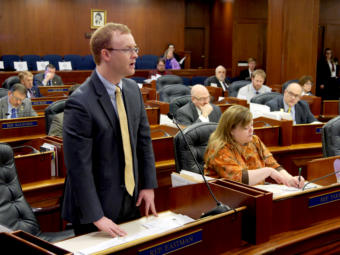
Rep. David Eastman, R-Wasilla, speaks during a House floor session, March 11, 2019. (Photo by Skip Gray/360 North)

A showdown is brewing in a Mat-Su Valley Republican primary that could reshuffle the balance of power in Alaska’s Capitol.

The state House race centers on an incumbent, David Eastman, who is so polarizing that some lawmakers say he played a big role in blocking his own party from forming a majority in his chamber last year.

Eastman’s challenger is Jesse Sumner, a Matanuska-Susitna Borough Assembly member who also runs a successful home-building business.

Sumner, 36, said he’s voted for Eastman in the past, and he and his wife were writing him $500 checks as recently as last campaign season.

But while Sumner said he shares Eastman’s conservative values, he’s grown disillusioned by Eastman’s refusal to compromise.

Sumner said that keeps Eastman’s Mat-Su district from meaningful participation in the House’s debate about the direction of the state, and blocks Republicans from setting the agenda in Juneau.

“I believed in his principles as espoused. But I didn’t see any productive work toward those,” Sumner said in a phone interview. “He ends up isolating himself in the Legislature, even among members of his own caucus.”

Eastman, 39, doesn’t dispute that he’s often on his own in the House, and he’s been on the losing end of dozens of 39 to 1 votes.

But he said he has no interest in taking positions that are easy or convenient, even if the result is condemnation from his colleagues and the public.

In his four years in office, Eastman has been formally reprimanded by the House for suggesting that women in rural Alaska get pregnant so that they can get a free flight to a city for an abortion. He’s also proposed legislation to criminalize abortion. And he was the only vote against a 2017 bill commemorating Black soldiers who helped build the Alaska Highway.

“It would certainly be easier if I just went along with the majority, I give you that. It would be easier on me, it would be easier on my family,” Eastman said. “But that’s not what my district asked me to do.”

With two months until the primary election, the House race has already drawn attention from political observers statewide.

Jesse Sumner is a member of the Matanuska-Susitna Borough Assembly, and he’s challenging Wasilla Rep. David Eastman in this year’s Republican Party primary. (Photo courtesy Jesse Sumner campaign)

Last week, the influential anti-abortion group Alaska Family Action endorsed Sumner, saying that Eastman is ineffective and refuses to work with other socially conservative lawmakers on their legislation.

And rumors are swirling that left-leaning groups may even try to quietly boost Eastman’s campaign, knowing that his re-election could make it easier for the largely-Democratic House majority to remain in power.

“You have two strong conservatives, in a very conservative district,” said Ron Johnson, a local GOP leader. “And I think that this race is going to get the attention of the whole state.”

There are two main criticisms of Eastman from Sumner and others.

One is that he’s ineffective. Eastman’s abortion-related legislation hasn’t gone anywhere, and neither have his efforts to pay out a larger Permanent Fund dividend under the historical formula.

Eastman pointed out that he was successful in his push to repeal big pieces of a 2016 criminal justice overhaul, Senate Bill 91. The other issues are longer-term projects, he said.

“Juneau is not going to give up the PFD, and Planned Parenthood’s not going to give up abortion, without a very long war,” Eastman said. “Sometimes Juneau’s going to win, we recognize that. And you know what? Sometimes, as in the repeal of SB 91, try as they might, Juneau’s still going to lose — and we have to fight that fight.”

The second criticism of Eastman is that he refuses to work not just with Democrats, but with members of his own party, too.

Eastman has targeted incumbent Republican lawmakers that he deems not conservative enough, by recruiting and supporting GOP candidates running against them in primary races. And after the 2018 election, he refused to agree when his GOP colleagues chose Healy Rep. Dave Talerico to be the next House speaker.

Afterward, the narrow, 21-member majority claimed by Republicans fell apart, and a half-dozen centrist GOP representatives instead joined a new, mostly-Democratic majority.

“Some could argue that if it wasn’t for David Eastman, Democrats wouldn’t be in the majority,” said Fairbanks Democratic Rep. Adam Wool.

There were other factors and personality conflicts that undermined the Republican effort to organize the House, Wool said. But he and others said Eastman’s unbending views were one important dynamic.

That’s why Democrats or left-leaning groups could make a low-profile effort to defend Eastman, according to a number of Republicans.

Jim Minnery, president of Alaska Family Action, said the idea is “wildly speculative” but not out of the question.

“They think he’s one of the sticking points to getting Republicans to organize, because he’s such a lightning rod,” Minnery said.

While the Democratic candidate running against Eastman in 2018 got just 22% of the vote, the Alaska Democratic Party said in a statement that this year, it’s focused on the general election and its own candidate, Monica Stein-Olson.

“Monica Stein-Olson is a stellar candidate and a pragmatic moderate who we believe is a far better choice than either of the two far-right extremists vying for that seat,” the statement quoted Mindy O’Neall, the party’s coordinated campaign director, as saying. “We believe that Eastman and Sumner’s ideologies and styles fall far outside the Alaska mainstream view.”

Sumner, Eastman’s challenger, said that he’s focused on flipping the House back to Republican control.

That’s particularly important, Sumner said, because the GOP governor, Mike Dunleavy, has just two years left in his term. If the House changes hands, and a largely-Republican majority remains in power in the Senate, the GOP would control the governor’s office and both legislative chambers, making it easier for the party to set the agenda in Juneau.

If the Mat-Su’s conservative lawmakers can be more flexible, Sumner said, they’ll have a better chance of forming a House majority that reflects their views — even if that means they have to accept policies that may not completely align with their principles.

“I don’t think that I’m saying that I’m less conservative than David Eastman. I think what I’m saying is that I’m more realistic than David Eastman,” Sumner said. “The Valley can have input in the direction of the state, and you can move in a reasonable direction. Or the Valley can sit out, and this coalition of the Democrats and the center-right Republicans will direct the state.”

There are 3 new cases of COVID-19 at a salmon processing plant in Excursion Inlet

Workers remove the bones from salmon fillets at Alaska Glacier Seafoods’ Auke Bay processing plant (Photo by David Purdy/KTOO)

A seafood processing company has confirmed three new cases of COVID-19 at a Southeast Alaska plant. They’re among 10 positive tests reported by the state Monday.

The three cases are at a salmon processing plant in Excursion Inlet, a remote spot about 40 miles west of Juneau. The plant is owned by OBI Seafoods, the new company formed by a recent merger of Icicle Seafoods and Ocean Beauty Seafoods.
The three workers are all non-residents, and they were tested as part of a routine COVID-19 screening on their sixth day of a 14-day quarantine, OBI says.

All three workers were not showing symptoms but were immediately isolated. Two of the workers lived in a house away from the plant’s bunkhouse, and the third worker was living with only one other person, the company says.

There are 140 workers already at the plant, and the company plans to bring in 40 more for the summer season.

The state announced one other nonresident case of COVID-19 Monday, in a visitor to the Wrangell-Petersburg Census Area. There are also six new cases among residents: Three are from Anchorage, one is from Palmer, one is from Wasilla and one is from the North Slope Borough.

There are now 258 active COVID-19 cases in the state.

U.S. Rep. Don Young downplayed COVID-19. Now he’s back to in-person campaign events.

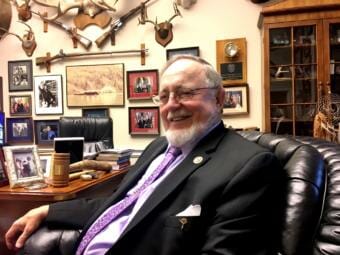
Rep. Don Young in his Washington, D.C. office in July 2019. (Liz Ruskin/Alaska Public Media)

As the Alaska economy reopens, so has U.S. Rep. Don Young’s campaign for his 25th two-year term.

At 87 years old, Young is the nation’s oldest Congressman, and he’s at increased risk of severe illness from COVID-19, according to the Centers for Disease Control and Prevention.

His campaign says it took precautions when holding a 130-person political fundraiser in mid-June, outside the downtown Anchorage home of former Alaska Lt. Gov. Mead Treadwell.

But just in case, Treadwell kept an extra layer of backup.

“If you have to do contact tracing,” Treadwell said, “there’s a pretty good list of who showed up.”

Young, a Republican, also held another outdoor event on the Kenai Peninsula earlier this month at the home of Soldotna GOP state Sen. Peter Micciche, according to an invitation. And he’s planning an in-person fundraiser to celebrate his birthday this week at a South Anchorage restaurant, Little Italy.

“This is a Covid-safe, socially distant event,” said the invitation to Young’s most recent two events. “Feel free to wear a mask.”

No one appeared to be wearing a mask, however, in a photo subsequently posted by Young’s campaign that showed dozens of people gathered outside Treadwell’s home.

The string of in-person events hosted by the Young campaign comes as Anchorage officials warn of a surge in COVID-19 cases fueled in part by people attending private gatherings. The city’s health department issued an alert Friday directing people to wear face coverings and avoid crowds and gatherings.

Young initially downplayed the coronavirus as the “beer virus” before it infected hundreds of Alaskans and killed 12. And he’s now the only major statewide candidate to resume in-person fundraising since the pandemic took hold.

At least one other GOP gathering also went forward last week, inside a busy Palmer restaurant. And on Saturday in Oklahoma, President Donald Trump held his first rally since the pandemic began, even as some health experts warned of the risk of a so-called “super-spreading” event.

Trump’s Democratic rival Joe Biden, meanwhile, held a subdued event in the Philadelphia suburbs last week, with about 20 reporters and locals each with their own socially distant chair inside a circle of tape, the New York Times reported.

The events highlight a sharp partisan split when it comes to treatment of COVID-19 at both the national and state level. In a poll of 400 Alaskans last month, 92% of Democrats said they see COVID-19 as a “real threat,” while just 1% say it’s “blown out of proportion.”

For Republicans, 42% see it as a real threat, while 53% see it as blown out of proportion, according to the poll, which was done by Dittman Research on behalf of the conservative group Alaska Policy Forum.

Nationally, twice as many Republicans as Democrats say they’re socializing in public places, according to a poll earlier this month by the data firm Morning Consult.

In Alaska, not all Republicans have resumed in-person fundraising. GOP U.S. Sen. Dan Sullivan, who’s up for re-election, has no events to announce, said campaign manager Matt Shuckerow.

But generally, left-leaning independents and Democrats have been more cautious about convening in-person gatherings. Sullivan’s best-funded challenger, independent Al Gross, has limited his fundraisers to online events, as has Young’s leading opponent, independent Alyse Galvin.

Both Galvin and Gross are seeking the nomination of the Alaska Democratic Party in the August primary election.

“COVID-19 really has no political boundaries,” Gross, an orthopedic surgeon with a master’s degree in public health, said in a phone interview. “And there’s really no reason for candidates on either side of the political spectrum to put their lives, as well as the lives of Alaskan voters, in jeopardy simply to raise money, when they can continue to raise money digitally.”

Some Alaska Democrats have gotten creative with their online fundraisers. Anchorage state House candidate Liz Snyder held a Facebook Live community event from her mostly-empty backyard last week, which had dozens of digital “co-hosts” and collected about 700 views.

“If you hear clucking, it’s cause there’s chickens,” Snyder warned viewers at the start of the event. “And if you hear kiddos, it’s because there’s kiddos.”

Gross, the independent U.S. Senate candidate, has held his own digital events, including fundraisers on the Zoom platform. Galvin, the independent challenging Young, has also shifted to virtual events, according to Malcolm Phelan, her campaign manager.

At first, Galvin’s campaign was worried about the impact of canceling in-person events, but so far, it has not seen a decline in financial support, Phelan said.

“Alyse has actually been able to reach many more voters across the state. We’ve had events in living rooms almost every night since the pandemic began. We’ve had supporters from Glennallen to Ketchikan host Alyse in their virtual living rooms,” Phelan said in a prepared statement. “We will be paying close attention to the guidance of our Alaskan public health professionals before we move back to in-person events.”

Republicans have moved more quickly to resume in-person campaigning.

After holding Zoom meetings and socially-distant gatherings in April and May, the Valley Republican Women held a forum for GOP state House hopefuls Thursday evening inside the packed Sunrise Grill in Palmer. Video footage showed candidates and viewers sitting shoulder-to-shoulder, and none appeared to be wearing masks.

As for Young, he’s only recently resumed in-person events, and other candidates are also getting out for door-knocking, parades and farmers markets, campaign manager Truman Reed said in an email. He noted that Anchorage Mayor Ethan Berkowitz, a Democrat, appeared at a Black Lives Matter rally earlier this month.

“The COVID-19 pandemic has forced all campaigns to make adjustments and we are taking all concerns very seriously,” Reed said. “Congressman Young himself is wearing masks where appropriate, and taken special precautions in regards to the distribution of food.”

Young is following the CDC’s guidelines, Reed said. But the CDC’s guidelines for “gatherings” include wearing a face covering when in close contact with other people, and avoiding handshakes — and photos from the event show an unmasked Young shaking hands with a Republican state House candidate.

Treadwell, the host, pointed out that the fundraiser was held outside, which is one of the CDC’s suggestions for gatherings. “There was hand sanitizer everywhere,” he added.

Treadwell said he’s taking the pandemic seriously, adding that the virus has killed one of his friends in Washington, D.C. But he acknowledged that not everyone at the fundraiser appeared to see things the same way, as some were giving hugs and handshakes.

“There was every opportunity for people to protect themselves,” he said. “I think most people behaved. Some didn’t. And I, as the host, could be found on the fringes of my own event — not smack in the middle.”

Site notifications
Update notification options
Subscribe to notifications