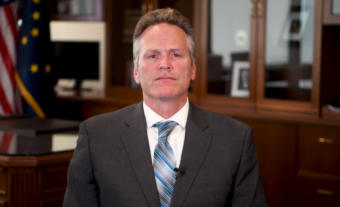
Alaska Gov. Mike Dunleavy released a new state spending plan Wednesday that retreats from some of his aggressive budget-cutting proposals, while still pushing for larger permanent fund dividends.
Dunleavy’s proposal would hold spending on education, health care and ferries essentially flat. And it budgets about $2 billion for dividends, enough for about $3,000 for each Alaskan — up from this year’s $1,606 payment.
In his first year in office, state lawmakers rejected many of the pieces of Dunleavy’s plan, which would have paid record-sized dividends while still eliminating Alaska’s deficit, largely through deep cuts to schools, health care, ferries and the state university system.
In Wednesday’s proposal, Dunleavy wants to keep the record-sized dividends while largely abandoning his push for reductions beyond those made earlier this year.
Without substantial cuts, Dunleavy’s new plan calls for the state to spend $1.5 billion more than it brings in. He wants to cover that deficit by spending roughly three-fourths of the cash in Alaska’s primary savings account, the Constitutional Budget Reserve, which is projected to hold about $2 billion at the start of the upcoming fiscal year.
Dunleavy and his aides, at a news conference in Juneau, suggested that the deficit could be reduced during the budget process as the governor’s proposal moves through the Legislature.
After Dunleavy left the news conference, one of his top advisors, Brett Huber, even left the door open for taxes as a means of closing the gap, saying that “everything is on the table in that discussion.”
The budget, Dunleavy said, “is a springboard for discussions with the Legislature, with the people of Alaska.”
“Because we have to work together to form a budget that’s going to make sense for all Alaskans,” he said.
Dunleavy made dividends a focus of his gubernatorial campaign last year, saying that the payments should be larger — set by a decades-old state law that links them to the investment returns of the $65 billion Alaska Permanent Fund. Dunleavy’s predecessor, independent Bill Walker, had favored smaller payments to leave more of the permanent fund’s earnings available for spending on government services.
Dunleavy’s first budget proposal called for dividends of $3,000, leaving a substantial deficit that the governor wanted to close largely through deep spending cuts.
Critics noted that Dunleavy did not advertise sharp cuts to those programs over the course of his gubernatorial campaign last year, leaving some Alaskans surprised and frustrated when he proposed them.
After months of debate in the Legislature, state lawmakers cut Dunleavy’s proposed dividend to $1,606 and rejected many of his proposed spending cuts. Dunleavy then vetoed hundreds of millions of dollars from the budget; legislators, in a special session, then restored money for some of the vetoed programs. Dunleavy subsequently vetoed many, though not all, of the same line-items a second time.
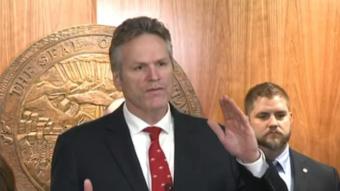
Alaska Gov. Mike Dunleavy speaks at a news conference at his Anchorage office in September. (Photo by Nat Herz/Alaska Public Media)
Last year’s budget proposal from Alaska Republican Gov. Mike Dunleavy was ambitious: record-sized Permanent Fund dividends of $2,900, a $300 million cut to schools and $400 million in oil taxes that would be diverted from municipalities to state accounts.
But by the time lawmakers finished debating the governor’s plan, none of those items remained: The Legislature sliced the PFD to $1,600, rejected the cut to schools and dismissed the oil-tax diversion plan.
Veterans of the state’s drawn-out budget process say that those events are worth keeping in mind this week, as Dunleavy announces his proposed spending plan for next year. While the Alaska Constitution grants the governor substantial powers over state finances, they’re far from absolute, and the governor’s initial proposal often amounts to an opening offer instead of the last word.
After Dunleavy announces his preliminary plan, it’s transmitted to the state Legislature, which can accept the governor’s recommendations, water them down or reject them outright — which is what happened with several of Dunleavy’s ideas last year, like many governors before him.
House Speaker Mike Chenault (center), Rep. Craig Johnson (right), and Minority Leader Chris Tuck (left) talk before taking up the daily calendar, April 10, 2014. (Photo by Skip Gray/Gavel Alaska)
“I’ve been there when they actually took the governor’s budget when they handed it out and just threw it in the garbage,” said Mike Chenault, the retired legislator who spent eight years as House speaker.
A spokesman for Dunleavy, Jeff Turner, said that the governor was not available for an interview.
Dunleavy said that his initial proposal, released in February, would have balanced the state budget through deep cuts to spending on schools, health care, ferries and Alaska’s university system.
His budget plan was undergirded by roughly a dozen bills needed to carry out his spending plans or make them permanent — by repealing certain programs, appropriating cash for dividends or eliminating certain municipal taxing authorities, for example.
But none of those bills made it through the Legislature. And lawmakers scaled back or dismissed many of Dunleavy’s proposed reductions in the budget bill itself.
“No one has a slam dunk on this,” said Anchorage Republican Rep. Jennifer Johnston, co-chair of the House Finance Committee. “The governor’s budget is the start. It’s not the finish.”
A similar process transpired in 2016 under Dunleavy’s predecessor, independent Bill Walker.
Alaska Gov. Bill Walker talks with his team from the back of a bus in May 2018 in Beijing, China. (Photo by Rashah McChesney/Alaska’s Energy Desk)
Walker proposed to close the state’s multi-billion-dollar deficit by restructuring the Permanent Fund and reducing dividends, along with raising revenue through an array of taxes — including on personal income, on gasoline and on the mining and fishing industries.
Each of those ideas, however, required its own piece of legislation. And lawmakers rejected nearly all of them, agreeing only to a modified version of Walker’s oil tax proposal.
The framers of Alaska’s constitution envisioned such an interplay between the executive and legislative branches, according to Gerald McBeath, a retired University of Alaska Fairbanks political science professor.
The framers had been frustrated by Alaska’s weak territorial executives and wanted to give the governor expansive powers, McBeath said.
“But they also wanted a strong legislature. And it was refreshed more frequently than the governor, and for that reason was closer to the people,” McBeath said. “And so the Legislature is the major check.”
One other complication for Dunleavy is that Medicaid spending, one of the budget’s biggest line items, is guided by state and federal law. Which means that even though he and lawmakers cut the Medicaid budget this year, Alaskans were still entitled to largely the same services that they were previously — leaving the state with higher costs than planned.
But the governor does have one final trump card: line-item veto power, which can only be overturned by a three-fourths majority vote by the Legislature — the highest hurdle of all 50 states.
After lawmakers boosted the spending levels initially proposed by Dunleavy earlier this year, the governor line item vetoed hundreds of millions of dollars from the budget. The Legislature again added money back during a subsequent special session, but Dunleavy vetoed much of that spending, too.
One dynamic likely to decide the success of Dunleavy’s upcoming budget proposal is his relationship with the Legislature, according to Chenault, the former House speaker. It’s much easier for a governor to impose their vision when they have a good working rapport with state lawmakers — and that didn’t exist last year, Chenault said.
Since then, though, Dunleavy has replaced some of his top advisors who lacked close relationships with legislative leaders, including former budget director Donna Arduin and chief of staff Tuckerman Babcock.
“The Legislature has a lot of power. They’ve got the power of the purse,” Chenault said. “While we have one of the most powerful governors in the U.S., you still have to be able to work with those legislators in order to get anything passed.”
Anchorage natural gas company ENSTAR is asking state regulators to allow it to bill its customers to recover $1 million in costs from last year’s major earthquake.
The company is insured for events like the earthquake, but it has a $1 million deductible, and ENSTAR had about $1.3 million in damages and repairs, it said in a 14-page petition to the Regulatory Commission of Alaska.
As a regulated utility, ENSTAR is now asking the RCA for permission to recover the costs by raising the rates it charges consumers. The specific amount of the increase isn’t known, and it won’t be filed until 2021, ENSTAR said.
The company’s service area includes Anchorage and parts of the Mat-Su and Kenai Peninsula, and it has more than 140,000 residential and commercial customers.
Among its repairs were replacing two pipelines along Vine Road, in the Mat-Su, that the quake moved 13 feet. That repair cost more than $320,000, the company said.
It also conducted numerous inspections and surveys, and brought in workers from outside Alaska.
A newly formed committee charged with planning for Alaska’s once-a-decade redistricting process will hold its first meeting Wednesday.
Redistricting is the task of redrawing Alaska’s legislative districts to align with new numbers from the federal census, which also comes once every decade. The process is often politically fraught, with lawsuits filed that challenge the new districts.
Final decisions about where district lines are drawn will be made by a separate redistricting board that’s authorized by the Alaska Constitution. But two decades ago, the Alaska Legislature also created what it calls a “Redistricting Planning Committee,” which is asked to make initial preparations for the Alaska Redistricting Board’s work.
Its powers include leasing office space for the board, compiling maps and databases, and acquiring redistricting computer software.
The committee has five members — two appointed by the governor and one each by the chief justice of the Alaska Supreme Court, the House speaker and the Senate president. They include:
Gov. Mike Dunleavy appointee Jordan Shilling, a former aide to North Pole GOP Sen. John Coghill who now works as a communications specialist in Dunleavy’s office;
Dunleavy appointee Bethany Marcum, who once worked as an aide to Dunleavy when he served in the state Senate and now runs the Alaska Policy Forum, a conservative advocacy group;
Senate President Cathy Giessel, R-Anchorage, appointee Jane Conway, who works as an aide to Giessel;
House Speaker Bryce Edgmon, I-Dillingham, appointee T.J. Presley, who works as an aide to Edgmon;
Supreme Court Chief Justice Joel Bolger appointee Jill McLeod, an Anchorage-based attorney for the law firm Dorsey & Whitney who previously worked at ConocoPhillips.
The constitutionally-authorized redistricting board has not yet been appointed. Its makeup is the same as the planning committee — two appointees by the governor and one each for the House speaker, Senate president and chief justice — though there’s also a requirement that members represent different geographic areas of the state.
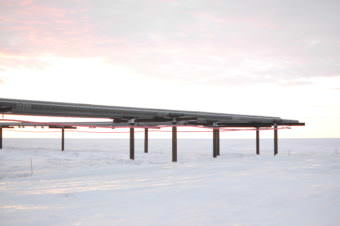
A flow line curves above the horizon on the western North Slope. (Photo by Elizabeth Harball/Alaska’s Energy Desk)
Oil company Hilcorp and one of its drilling contractors each paid more than $25,000 in penalties earlier this year after a worker was killed last December on one of Hilcorp’s rigs on the North Slope.
Shawn Huber, 36, died at the Milne Point field when the rig’s operator accidentally opened a set of hydraulic jaws and dropped a 700-pound, 31-foot section of drilling pipe that struck Huber in the head, according to the companies’ internal investigation subsequently submitted to state workplace safety regulators. The operator was distracted, according to the investigation, because he was training a colleague.
Some six months later, Hilcorp paid $25,000 in state-assessed fines for violating a pair of safety regulations — one that says employers shouldn’t allow rig workers to stand or pass under “suspended loads,” and another that requires appropriate disinfectant to be used after a blood spill. A Hilcorp supervisor instructed rig workers to clean up after the accident, and some of them weren’t wearing gloves, exposing them to bloodborne illnesses, according to a state investigator’s report.
Hilcorp’s contractor, Kuukpik Drilling, paid its own $30,000 fine for five violations — two that were the same as Hilcorp’s, two more that had to do with unsafe use of a stepladder, and another for the company’s failure to protect Huber from the hazards of his job.
Huber, who was working for Kuukpik, had more than 10 years of drill rig experience, and was married with three children, according to his obituary.
Public interest in Hilcorp, a privately owned company, has risen sharply since the company announced in August that it would buy BP’s assets in Alaska for $5.6 billion. If approved by state regulators, the purchase would give Hilcorp a major stake in two of the highest-profile assets in Alaska’s oil industry, the Prudhoe Bay field and the trans-Alaska pipeline.
The details of Huber’s death and the subsequent penalties were laid out in a pair of inquiries conducted by the state’s workplace safety agency, Alaska Occupational Safety and Health, and released in response to a public records request. The agency, known as AKOSH, found both Hilcorp and Kuukpik Drilling responsible for the accident, which appears to be the first worker death on the North Slope’s oil fields since 2012.
Officials at Kuukpik Drilling referred requests to parent company Kuukpik Corp., whose chief executive, Lanston Chinn, declined to comment.
A Hilcorp spokesperson, Justin Furnace, responded to a request for an interview with a prepared statement that called Huber’s death “a tragic event for the entire Hilcorp Alaska family.”
“We have worked closely with AKOSH on their investigation, as well as our own,” Furnace said. “We have reviewed the findings of this work closely to determine how we can apply lessons learned to improve workplace safety with both our employees and with contractors that provide services to us in the field. The safety of our personnel and anyone associated with our operation is always our top priority.”
The accident took place at the aging Milne Point field, northwest of Prudhoe Bay, which Hilcorp co-owns with BP.
Huber’s 11-person crew began their work shift at midnight Dec. 7 after 18 hours off-duty, according to the internal investigation written by officials from Hilcorp, Kuukpik Drilling and a third company, Aurora Drilling. After a short safety meeting, workers started “normal drill rig activities,” pulling segments of drilling pipe out of the well, the investigation said.
Two hours later, Huber was on the rig floor, walking around a piece of drilling pipe that was coming out of the well. He was spray painting it, to indicate that the end was damaged.
The drill’s operator was working from a console, controlling a set of hydraulic jaws used to pull the 31-foot sections of pipe from the well, then lower them off the floor. At the same time, he was describing his actions to another worker that he was mentoring, the investigation said.
As the drill operator lowered a piece of pipe that had previously come out of the ground, he was describing how to open the jaws and release it when he accidentally took the two steps required to do so, according to the investigation and a separate memo written by state regulators.
When he realized what was happening, the operator tried to reverse himself by pressing a “close” button on his joystick, “while also yelling over the intercom to alert the crew,” the investigation said.
Two other workers on the rig floor heard the operator’s yell and reacted, the investigation said. But Huber did not appear to respond, and he was hit by the top end of the pipe as it fell an estimated 28 feet. Trained medical responders arrived within three minutes, and a nurse practitioner arrived within nine minutes, but Huber was pronounced dead roughly an hour later at Milne Point’s clinic, according to the companies’ investigation.
The investigation identified two “root causes” for the accident — first, that the drill operator was “performing two tasks at the same time” by operating and mentoring. And second, there were “contradictory requirements” when it came to workers’ exposure to overhead loads. The companies had “safe work practices” in place to limit exposure, the investigation said, but employees were still sometimes exposed when they were working.

Kuukpik Drilling’s safety manager, Sonny Kula, told a state regulators that “the procedure that was being followed was normal operating procedure.”
After the accident, the companies said they’d put several safeguards in place to correct the workplace safety violations.
First, at the request of a Hilcorp drilling superintendent, a technology company changed the rig’s controls to block the operator’s normal two-step procedure from opening the hydraulic jaws within a specific range of heights, unless the operator took a special third step to override the restriction. That system was tested within three days of the accident.
Second, Hilcorp and Kuukpik Drilling sent regulators a diagram that set out a “restricted work area,” and a list of tasks that are barred while the rig is operating, like the one Huber was doing. “Workers with essential operations are permitted within the fall zone, but not directly under the load,” Kula wrote in a memo to state regulators.
And third, Kuukpik Drilling required all its workers to retake a bloodborne illness training program.
The companies’ assessment of the accident’s root cause — the driller’s distraction and the “contradictory requirements” around overhead loads — appears to be “thoughtful and thorough,” said Deb Kelly, who spent three years supervising AKOSH as a top official at the Alaska Department of Labor.
But it’s the companies’ responsibility to make sure that when workers do make mistakes like the rig operator’s, the results aren’t catastrophic, added Kelly, who reviewed the state’s case files at Alaska Public Media’s request.
“An employer should never put employees in a position where a moment’s inattention will cause a fatality,” she said. “You have to have as many layers of safety as you can practically apply, so that a lot of things have to go wrong before someone gets hurt.”
A new lawsuit challenges the initial denial of a $1,606 permanent fund dividend payment to the same-sex spouse of a member of the military stationed outside Alaska. (Photo by Rachel Waldholz/Alaska Public Media)
As many as seven people were initially denied their 2019 permanent fund dividends because they’re married to same-sex members of the military or students living outside the state, according to an anonymous state worker quoted in newly-filed court documents.
The documents are part of a suit filed in federal court Wednesday by Denali Nicole Smith, the spouse of a member of the military, who claims the state denied her this year’s $1,606 PFD because of an Alaska law against same-sex marriages. A federal judge struck down that law in 2014.
After the lawsuit was filed, the state agreed to pay Smith’s PFD, but it would not promise she wouldn’t be denied payments in the future, according to the documents filed Monday.
The new filings quote an anonymous state worker inside the Alaska Permanent Fund Dividend Division, and they appear to contradict a press release from Alaska Attorney General Kevin Clarkson’s office Friday that said there is no one else “similarly situated” to Smith.
Clarkson also accused Smith’s attorney, Caitlin Shortell, of filing a “false lawsuit” that ignored that the state had already reversed itself and agreed to pay Smith’s dividend.
“No one disagrees that the denial letter never should have been sent,” Clarkson was quoted as saying in his press release. “But the division promptly remedied the action once it figured out its mistake.”
Clarkson said questions were raised over the summer about a PFD Division statute booklet that still included the invalidated same-sex marriage law, and that applications that could have been denied on that basis were placed “on hold.” But Smith’s, for a reason that Clarkson did not specify, was “inadvertently” denied instead.
Shortell and Smith, in two separate declarations filed with the court, argue that Clarkson’s statement is false, that as many as six other applications were denied — not just placed on hold — and that the denials were only fixed after the lawsuit was filed.
The documents also describe the series of events leading up to the lawsuit.
After hearing about Smith’s denial in September, Shortell published a Facebook post asking for information or evidence about others denied their dividends on a similar basis, Shortell wrote in her declaration.
The same day, Shortell said she heard from a worker in the PFD Division who confirmed that the state still denied the payments to same-sex spouses and children of same-sex spouses accompanying military members and students outside the state. The employee gave Shortell other details about the state’s practices and “told me that they would provide me information to assist me in this lawsuit and would testify truthfully to these facts under subpoena,” Shortell said.
After the lawsuit was filed last week, the employee told Shortell that the PFD Division’s management asked employees to identify and pay any dividends denied based on the invalidated same-sex marriage statute, and that “approximately seven” cases had been found. But workers have not yet been asked to reverse and pay any denials predating 2019, Shortell said, which, along with Smith’s experience this year, “created the factual basis for the above-captioned lawsuit.”
In a footnote, Shortell said she’s keeping the employee’s name confidential because of their fear of being fired “for having confirmed the unconstitutional actions of state officials in this lawsuit.”
“The PFD employee is referred to with the pronoun ‘they’ to preserve their anonymity,” Shortell wrote.
Clarkson criticized Smith’s lawsuit in a tweet Friday that called it “pointless” and a “big non-issue,” saying she was eligible for a 2019 dividend and that it had gone unpaid only because Smith has not provided a correct address. After deleting the tweet, Clarkson issued his prepared statement, which also criticized Shortell for filing a “false lawsuit, knowing full well that the (PFD) Division had already changed course and had in fact informed her that her client’s dividend was scheduled for payment before the lawsuit was filed.”
Alaska Attorney General Kevin Clarkson’s since-deleted tweet from Friday. (Alaska Public Media screenshot)
Smith, in her own declaration, said she filed her lawsuit because the state only reversed itself after she hired an attorney, refused to clearly explain why and wouldn’t guarantee that she wouldn’t be denied in the future.
After her initial denial in September, Smith said she notified state officials that Shortell was representing her and requested relevant documents. A PFD specialist then emailed Smith and Shortell in early November to say that her dividend would be paid, Smith said.
The specialist “did not explain the reason for the reversal in eligibility,” Smith said. In a follow-up phone call, another PFD Division employee told Smith that the state’s lawyers “realized it was wrong what they did,” but would not guarantee that her dividend would not be denied again in the future and refused to give Smith a written explanation for the reversal.
Smith said she subsequently filed the lawsuit because “it appeared to me that the PFD representatives were trying to placate me by promising to pay me my 2019 PFD only after I retained an attorney and to deter me from challenging their practices against me and other same-sex accompanying spouses.”
Smith’s lawsuit asks a federal judge not just to order the state to allow her to receive her own dividend, but also to permanently block Alaska from denying dividends to same-sex spouses of military members and students who live outside the state. It also asks for an order requiring the state to pay all dividends, plus interest, to anyone denied them after the 2014 ruling invalidating Alaska’s same-sex marriage laws.
Both Smith and Shortell said in their declarations that Clarkson’s press release Friday was “false” and “defamatory” and, according to Shortell, “was published with an intent and an effect of prejudicing the public, court, and the legal community and to detract attention from state officials’ ongoing discriminatory practices against Ms. Smith and others who file civil rights lawsuits against state officials and their counsel.”
A spokesperson for Clarkson did not immediately respond to a request for comment on Shortell’s statements.
Close
Update notification options
Subscribe to notifications
Subscribe
Get notifications about news related to the topics you care about. You can unsubscribe anytime.