Nat Herz, Alaska Public Media

Big parts of Dunleavy’s agenda remain unfinished. But he still has time, tools at his disposal.

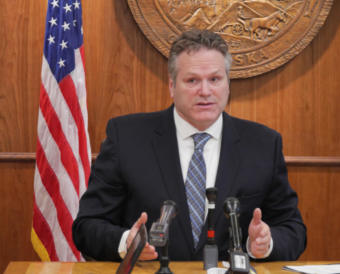
Alaska Gov. Mike Dunleavy speaks at a news conference at the Capitol. (Photo by Skip Gray/360 North)

Alaska Gov. Mike Dunleavy’s agenda for his first year in office was ambitious: Pay a $3,000 permanent fund dividend and balance the state budget through massive spending cuts.

With the legislative session winding down, Dunleavy has gotten traction with some of his ideas, but many others have stalled. Several big pieces of Dunleavy’s budget proposal have been discarded — not just by the mostly-Democratic House majority, but also by the mostly-Republican Senate majority.

Dunleavy’s goal of a $3,000 PFD is still up in the air. But lawmakers have rejected his plans to slash state spending on health care, schools and the state university system. They haven’t approved his proposed constitutional amendments on budget matters. And they haven’t held a single hearing on his bill to divert nearly half a billion dollars in oil-tax revenue to the state, away from cities and boroughs.

Outside of budget legislation and an earthquake spending package, Dunleavy has introduced 25 bills this year, and none of those have passed the House or Senate.

“Clearly, his budget proposal effectively didn’t garner any support, and I think you’ve seen a lot of skepticism about his amendments to pretty radically change the Constitution,” said Anchorage Democratic Rep. Zack Fields.

Lawmakers have also been slow to advance a package of Dunleavy’s tough-on-crime bills. But those ideas have shown signs of life in the past couple of weeks, and Fields said he and other lawmakers want to get some of them done before the legislative session wraps up.

“They’re running close to the end. But there’s still time to address some of these concerns that the governor has,” Dunleavy spokesperson Matt Shuckerow said. “And that’s why he’s meeting with lawmakers and leadership on a regular basis, sometimes daily.”

The governor’s office is still holding out for more of his bills and initiatives to get across the finish line this year. But Cathy Giessel, the Anchorage Republican who’s president of the Senate, said Dunleavy can still declare victory even if that doesn’t happen.

Sen. Cathy Giessel, R-Anchorage. (Photo by Skip Gray/360 North)

The governor’s proposals may have drawn backlash from Alaskans who oppose sharp spending reductions. But Giessel said they’ve sparked new public awareness and debate about how the state is spending its money.

“It’s at the kitchen tables of families, and that’s never been achieved before,” she said. “If you look at items, bulleted lists of the things he’s asked for, yeah, they haven’t been checked off yet. But they are still under discussion, and that’s a huge accomplishment.”

And even if Dunleavy doesn’t get everything he wants from the Legislature — like a much smaller budget and much larger PFD — that doesn’t have to amount to a big political loss. Instead, he can try to blame lawmakers for failing to get the job done, according to Pat Pourchot, who once worked as a top deputy to former Democratic Gov. Tony Knowles.

“That’s exactly what happens oftentimes in the world of politics, is: ‘I tried to get you a $3,000 dividend, but the Legislature balked and you need to hold your legislators accountable,’” Pourchot said. “Sometimes that goes a ways in explaining why you didn’t deliver on your promise.”

Dunleavy can always return to his agenda next year; he’s in the first year of a four-year term. And those who opposed some of his ideas in this legislative session said they expect they’ll have to keep up that effort in the next one.

“The questions in front of the Legislature this year won’t go away just because they didn’t advance,” said Nils Andreassen, the director of the Alaska Municipal League — a coalition of cities and boroughs that was a strident critic of Dunleavy’s proposals to divert municipal revenue to the state. He added: “AML can’t back down from a conversation about the the important partnership between state and local government that should exist.”

But the session also hasn’t finished yet, and lawmakers can still pack a lot of work — and a lot of bills — into the Legislature’s closing days. Shuckerow, the governor’s spokesman, pointed out that Dunleavy still has some levers to use.

Dunleavy won’t hesitate to call lawmakers into special session if he feels like they haven’t made enough progress on criminal justice legislation, Shuckerow said.

“If the Legislature fails to address these critical issues, he’s not going to let them go,” he said.

Meanwhile, if lawmakers decide to pay a PFD of less than the $3,000 that Dunleavy wants, the governor doesn’t have the power to put that money back himself. But he does have authority to reduce spending on other programs through his line-item veto power. And he hasn’t ruled out that step, either.

Dunleavy administration pick for $94,000-a-year labor relations manager comes without labor relations experience

State and local government workers receive similar compensation to priv-ate-sector workers, according to an Institute of Social and Economic Research report. State Office Building. Aug. 5, 2016.(Photo by Andrew Kitchenman/KTOO)
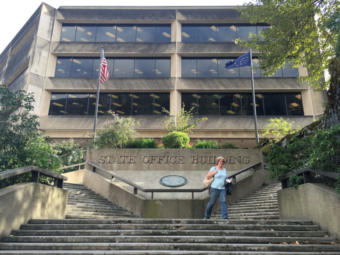
The Alaska State Office Building in Juneau houses the Division of Personnel and Labor Relations, where Jared Goecker is the new labor relations manager. (Photo by Andrew Kitchenman/KTOO)

A new high-level appointee in Gov. Mike Dunleavy’s administration has been hired into a $94,000-a-year-job in spite of his relative youth and lack of experience.

Jared Goecker, whose Facebook page lists his age as 25, started as the state’s labor relations manager last month – a job that includes helping to supervise a group of negotiators who hammer out contracts worth hundreds of millions of dollars with Alaska’s public sector unions.

Goecker’s experience includes two-and-a-half years working for real estate company Weidner Apartment Homes as a manager in training, assistant community director and community director, according to his LinkedIn profile. He’s also worked in Republican Party politics, helping with Dunleavy’s campaign and with Mike Pence’s 2016 gubernatorial bid in Indiana before Donald Trump picked Pence as his running mate.

Goecker previously worked for Tuckerman Babcock, Dunleavy’s chief of staff and a former Alaska GOP chairman. (Photo by Josh Walton)

Most recently, Goecker worked as executive assistant to Tuckerman Babcock, Dunleavy’s chief of staff. Babcock chaired the Alaska Republican Party until Dunleavy was elected.

Goecker didn’t respond to requests for comment. But Kate Sheehan, Goecker’s boss and the director of the Division of Personnel and Labor Relations, said she interviewed several candidates for the job and that Goecker was the best fit. The hiring decision was hers, and it wasn’t directed by the governor’s office, she said.

“Jared is a real go-getter – I know it’s kind of a cheesy thing to say,” Sheehan said, adding: “He has a skill set that I thought would be a good fit.”

The description for Goecker’s job lists “thorough knowledge of practices and principles of labor contract administration, labor contract negotiations, grievance handling and arbitration processes” as among the desired knowledge and skills. His predecessor, Emily Gaffney, was an attorney, and some of the labor negotiators who work under Goecker have law degrees.

Goecker does not. But Sheehan said his job doesn’t require as much specific subject matter expertise – his responsibilities are more managerial, and include making sure that the positions taken by the division’s negotiators align with the direction handed down by the governor’s office.

Goecker’s hiring was announced to labor officials last month. Several union leaders said they found the decision perplexing, given Goecker’s lack of experience, though most didn’t want to speak publicly about it, saying they expected to be working with him.

Trina Arnold, the Juneau-based regional director of the Inlandboatmen’s Union of the Pacific – which includes 400 state ferry workers – said Goecker sat at the table during a recent round of contract negotiations.

“We did ask him what his background was in labor relations, and he said he’d worked in real estate,” Arnold said.

There are no specific minimum requirements for Goecker’s job under state law. His position is defined as “partially exempt,” which also means that it does not have to be advertised on the state’s jobs website, Sheehan said.

An international airplane feud could crimp one of Alaska’s most lucrative fisheries

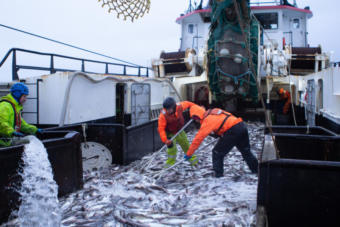
Crew members shovel pollock off the deck of a Bering Sea fishing boat earlier this year. (Photo by Nathaniel Herz/Alaska’s Energy Desk)

A new twist in a decade-long trade war over airplanes could crimp one of Alaska’s most lucrative fisheries: The European Union is threatening new import taxes on Alaska pollock.

The tariffs stem from a feud over government support for the American company Boeing and European company Airbus. Earlier this year, the World Trade Organization issued separate rulings that said both companies have received illegal subsidies.

In response, both the U.S. and EU last month proposed tariffs on billions of dollars worth of the other’s exports.

The potential effects underscore the global nature of the market for Alaska fish products, of which Europe and Asia are big consumers.

The proposed EU tariffs on pollock would hit the largest market for fillets of the Bering Sea whitefish. European processors turn blocks of frozen pollock into fish sticks and fish pies; more than $250 million in exports go to Europe each year, or a little less than 20% of the $1.4 billion value of the total annual pollock catch.

“It’s a key market,” said Dan Lesh, an analyst with the McDowell Group, a research firm that works with the fishing industry and is studying the tariffs’ impact.

The EU’s proposed tariffs would also apply to about $70 million of salmon and Pacific cod.

The tariffs could affect the price of fish in Europe, make it less widely available or cut into the profits of the American companies that catch pollock in the Bering Sea.

“A lot of this trade would still continue,” Lesh said. “But the price would go up.”

The dispute isn’t just about fish. The EU tariffs would affect some $20 billion of American products, including ketchup, handbags and tractors.

The EU proposal came after President Donald Trump’s administration threatened its own set of tariffs on $11 billion in European products, including wine and dairy.

Trump himself has weighed in, tweeting last month, “The EU has taken advantage of the U.S. on trade for many years. It will soon stop!”

As Capitol reporters dwindle, Alaska lawmakers grapple with rise of political blogs

Blogger Jeff Landfield of The Alaska Landmine works from his “office,” a public lounge in the Capitol in Juneau while talking with Alaska's Energy Desk reporter Nat Herz on March 25, 2019. Landfield said a legislative staffer gave him the black eye at a bar on March 22.
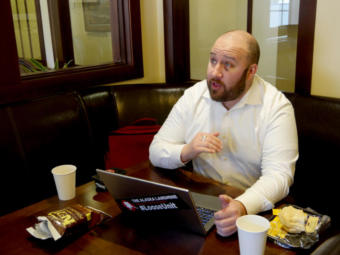
Political blogger Jeff Landfield sits at his makeshift workspace in a public lounge area at the Alaska Capitol. (Photo by Skip Gray/360 North)

The press corps at the state Capitol has a new addition this year: Jeff Landfield, a failed candidate for state Senate who is now running a colorful political blog called the Alaska Landmine.

Landfield isn’t your average reporter — he once made the news for posing for photos in a Speedo. But he’s one of a growing number of political bloggers who are trying to fill in gaps left by Alaska’s shrinking mainstream media, posing challenges for both lawmakers and the bloggers themselves.

On a recent Monday morning in Juneau, Landfield was standing outside the chambers where the state House meets. And he was getting some attention because he had a very conspicuous black eye.

It was a souvenir, Landfield said, from when a legislative aide punched him, unprovoked, a couple days before at a downtown Juneau bar. Rep. Gabrielle LeDoux, R-Anchorage, gave him a hard time as she walked past.

Blogger Jeff Landfield of The Alaska Landmine posted this photo of himself on on March 23, 2019. He says a legislative staffer gave him the black eye in a bar in Juneau on March 22, 2019.
Blogger Jeff Landfield of the Alaska Landmine posted this photo of himself on March 23, 2019. He said a legislative staffer gave him the black eye in a bar in Juneau on March 22, 2019. (March 25, 2019 screenshot by Skip Gray/360 North)

“You should have slugged him back!” she said.

Landfield took an unconventional path to his job as a political blogger.

He once lost out on a seat on a state commission overseeing judges when pictures emerged of him posing in a Speedo with women in Las Vegas; another showed his hands on a woman’s breasts.

He’s twice run as an outsider candidate for state Senate and lost. And just last year — while he was publishing his blog — he ran a state-level super PAC that worked, successfully, to oust an incumbent representative from Anchorage.

But Landfield has also gotten some real scoops, publishing off-color social media posts and statements by some of Gov. Mike Dunleavy’s appointees who later had to withdraw from consideration. And, he said, he’s serious about his work.

“There’s so many things I know that I don’t write because I’m not sure,” he said. “I’m very cognizant to verify and get sources and get information about what I put out there, especially when it’s something that can have real-life impacts on people or on organizations.”

Landfield used to work in the oil industry. But he said he got political blowback from some of the provocative posts on his blog, which he thinks was one of the reasons why he lost his job in December.

And so in February, Landfield moved to Juneau to cover the legislative session.

Landfield is part of a burgeoning industry in Alaska political blogs — there’s also the Midnight Sun, from a former Fairbanks newspaper correspondent.

There’s DermotCole.com and CraigMedred.news, both run by veteran Alaska journalists. And there’s Must Read Alaska, a conservative blog by Suzanne Downing, a former spokeswoman for the Alaska Republican Party.

Other blogs have waxed and waned over the past 15 years. The liberal-leaning Mudflats site once skewered Gov. Sarah Palin, while later, journalist Amanda Coyne published scoops about state politics before taking a job with U.S. Sen. Dan Sullivan.

Each blogger has their own bent. And they’re not part of bigger institutions that have defined journalistic standards and layers of editors.

Landfield said he thinks a robust mainstream media would be preferable to people like him — bloggers have to spend time selling ads, and they’re not exactly well-paid. But he said there are gaps in political coverage right now that he can fill.

“I recognize a need and a void, and that’s why I’m doing this,” he said. “If what I was doing didn’t have any purpose, or I didn’t think it was having an impact, or I thought it was a waste of time, I wouldn’t be doing it.”

Landfield does regularly break news that’s picked up by outlets like the Anchorage Daily News and Alaska Public Media, and people have noticed.

Ashley Reed, a lobbyist in Juneau for decades, said Landfield’s blog, and others, have become indispensable sources of information for people like him, who work in Alaska politics and need to know what’s happening at the Capitol.

Taken together, Reed said, the bloggers are also helping to replace a level of accountability that has diminished as the presence of other media outlets in Juneau has gotten smaller. That diminished accountability extends even to people in his profession, Reed said.

“The (Anchorage) Daily News used to spend a lot more money on ink writing about lobbyists than they do today,” he said. “The newsrooms, they have a lot of blank pages to fill every day. The people that are your mainstream reporters are out there filling their days doing that, and I don’t think they have a lot of time to go out and play Woodward and Bernstein.”

One thing that’s different about the bloggers, though, is that they can have agendas and affiliations that don’t align with traditional ideas about journalism.

When Landfield ran for state Senate, he feuded with one of his opponents in the Republican Party primary, Natasha von Imhof. Von Imhof was eventually elected and now belongs to the Legislature that Landfield covers.

Other bloggers have targeted individual politicians or members of particular political parties with their posts.

The blurred line between political operative and political journalist has posed a dilemma to the lawmakers who have to work with the bloggers, like Sen. John Coghill, R-North Pole.

Sen. John Coghill, R-North Pole, talks with reporters at a Senate Republican press availability in Juneau on Jan. 15, 2019.
Sen. John Coghill, R-North Pole, talks with reporters at a Senate Republican press availability in Juneau on Jan. 15, 2019. (Photo by Skip Gray/360 North)

Coghill, who chairs the Senate Rules Committee, was one of the lawmakers who rejected Landfield’s request for a media credential this year. He said that decision was based on Landfield’s history of political activism, and what Coghill described as Landfield’s tendency to put his own personality at the center of his work.

Also, Coghill added: “I’m a straight-laced Christian, right?”

Landfield, Coghill said, “uses language that I would not use. He talks about people in ways that I find very disturbing. He has strong opinions. He doesn’t mind poking people. When you start taking people on personality-wise, it starts getting kind of dirty. And I just don’t like that style.”

Even if Landfield hasn’t been officially sanctioned by the Legislature, he can still roam the Capitol, not to mention Juneau’s bar scene. And he doesn’t need a press credential to get news tips.

Landfield said he’s not sure if he’s going to keep doing his job for the long term. He said he likes getting a steady paycheck and having other colleagues. But for now, he has work to do.

As he waited in the Capitol hallway, a new tip appeared in his email. It was about a man he’d already written about once — a convicted stalker of Bristol Palin who’d been hired by a state senator.

“According to this, there might be more stuff,” Landfield said. “I’m not exaggerating — I’m getting so many emails now, I almost need a filter person.”

The tip turned out to be legitimate, and a few hours later, it became a tweet.

As his crime bills languish, Dunleavy renews the idea of a special session

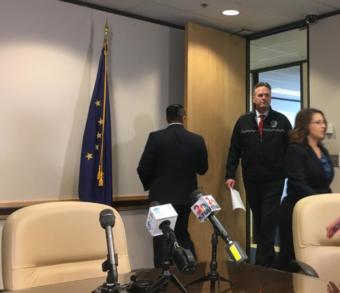
Alaska Gov. Mike Dunleavy stands at the corner of his Anchorage conference room, where he gave a news conference Monday in which he urged lawmakers to take action on his criminal justice legislation. (Photo by Nat Herz/Alaska’s Energy Desk)

Alaska Gov. Mike Dunleavy, at a news conference Monday, again suggested he could order Alaska lawmakers into a special session unless they start advancing his batch of criminal justice bills.

Dunleavy put a tough-on-crime approach at the center of his campaign last year. And at the start of the legislative session in January, he proposed four different bills.

One toughens penalties for certain sex crimes; a second boosts possible sentences for drug and other types of crimes. Two others allow for tougher bail, probation and parole conditions.

But none of the bills has passed the House or Senate. In the House, all the bills are still stuck in their first committee. If that doesn’t change, Dunleavy said, he won’t take the idea of a special session off the table.

“The people of Alaska, I believe, right now demand that we get these bills that we filed moving and out before the session is over,” he told reporters gathered in his Anchorage office. “We have plenty of time to do that and we are imploring, once again, that the Legislature move our crime package.”

Dunleavy made a similar pitch to lawmakers earlier to this month, saying there will be no session-ending deal without action on his crime bills, or his constitutional amendments on state finances and the PFD.

But a key state House member said the changes Dunleavy wants are likely too ambitious to get all of them done this year, even if some of them likely have support to pass.

Anchorage Democratic Rep. Matt Claman chairs the House Judiciary Committee, where two of Dunleavy’s bills are stuck. And he told reporters Monday that Dunleavy is going to have to compromise.

Rep. Matt Claman, D-Anchorage, questions Chief Procurement Officer Jason Soza of the Department of Administration, at a joint meeting of the House State Affairs and Health and Social Services Committees on April 2, 2019. The committees were examining procurement procedures that led to a controversial contract to manage the Alaska Psychiatric Institute.
Rep. Matt Claman, D-Anchorage. (Photo by Skip Gray/360 North)

“You know, we ask the governor, ‘Okay, you’ve got four massive crime bills. What are your priorities for these?’ And the answer we get is, ‘All of them,’” Claman said. “He wants everything. Well, I’ve been around here long enough to know that you sometimes have to make choices.”

Claman has been a defender of the changes to state law that were in Senate Bill 91 — a 2016 overhaul of Alaska’s criminal justice system.

The changes stemmed from the idea, supported by data, that longer jail and prison sentences won’t make someone less likely to commit another crime. Claman said Monday that he supports tough penalties for the most serious offenses, like murder.

But he said his constituents prefer to spend money on drug treatment rather than paying to keep more addicts in prison for longer periods.

Claman said one thing lawmakers should do to enhance public safety is pass legislation to give police and firefighters better retirement benefits. Dunleavy’s spokesman, Matt Shuckerow, didn’t immediately respond when asked if the governor supports that policy.

The special ingredient inside these new gluten-free noodles? Fish, from Alaska.

Julia O’Malley serves two bowls of ramen with Trident Seafoods’ “protein noodles,” which are made from pollock caught in the Bering Sea off Alaska’s coast. (Photo by Nat Herz/Alaska’s Energy Desk)

The featured ingredient in the new gluten-free “protein noodles” stocked at Costco might surprise you: It’s pollock, the unassuming whitefish caught by the millions in the Bering Sea, off Alaska’s coast.

Trident Seafoods, one of the country’s largest seafood companies, is betting that Americans’ enthusiasm for protein means they’re ready for noodles made from fish. And while skeptics have, in the past, dismissed pollock as a “trash fish,” the new noodles fit into a broader seafood industry push to brand pollock as a healthy, whole food worth paying for – to make pollock “sexy,” as an official with another company once put it.

“It’s been the Pabst Blue Ribbon to the microbrew,” said John Salle, a Trident executive who worked on the new noodles’ development. “We’re kind of taking it upon ourselves to really go out and extoll the virtues of wild Alaska pollock.”

Pollock are transferred from a fishing boat into a processing plant in Dutch Harbor, in the Aleutian Islands, in January 2019. (Photo by Berett Wilber)

Alaska’s fishing industry is better known for its annual summer harvest of salmon, with bright-red fillets shipped around the country. But fishermen catch Bering Sea pollock in far greater volumes – more than 2 billion pounds a year – using huge nets that stretch a quarter-mile long. Some boats actually process the catch in on-board factories, packing boxes full of frozen fillets and fish paste that are loaded into shipping containers at the dock.

Seafood companies have historically processed pollock into high-volume, lower-value products like fish sticks and fish fillets, as well as surimi – the minced fish used in fake crab. And much of the market for pollock is in Europe and Japan.

But in the past few years, companies have been marketing pollock in new ways in America, as a fish with its own identity that’s a fresh and healthy alternative to meat. Trident is introducing products like whole pollock, with the fish head still on, as well as boneless, skin-on fillets, Salle said.

“There’s definitely a renewed attention on pollock and its value,” said Dan Lesh, a Juneau-based senior analyst at McDowell Group, a research firm that works with the fishing industry. “There’s a widespread recognition that it’s a really high-quality protein and there’s a lot of value there to provide the world – and we just need to figure out how to market it and what people want to eat.”

Anchorage food writer Julia O’Malley holds up a Trident noodle. (Photo by Nat Herz/Alaska’s Energy Desk)

The noodles are part of that push. They’re still processed – a Trident plant in Minnesota makes them out of surimi. But they only have eight ingredients, with 10 grams of protein in each serving.

And by going into noodles, Trident says it’s targeting a new group of consumers, rather than competing with its existing seafood products.

“We saw an opportunity here not to position this as another imitation product, but to create a new category,” Salle said. “This is all incremental.”

The noodles are available at some Costco stores, though not yet in Alaska. For an Alaska Public Media taste test, a Trident official flew a package, with an ice pack, up from Seattle.

The noodles can be prepared hot or cold. For the test, Anchorage food writer Julia O’Malley cooked them in ramen, with steamed vegetables.

She and others who have sampled them described the noodles as neutral, not fishy. And filling: “There’s, like, a caloric sort of density to them,” O’Malley said.

They were heavy for ramen but would work well in other Asian dishes, like stir fries, she added – particularly if you want a low-carb option.

“Is this noodle better than a rice noodle? No. What they offer that a rice noodle doesn’t is protein,” she said. “It comes down to what people want.”

Site notifications
Update notification options
Subscribe to notifications