The Future of the Arctic Refuge: Riches or Ruin?
Two worlds that overlap: Richard Glenn sees ANWR drilling as a boon to Iñupiaq communities

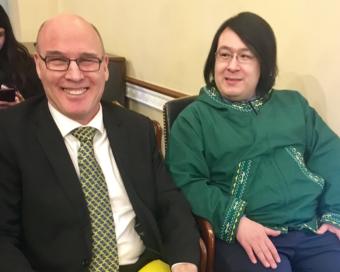
Richard Glenn, left, and Matthew Rexford, tribal administrator for Kaktovik, wait to testify at a 2019 House hearing on drilling in the Arctic Refuge.
Richard Glenn, left, and Matthew Rexford, tribal administrator for Kaktovik, wait to testify at a 2019 U.S. House of Representatives hearing on drilling in the Arctic National Wildlife Refuge. (Photo by Liz Ruskin/Alaska Public Media)
Richard Glenn is an inconvenient truth for those who want to stop drilling in the Arctic National Wildlife Refuge.

In congressional hearings, he presents a challenge to the narrative prevalent in Washington, D.C., that Native people oppose development in the Arctic. Glenn has been a compelling witness in favor of drilling in ANWR for about 20 years.

Sen. Maria Cantwell, D-Wash., looked past Glenn as he waited to testify in front of the U.S. Senate Committee on Energy and Natural Resources at a 2017 hearing on ANWR. She said she was disappointed there weren’t more tribal members on the witness list.

“Individual tribal members, as we have seen throughout Alaska and throughout the United States of America, don’t support this kind of development because they believe in the wildlife nature that God has given us and that we are stewards of Mother Earth,” she said.

That generalization, from the committee’s top Democrat at the time, put Glenn in a slow burn.

Glenn is executive vice president for external affairs at Arctic Slope Regional Corporation. ASRC and its Iñupiat shareholders stand to profit from drilling in ANWR. When it was his turn to speak, Glenn pointed out he is also a member of a tribe. So were three other Alaska Native witnesses who testified for drilling.

“And I was particularly stung by the ranking member’s comments that she didn’t see tribal members,” Glenn said. “Maybe she just didn’t find enough tribal members that agreed with her position.”

But Glenn doesn’t match the image some senators have in their heads for what a tribal member should look and sound like. In his dark suit and metal-rim glasses, Glenn wouldn’t have looked out of place in an accounting firm.

And he would not let himself be painted as less Native because he supports oil development in ANWR. He’s Iñupiaq with a deep connection to the ice and soil.

Opponents of drilling say the coastal plain of the refuge is sacred land to the Gwich’in people of the Interior. Glenn told the senators it’s all sacred land, north and south. Lands across the North Slope bear the bones of his ancestors, he said. He meant that literally.

“Some of my ancestors’ bones, my grandfather’s grandmother, are in Prudhoe Bay,” he said. “Others are scattered along the coastal plain, from the Canadian border to Point Hope.”

Glenn told the senators that his people depend on sacred land for both food and resource development. Glenn is comfortable with the idea that land can be sacred and produce oil. Synthesizing the knowledge of two worlds is what he’s all about.

Kaktovik sits on an island in the Arctic Ocean on Alaska’s northeast coast. It’s the only village within the Arctic National Wildlife Refuge’s coastal plain, which Congress opened to oil exploration in 2017. (Photo by Nat Herz / Alaska’s Energy Desk)

When Alaska’s Energy Desk inquired to Glenn about profiling him, he and the public relations department of Arctic Slope Regional Corporation declined to participate. They insisted the Energy Desk should first profile a pro-drilling tribal representative from Kaktovik, the only community in the refuge. And it’s easy to see why they might want that. The anti-drilling side sometimes portrays the battle over the Arctic Refuge as for-profit corporations fighting tribes. Money versus culture. Suits versus moose-hide vests.

But from Glenn’s perspective, it’s not that simple. And he has told his story before.

“I was born in 1963, in Mountain View, California,” Glenn said when Karen Brewster interviewed him in 2016 in his home in Utqiaġvik for an oral history project.

Glenn told Brewster his mom is a daughter of the Ahmaogak family from Utqiaġvik, also known as Barrow. His dad is a son of Nebraska, sent to the Arctic to work on the Distant Early Warning Line, or DEW Line — the Cold War-era early warning radar system.

“And in those days, you weren’t allowed to fraternize with the locals,” Glenn said. “But there were a few Barrow people who worked out on the DEW Line station. And they like to say they played cupid for my mom and my dad.”

The young couple left the North Slope when Glenn’s dad took a tech job in what would soon be called Silicon Valley, so Richard was born and grew up in the Bay Area. Richard and his siblings learned Iñupiaq from their mom, and they knew other North Slope families living in that part of California. They also had a stream of visitors going to and from Barrow.

“So we had a communications network,” Glenn said. “Everyone had Eskimo food in their freezer all the time.”

His first trip to Barrow, aside from when he was a toddler, was at age 13. It was a summer of cousins and an introduction to hunting.

“I made a promise to myself that I’d go back, even if my family didn’t,” Glenn said in the interview with Brewster. “So every summer I did, from the day that school was over till the day school started, from seventh grade on. And it was a great upbringing.”

As he learned to hunt — ringed seal, bearded seal and caribou — Glenn began to learn about ice: how to move on it, how to be safe, how it drifts and breaks off. By his 20s, he was on spring whaling crews and became a whaling co-captain.

He became, he said, obsessed with ice. Infatuated with it. He told Brewster he got to double-dip in ice education, with traditional knowledge and a master’s degree in geology from the University of Alaska Fairbanks. Every ice trail he cuts tells a story, and Glenn reads the details.

“You’re looking at that popcorn junk ice that your pick hates to swing on. Or the mud-rich stuff that was born when the slush was dragging the bottom,” he said. “Or this kind of columnar basalt-looking ice that grew all at once and just stayed that way, from birth to — just a flat, tabular ‘bang,’ hit it with a pick, it all breaks like that.”

A view of the sea ice and the Arctic Ocean near Utqiaġvik, April 16, 2019. (Photo by Ravenna Koenig/Alaska’s Energy Desk).

The Gwich’in say to allow drilling in the Arctic Refuge will destroy their Native way of life. But Richard Glenn sees a fruitful integration. The oil industry pays local taxes, and Arctic Slope Regional Corporation owns some of the subsurface rights in the refuge. As Glenn sees it, oil development provides the cash that allows the Iñupiat to continue to live in the Arctic and teach future generations how to hunt on ice.

“If my DEW Line father and my Iñupiat mother have taught me anything, it’s taught me that there’s these two ways of looking at the world, but they overlap in the middle,” he said at a forum in Washington, D.C. “And if you can find that place where the overlap exists, it’s nothing but pay dirt, as far as good lessons to learn.”

Read and listen to more stories from our series The Future of the Arctic Refuge: Riches or Ruin?

‘We’re never going to surrender’ — Sarah James on a life fighting oil drilling in the Arctic Refuge

Sarah James (Photo by Elizabeth Harball/Alaska
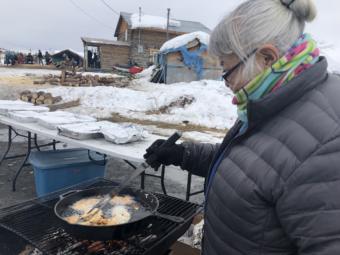
Sarah James in her kitchen in Arctic Village, mixing ingredients for fry bread. (Photo by Elizabeth Harball/Alaska’s Energy Desk)

Neetsa’ii Gwich’in elder Sarah James is known internationally for her advocacy surrounding one of the most contentious issues in Alaska: oil development in the Arctic National Wildlife Refuge.

And, on the occasion of Arctic Village’s annual spring carnival, James is also known for her fry bread.

Assessing the supply of flour in her kitchen early one April afternoon, James, 75, wasn’t sure she had enough ingredients on hand to satisfy the demand.

“Even if I mix up ten pound, they’re crazy for it,” she said. “They wanted it yesterday.”

The recipe is one-of-a-kind.

“This is Navajo fry bread,” James explained. “But it became my own fry bread — my own recipe. So it’s my fry bread now.”

James’ recipe originated in Oregon where, at 13, she began attending Chemawa Indian High School in Salem. Like many Alaska Native children at the time, she was sent away to boarding school.

But James’ roots remained firmly in the land where she was born. As she folded ingredients together with a long spoon, James spoke about her family going into the mountains in summer to hunt sheep and other game, catching trout in the nearby Old John Lake and seeing caribou stampede upriver — she remembers listening from a tent as they hit the water, crossed and shook off on the other side.

Arctic Village, James’ home, is just south of the Arctic National Wildlife Refuge. (Photo by Elizabeth Harball/Alaska’s Energy Desk)

“Even though I went to Western school, I feel like I learned more from growing up off the land,” James said. “It makes more sense.”

James’ desire to preserve that way of life drove her into the thick of the battle over the Arctic National Wildlife Refuge. For decades, James has traveled around the world to speak about her people’s ardent opposition to oil drilling in the refuge’s coastal plain, where the caribou herd they hunt commonly gives birth to calves.

Speaking to James in her kitchen, it becomes clear she carries multiple roles within her. She is an elder, a keeper of traditional knowledge and history — a true Neetsa’ii Gwich’in woman, as the first tribal chief of Arctic Village put it in a recent interview. James is also a seasoned, politically astute and indefatigable activist.

Recently, though, James transitioned to a more formal role. She has been appointed as a spokesperson on the Arctic Refuge issue for the three Neets’aii Gwich’in tribal governments that own 1.8 million acres at its borders — the Arctic Village Council, the Venetie Village Council and the Native Village of Venetie Tribal Government. The tribes are now engaging directly in government-to-government meetings with the Trump administration as it plans for an oil lease sale in the refuge.

James draws a distinction between her work and the work of conservation groups.

“They are for recreation, for animal protection, hiking, rafting… We Neetsa’ii Gwich’in, we have always been there. God put us there to take care of that part of the world,” James said.

Asked when she began her advocacy, James doesn’t name a specific event: “It’s not when I started. I was born with it.”

Even before the Arctic Refuge controversy heated up, James was involved in notable protests. While attending college and working in San Francisco in the late 1960s, she fell in with a group of other indigenous students.

“And they were talking about Alcatraz, ‘we should just take Alcatraz back,’” James recalled.

And they did — for 19 months. Led by Mohawk activist Richard Oakes, a group occupied the former prison island starting in November 1969. James was there for part of it. She remembers watching government helicopters flying overhead.

But James describes her role in the Alcatraz occupation as a “tagalong.” Her leadership on the issue she became known for came later.

In 1988, Gwich’in leaders from across Alaska and Canada gathered in Arctic Village and passed a resolution formalizing their opposition to oil development in the refuge.

In part, it reads: “The health and productivity of the Porcupine Caribou Herd, and their availability to Gwich’in communities, and the very future of our People is endangered by proposed oil and gas exploration and development in the calving and post-calving grounds in the Arctic National Wildlife Refuge.”

The leaders asked James, then in her forties, to be one of eight representatives to take that resolution into the political arena.

“They said, ‘the only way we can win is to do it in a good way, make friends, [explain] why we say no to oil, educate them in a good way, stay united — and no compromise,’” James said.

James speaking at a rally against oil development in the Arctic Refuge in Washington, D.C. in 2005. (C-SPAN)

James took that philosophy with her on many trips to Washington, D.C. during Congress’ repeated attempts to open the refuge’s coastal plain to oil development. There, she rubbed shoulders with powerful figures on both sides of the fight, from former Alaska Senator Ted Stevens to former Secretary of State John Kerry. In 2005, during President George W. Bush’s second attempt to allow oil exploration in the refuge, she kept a 5-month vigil near the Capitol, outside the National Museum of the American Indian.

On the wall by James’ kitchen, there is a photo of her shaking hands with former President Bill Clinton, who vetoed a bill allowing drilling in the refuge in 1995. Clinton signed the photo with a note that reads, “With thanks for your great work.”

Gail Small, one of James’ good friends, said they often talk about shifting between their own cultures and the political world of Washington, D.C. Small, a program director at an organization for indigenous women leaders, is Northern Cheyenne and also has long advocated on similar issues.

“I grew up on the reservation,” said Small. “For you to understand the complexities of the Western world and be able to move back and forth between those worlds — it’s exhausting, it’s tiring, and the fact that Sarah’s been doing this for like 50 years, it’s a remarkable achievement for anyone.”

Small said she has watched as James, exhausted from a long international flight, came to life when delivering a speech. She said James would arrive at meetings with pre-written resolutions of support for the Gwich’in.

“One thing about Sarah James, she always comes prepared,” said Small. “She’s always got all these papers, pulling them out of her backpack.”

And just as her elders directed, James’ message is always positive.

“Sarah never tries to be someone who’s angry, or aggressive. She just talks her story,” Small said.

James explained this is intentional. Of course she hears the criticisms often directed at her and other Gwich’in advocates — like that they’re working at the behest of their environmentalist allies or overstating the risk to caribou at the expense of economic benefits for other Alaskans.

But James refuses to fight with her critics.

“I say what I need to say and leave,” she said. “Not even mention how mean they are, or they’re wrong, or what. I don’t answer them.”

And, James added, “We always won!”

Her side did win — until 2017, when Congress passed the Tax Cuts and Jobs Act, which included language opening the Coastal Plain to oil leasing. In the very long war over the Arctic Refuge’s fate, it was a big battle lost.

Sarah James, preparing frybread for neighbors and guests at Arctic Village’s annual spring carnival. (Photo by Elizabeth Harball/Alaska’s Energy Desk)

But a lot could happen between now and when oil rigs show up in the refuge. The possibility of lawsuits and elections loom over the entire process. So James isn’t giving up.

“We’re proud to be Gwich’in, we’re proud to be caribou people. We love our food. We love who we are. So we’re never going to give up on that,” James said. “We’re never going to surrender.”

After she finished preparing the frybread dough, James rode her four-wheeler down a snow-covered road to the fire pit, where her neighbors and friends had gathered for the spring carnival. There, James dropped pieces of dough into a pan of bubbling oil. It was served to residents and visitors alongside hot tea, rice, salmon, jello and, of course, caribou.

This article has been updated to clarify James’ current role.

Read and listen to more stories from our series The Future of the Arctic Refuge: Riches or Ruin?

Meet the Trump administration official whose signature could formally open ANWR to drilling

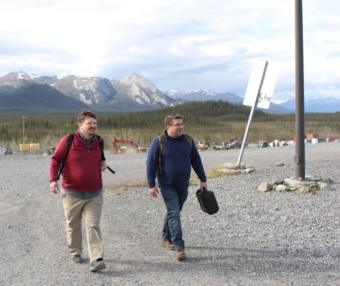
Joe Balash, left, walks toward a federal charter plane in June after a meeting between the Trump administration and tribal officials in Arctic Village, a Gwich’in community in Interior Alaska. At right is Chad Padgett, the top Bureau of Land Management official in Alaska. Balash is the Interior Department official leading the federal government’s planning process in advance of opening the Arctic National Wildlife Refuge to oil development. (Photo by Nat Herz / Alaska’s Energy Desk)

It’s 3,200 miles from Joe Balash’s office in Washington, D.C., to the Neets’aii Gwich’in community of Arctic Village, at the southern edge of the Arctic National Wildlife Refuge. But Arctic Village is barely 200 miles from North Pole, the Alaska town where Balash grew up.
Balash is a top Trump administration official, the assistant secretary for land and minerals management at the U.S. Interior Department. He was confirmed in December 2017 – the same month Congress voted to open a portion of the refuge to oil development.

On his second day on the job, he said, he was personally tasked by Interior Secretary David Bernhardt – then the deputy secretary – with ensuring the refuge oil lease sale moves ahead. It’s likely that when the federal government formally signs off on the required environmental review later this year, Balash will be the one holding the pen.

That step will fulfill a longstanding dream of pro-development Alaskans like Balash, who have long lobbied Congress and presidential administrations to open the Arctic Refuge’s coastal plain to drilling. Environmental groups, Democratic lawmakers and the Gwich’in people successfully blocked those efforts for decades, until Donald Trump signed the GOP tax reform bill, which also allowed development in the refuge’s coastal plain. That area is 1.6 million acres, or slightly larger than the state of Delaware – though still less than 10 percent of the refuge’s overall area.

The Gwich’in people’s subsistence lifestyle depends on the Porcupine caribou herd that commonly gives birth in the coastal plain; they see those drilling plans as a desecration. But Balash is certain that caribou and oil infrastructure can coexist.

“The one thing that I wish more than anything is that the fear that people have about the consequences of this – I am confident that we are able to move forward here and not devastate the Porcupine caribou herd. I am absolutely convinced of that,” Balash said in an interview. “And if I weren’t, I would have very different feelings about this.”

When Balash’s charter plane, filled with an all-white delegation of federal officials, landed on Arctic Village’s gravel runway in June, there was no one to meet them at the airport — instead, they walked the half-mile in the spring sunshine to the village’s community hall, where they were scheduled to meet with the local tribal government.

But when Balash’s group walked in the door, they got a welcome that, if not warm, was far from chilly. There were handshakes and hugs, and as the meeting began, council members pointed out their houses, “in case you guys need anything, even after the meeting,” said Galen Gilbert, Arctic Village’s chief. One of Balash’s colleagues handed out sticks of homemade moose pepperoni brought from Anchorage. For lunch, the council prepared a buffet lunch of moose, caribou and pie — eaten as they implored Balash to protect the refuge’s integrity.

Such is the paradox of the Arctic Refuge debate on the ground, and of the task for Balash, who went to high school near Fairbanks and spent half a career working in Alaska state government — and occasionally advocating for drilling in the refuge — before moving to Washington.

The Gwich’in are respectful, welcoming hosts, even as they see Balash as the arm of a government that, by opening the refuge to drilling, is pushing them aside and threatening their way of life. Balash, meanwhile, came to listen to the Gwich’in people’s fears and opinions directly, in hopes of accounting for them in the department’s plans for how and where development will be allowed in the refuge.

Arctic Village, a Gwich’in village of about 150 people, sits at the southern boundary of the Arctic National Wildlife Refuge. (Photo by Nat Herz / Alaska’s Energy Desk)

What Balash is not considering, though: The Gwich’in people’s demand that drilling not take place at all.

“I’ve had a couple of conversations with individuals about that, where they’ve said, ‘Come on, Joe, it’s your signature. You can make this okay, you can stop this from happening,’” Balash said in the interview, just before his charter flight took off from Fairbanks. “The reality is, Congress has passed a law. The president is fully behind that law and implementing it faithfully. And if I were to, for some reason, balk at that, I’d be replaced.”

He added: “After digging into the details, and with the benefit of sitting down for literally hours and days with our biologists and other experts, I’m convinced that we can fashion a program here that is going to allow the Porcupine caribou herd to continue to migrate, to continue to procreate and continue to sustain the Gwich’in people.”

Balash, 44, grew up in an Air Force family and moved to Alaska just before starting sixth grade. At high school on Eielson Air Force Base, outside Fairbanks, he was a three-time state wrestling champion known for his “grim countenance” before meets, according to a 1993 Anchorage Daily News story.

After moving to Alaska, Balash spent time with his father, “chasing salmon wherever his Subaru could take us,” he said during his confirmation hearing. He also started learning about the state’s Permanent Fund dividend program, which pays Alaska residents cash earned by an investment fund seeded with oil revenue. Those experiences, he said, helped form his view that “with the right approach, you can have responsible development without sacrificing clean air and water.”

Balash’s initial experience with the politics of the Arctic Refuge came around that time, in a high school government class. He chose the development debate as the subject for a current events paper, and his conclusion, he said, was that “we Alaskans could get it right.”

Balash’s first job in politics came through a church friend of his father’s: former Republican state legislator Gene Therriault. After eight years as a legislative aide, he was hired as a special assistant to Sarah Palin after she was elected governor, then worked as deputy commissioner and commissioner of the Department of Natural Resources under Palin’s successor, Sean Parnell.

At the natural resources department — Balash’s highest-profile job before being appointed by Trump — he advanced and defended Parnell’s pro-development policies and was a fierce political advocate for his Republican boss, occasionally penning opinion pieces to fend off the administration’s critics.

He also helped pass the controversial 2013 reduction in state oil taxes, Senate Bill 21, and he pushed legislation to ease permitting requirements for development projects, House Bill 77, that the Republican-led Senate ultimately rejected as too divisive.

In those jobs, Balash said in the interview, one of the things he learned was, “sometimes you shouldn’t do something just because you can.”

“If you don’t bring certain key players, institutions, communities along, just because you have the power for the moment doesn’t mean that that decision or that policy is going to stand the test of time,” he said.

When Parnell lost his re-election in 2014 to independent Bill Walker, Balash took a job as chief of staff to newly-elected GOP U.S. Sen. Dan Sullivan, who was Parnell’s natural resources commissioner while Balash was the deputy commissioner.

Balash and Padgett walk along the road between Arctic Village’s community hall and its gravel airstrip. (Photo by Nat Herz / Alaska’s Energy Desk)

Trump then appointed Balash to his Interior Department job in mid-2017. As assistant secretary for land and minerals management, he oversees agencies including the Bureau of Land Management and the Bureau of Ocean Energy Management (which oversees offshore oil drilling), with more than 10,000 employees and $1 billion in federal spending.

He eschews the bombast of some other Trump administration political officials. And during the confirmation process, in response to written questions from U.S. Sen. Bernie Sanders, D-Vermont, Balash said he believes that “climate change is not a hoax, and that man has an influence.”

Nonetheless, Balash is a believer in oil development — in the way it can bring, and has already brought, critical infrastructure and cash into the isolated Alaska Native Inupiat villages on the North Slope.

The North Slope Borough has a $400 million budget, paid for almost entirely with property taxes on oil and gas infrastructure; it provides education, firefighters, police officers and other services to the region’s villages. Balash points to academic research that found dramatic increases in life expectancy in the area since production began at the North Slope’s Prudhoe Bay oil-fields.

“The benefits that they’ve achieved for their people are indisputable,” Balash said. “Whatever other issues one has about the environment, the climate, the behavior of oil companies — for the Inupiat people on the North Slope, it’s not all positive, there’s downsides. But on net: big, big benefits.”

Those benefits also extend to the state as a whole, since Alaska has collected and spent billions of dollars in oil revenue on its own government services. But coastal Alaska communities both on the North Slope and elsewhere in the state are also now facing expensive problems created by global warming, which scientists agree is driven by oil consumption.

Balash said the scale of oil production from the Arctic Refuge won’t be enough to make a difference on a global scale. And, he said, he assumes that an “enormous amount” of new oil and gas development will still be produced before the world stops depending on fossil fuels.

“That will happen, and it will happen somewhere on this planet,” Balash said. He added, referring to the refuge: “It just so happens that in this particular place, we have very good reason to believe that there’s an enormous resource there and that we can develop it in a safe and responsible manner.”

Balash’s confidence in the government’s ability to protect the refuge’s wildlife, while allowing drilling, stems from what he’s seen elsewhere on the North Slope, he said: Caribou populations don’t appear to have been dramatically reduced by development at existing fields in Prudhoe Bay.

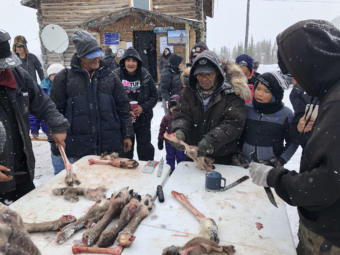
Arctic Village residents participate in a caribou leg-skinning contest earlier this year. (Photo by Elizabeth Harball / Alaska’s Energy Desk)

But Balash also acknowledges that the refuge and the Porcupine herd have different characteristics from the environment and caribou on the rest of the North Slope. Farther to the west, where oil infrastructure already exists, there’s more room for caribou to roam between the mountains and the ocean. In the refuge, that space is narrower.

To account for that, Balash said, the Trump administration is considering three different plans for development, all with at least some level of restrictions on drilling in the Porcupine herd’s core calving grounds. One option bans oil leasing in more than one-fourth of the total area that Congress opened to drilling; a second allows horizontal drilling but no surface disturbance in critical caribou habitat; and a third allows surface disturbance but restricts construction during calving season.

But, citing uncertainty about the refuge’s environment and ecology, he wouldn’t say development would stop if there was evidence that it was harming the population.

“I think the question in that scenario would be: What’s going on with the herd? And what changed? Is it that the herd is just migrating somewhere else? Or is the herd getting smaller?” Balash said. “There would be a number of things that you’d have to look at.”

The “fear” Balash referenced earlier pops up at Arctic Village meeting, where he sat, dressed in a red zip-up sweater and khakis, on a bench with his colleagues.

“We’re not just fighting for caribou. We’re fighting for polar bears and all (the) species of birds,” Jerald John, one of the council members, told Balash’s group. “Where are these birds going to go once you disturb their natural habitat?”

For this government-to-government consultation, Balash is on Gwich’in turf — the community hall is hung with heart-shaped signs celebrating caribou. His Interior Department colleagues noted it’s rare for such a high-ranking official to make multiple in-person trips to tribal meetings in rural Alaska, as Balash has done as part of the planning process for development in the refuge.

Balash sits with Padgett, left, and Steve Berendzen, the Arctic Refuge manager, during the meeting in Arctic Village. (Photo by Nat Herz / Alaska’s Energy Desk)

Balash’s on-the-ground presence and familiarity with Alaska does make a difference, said Matt Newman, an Anchorage-based attorney for the Native American Rights Fund who’s working with the Gwich’in tribal governments. Like Balash, Newman grew up in North Pole, and Balash’s brother Luke was one of Newman’s high school teachers.

“Not to be too crude about it, but he goes into a village and realizes what that little outhouse out back is for,” Newman said in an interview.

Newman, in an interview, said he believes Balash and his colleagues are sincere in their effort to accommodate the Gwich’in people’s concerns.

“There’s no mustache-twirling villains here. There’s no antagonists in the traditional storytelling sense,” Newman said. Balash, he added, is not in Arctic Village “just to say: ‘To hell with you people, we’re drilling.’”

“He actually is making, in my mind, a good-faith effort to meet people, to talk with them, and at least attempt to try to find ways to address their concerns,” Newman said.

But, Newman added, the Gwich’in people’s message only goes so far with Balash. In spite of that message, Balash’s “core belief” that oil development and caribou can co-exist remains unshaken, Newman said.

“I don’t think it has swayed him, or changed his mind,” he said.

In the same way, Newman added, “the Gwich’in folks are not rolling over. They’re not conceding defeat. And they’re not just going to sit down and cut a deal and say, ‘All right, this has happened. How can we benefit from it?’”

Tonya Garnett, a Gwich’in leader at the Arctic Village meeting, is less convinced of Balash’s sincerity. In an interview afterward, she said she feels drilling proponents are “just trying to check the boxes” during the planning process.

“I just really feel like their minds were already made up before they came into this,” she said.

For the only moment over the course of a long day, Balash seemed irritated when asked about that comment, as he stepped off his federal charter plane back in Fairbanks.

“I sure feel like I’m doing more than checking the box here. I don’t know how to convince them of that,” he said. “At the end of the day I’m not sure I can. But I have to live with myself.”

The comments about the refuge’s bird species by John, the tribal council member, made an impression on Balash; he said he’d be taking a “harder look” at some of the proposed drilling restrictions intended to protect birds.

The big takeaway from his meeting, Balash said, is that the Gwich’in want to stay engaged in the planning process.

And when it’s over? “They’re still going to sue us,” he said.

Read and listen to more stories from our series The Future of the Arctic Refuge: Riches or Ruin?

In Arctic Village, Gwich’in leaders say the fight to stop drilling in the Arctic Refuge isn’t over

Arctic Village residents and visitors gather for a caribou leg skinning contest during the community’s annual spring carnival in April. (Photo by Elizabeth Harball/Alaska’s Energy Desk)

One thing lies at the heart of Gwich’in tribes’ opposition to oil development in the Arctic National Wildlife Refuge: caribou.

At Arctic Village’s annual spring carnival in April, men gathered around a plastic folding table for a contest to see who could skin a caribou leg the fastest. Their knives worked swiftly from knee to cloven hoof, hands tugging meat, tendon and hide from bone.

Second place went to David Smith Jr., 22. Smith is a leader — the second chief — in Arctic Village. And like most everyone here, Smith believes oil development in the refuge that borders their tribal lands will endanger the caribou his people hunt.

“And that’s going to change our very lifestyle,” Smith said. “The reason we’re here is for the caribou.”

Until recently, the residents of 15 Gwich’in villages scattered across northeast Alaska and northwest Canada were on the winning side of the drawn-out political battle in Washington, D.C., over oil development in the refuge. They helped fight repeated attempts in Congress to legalize drilling in the refuge’s 1.6 million-acre coastal plain.

Then, in late 2017, Congress opened the coastal plain to oil development. So Gwich’in tribes are now taking unprecedented steps to try to protect a resource they call vital to their culture and survival.
Caribou are a primary source of subsistence food in Arctic Village — more than that, they’re part of the tribes’ cultural identity. And today, some 200,000 caribou in the Porcupine herd travel past Arctic Village and other Gwich’in communities every year.

Smith said the caribou they harvest allow Arctic Village residents to continue their traditional way of life, on their traditional land.

“I would say this is like no other place on earth, so we shouldn’t be treated like any other place on earth,” Smith said. “I can drive in any direction and hunt freely. I can drive in any direction and go trapping.”

David Smith Jr. is the second tribal chief of Arctic Village. Smith, who opposes drilling in the refuge, doesn’t think the fight is over: “I believe everything is going to come out on top for us,” he said. (Photo by Elizabeth Harball/Alaska’s Energy Desk)

Smith, like many other Gwich’in leaders, hasn’t given up on the idea of blocking drilling in the refuge. He recalled a story he heard at a recent meeting, about a prediction made by an Elder in years past:

“They said, ‘Later on in the future, there’s going to be a war between the south and the north — the south being the U.S. government, and us being the north. It’s going to be a war of paper, not of weapons.’ And they said, ‘As long as we stick through, the north will always win.’”

Pro-drilling Alaskans often point out that Arctic Village and the area set aside for oil exploration are separated by about 100 miles and a mountain range. The Gwich’in say their link to the place is the caribou, because the Porcupine herd gives birth in same part of the refuge where drilling is now legal.

Scientists say predicting exactly how oil development will affect the caribou herd’s population or migration patterns is tricky. It’s not yet known what future oil development in the refuge may look like, in terms of size, location or design. And in other parts of Alaska’s Arctic, calving caribou were able to shift their movements away from oil infrastructure and still access similar habitats.

But the calving area in the refuge is narrower, hemmed in by a mountain range and the Arctic Ocean, so some biologists worry the impacts will be greater.

In Arctic Village, those fears are more acute. As she bounced a relative’s baby on her lap, village council member Faith Gemmill said when Congress legalized drilling in the refuge in 2017, it shifted the ground beneath the Gwich’in — and galvanized them, too.

“It’s put our tribe in the position of defense. And we have to work hard – harder than we’ve worked before to try to defeat that,” Gemmill said.

This led to an historic shift. For decades, engagement on the issue of oil development in the refuge was led by the Gwich’in Steering Committee, a nonprofit with members from each of the Gwich’in villages in Alaska and Canada.

Faith Gemmill, a member of the Arctic Village council, looks after a relative’s baby during the community’s annual spring carnival. Gemmill says Congress’ vote to legalize drilling in the Arctic Refuge in 2017 “put our tribe in the position of defense.” (Photo by Elizabeth Harball/Alaska’s Energy Desk)

But now that the federal government is advancing the formal process to open the refuge to oil leasing, the Gwich’in people’s tribal governments have asserted their legal right to be directly involved in that process. Those are separate entities from the steering committee — Arctic Village has its own tribal government, for example, as does the village of Venetie.

Each of those tribal governments are now having regular meetings about the oil leasing plans with the Bureau of Land Management and top Trump administration officials.

But Matt Newman, an attorney with the Native American Rights Fund who represents the tribes, said there are limits to their ability to influence Trump administration policy.

“No one has any blinders on, or any illusions,” Newman said. “There’s no secret that they wish to see oil drilling and this environmental review process completed. On the flip side, the tribes are equally open about the fact that they oppose it.”

Additionally, while some Alaska Native corporations stand to benefit financially from drilling in the refuge, the way the Gwich’in see it, they have nothing to gain, and everything to lose. Gwich’in tribes in Alaska refused to participate in the Alaska Native Claims Settlement Act of 1971, in favor of maintaining ownership of 1.8 million acres of their traditional land. It’s a choice they’re still proud of.

Newman put it this way:

“Even if the state or the federal government somehow said, ‘One percent of oil royalties from the refuge will go to an account for Venetie and Arctic Village,’ that money is going to sit untouched until kingdom come,” Newman said. “Because for the people in these villages, this isn’t about money.”

In addition to the government-to-government process, the Gwich’in continue pushing back every other way they can. Gwich’in activists maintain strong alliances with environmental groups, they give interviews to reporters from all over the world and they regularly make their case before Congress in Washington, D.C., as Arctic Village’s first chief, Galen Gilbert, did in March:

“Development in the coastal plain is a direct attack on our Gwich’in culture. Just the idea of development is causing stress and fear in my village,” Gilbert told a House committee.

This stance has drawn ire from many in Alaska.

“I’ll tell you Mr. Chairman, I want to believe the people. Not the Gwich’in, because they’re not the people. They’re 400 miles away,” Republican U.S. Rep. Don Young said at the same hearing.

Young repeated things often said about the Gwich’in. He accused them of protesting against oil development as a way to make a living, and of stealing the national narrative from other Alaska Native people. Young blasted the introduction of a bill to restore protections to the coastal plain, which made no mention of the Iñupiat people who live in the Refuge — many of whom do support drilling.

Such arguments have been going back and forth for decades. But as drilling moves closer to reality, the edges have gotten sharper.

“Think about that when you say, ‘We want to save the culture,’” Young said, addressing the other members of the committee. “Save the culture of the people! Not those that are foreigners or living away from the area. These are not the Natives directly affected.”

This year’s spring carnival in Arctic Village could be the last before oil companies bid on leases in the Refuge. Still, there were many moments of joy. One evening, families gathered at the community hall for a dance.

Gilbert, the first chief, was there with his family, wearing a baseball cap and occasionally making his way to the dance floor — a very different scene than the month before, when he testified before members of congress. In an interview later that night, Gilbert said being part of the Arctic Refuge controversy is part of being a Gwich’in leader.

Galen Gilbert, first chief of the Arctic Village Council, said even if he wasn’t a leader, he would work to fight oil development in the Arctic Refuge. (Photo by Elizabeth Harball/Alaska’s Energy Desk)

But Gilbert added, “Even if I wasn’t chief, if I had the opportunity to fight against it I would do it — totally.”

Gilbert said while he was in Washington, D.C., to testify, it was hard for him to listen to arguments from oil development supporters.

“I hate it when people say, ‘The caribou will be all right, even if they did open it.’ I heard that multiple times,” Gilbert said. “You know, ‘They’ll be OK.’ No!”

Gilbert has three young daughters. He said they’re growing up the way he did, witnessing caribou wandering near their home.

“I wouldn’t want to lose that,” he said. “Never.”

Read and listen to more stories from our series The Future of the Arctic Refuge: Riches or Ruin?

In the Alaska village where ANWR is the backyard, many see drilling as an opportunity

Nathan Gordon Jr., 24, patrols for polar bears in Kaktovik, the only village inside the Arctic National Wildlife Refuge’s coastal plain – the area that Congress, in 2017, opened to drilling. Gordon supports oil exploration in the refuge and says he thinks caribou wouldn’t be affected by drilling infrastructure: “I wouldn’t be worried about it at all. It’ll be a lot safer for them to be out there than being hunted by me.” (Photo by Nat Herz / Alaska’s Energy Desk)

The Trump administration will soon take a big step toward drilling for oil in the Arctic National Wildlife Refuge. It hopes to sell leases to companies before the end of the year.

It’s a major reversal, after Congress opened up the refuge a year and a half ago. For decades, opponents argued that drilling will harm the refuge’s unique landscape, and its caribou and birds. But many of the Alaska Native residents of Kaktovik, the only community inside the refuge, see oil development as an opportunity — though others remain deeply skeptical.

Even into June, a mile-long shelf of ice hemmed in the village of 250, which sits on an island in the Arctic Ocean on Alaska’s northeast coast.

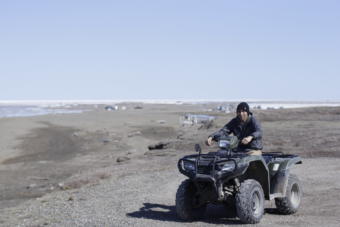
But Arctic sea ice has been melting, and that means more hungry polar bears have been coming to Kaktovik. On a recent warm spring day, Nathan Gordon Jr., 24, kept watch from the seat of his four-wheeler. He is part of the village’s polar bear patrol.

“It’s part of my job to make sure the town is safe, and all the visitors and the polar bears at the same time,” he said.

The Arctic Refuge’s tundra and mountains surround Kaktovik — there are no roads in or out, and there’s no oil infrastructure nearby.

But Gordon’s paycheck comes largely from the oil industry, thanks to drilling in Prudhoe Bay to the west. The industry pays some $370 million in annual property taxes to the North Slope Borough, and that money, in addition to Gordon’s salary, helped build Kaktovik’s $16 million new basketball gym. It also funds a full-time fire department, with two gleaming fire trucks.

Residents also have flush toilets, which are lacking in dozens of other villages outside the refuge. Oil, Gordon said, has done a lot for Kaktovik and its Native Inupiat residents, and he supports drilling in the refuge.

Kaktovik has a full-time fire department with two fire trucks, funded by taxes on oil that the industry pays to the North Slope Borough. (Photo by Nat Herz / Alaska’s Energy Desk)

“People have been benefiting really great through all of this,” he said. “Opening ANWR — it would be great for our kids, for the economy, for our village and everything that would go on.”

Kaktovik is surrounded by the refuge’s coastal plain — the area that Congress opened to development. Indigenous opposition to drilling is centered in Gwich’in communities, more than 100 miles away from the refuge’s coastal plain.

In interviews, Kaktovik’s drilling boosters said they’re frustrated with what they see as a tendency by outsiders to defer to the views of the Gwich’in people, even though the Inupiat have lived on the North Slope for thousands of years.

“They try and just blatantly tell us: ‘No, you cannot do this on your own land. We have more of a right to what you do in your own community, in your own village,’” said Charles Lampe, 43, a Kaktovik whaling captain who supports development. “They think that we’re trying to make it to where it’s just going to be a big oil field out there. That’s not what we’re trying to do.”

Kaktovik’s drilling backers say they want to make sure that development doesn’t jeopardize residents’ ability to harvest both caribou and whale.

The average Kaktovik household consumes hundreds of pounds of caribou each year, and as much as 1,000 pounds of bowhead whale, according to surveys. When it comes to caribou, Gordon said he doesn’t expect them to harmed by oil infrastructure.

“I wouldn’t be worried about it at all,” he said. “It’ll be a lot safer for them to be out there than being hunted by me.”

If development does harm the Porcupine caribou herd, whale meat would be a safety net for the residents of coastal Kaktovik that’s lacking in landlocked Arctic Village. But Lampe, the whaling captain, rejected the idea that Arctic Village is more dependent on caribou.

Kaktovik sits on an island in the Arctic Ocean on Alaska’s northeast coast. It’s the only village within the Arctic National Wildlife Refuge’s coastal plain, which Congress opened to oil exploration in 2017. (Photo by Nat Herz / Alaska’s Energy Desk)

“If they wanted whale, we’d send them whale,” Lampe said. “I mean, that’s the kind of community and the kind of people we are.”

Other Kaktovik residents are less convinced that oil infrastructure can coexist with their traditions. A poll of 93 people conducted by the village government found 52 percent in favor of development, 32 percent oppose it and the rest are unsure.

Carla Kayotuk, an avid hunter and camper who opposes drilling, said that even living in a small village, she values the open spaces nearby.

“When we get away, it’s quiet right now. And I’m afraid, once the development starts happening, that’s not going to happen,” she said. “Where are we going to go?”

Speaking up against development can be intimidating here, Kayotuk said. She’s been accused of ignoring benefits from oil that could come to the village, she said.

“We’re not ignorant,” she said. “We just value something different than what you value.”

It’s still too early to know exactly how close oil infrastructure might come to Kaktovik. After a lease sale, companies will still have to drill wells to see if commercially viable amounts of oil even exist under the coastal plain. If they find it, they’ll need environmental reviews and permitting before they can pump it out.

From atop the bluff at the edge of town, Gordon, the polar bear patroller, looked out over the tundra to the west, where he thinks the first development is likely. What does he think he’ll see on the horizon once development starts?

“Nothing,” he said. “You won’t be able to see a footprint out there.”

It will take years to see if Gordon’s prediction comes true.

Read and listen to more stories from our series The Future of the Arctic Refuge: Riches or Ruin?

Site notifications
Update notification options
Subscribe to notifications