Elizabeth Harball, Alaska's Energy Desk
Lawyers spar over whether young Alaskans’ climate lawsuit can move forward

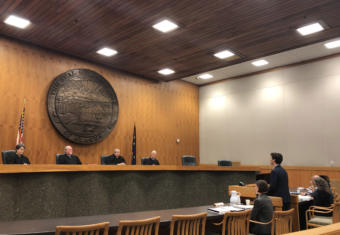
Attorney Andrew Welle argues before the Alaska Supreme Court on behalf of 16 young Alaskans hoping to change the state’s policy on fossil fuels and climate change. (Photo by Elizabeth Harball/Alaska’s Energy Desk)

The Alaska Supreme Court heard arguments Wednesday in a case that could ultimately change the state’s approach to climate change and fossil fuel production.

The case, Sinnok v. State of Alaska, is being brought by 16 young Alaskans arguing that current policy violates their right to “a stable climate system” under the state constitution.

During oral arguments, attorney Andrew Welle said the judiciary has a duty to clarify how the Alaska Constitution should guide state government’s approach to climate change.

“A declaration that state’s actions contributing to climate change in the face of the emergency that’s facing these plaintiffs is unconstitutional — it would, at minimum, tell the defendants what they can not do, and that is to continue to promote fossil fuels, knowing of its dangers to these young plaintiffs,” Welle said.

Welle is an attorney with Our Children’s Trust, an Oregon-based nonprofit that is pursuing a number of similar cases in states across the country, as well as a case against the federal government, Juliana v. United States.

The Alaska Supreme Court dismissed a similar case in 2014, which was also backed by Our Children’s Trust. Then, the court ruled that making state climate policy isn’t the judiciary branch’s job. They said it’s something the governor’s office, state agencies and the Legislature should address, instead.

Welle argued that this time they’re bringing a different case. Instead of challenging the state’s lack of action on climate change, they’re challenging its policy promoting fossil fuel production.

Anna Jay, the attorney representing the state, argued the case should still be dismissed.

“Alleging that the state has affirmatively supported greenhouse gas emissions as opposed to merely failing to prevent them is simply another way of describing the same policy decision,” Jay said.

If the Alaska Supreme Court rules in favor of the plaintiffs, they will then go to trial against the state.

Pebble opponents sue Trump administration over EPA reversal

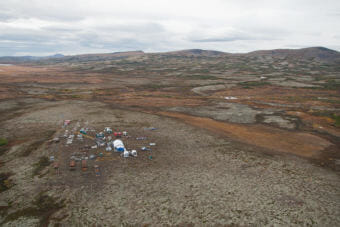
The proposed site of the Pebble Mine.
The proposed site of the Pebble Mine. (File photo by Jason Sear/KDLG)

A coalition of Pebble Mine opponents announced Tuesday that they are suing the U.S. Environmental Protection Agency.

The group is challenging EPA’s decision this summer to throw out what some saw as a “preemptive veto” of the proposed copper and gold mine, claiming the agency did not properly justify the decision.

“The federal government has a trust responsibility to protect the resources that our cultures depend on, and eliminating the proposed protections violates that responsibility,” said Bristol Bay Native Association President and CEO Ralph Andersen at a press conference announcing the lawsuit on Tuesday outside the federal courthouse in Anchorage.

Bristol Bay Regional Seafood Development Association Executive Director Andy Wink called the EPA’s now-revoked proposal “an important tool for safeguarding the world’s most valuable salmon fisher.” He said his organization “cannot allow it to be cast aside without due process.”

An EPA Region 10 spokesperson declined to comment on the lawsuit.

Pebble Partnership spokesman Mike Heatwole said in an interview the company believes the lawsuit is without merit and will be dismissed.

“The ask is to return the preemptive veto on the project, which many Alaskans, including a range of trade and business associations, viewed as really poor and precedent-setting public policy,” Heatwole said.

It’s the latest in a complicated series of events involving the federal agency, the Pebble Limited Partnership and the mine’s opponents. The coalition that filed the lawsuit is made up of five groups based in Bristol Bay, in the same watershed where the mine would be built.

EPA, during the Obama administration in 2014, proposed putting restrictions on the project, citing its potential impact on Bristol Bay’s rich salmon fishery. That effectively halted the effort to build the mine.

But the project began moving ahead again under the Trump administration. EPA reached a settlement with Pebble in 2017. That allowed another federal agency, the Army Corps of Engineers, to start the permitting process for the mine.

EPA formally revoked its Obama-era restrictions in July, calling them “outdated.” It was a significant victory for Pebble, which viewed the proposal as government overreach.

But EPA also has taken a few actions under Trump that have buoyed Pebble opponents, such as sending a letter criticizing the Army Corps of Engineers’ draft environmental review earlier this summer. The mine opponents cite those comments in their lawsuit filed Tuesday.

In addition to the Bristol Bay Native Association and the Bristol Bay Regional Seafood Development Association, the other plaintiffs are the United Tribes of Bristol Bay, the Bristol Bay Reserve Association and Bristol Bay Economic Development Corporation.

As BP exits Alaska, 1,600 employees are waiting to find out what’s next

BP employee Joe Miller in his Anchorage home with his children Hadley, 5, and Liam, 8. (Photo by Elizabeth Harball/Alaska’s Energy Desk)

On Aug. 27, BP engineer Josh McFarland entered a packed conference room, where company leaders addressed everyone simultaneously via video conference: “Sort of like watching the finale to a TV show,” McFarland said.

That day, BP announced it intends to sell its entire Alaska business to Hilcorp for $5.6 billion. McFarland said he and his colleagues were stunned.

“A lot of people’s reaction, including mine, was emotional at first — it was sort of awestruck,” said McFarland, who has worked at the oil company for four and a half years. “Because it was like, ‘Man, what is Alaska like without BP?’”

BP has operated in Alaska for over half a century and has long had a hand in running the state’s biggest oilfield, Prudhoe Bay. The company’s plans to exit the state has left hundreds of workers like McFarland in limbo.

Today, many BP employees are waiting to learn if they will get a job offer with Hilcorp, the company buying BP’s Alaska business, or if they will get an offer to work for BP outside Alaska. They have been given the choice to pursue those opportunities or they can take a severance package up front.

BP engineer Josh McFarland has worked at the company for four and a half years. (Photo by Elizabeth Harball/Alaska’s Energy Desk)

Employees seeking jobs with BP and Hilcorp have been told they will learn what their options are by late December.

Of the roughly 9,900 people who work directly in Alaska’s oil and gas industry, more than 1,600 work for BP. And it’s widely accepted that Hilcorp, an oil company with a reputation for cutting costs, will not be hiring back all the BP employees who are currently working there.

So now, as they find themselves in the middle of one of the biggest industry transitions in the state’s history, BP’s Alaska employees are all trying to figure out what’s next.

“I think I’m feeling trepidation,” said Abbie Barker, a BP employee of nearly 13 years.

“There are so many choices, and there are good things about each choice,” Barker said. “But some of those options come with sacrifices, you know? Or wholesale changes.”

Barker, a drilling engineer, described getting a job at BP as getting a “golden ticket.” She was hired from outside the industry, and BP provided her with coursework and training so could get the job she has today, a drilling performance analyst.

Barker has looked BP jobs in Houston, Texas, but as someone who grew up in Alaska, she said it’s hard to imagine living there.

“It’s so different from Anchorage,” Barker said. “Bugs, spiders, traffic — not just Glenn Highway traffic, but real traffic — hurricanes.”

But Barker is thinking about much more than just spiders, traffic and hurricanes. She has a family here: two small children and a husband who is a lifelong Alaskan with a good job at the Alaska Railroad.

“The thing I get caught up in is, ‘OK, if I make this choice, what else changes? What does that mean for my husband’s work? What does that mean for how we live today?” Barker said.

Abbie Barker has worked for BP for over a decade. “There are so many choices,” she said. (Photo by Elizabeth Harball/Alaska’s Energy Desk)

Barker feels many Alaskans haven’t realized the transition is bigger than just BP and the oil industry.

“This is a change in ways we can’t even begin to appreciate, that will take years to really, fully understand. There’s a whole lot of people that have a lot of things to decide in the next few months…for a lot more people than just BP employees.”

Barker emphasized she doesn’t think the change is necessarily bad. She said she’s impressed with what Hilcorp has done with the oilfields it operates. It’s more that it’s an uncertain time for a lot of people, she said, from the caterers who feed Prudhoe Bay workers to the people at the daycare who look after her children.

Another person living with that uncertainty is Joe Miller. Miller was just months into a new job at BP when the announcement landed — his first day was March 3. He said he’s feeling “cautiously optimistic.”

“One thing about the oil and gas industry is it’s taught me to deal with or manage change much better than others,” Miller said.

Miller also has two kids: a son, Liam, who is 8, and a daughter, Hadley, who is 5.

In Miller’s tidy blue house in downtown Anchorage, Liam and Hadley ate an after-school snack as their father described how they are his top priority as he weighs what’s next.

BP’s office building in Anchorage. (Photo by Elizabeth Harball/Alaska’s Energy Desk)

“Alaska is home for me and our family, we have both sides of the family here,” Miller said. “We’re very fortunate. So I’d say we are looking for Alaska opportunities.”

Miller said the day BP dropped the news was an “emotional roller coaster” for him. It happened to be Hadley’s first day of kindergarten. When he went to pick her and Liam up from school, they already knew what had happened.

“The kids were in the back, and (Hadley) had heard about the announcement and said how concerned she was and that, ‘Dad, everything is going to be OK.’” Miller said. “And I just wanted to start crying. It was a good reminder that everything with the Millers is good. We have a solid family, we are going to be OK.”

McFarland is also trying to stay positive. He’s 29 years old and doesn’t have a family here. And while he was happy to get a job with BP in Alaska — he likes the outdoors and enjoys how quickly he can get to trails and rivers from Anchorage — he sees the transition as an opportunity for change.

“At my age, I don’t know how many people get these choices,” McFarland said. “Do you want to redefine your career path? Do you want to go and work for a much smaller company? Do you want to stay and work elsewhere with BP? Do you want to just not do any of it?”

But McFarland recognizes that for others at BP, the situation is harder.

“You sort of see all the different reactions based on the different circumstances for everybody,” he said.

And for the next few months, at least, Miller, Barker, McFarland and hundreds of other BP employees in Alaska won’t know exactly what lies ahead.

8 key takeaways for Alaska in a major new United Nations report on climate change

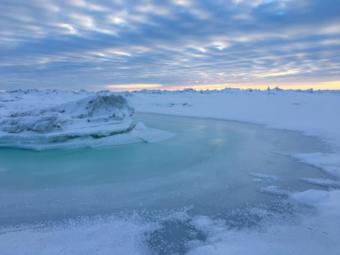
Sea ice near Nome, Jan. 29, 2018. (Photo by Zoe Grueskin/KNOM)

The United Nations on Wednesday released a major new report on how climate change is affecting the world’s oceans and frozen areas, like glaciers, ice sheets and permafrost. It contains stark warnings on how rising emissions will affect the environments that blanket most of the earth’s surface — and much of Alaska.

University of Alaska Fairbanks Professor Emeritus Gary Kofinas was one of more than 100 experts from around the world who authored the report, helping lead the chapter focused on polar regions.

Kofinas acknowledged that for Alaskans, a lot of what’s in it won’t be a surprise.

“Much of what’s happening in polar regions, particularly the Arctic, will be something that people experience firsthand in Alaska,” Kofinas said. “For example, thawing permafrost, changes in seasonality that affect the harvesting for subsistence users and harvesters in general, changes in fisheries, those sorts of things.”

“But what might be new to Alaskans is the scale of change,” he said.

Here are just a few of the report’s takeaways for Alaska, along with related news coverage.

1. “Ice sheets and glaciers worldwide have lost mass.”

2. “Permafrost temperatures have increased to record high levels.”

3. “Between 1979 and 2018, Arctic sea ice extent has very likely decreased for all months of the year.”

4. “Arctic residents, especially Indigenous peoples, have adjusted the timing of activities to respond to changes in seasonality and safety of land, ice, and snow travel conditions.”

5. “Warming-induced changes in the spatial distribution and abundance of some fish and shellfish stocks have had positive and negative impacts on catches, economic benefits, livelihoods and local culture.”

6. “Summertime Arctic ship-based transportation (including tourism) increased over the past two decades concurrent with sea ice reductions.”

7. “Coastal protection through hard measures, such as dikes, seawalls, and surge barriers, is widespread in many coastal cities and deltas.”

8. Scientists have high confidence that things are going to keep changing — the ocean will continue to warm and marine heatwaves will increase in frequency and intensity, glaciers will continue to lose mass, snow cover is expected to continue to decline and sea ice extent in the Arctic is expected to keep shrinking.

But Kofinas said one of the report’s key messages is that while some climate impacts are already unavoidable, people can still make choices that affect how severe those impacts will be.

“Hardships will be experienced. Adaptation will be needed. But the question is, to what extent, and will we be able to keep pace with those changes?” he said.

About 300 BP union employees will keep their jobs — for now

BP’s operations center at Prudhoe Bay. (Photo by Elizabeth Harball/Alaska’s Energy Desk)

About 300 BP union workers at Prudhoe Bay will remain in their jobs, at least through the end of their current contract.
That’s according to Hilcorp, the oil company set to take over BP’s entire business in Alaska.

But the leader of the union representing those workers said he remains uncertain about Hilcorp’s relationship with labor going forward.

“We haven’t had any formal meetings with them yet,” said Kristjan Dye, president of United Steelworkers Local 4959.

“Until we really sit down and talk to them, I don’t know for sure,” Dye said.

Prudhoe Bay is split, in terms of workers. On the west side of the oilfield, BP Alaska has about 300 United Steelworkers employees. On the east side, all employees are at-will. That’s a legacy from when Prudhoe Bay was owned by two separate oil companies, before BP purchased Arco in 2000.

Dye said his union negotiated its latest contract with BP in January, and it includes an agreement that the 300 workers have jobs for three years, even if BP sells to another company.

Which is, of course, exactly what happened in August, when Hilcorp announced it intends to buy all of BP’s Alaska business for $5.6 billion.

In an emailed statement, Hilcorp spokesperson Justin Furnace said, “Hilcorp will honor the existing labor contracts governing union employees associated with the acquisition.”

But Dye said he still feels uncertain about union workers’ long-term prospects with Hilcorp.

“The interesting time may come when the contract has to be renegotiated. Then, we’ll just have to see what happens,” he said.

Hilcorp did not respond to emailed questions about what happens after the contract with United Steelworkers ends, or if the company currently employs any union laborers.

Dye said he doesn’t know if the union’s relationship with Hilcorp will be much more difficult than its relationship with BP. United Steelworkers sued BP last year over a contract dispute. And, he said, some workers were frustrated that BP wasn’t exploring for oil more aggressively.

“Right now, people have kind of mixed emotions because on one hand, they realize we’re getting a new employer and that they aren’t really union friendly,” Dye said. “But on the other hand, they would like to start making oil again and Hilcorp does have a reputation for making oil.”

BP’s sale also included the company’s interest in the trans-Alaska pipeline. Harvest Alaska, a Hilcorp affiliate, will take BP’s place at the owner’s table when the sale is finalized.

And Alyeska now employs a blend of union and non-union employees, according to Michelle Egan, a spokesperson for Alyeska Pipeline Service Company.

“Changing a TAPS owners does not change the union make-up of our workforce or the workforce of our contractors,” Egan said in an email.

Hilcorp’s Harvest Alaska will be part of the group of owners that approves contracts going forward, which also includes affiliates of ConocoPhillips, ExxonMobil and Unocal.

In a follow-up email, Egan said, “I can’t speculate about what might happen in the future,” and described Ayeska as “agnostic” on unions, adding, “we don’t dictate the terms of any contractor’s relationship with their employees.”

Other BP employees may be leaving Prudhoe Bay much sooner than their union counterparts. They have been given three options — to apply for jobs with BP outside Alaska, to request to leave BP with a severance package or to apply for a job with Hilcorp.

These Anchorage students skipped school to attend a climate protest. Here’s why, in their own words.

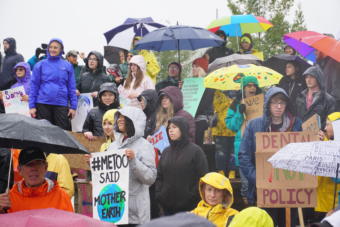
Participants in the Sept. 20 Climate Strike hold signs and listen to speeches at Cuddy Park in midtown Anchorage.
Participants in the Sept. 20, 2019, Climate Strike hold signs and listen to speeches at Cuddy Park in midtown Anchorage. (Photo by Elizabeth Harball/Alaska’s Energy Desk)

Millions of people around the world joined a protest on Friday to demand action on climate change. Many of the young people who participated were inspired Greta Thunberg, a 16-year-old from Sweden who became famous for skipping school to sit outside her country’s parliament to demand action on climate change.

Despite pouring rain, about 300 people of all ages gathered at a park in midtown Anchorage to take part in the global protest. It was organized by Alaska Youth for Environmental Action and its umbrella group, The Alaska Center. Many of the protesters and organizers were students who, like Thunberg, were missing school.

Alaska Public Media reporter Elizabeth Harball asked some of them why they attended the Climate Strike instead of going to class. Here’s what they said.

Some U.S. school districts excused student absences if they were participating in the Climate Strike. The Anchorage School District did not.

“We cannot assume that all absent students are at the strike,” a spokesperson for the school district said in an email, adding that parents and guardians are the only ones who can excuse a student’s absence.

Site notifications
Update notification options
Subscribe to notifications