Elizabeth Harball, Alaska's Energy Desk
Trump administration rolls out final environmental review for Arctic Refuge oil leasing

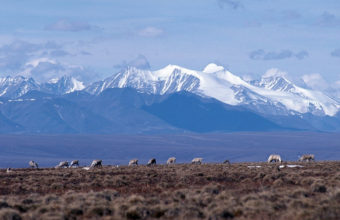
Caribou graze on the coastal plain of the Arctic National Wildlife Refuge, with the Brooks Range as a backdrop in October 2010.
Caribou graze on the coastal plain of the Arctic National Wildlife Refuge, with the Brooks Range as a backdrop. (Creative Commons photo by U.S. Fish and Wildlife Service)

On Thursday, President Donald Trump’s administration took one of the last steps to allow oil drilling in the Arctic National Wildlife Refuge.

The U.S. Interior Department has released its final environmental analysis for oil lease sales in the northernmost 1.6 million acres of the refuge, known as the coastal plain. The agency is expected to sign a final decision on oil leasing in the refuge in roughly 30 days.

In its final environmental impact statement, the agency selected a preferred option that would give oil companies the chance to express interest in close to the entirety of the refuge’s coastal plain.

Interior had proposed alternatives with tighter restrictions, including one that would put hundreds of thousands of acres off limits to help protect caribou habitat.

Still, during a call with reporters, Bureau of Land Management Alaska State Director Chad Padgett said he believes the agency’s preferred choice would strike the right balance between economic development and protecting the environment.

“I’m confident that we are on track to do what Congress has asked us to do in a safe and balanced way, that advances the president’s goals of job creation and energy independence with the minimal impact to the area,” Padgett said.

There are restrictions to how oil companies can develop in the area under the preferred alternative, including limitations on how much surface area can be covered by infrastructure.

But environmental groups immediately condemned Interior’s analysis, calling it a “sham.”

In an interview, Susan Culliney with Audubon Alaska said she isn’t surprised the Trump administration’s preference is to try to maximize the amount of land available for oil leasing.

“No matter how you cut it, we don’t think oil drilling belongs in the Arctic Refuge, but this is a particularly bad way to do it,” Culliney said.

The issue has long been hugely controversial, and following Congress’ vote to allow drilling in the refuge in 2017, Interior’s push to make it happen has been tumultuous.

An effort to allow early-stage oil exploration in the refuge last winter stalled. Joe Balash, the Interior official spearheading the effort to hold a lease sale, recently left the Trump administration to take a job at an oil company.

And Thursday, the U.S. House of Representatives passed a bill that would once again block oil development in ANWR. That legislation is largely symbolic, as it has little chance of passing the Republican-led Senate. Still, it sends a strong signal regarding Democrats’ position on drilling in the refuge ahead of next year’s presidential election.

Alaska’s political leaders condemned the House bill and praised the release of the environmental review.

“I’m hopeful we can now move to a lease sale in the very near future, just as Congress intended, so that we can continue to strengthen our economy, our energy security, and our long-term prosperity,” said Sen. Lisa Murkowski, R-Alaska, who played a pivotal role in passing the legislation that allowed for oil development in ANWR.

Arctic Slope Regional Corp., an Alaska Native corporation with a significant stake in potential oil development on the coastal plain, also welcomed the release.

“We are encouraged the Department heard our voices and incorporated our concerns into the final EIS. We look forward to a successful lease sale and strongly believe exploration and production can incorporate cultural and environmental protections while providing for the nation’s energy security,” ASRC said in a statement.

Neets’aii Gwich’in leaders from Alaska Native communities south of the refuge, who have long opposed drilling there, accused the Interior Department of downplaying potential impacts.

“Any impacts to the Porcupine Caribou Herd from changes in migration patterns, lower fertility rates, and loss of habitat will have significant adverse social, cultural, spiritual, and subsistence impacts on our people,” Native Village of Venetie First Chief Margorie Gemmill said in a statement. “This process must be stopped.”

With the release of the final environmental review, leaders at Trump’s Interior Department reiterated that they aim to let oil companies bid on land in ANWR’s coastal plain before the end of the year.

This story has been updated.

New technology could help save Anchorage homes from wildfires

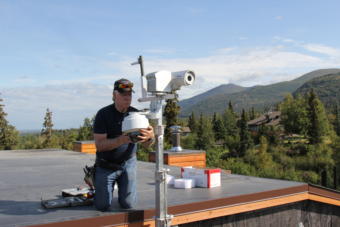
John Parker installs a new wildfire monitoring system on the roof of an Anchorage home. The Anchorage Fire Department hopes it will help them spot wildfires faster. (Photo by Elizabeth Harball/Alaska’s Energy Desk)

In mid-August, Anchorage forester John See stood on the roof of a home in the city’s Stuckagain Heights neighborhood.

“We’re going day by day now,” See said, looking out over the Anchorage Bowl. “When we hit these lower humidity, higher temperature days like we’re expecting today and through the weekend, those are kind of the worst case scenario.”

See’s words were prescient. That weekend, major wildfires ignited north and south of Anchorage, consuming tens of thousands of acres and, in the case of the McKinley Fire, over 50 homes.

Trying to prevent another, similar disaster is why See was on the roof of the Stuckagain Heights home. He was overseeing the installation of a specialized monitoring device, meant to help the Anchorage Fire Department respond to fires faster.

The device is called a thermography camera, and it resembles a security camera. It and the accompanying system are designed to locate and analyze the telltale signs of a wildfire, said John Parker, president of Integrated Robotics Imaging Systems: “Persistent heat sources, heat sources that grow over time, moving heat sources and heat sources that have the common elements of a fire.”

During the testing phase, the camera will sweep forested areas from Tudor Road to the north and Service High School to the south.

When the camera detects something suspicious, it will send a signal to the Anchorage Fire Department. First, the potential fire spot will show up on a screen in the dispatch center, indicated by a green square.

“Once it determines that it actually is a fire, that square turns bright red and starts strobing,” Parker explained.

Then, an alarm will sound and responders will be given a GPS location for the fire. A different camera will zoom in and and show visual image of what’s happening on the ground.

The whole setup is not exactly cheap — the thermography camera alone is worth $12,000. But this is a pilot project, Parker said, so he is installing the system at no cost to the city. According to Parker, The Eyak Corporation, the village corporation for Cordova, is helping fund the pilot project in hopes that it could ultimately be used for wildfire detection in rural Alaska.

The thermography camera in Stuckagain Heights is one of two now installed in the city; the other is at the Anchorage Fire Department. The system isn’t operational yet, but the department hopes to finish setting it up and begin testing this fall.

See with the Anchorage Fire Department said if it works, one of the main benefits is its ability to show exactly where the fire is. That’s because sometimes people who call in to report smoke rising from the forest have a hard time explaining its location, making it take longer for firefighters to get there.

“The kind of description the dispatchers get is, ‘well, it’s somewhere east of Elmore Road, and it’s south of Tudor .. I’m not sure exactly where it’s at,’” See said.

The cameras, he added, are “definitely going to save critical time”

See also said they could help the fire department figure out how aggressively they need to go after a fire. If they show an incident that is less of a risk, it could save resources. On the other hand, if the fire looks like the real deal, “it’ll allow us to immediately contact Division of Forestry and get the assistance we need…the air tankers, helicopters with bucket drops and the crews ordered up to come help us,” See said.

According to See, small fires in Anchorage are relatively common — so far, no major wildfire disasters, but there have been some near misses. The hope is that these cameras help the city avoid a bad incident in the future.

Chris Northcut owns the house where the camera is being installed. Northcut used to work in fire response and happens to live in a perfect spot for the camera, so he volunteered his roof for the project.

“The Anchorage hillside is a tinderbox. And the hotter the temperatures get and the longer that we get and the drier it gets, the worse it could get,” Northcut said.

Will the new system provide a bit more peace of mind to someone living in the middle of that ‘tinderbox?’

“Lots of peace of mind,” Northcut said.

Internal email casts uncertainty on future of BP Alaska employees

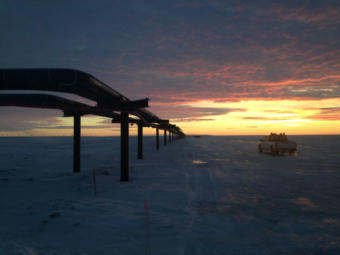
BP employees will continue operating Prudhoe Bay for the next 6-12 months, but their jobs may not be guaranteed beyond that time. (Photo by Elizabeth Harball/Alaska’s Energy Desk)

A leaked internal email brings uncertainty to how many of BP Alaska’s employees will retain their jobs, following the $5.6 billion dollar deal to sell all the company’s assets in the state to Hilcorp.

In the email, sent after the deal was made public, BP Alaska President Janet Weiss told employees they have three options.

Click to view email.
An email from BP Alaska President Janet Weiss to BP Alaska employees. (Click to view)

First, they can apply for jobs with BP outside Alaska.

Second, they can request to leave BP with a severance package.

The third option for BP Alaska employees is to apply for a job with Hilcorp.

“We have designed the sale to give our employees as many options as possible,” Weiss said in the email.

She added, “it is an understatement to say this is a hard day for all of us.”

The email was obtained by Alaska Public Media and first made public by the Alaska Landmine, a political blog.

BP Alaska spokesperson Megan Baldino confirmed the email’s legitimacy on Wednesday evening.

BP does employ union workers on the North Slope, and it is unclear if they have additional options.

The email states BP employees will continue to operate Prudhoe Bay for the next 6-12 months, before the sale gets final state and federal approvals.

BP’s Alaska exit no surprise, say experts and industry insiders

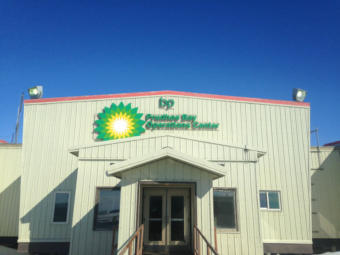
BP’s operations center at Prudhoe Bay. (Photo by Elizabeth Harball/Alaska’s Energy Desk)

Oil industry insiders traded rumors about BP’s exit from Alaska long before it was officially announced on Tuesday.

But that’s not the only reason experts aren’t surprised about the company’s $5.6 billion deal with Hilcorp to sell off its interest in the Prudhoe Bay oil field, the trans-Alaska pipeline and the rest of its Alaska assets.

“When you’re BP and you’re a massive company and you’ve got assets all over the world, it’s hard for Alaska to compete with allocations in investments,” said Rowena Gunn, a research analyst for Alaska with Wood Mackenzie. “With BP being so large, often the majors aren’t quite so good with the mature, late-life fields because they’ve got such large overheads.”

At this point, Alaska represents just around 2% of the company’s global portfolio, Gunn said. In other words, while BP is big for Alaska, Alaska is no longer big for BP.

The company had largely stopped looking for new oil in Alaska, and in recent years, it sold its interests in other major North Slope assets to Hilcorp and ConocoPhillips. During that time, BP focused its efforts on stemming the decline of oil production at Prudhoe Bay.

In a statement accompanying the announcement, BP’s chief executive Bob Dudley said, “Alaska has been instrumental in BP’s growth and success for well over half a century.”

“However,” Dudley added, “we are steadily reshaping BP and today we have other opportunities, both in the U.S. and around the world, that are more closely aligned with our long-term strategy and more competitive for our investment.”

BP’s departure is part of a larger pattern in the oil industry, experts said.

“There is a natural order of progress in terms of operators in Alaska and elsewhere as the majors tend to do big, complicated megaprojects … and then they tend to transition to smaller operators, particularly private or private equity-backed operators as you enter late-life and efficiency is very important,” said Cody Rice, research director with Wood Mackenzie.

Hilcorp is known for buying older oil and gas fields and reviving production by streamlining operations. That’s exactly what the company has done in Cook Inlet since it arrived in the state in 2012 — it is now by far the biggest oil and gas operator there.

“We are in a transition in Alaska from maybe what we call the legacy companies into a situation where we have a couple of legacy companies — they would be Conoco and Exxon — with a handful of these newer types of companies that have come in to pick up where other companies are leaving,” said Andy Mack, Alaska Department of Natural Resources commissioner under former Gov. Bill Walker. He added: “This is what we see today.”

Hilcorp founder and executive chairman Jeffery Hildebrand has “proven that he can develop and wring out of oil fields lots of production that previously was not available,” Mack said.

Industry insiders in Alaska said they long suspected the news was coming.

“People have known for a while there was going to be some kind of a change with regards to operation of the Prudhoe Bay unit,” said Rebecca Logan, chief executive of the Support Industry Alliance, an oil and mining trade group.

Since oil prices dropped in 2015, Logan said she has been paying attention to myriad oil company mergers and acquisitions on both a national and international level.

“I think people have to recognize this is the trend in the industry,” Logan said.

Logan said it’s likely jobs will be lost as BP transfers its assets to Hilcorp. But she added that the overall industry in Alaska got used to changes long ago.

“We are coming off a horrible three years for our industry. Our members laid off close to 6,000 people, and nobody ever thought we would gain all of those jobs back,” Logan said. “And so people are pretty fluid right now and pretty efficient — they had to be. And so I think they are prepared to continue working in that environment.”

Representatives from both BP and Hilcorp did not have firm answers Tuesday on the fate of the more than 1,600 employees who work for BP Alaska.

In an emailed statement, Hilcorp spokesperson Justin Furnace said Hilcorp’s plans for BP’s North Slope workforce “will develop as we determine how we will integrate the acquisition into Hilcorp’s existing operations and we receive a list of eligible employees from BP so we can begin the interview process.”

“We will be working to evaluate new opportunities at Prudhoe, but this process will take many months,” Furnace said.

BP moves to exit Alaska, relinquishing role as operator of Prudhoe Bay

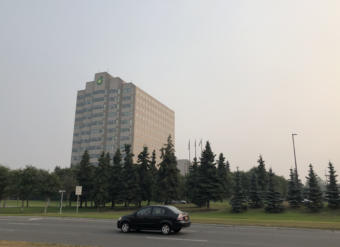
BP’s headquarters in midtown Anchorage on Aug. 19, 2019. BP sold the building in 2016. (Photo by Elizabeth Harball/Alaska’s Energy Desk)

One of Alaska’s “Big Three” oil companies is stepping entirely away from its major role in the state, leaving its position as the company that oversees Prudhoe Bay and its partial ownership of the trans-Alaska pipeline.

BP announced Tuesday it is has reached an agreement to sell its entire business in Alaska to the private, Texas-based Hilcorp Energy Company for $5.6 billion.

BP Alaska currently employs over 1,600 people, according to a 2018 company report, and it pays hundreds of millions of dollars in taxes and royalties to the state each year.

In a statement, Bob Dudley, BP group’s chief executive, said, “We are extraordinarily proud of the world-class business we have built, working alongside our partners and the State of Alaska, and the significant contributions it has made to Alaska’s economy and America’s energy security.”

But Dudley added, ”We are steadily reshaping BP and today we have other opportunities, both in the U.S. and around the world, that are more closely aligned with our long-term strategy and more competitive for our investment.”

The sale is still pending state and federal regulatory approvals.

BP’s exit from Alaska has been rumored for years, but the gossip intensified in the weeks leading up to the announcement, appearing on internet message boards and the trade publication Petroleum News.

Larry Persily, a longtime observer of Alaska’s oil industry, said the move is not surprising for an international company like BP.

“My guess would be it’s just a matter of looking at their portfolio and saying, ‘We have a finite amount of money and a finite amount of management attention. Where is it going to be most profitable to devote that money and attention for the next 20-to-30 years?” Persily said.

The company had largely stopped exploring for more oil in Alaska, instead focusing its efforts on stemming the decline of oil production at Prudhoe Bay. It did conduct a massive 3D seismic survey of Prudhoe Bay this winter, seeking more “pockets of oil” to help keep the field producing longer.

In 2014, BP turned four other North Slope oilfields over to Hilcorp to operate, selling off the Endicott, Northstar and much of its interest in Milne Point, as well as the not-yet-developed Liberty Project.

Hilcorp is both the largest private oil company in the state and among the biggest private oil companies in the world. The company has been operating in Alaska since 2012.

In a statement, Jason Rebrook, president of Hilcorp, said, “Hilcorp has a proven track record of bringing new life into mature basins, including Alaska’s Cook Inlet and the North Slope, and we have a clear understanding that an experienced local workforce is critical to success.”

This story has been updated.

ConocoPhillips’ next big oil project in Alaska takes another step forward

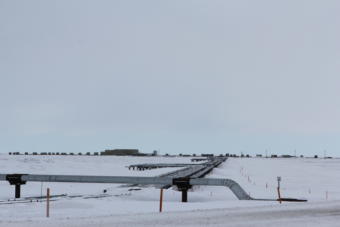
Pipelines stretch toward the horizon in the National Petroleum Reserve-Alaska. (Photo by Elizabeth Harball/Alaska’s Energy Desk)

The federal government today made another move toward advancing a major new North Slope oil project.

The Bureau of Land Management released a draft of its environmental analysis for ConocoPhillips’ Willow project.

The Willow oil development would be located in the federally-managed National Petroleum Reserve-Alaska, west of Prudhoe Bay and the village of Nuiqsut.

It would be a significant addition to the region, where ConocoPhillips already has built a series of other oil developments. The company hopes to construct a new oil processing facility, up to five drill sites, about 40 miles of permanent roads, a gravel mine and hundreds of miles of pipelines and seasonal ice roads.

ConocoPhillips estimates Willow could produce up to 130,000 barrels of oil per day. That would be a notable boost — this year’s average daily throughput down the trans-Alaska pipeline has been just over 500,000 barrels per day.

Natalie Lowman, a spokesperson for ConocoPhillips in Alaska, said the company is “encouraged” by the release of the draft analysis, calling it “a key milestone in the environmental permitting process for the project. ”

BLM anticipates the project would support hundreds of jobs — an estimated 350 direct positions once completed, and well over 1,000 during peak construction — and provide billions in tax dollars to the state, the federal government and the North Slope Borough.

But the draft analysis also concludes Willow “may significantly restrict” use of the land for the village of Nuiqsut, which relies heavily on subsistence hunting and is close to a number of other existing and planned oil developments.

“Nuiqsut’s core subsistence use area has shifted west over time due to the development in Prudhoe Bay,” the BLM’s draft analysis states. “The BLM expects that limitations to subsistence access and the reduced resource availability attributable to development of the Project would result in an extensive interference with Nuiqsut hunter access.”

Additionally, conservation groups are worried about environmental impacts. The Teshekpuk Lake Special Area is northwest of the proposed oil development and is prized habitat for migratory birds and other species. The Trump administration is currently considering opening more land in the area to oil development.

“BLM will be allowing development that is likely to pose a serious threat to critical and irreplaceable habitat,” Karlin Itchoak, Alaska state director for The Wilderness Society in Anchorage, said in a statement.

Itchoak also criticized the length of the public comment period, which ends Oct. 15.

“That is not enough time,” Itchoak said.

Site notifications
Update notification options
Subscribe to notifications