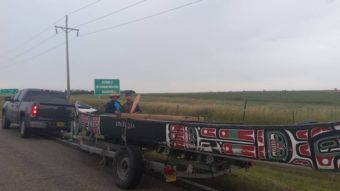
Alaskans arrive on the Standing Rock Indian Reservation to join the protest (Photo courtesy One People Canoe Society).
Members of the One People Canoe Society from Juneau paddled in unison today down the Missouri River in North Dakota. The trip is a show of solidarity with the Standing Rock Sioux who are protesting the Dakota Access Pipeline Project.
If built, the pipeline would carry oil from North Dakota to Illinois. Developer Energy Transfer Partners claims the pipeline is the safest way to carry the oil. But the Standing Rock Sioux are worried the pipeline could contaminate their water.
Catherine Edwards, who is from Juneau but now lives in Washington, is a member of the Tlingit and Haida Central Council. She was standing on a windy hill waiting for her daughter, Miciana Hutcherson, who was helping paddle the canoe. Alaskan and One People Canoe Society member Jim Zeller owns the canoe.
Before they started down the river, Edwards said the group held a ceremony with water from the Pacific Northwest.
“They brought the water down with them… poured it into the river, and said, ‘we now stand with you in your body of water, to keep it protected, to keep it safe,'” said Edwards.
Edwards said there’s a feeling of unity among the protesters.
“You can feel it, you can feel it’s a movement, you can feel it’s a shift, you can feel people coming together and [saying] ‘hi, where are you from, these are our issues, our issues are similar to yours,'” Edwards said. “We all want to stand up here and say, ‘we’re done, we’re done with this. You can’t just walk over us anymore.'”
Several national news outlets have reported some violent clashes between demonstrators and private security guards; the North Dakota governor called in the National Guard on Thursday. But Edwards said organizers are emphasizing non-violent protests.
On Friday, a federal court is expected to rule on whether pipeline construction goes forward.
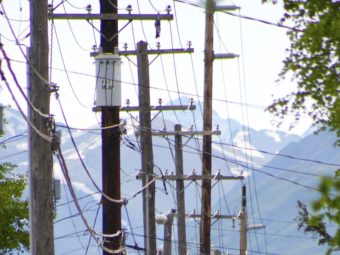
Power poles in Anchorage. (Photo by Antti T. Nissinen via Flickr)
When Chris Rose makes tea in his downtown Anchorage apartment, he uses an electric stove to boil the water — pretty simple stuff. But Rose, who is the executive director of the Renewable Energy Alaska Project, knows how the electricity got to his stove is anything but simple.
“There is a backstory to this whole miracle that we call electricity that we use all the time in our lives but often just take for granted, because all we really want is the light to go on when we flip the switch,” Rose said.
That backstory is especially messy in Alaska. There are six power companies in the Railbelt — the region stretching from Fairbanks to Homer. That’s a lot of utilities for a relatively small population.
Now, for the first time in years, the state is seriously talking about putting a kind of referee in charge of how electricity moves from point A to point B. That could lower Alaskans’ electric bills. The Railbelt’s power companies are working on making this happen, but they’re also nervous about handing over the keys to just anyone.

And in the past, the companies haven’t worked together very well. Rose says that could mean Alaskans are paying more for electricity than they should.
“The utilities collectively have spent more than $1.5 billion on new, mostly natural gas generation over the last five years in the Railbelt,” said Rose. “Some critics would say we didn’t necessarily need all of that had we had regional planning.”
The Regulatory Commission of Alaska keeps tabs on the state’s electric system. Chairman Bob Pickett explained the Railbelt’s grid was set up decades ago, when Alaska’s population was smaller and more spread out. Back then, it made sense for each town to have their own power company.
“When you look at it historically, it’s not really surprising that it happened that way,” said Pickett. “If you were starting from scratch today, you would probably have a different structure.”
In a June 2015 letter, the Commission told Alaska lawmakers the Railbelt power grid needs reform — and maybe a kind of supervisor. That person, or really, a group of people, would look at the whole grid and make sure electricity moves around the region efficiently. Paul Hines, associate professor of electrical engineering at the University of Vermont, says some version of this is pretty common in the rest of the United States.
“Some coordination is definitely a good idea because electricity is one of those things where you’ve got to balance everything within the system at every second of every day,” Hines said. “So that balancing activity for the system as a whole is very important.”
Regional planning has taken on new urgency because Alaska needs new transmission lines, which will cost hundreds of millions of dollars at a time when the state doesn’t have much extra cash to pay for it. So much of the cost could be borne by Alaskans on their electricity bills.
For now, the state is letting the utilities try to work things out themselves. And at least two of them, Chugach Electric Association Inc. and Anchorage Municipal Light & Power, told the Regulatory Commission of Alaska last week they could team up within months, and then expand the partnership to other utilities soon after.
“A year, I think, is really optimistic, it might take us two years, but I really do think that we can pull this together in pretty short order,” said Chugach Electric CEO Lee Thibert.
But some the Railbelt’s power companies aren’t thrilled about a new group of people looking over their shoulders, a group that could include renewable energy advocates like Rose. Rose thinks that a grid overseer could help independent renewable energy producers get electricity on the grid for less money than they do today.
However, Fairbanks-based Golden Valley Electric President Cory Borgeson said he isn’t comfortable rushing into a new way of doing things.
“I called it a legacy project,” said Borgeson. “You make a mistake, we are going to be living with it for a very long time and there could be very big dollars at stake.”
One thing that might take some time is that the companies need to hammer out how each gets paid for the electricity sent in to another company’s territory. If all six companies can’t settle this issue themselves, the state might have to step in.
Crews and visiting journalist check out the first turbine to go up at the CIRI Fire Island wind farm. (Photo by Daysha Eaton, KSKA – Anchorage.)
After years of talks and setbacks, there’s momentum to expand the Fire Island Wind project. The first turbines started spinning on the island near Anchorage four years ago, but a planned expansion has been stalled ever since.
Cook Inlet Region, Incorporated, or CIRI, wants to double the number of wind turbines on Fire Island from 11 to 22. But convincing power companies to pay for its electricity has been hard.
CIRI this week announced it’s nearing a deal with Golden Valley Electric in Fairbanks.
Golden Valley Electric President and CEO Cory Borgeson thinks they can get the power for as low as $56 per megawatt hour — about 40 percent lower than the utility’s average cost of power now.
“It’s not cheap, but we think the benefits of the wind and the reasonable cost that CIRI is providing us [means] it makes economic sense to take a real good hard look at this,” said Borgeson.
Ethan Schutt of CIRI said the talks may be good sign for independent renewable energy producers in Alaska, but he added they’re still fighting an uphill battle. For example, Alaska doesn’t have state-mandated renewable energy targets that power companies have to meet.
“Basically all we have to offer to attract the utilities is the stability of the price and the ultimate price of the delivered power. There’s no other leverage in our system here,” said Schutt.
There’s also the matter of sending power all the way to Fairbanks. Because it moves through other power companies’ territory, it costs more. That’s another sticky issue they’re trying to resolve.
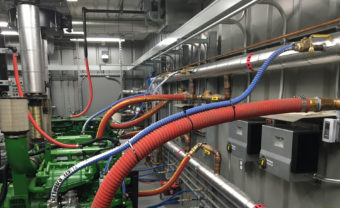
Wires, tubes, John Deere engines and other equipment fill the inside of Perryville’s new powerhouse. (Photo by Annie Feidt, Alaska’s Energy Desk – Anchorage)
The Native Village of Perryville on the Alaska Peninsula has a new power generator. It will help the village use more renewable power and save on costs. Contractors have almost finished putting it together –- but at the moment, it’s almost 500 miles away from its destination.
Today the powerhouse can be found in an unassuming back lot in Anchorage, in a metal container about half as big as a mobile home. The inside is filled with machinery, wires and colorful tubing, including three green diesel engines.
Alan Fetters, who works for the Alaska Energy Authority, sounded a little like an auto mechanic as he showed off the powerhouse’s shiny new John Deere generators.
“It would be like having an old carbureted car you might have had…like a VW Volkswagen Beetle versus a new fuel-injected [engine],” Fetters said. “You get more power, you get more efficiency, it’s cleaner emissions.”
Perryville’s new power system will also be better at using the electricity generated by the village’s wind farm. The powerhouse also will capture heat from the engines for the village school. It will get electricity to more than 100 people when it’s up and running in October.
A mix of federal and state money paid for the $3.3 million project. Sean Skaling, also of the Alaska Energy Authority, argued that’s a reasonable price tag for reliable power in a rural village.
“The size and the cost of this matches the community need. I think the fundamental point here is you need reliable power — everybody needs it and relies on it and it’s just got to be there all the time, without failure,” said Skaling.
Perryville Village Council leader Gerald Kosbruk says the old powerhouse, a wooden building with a rotting foundation, has generators that need to go.
“One just went out last winter and it’s hard to find parts for them and the one that went out actually couldn’t be rebuilt anymore,” said Kosbruk.
Through what’s called the Rural Power Systems Upgrade program, the Alaska Energy Authority has already fixed up dozens of powerhouses across the state. Dozens more communities like Lime Village, Whale Pass and Kivalina, are on the waiting list.
In a few weeks, Perryville’s powerhouse — which weighs more than ten trucks — will be loaded onto a barge and shipped off to its new home.
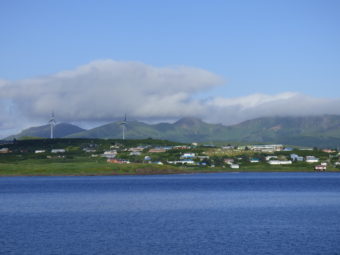
Two wind turbines tower over the city of Sand Point. (Photo by Zoë Sobel/KUCB)
Since 2008, the state has set aside a pot of money for renewable energy projects like small dams and wind turbines. Called the Renewable Energy Fund, the projects it’s backed have replaced tens of millions of gallons of expensive diesel in communities from Skagway to Nome.
But with the current budget crisis, that money has disappeared.
For example, utility TDX Power last year asked the Alaska Energy Authority for about $650,000. The utility needs the money to help improve a wind power system in Sand Point, a community of about 950 on the Alaska Peninsula.
Sand Point City Administrator Andy Varner said an improved wind system would lead to cheaper power.
“Energy is a big issue, it’s a big chunk out of people’s paychecks, it’s a big drain on, in our situation, on the community budget,” said Varner.
If Sand Point’s two wind turbines were more efficient, the town would use less pricey diesel. That means more money for other things, Varner explained.
“You know, fixing up our fire truck, making our roads safer — all the stuff that we need to be doing,” said Varner.
The Alaska Energy Authority also thought improving Sand Point’s wind power system was a good idea. They added it to a list of projects slated to receive funding from the state’s Renewable Energy Fund.
But due to the budget crisis, the legislature didn’t provide money to any Renewable Energy Fund projects this year.
And the state won’t accept applications for new projects this year, either. Sean Skaling of the Alaska Energy Authority said instead, they’re giving the legislature the same list of 39 projects they turned in last year.
“We feel it’s the fairest way to move forward given the financial times in the state and giving those 39 projects another opportunity to get funding, possibly,” said Skaling.
Sand Point’s wind power system is near the top of that list. But Skaling said it’s hard to predict if the projects will get funding the next time around.
Close
Update notification options
Subscribe to notifications
Subscribe
Get notifications about news related to the topics you care about. You can unsubscribe anytime.