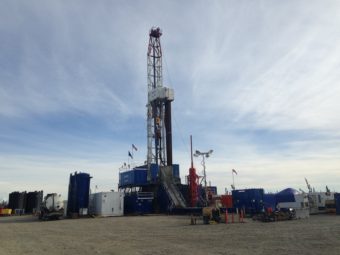
Exploration well Tolsona No. 1 is located about 11 miles west of Glennallen, Alaska. (Photo by Elizabeth Harball/Alaska’s Energy Desk)
Alaska Native Regional Corporation Ahtna, Inc. is searching for natural gas to reduce local energy costs and provide jobs. Last week, Ahtna, Inc. subsidiary Tolsona Oil & Gas Exploration LLC started drilling an exploration well on state land near Glennallen.
Daniel Lee, oil and gas development manager for Ahtna, gave a tour of the new well on Monday.
“What we’re looking at currently is a great big blue piece of iron, which is a drilling rig,” said Lee. “This is a true exploration, this is a brand new hole that we are drilling in the ground.”
The drill is slowly descending thousands of feet beneath the gravel pad. Ahtna is hoping it will find enough recoverable natural gas to power their eight villages, including Gulkana and Chitina. Ahtna, Inc. president Michelle Anderson explained high fuel costs are a big burden for Interior Alaska.
“To fill your fuel tank up here in the wintertime, for many people, it’s as much as a mortgage payment in Anchorage,” said Anderson.
The Alaska Department of Commerce reports heating fuel prices in Interior Alaska are among the highest in the state. Ahtna hopes natural gas will be a cheaper replacement. They also hope a find will mean more jobs.
Ahtna shareholder and former board member Roy S. Ewan said, “There’s just no work out here. There’s no economic development.”
Ewan said many of Ahtna’s young people move to Anchorage or Fairbanks to find work. Ahtna hopes a natural gas find will change that.
Alaska Native regional corporations driving energy development is a trend worth watching according to Tim Bradner, editor of the Alaska Economic Report. Bradner said in the past, private companies took the lead while Native corporations were either passive partners or bought in later.
“This is kind of a different thing,” said Bradner, “Where the corporations themselves are leading the exploration and putting their own money at risk.”
Fairbanks-based regional Native corporation Doyon, Limited is also exploring for gas in Interior Alaska.
During the tour of Ahtna’s drilling site near Glennallen, Lee said exploration means they might find gas — or they might not.
“Worst case is we get to our targeted depth and there is nothing there, and that’s considered a dry hole,” said Lee. “And with that, you reassess whether you want to move forward with further exploration wells or not.”
Lee said the company chose this spot to drill because it’s promising. However, there’s no guarantee the $11 million project will find what it’s looking for.
Conoco’s new Extended Reach Drilling Rig will allow the company to access more from a single drill site (Image courtesy ConocoPhillips Alaska)
ConocoPhillips Alaska has announced plans for a new drilling rig on the North Slope that will more than double the area it can develop from a single drill site.
The company is calling it a “potential breakthrough” and said the rig will increase production by making development possible in areas that are currently hard to reach.
It will allow Conoco to access an undeveloped field, Fiord West, from existing infrastructure. Fiord West was discovered in 1996.
Conoco spokeswoman Natalie Lowman said the state would not have extended the company’s Fiord West leases without the contract for the new rig.
“In order to retain our leases, such as those around Fiord West, we have to be able to develop them, and the (extended reach drilling) rig allows us to do that,” Lowman said in an email.
Gov. Bill Walker said in a statement, “I applaud ConocoPhillips and Doyon for their work to spur production during fiscally challenging times. This is welcome news, as it fulfills lease terms for Fiord West.”
ConocoPhillips signed a contract with Doyon Drilling, which is under the Fairbanks-based regional Native corporation, to build the new rig.
It will arrive in Alaska in 2020.
Lowman said under the terms of the contract with Doyon, the company can’t release the rig’s total cost.
Lawmakers from the House and Senate Natural Resources Committees listened to testimony on the gas line on Aug. 25, 2016. From left: Sen. Mike Dunleavy, R-Wasilla; Sen. Anna MacKinnon, R-Eagle River; Sen. Cathy Giessel, R-Anchorage; Rep. Dave Talerico, R-Healy; Rep. Benjamin Nageak, D-Barrow; and Rep. Bob Herron, D-Bethel. (Photo by Rachel Waldholz/Alaska’s Energy Desk)
Gov. Bill Walker is making the case that his new gas line plan will get the project off the drawing board and on to Alaskan soil. But it’s not hard to find skeptics who say Walker is just creating more paperwork.
For the final story in our series Pipeline Promises, Elizabeth Harball talked to the Walker’s critics.
As a new energy reporter in Alaska, it didn’t take long for me to notice that even though state leaders are always talking about the gas line, there’s something left unsaid. I mentioned this to Larry Persily, a gas line expert who now advises the Kenai Peninsula Borough.
HARBALL: It seemed to be this unstated truth that a lot of people don’t believe this is going to happen. This may not even materialize …
PERSILY: Right, oh yes. Even a couple years ago when [Alaska LNG] looked like, hey! People were still like, “Oh, it won’t happen.”
HARBALL: Right, and being a new Alaskan …
PERSILY: Do you have a dog yet?
No dog yet. That being said, this new Alaskan had to learn why so many people think the governor’s plan is doomed.
Skeptics like Persily see big forces working against the project. The biggest is the market: This is an expensive project aimed at supplying a product, gas, that today is plentiful and cheap.
“Prices for the commodity are down, the project is one of the most expensive energy projects ever in the history of the world, so that alone would make a lot of people skeptical,” said Persily. “They look at the price tag, look at what you are going to get for the project at the end and they say, ‘That’s not going to happen, turn the TV back on.'”
Lousy market conditions help explain why the big oil companies are stepping back from the effort to build the gas line. And this plays into another big issue skeptics bring up — one that became clear as I walked into Anchorage Republican State Sen. Cathy Giessel’s office. We spoke sitting between stacks of cardboard boxes. Oil-dependent Alaska can’t afford the legislature’s sleek new building, so lawmakers are moving.
The governor argues Alaska’s dire fiscal situation is one reason to charge ahead. Giessel said it’s a reason to be cautious.
As much as she’s like to see the project built, she said, “We have a significant budget challenge right now and I think that we can overplay our hand and find ourselves in an even worse fiscal predicament if we act rashly.”
Giessel said she’s not sure the state has the capacity to manage the project and she’s not sure how much it’s going to cost to build that capacity. She also said more state control means the state is taking on more responsibility for the project’s risks, as well.
This idea of risk brings us to the other reasons people are skeptical, which have to do with Walker’s plan in particular. That plan, in brief, is for the state to bring in money from outside investors rather than relying on the oil companies to pay for most of the gas line. State leadership may also mean some part of the project may not have to pay federal taxes. In late August, energy analyst David Barrowman of Wood Mackenzie told lawmakers that in theory, elements of Walker’s proposal could be a promising way to bring the project’s total cost down.
“Currently Alaska LNG, in terms of global competitiveness, is quite challenged,” Barrowman said. “But there are levers that can be used.”
Those levers, he said, are exactly the ones Walker is trying to pull to reduce the project’s price tag — attracting third party investors and avoiding some federal taxes. But the next day, the legislature’s energy consultant, Nikos Tsafos, took his turn before lawmakers and tore into Walker’s plan.
“You usually want to take over economic projects, not uneconomic projects,” Tsafos said.
One of Tsafos’ critiques is the idea of outside investors. The oil companies — BP, ExxonMobil and ConocoPhillips — worry their investments in a gas line wouldn’t pay a high enough return to be worthwhile. The governor argues that instead, the state can find outside investors, like pension funds, that would require less of a profit on the project and finance it more cheaply.
In an interview, Tsafos said he’s not sure investors like this actually exist.
“I mean borrowing money — everyone borrows money,” Tsafos said. “The idea that somehow the state of Alaska has discovered that by borrowing money the project could be made cheaper, that doesn’t make any sense, right?”
Tsafos said he’s looked at other projects around the world and can’t find many examples of the kind of investors the governor has in mind backing LNG projects, much less at this massive scale and this early in the game. And Tsafos doubts they’ll accept less profit in return for their investment than the oil companies.
Walker also wants to make the pipeline cheaper by getting out from under some federal taxes. A lot of the state of Alaska’s projects don’t pay federal taxes because they benefit the public. The governor argues if Alaska leads the way, it can make a case that part of the project won’t owe the IRS a check.
But Walker’s skeptics argue that because this project will involve private interests — potentially some of the wealthiest companies in the world — the IRS may not approve of this idea.
“This is not a school or a highway for general public use,” said Persily. “This is really a private undertaking where 95 percent of the gas is going to go not just outside of Alaska, but overseas.”
After hearing all this skepticism, I started to wonder, what’s the downside? What if the project doesn’t work? Will the state lose billions of dollars? Will I have to pack up my bags and move back to Washington, D.C.?
Everyone told me, calm down. Walker is taking one step in what’s going to be a very long journey. Will it cost money? Sure, and that’s important to pay attention to at a time when every dollar for the gas line is one that doesn’t go to other state services.
But Persily said it’s nothing compared to what the state has spent on this project in the past.
“Looking at the hundreds of millions the state has spent in the last 10 years, the billion the companies have spent in the last 10 years on this — if that’s what it takes to put this to rest … if that’s the political price of all this, maybe that’s the way we’ve got to go,” he said.
Persily gives Walker’s plan a 10, maybe 20 percent chance of working. But he’s not losing any sleep over it.
Meanwhile, Walker will spend the next year making a case to the public, lawmakers and the market in hopes of proving his skeptics wrong.
Pipeline Promises: Alaska's quest for a natural gas line
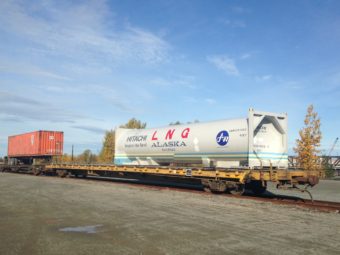
A cryogenic tank container used to carry liquefied natural gas by rail (photo by Elizabeth Harball).
Standing next to a massive cylindrical rail car at the Anchorage Railroad Yard, Alaska Railroad Mechanical Supervisor Josh Cappel asked a fireman to test out the car’s hand-operated braking system.
“Go ahead and fire that thing up tight. Come on, a little tighter than that — there you go!” Cappel joked, drawing laughs from the crowd of about 16 other members of the Anchorage Fire Department.
Starting tomorrow, the Alaska Railroad will be the first in the nation to carry liquefied natural gas by rail. With the Federal Rail Administration’s blessing, LNG will travel the tracks from Anchorage to Fairbanks.
As with any new venture, safety is always a topic of discussion. Cappel said he’s training the Anchorage Fire Department in case the worst happens.
“It’s very important for everyone to understand how rail cars work, especially the fire department,” said Cappel. “If they are responding to any kind of disaster they need to know how these cars work so they don’t get hurt and the people they are rescuing don’t get hurt.”
Over the next four weeks, the Alaska Railroad will complete eight round-trip test runs of liquefied natural gas shipments from Anchorage to Fairbanks. It’s a big first, for Alaska and the U.S. — LNG has never been shipped by rail before. Fairbanks Natural Gas hopes this will be a cheaper, safer way to move the fuel.
Recent oil train explosions in the lower 48 have some people worried about moving train cars filled with fossil fuels through communities. Lois Epstein, an engineer who works for The Wilderness Society, says shipping LNG by rail is generally safer than carrying it in a truck, which is how the LNG is being shipped to Fairbanks now.
“Where I would be concerned, however, is places where the railroad crosses the road because that’s where there are some very real safety issues,” said Epstein.
Collisions with cars crossing the tracks is a concern, but Captain Jared Stiglich with the Anchorage Fire Department says big, fiery explosions aren’t something to worry about with LNG train cars. It’s the extreme cold that’s the problem.
“The biggest concern with LNG is that it’s transported at minus 260 degrees Fahrenheit, so it would freeze-burn anything or anyone.” said Stiglich.
The Alaska Railroad reports most of the LNG’s journey won’t be too close to communities and roadways. But just in case, they’re making sure emergency responders up and down the Railbelt are prepared to handle a new kind of cargo on the tracks.
“For a goodly portion of what we do, we’re off the roadway and out of communities, so folks aren’t going to see us as much while we’re going through,” said Tim Sullivan, External Affairs Manager for the Alaska Railroad. “But it does behoove us to make sure that first responders in the area, even if it’s remote, know what it is we’ve got going on.”
Mark Wiggin will be the new deputy commissioner at the Department of Natural Resources (Photo courtesy DNR).
The Alaska Department of Natural Resources announced it has hired a new deputy commissioner in charge of oil and gas.
Mark Wiggin left Brooks Range Petroleum to take the post, where he worked as an engineering and development manager.
The deputy commissioner role has been vacant since March, when Marty Rutherford temporarily stepped in to the lead role at the Department of Natural Resources before she became a trustee of the Permanent Fund Corporation Board.
Wiggin will work under Commissioner Andy Mack, who took the reins of the Department in July. (Wiggin is currently vice chair of Alaska Public Media’s board of directors.)
In a press release announcing the hire, Mack touted Wiggin’s three decades of experience in Alaska’s oil fields, including big developments like Lisburne, Alpine and Mustang. Before working at Brooks Range Petroleum, Wiggin was at ASRC Energy Services focusing on the Alaska Gas Pipeline Project and the Nikaitchuq oil field.
“His knowledge of upstream oil and gas issues, his experience in project development, and his work on resource economics and policy will add valuable expertise to DNR,” said Mack.
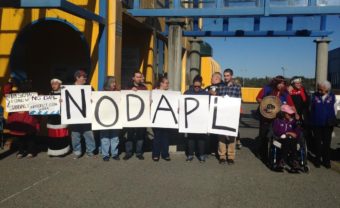
Demonstrators in downtown Anchorage protest the Dakota Access pipeline. (Photo by Elizabeth Harball/Alaska Public Media)
About 60 demonstrators gathered in downtown Anchorage Saturday afternoon to sing, dance and carry signs. Many Alaska Native people were there to support North Dakota’s Standing Rock Sioux tribe in their fight against the Dakota Access oil pipeline.
The Standing Rock Sioux tribe is afraid the pipeline could contaminate their water; the developer claims the pipeline is the safest way to carry the oil. The tribe’s protests have gained national attention.
Late last week, the Obama administration paused the development of the pipeline following the tribe’s protests.
The demonstrators in Anchorage said the pipeline developer isn’t listening to the Standing Rock Sioux’s voices. But because oil is such a big part of Alaska’s economy, some demonstrators also said protesting the North Dakota pipeline wasn’t as simple as being for or against oil.
Kelli Reed organized the demonstration.
“This demonstration is not opposed to oil,” said Reed. “Oil production on the North Slope has been very beneficial for Native Alaskans who live up there. However, what we are objecting to is a silencing of the voice of a people called the Lakota Sioux.”
Gregory Nothstine, a member of the Native Village of Wales, said he supports the Standing Rock Sioux because he feels Native rights are often ignored. But he’s okay with oil development if it’s done responsibly.
“Being for or against the oil pipelines here in Alaska? They’ve been providing revenues for our state for years,” Nothstine said.
Ada Coyle and her daughter Ashley Doctolero were at the demonstration; Doctolero was wearing the traditional regalia of the Kodiak Island’s Sugpiaq people. Coyle said protecting water should be the number one priority.
“You can’t drink or eat money, but the water is there,” said Coyle. “We need it to drink, we need it to cook with, shower with, to cleanse us, you know?”
Close
Update notification options
Subscribe to notifications
Subscribe
Get notifications about news related to the topics you care about. You can unsubscribe anytime.