Elizabeth Harball, Alaska's Energy Desk

Alaska’s leaders don’t want a fight over oil taxes this year, but they might get one anyway

Tax Director Ken Alper
Tax Director Ken Alper with the Department of Revenue speaking on oil tax credits to state lawmakers this February. Alper would like to spend less time talking about oil taxes this legislative session. (Photo by Skip Gray/360 North)

Alaska’s leaders are getting ready for tough negotiations over how the state will deal with its multibillion-dollar budget hole. How much the oil and gas industry should help fill that hole will be an especially controversial question for the legislature this session.

But during a speech to industry leaders, Gov. Bill Walker’s top tax man said he wants lawmakers to focus on the big picture, instead.

Ken Alper, director of the Alaska Department of Revenue’s Tax Division, has a dream:

“We don’t want the 2017 legislative session to be dominated by fights over oil taxes. We just don’t,” Alper said in a Thursday speech at a breakfast hosted by the Resource Development Council, which advocates for the industry.

That dream may not come true. Last session, Gov. Bill Walker and the legislature went back and forth over oil taxes well into the summer months. But Alper said the state should instead focus on bigger changes to fix its budget shortfall.

This means two things: an income tax or a sales tax, and a change in how Alaska uses earnings from the Permanent Fund. These are things Gov. Walker proposed last year. But the legislature didn’t pass the comprehensive plan the governor had in mind. So Walker infuriated the oil and gas industry by vetoing about $430 million in tax credits promised to the companies.

Alper says the governor wants to pay those credits back — but it depends on how the legislature moves forward this year.

“I expect that this year there will be a pretty similar dynamic, where the governor’s comfort level for paying off these obligations is going to increase dramatically the closer we get to a fiscal solution,” Alper said.

Even though he wants to avoid a fight, Alper said changes to oil taxes are probably going to be part of the solution.

All these changes will be tough, but Alper said they have to happen this year — or the state will be in danger of draining its savings account.

“If no solution is passed this coming session, it means that the legislature in 2018 can’t balance the budget — period,” Alper said. “And at that point, it means almost a panic, hair-on-fire budgeting — one year from now.”

Alaska Oil and Gas Association leader Kara Moriarty said she agrees with Alper — she doesn’t want to squabble over oil taxes this year, either. But oil companies are also worried about how the governor plans to deal with the issue.

“He didn’t say anything today that gives us any certainty or any stability,” Moriarty said. “Even though he doesn’t want oil taxes to dominate the legislative session, it’s still going to be part of the package, but it’s still not clear what that is.”

If Walker’s budget proposal is anything like what he released last year, which included raising taxes on oil and gas, then the industry is ready to fight it.

Gov. Walker is slated to release the budget on Dec. 15.

Armstrong Oil and Gas has high hopes for another North Slope find this winter

ArmstrongPikka
Armstrong has high hopes for a development in its Pikka Unit on the North Slope. (Photo courtesy Armstrong Oil and Gas)

As the amount of oil flowing through the Trans-Alaska Pipeline System declines, big new finds on the North Slope are kindling a lot of excitement in Alaska. Speaking at a recent conference in Anchorage, Department of Natural Resources Commissioner Andy Mack called out one find in particular.

“We think that Pikka is going to be critical to bring production not only in balance, but to raise it tremendously,” Mack said.

Mack was referring to the Pikka Unit on the North Slope, the site of a major discovery Armstrong Oil and Gas announced last year. Armstrong and its partner Repsol, a Spanish company, say a development there could produce about 120,000 barrels of oil per day. That’s almost a quarter of the amount currently flowing through the pipeline. Armstrong Energy director Ed Kerr says the company aims to deliver first oil in 2022.
“We are actually moving ahead,” said Kerr. “We’re not contemplating it, we’re not formulating our thoughts on it — we’re prosecuting on it.”

Since Armstrong bought its first lease in Alaska in 2001, the company has made two other discoveries on the North Slope, but it sold those assets to an Italian company, Eni. Kerr says Armstrong plans to hang on to this find, which it calls the Nanushuk project.

“The reason we want to stay in on this is, candidly, it is much bigger than other projects we’ve worked on, and we’ve worked on very large projects in Alaska,” said Kerr.

In January, Kerr says the company hopes to start designing Nanushuk’s central processing facility, which would get oil ready to send down the pipeline. And even though Armstrong’s discovery is already being called a game-changer, the company thinks there’s even more oil to be found in the region. This winter, Armstrong is drilling an exploration well about 20 miles away from their planned development.

“We’re drilling a well that’s completely separate and a different idea that we have high hopes for, as well,” said Kerr. “So we’re actually moving forward on multiple fronts on this, and it’s an exciting time. We’re as excited as we can be on everything that’s going on.”

One thing Armstrong is less excited about this winter is negotiating with lawmakers. Like other small companies, Kerr says Armstrong is worried about how oil production taxes could change as the legislature takes on the state’s budget crisis. That means this winter, Alaskans can expect Armstrong to have a presence both on the North Slope — and in Juneau.

One Alaskan’s quest to transform how we clean up oil spills

Kevin Kennedy works on a piece of one of his oil spill cleanup devices. (Eric Keto/Alaska's Energy Desk)
Kevin Kennedy works on a piece of one of his oil spill cleanup devices. (Eric Keto/Alaska’s Energy Desk)

Cleaning up after a major oil spill is a huge challenge. After the BP Deepwater Horizon disaster, for example, the federal government estimates responders removed only about a quarter of the nearly 5 billion barrels of oil released.

One Alaskan thinks he’s figured out a better way to do it. He doesn’t work in a lab, he doesn’t have any fancy degrees and he’s not backed by the government or a big company. But some experts think he might be on to something.
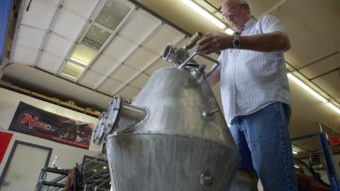
His name is Kevin Kennedy, and he spends a lot of time poking around what he refers to as his “mad scientist den.”

It’s a garage that smells strongly of oil, cluttered with mechanical parts and tools, right behind Kennedy’s house in South Anchorage. Here, Kennedy has poured his soul — and, he says, his retirement — into developing a new kind of oil spill cleanup technology.

Kennedy knows just how damaging an oil spill can be. On Good Friday in 1989, he was getting his shrimp boat ready for a day of work in Prince William Sound.

“I didn’t have any idea how big it was until I got three-and-a-half, four hours out of Whittier and got to Knight Island Pass,” said Kennedy.  “And then you could smell it. And then you could start seeing it. And it just kept coming and coming and coming.”

That was Kennedy’s last day as a shrimper — he helped with the cleanup effort, instead. Since the Exxon Valdez, Kennedy has gone from occasional tinkering to all-consuming work to develop a better way to clean up oil spills.

On his website, Kennedy has posted videos of his inventions at work — there’s one of what he calls the Otter Skimmer chugging away on a spill off Louisiana’s coast. A net extends into the ocean, corralling the oil towards a little red pontoon boat. There, a device separates the oil from the water and pumps it into a storage container.

Kennedy claims it works a lot better than the equipment response teams use to clean up oil spills today.

“Nobody makes anything that works in Alaska until it hits the beach,” said Kennedy.

But for a self-taught, self-funded inventor like Kennedy, trying to break into the market has been a long, hard journey. Over the years, Matt Melton has heard Kennedy’s pitch a lot. Melton is general manager of an oil spill response team based in Anchorage called the Alaska Chadux Corporation.

“In the last 10 years that I’ve been in this business, Kevin’s been there, too,” said Melton. “He’s just always there — it’s quite amazing. He’s a unique man.”

Melton says Kennedy’s an unconventional figure in the oil spill response world — but he also thinks he may be on to something. He says Kennedy’s device is efficient at separating oil from water, which makes it easier to store the waste during a cleanup. Alaska Chadux Corporation can’t endorse his equipment, but on certain uniquely challenging spills, Melton says he thinks Kennedy’s device might come in handy.

“If I had an oil spill tomorrow and I called Kevin and he had one sitting on his shelf, I’d take it in a second,” said Melton.

But oil spill response teams like Melton’s still aren’t rushing to buy Kennedy’s technology. Most already have cleanup equipment on hand that meets all their requirements and they’re used to using that equipment. And some experts disagree with Kennedy’s assertion that the equipment hasn’t improved at all since the Exxon Valdez.

“The bread and butter — the basic equipment — hasn’t changed a whole lot… but there have been certain improvements to some of the equipment,” said Richard Bernhardt, who works on oil spill response with the Alaska Department of Environmental Conservation.

Bernhardt says skimmers have gotten a lot more efficient since Exxon Valdez. Barkley Lloyd agrees — he’s the president and general manager of Alaska Clean Seas, an oil spill response group on the North Slope. But Lloyd says that doesn’t mean there isn’t room for improvement.

“You always want more,” said Lloyd. “It’s always great to have the solution to everything.”

Kennedy says he isn’t promising the solution to everything — but he thinks his spill technology is an important step in the right direction.

“I’d be a fool to sit there and say it’s because I’m going to save the world. When I first started into this, it was because I knew that there was a better way to do it.”

Kennedy is determined to keep pushing forward until response teams actually start using his invention to clean up oil spills. Then, he says he doesn’t want to invent another thing again.

Correction: According to NOAA, burning, skimming and direct recovery from the wellhead of the BP spill removed about a quarter of the oil released during the Deepwater Horizon oil spill. NOAA does not count chemical dispersal as removal, as an earlier version of this story implied. 

Alaska Native corporation acquires oil and gas leases in Arctic waters

17?USGSArctic
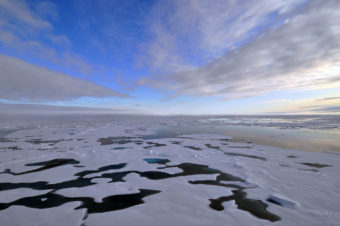
A Native Corporation is now able to explore oil and gas opportunities in the Arctic Ocean. (Photo courtesy of the U.S. Geological Survey)

The Alaska Native corporation representing the North Slope has bought 21 federal leases in the Beaufort sea formerly owned by Shell. That gives the Arctic Slope Regional Corporation, or ASRC, the right to explore for oil and gas in the Arctic Ocean, which has historically been controversial.

Rex Rock Sr. is the president and CEO of ASRC.  He announced Wednesday that the corporation has acquired Shell’s leases in Camden Bay, just off the coast of the Arctic National Wildlife Refuge.

After spending billions on an unsuccessful exploration campaign, Shell halted its efforts to drill in the Arctic in 2015. However, Rock said Shell’s failure to develop on the Outer Continental Shelf doesn’t mean there isn’t opportunity for oil and gas development there.

“We all know how the Chukchi effort ended, yet we know there is still tremendous potential in Alaska’s offshore,” Rock said.

Camden Bay is the site of the Sivulliq and Torpedo prospects. Rock said ASRC also obtained Shell’s data on the sites. He made the announcement at a conference hosted by the Resource Development Council in Anchorage.

The Interior Department is expected to announce soon whether it will include the Arctic in its 5-year plan for offshore oil and gas leasing. Alaska Department of Natural Resources Commissioner Andy Mack said ASRC’s willingness to take on the leases is a sign of local support for offshore drilling — and it should signal to the federal government that the Arctic must be included in the plan.

“For ASRC to take this step out and say we believe that we can do this and we believe this can be done safely and we’re doing this on behalf of our shareholders should speak volumes to the conversations that are going on and the analysis being conducted in Washington, D.C.,” Mack said.

Alaska officials and the oil industry have strongly advocated for Arctic leases to be included in the 5-year plan. Environmental groups oppose their inclusion due to concerns about climate change and impacts to wildlife.

A decision not to offer future lease sales in the new five-year OCS plan would have no effect on current leases.


Correction: An earlier version of this story misstated the number of leases ASRC acquired in the Beaufort Sea. It is 21, not two. 

Dakota Access pipeline protesters march in Anchorage

15daplanch_Harball
Demonstrators march to the Anchorage 5th Avenue Mall to protest the Dakota Access pipeline project. (Elizabeth Harball/Alaska’s Energy Desk)

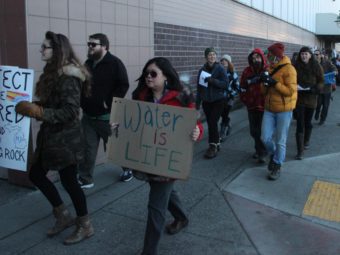
Alaskans joined protesters around the country Tuesday staging demonstrations against the Dakota Access pipeline project, including two in Anchorage.
The Standing Rock Sioux Tribe objects to the project in North Dakota because they worry it will harm their water supply and disturb sacred sites. Their cause has drawn support from Native and environmental groups nationwide.

Monday evening, the U.S. Army Corps of Engineers continued their hold on the Dakota Access pipeline project, saying “additional discussion and analysis are warranted.” But the decision isn’t final, and protests went ahead as planned.

In downtown Anchorage, about 50 demonstrators gathered at Town Square Park and marched to a local branch of Wells Fargo, chanting, “water is life.” The demonstrators protested the bank for financing the project.

Kirby Spangler is with the environmental group Alaska Rising Tide. He helped organize the demonstration. Spangler said he was there for two reasons: to protest fossil fuel development because he’s concerned about climate change and to support indigenous rights, “both of which have huge implications for Alaska’s future,” he said.

Lisa Wade of Chickaloon Village had just returned from North Dakota after visiting the protests there. She said Alaska Native people recognize the Standing Rock Sioux Tribe’s concerns.

“I think that we are facing a lot of the same issues,” Wade said. “We are facing resource extraction here that impacts a lot of indigenous peoples’ lands.”

Protesters marched from Town Square Park to the Wells Fargo branch in the Anchorage 5th Avenue Mall, where Wade closed two bank accounts. Police officers arrived to monitor the scene, but after about half an hour the protesters left the building peacefully and no arrests were made.

In an emailed statement, Wells Fargo’s Alaska spokesman, David Kennedy, said the bank “respects the differing opinions involved in this dispute.” He said the bank is taking a look at issues the situation in North Dakota has raised, but added Wells Fargo doesn’t comment on its relationships with specific customers.

The bank does business only with companies that comply “with all applicable federal, state and local laws and regulations,” Kennedy said.

About 120 to leave gas line team as state takes charge of project

Prudhoe Bay at night on Jan. 28, 2013.
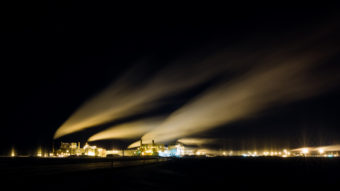
Prudhoe Bay at night on Jan. 28, 2013. Gov. Bill Walker’s team hopes state leadership will mean North Slope gas can someday make it to market. (Creative Commons photo by jweston_40)

At a meeting of the Alaska Gasline Development Corp. board today, corporation Vice President Frank Richards said staff is winding up the project’s first phase, which includes early design and engineering work — called preliminary front-end engineering and design, or pre-FEED. The project is not immediately moving into the next phase, and Richards said they are disbanding the existing project team and approximately 120 people will move on.

“The project management team is demobilizing, so they will be sent back to their parent companies,” Richards said.

Those companies include ExxonMobil, BP and ConocoPhillips, who had been partnering with the state. The companies indicated earlier this year they would not move forward with the gas line as originally planned, and Gov. Bill Walker decided the state would take over the project. The state is marketing the project to potential gas buyers overseas but hasn’t yet determined whether it will be able to move into the next phase.

Richards said the companies did good work to get the project this far. Now the state will bring on contractors to navigate the next step: getting the necessary permits from the Federal Energy Regulatory Commission, or FERC.

“They’ve achieved the work — an excellent quality of work and so now we will take that work and advance it into the FERC process,” said Richards.

Also at the board meeting, corporation president Keith Meyer said negotiations with the North Slope producers over the transition are taking longer than he had hoped. The state aimed to reach an agreement with the companies in October. But Meyer added he felt negotiations are “going well” and that he doesn’t “detect anything that’s going to stop the process.”

Natalie Lowman, a spokeswoman for ConocoPhillips, said in an email the companies aim to complete the handover by the end of the year.

Site notifications
Update notification options
Subscribe to notifications