Elizabeth Harball, Alaska's Energy Desk
“Made for me”: An Alaskan couple looks back at romance and upheaval in the wilderness

Sonja+Rich
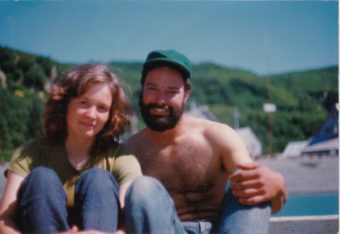
Sonja Woodman-Corazza (left) and Rich Corazza in 1976 on a boat in Cook Inlet, Alaska. (Photo courtesy Sonja Woodman-Corazza)

During the 1970s, a small number of tough-minded young people moved into what is now the Yukon-Charley Rivers National Preserve. They built cabins, trapped, fished, hunted and raised sled-dogs — living a version of the Alaskan dream that would soon become a thing of the past. The third section of John McPhee’s book, “Coming into the Country,” profiles many of these people, living a life only the Alaskan frontier could offer.

One of those profiles is the beginning of a love story. It was first written in a journal in 1975, tacked to the wall of an empty cabin and left in one of the wildest parts of Alaska.

“Monday, November 10th. Minus 12 degrees. Cloudy and may snow. Today is the anniversary of being in Alaska for exactly one year now,” the journal reads.

Rich Corazza’s story might have stayed in the cabin forever, but after some months, John McPhee wandered in and found his journal. McPhee was taken by this tale of survival, addressed in parts to a girl named Sara. The writer included excerpts like this one in his book, “Coming into the Country:”

“Quite a lot has happened and if I had Sara now it would be the end of a near perfect year. Still it was the best decision I ever made, and I’m very glad things worked out. If I was religious, I might say ‘thank you, Lord. Amen.'”

Corazza spent his first winter in the Alaska wilderness in 1975, when he was just 23. He had been working as a logger in the forests of Wyoming and Colorado, but he felt constricted. He drove north to Montana and within days, he decided there were too many people there, too. In the book, McPhee quotes Corazza saying he settled on the Alaska bush because “There ain’t no barbed wire up here.”

Corazza says that sums it up.

“Oh, that was so good,” said Corazza. “A lot of things that he said in one line, yeah, I could waste a lot of words on, but he said it right.”

He added, “there was no barbed wire, none. And I loved it — it was made for me.”

Although Alaska was everything Corazza hoped for, a girl he’d left behind in the lower 48 occupied his thoughts. In his journal, Corazza punctuated his accounts of grouse hunting and chopping wood with heartsick notes like “good night, Sara,” “good morning, Sara,” and “Sarah, where are you?”

It’s been 40 years since these words ended up in the pages of “Coming into the Country.” Even though he gave McPhee permission to publish the journal, Corazza is still a little shy about it.

“I was kind of shocked that he wrote the love story part of it, of all the things he could have written about it,” Corazza said.

It’s a bit awkward to talk about today, because as he’s reading from his old journal, Rich is next to the woman he’s spent his life with — and her name is not Sara. It’s Sonja.

“Sonja was the first girl I met in Alaska,” said Corazza.

“But, we weren’t at all impressed with each other,” responded Sonja Woodman-Corazza.

At the time, Woodman-Corazza was also living in the upper Yukon. She was born on Alaska’s Kenai Peninsula and grew up fishing. But she was also drawn to the bush, and in 1975 she was living with a friend in a cabin about 40 miles from Corazza. The two kept running into each other — and helping each other out.

“I had my chainsaw, trying to figure out how to put a new link in my chainsaw, Rich was there and said, ‘you need help?’ I said, ‘yeah,'” said Woodman-Corazza. “And he said, ‘I always wanted to go fishing, and you know how to fish.’ And I said, ‘yeah.'”

As Corazza and Woodman-Corazza taught each other survival skills, they discovered they shared a deep love for the land.

The two were discussing marriage when Corazza’s journal pining for Sara appeared in the pages of “Coming into the Country,” first published in one of the most famous magazines in America, The New Yorker.

“I was thinking well, this is interesting. We’ll see how this ends up,” said Woodman-Corazza. “I didn’t know at that point if Rich was going to choose to stay with the fishing woman from Alaska or if he was going to revert to his longing of his heart for Sara.”

Of course, Corazza did choose the “fishing woman from Alaska,” and they’ve been together ever since. Today, the couple is living on a bluff overlooking Homer, in a cozy log home Corazza built himself, on land Woodman-Corazza’s grandparents homesteaded.

But the couple is still mourning the way things ended on the Yukon. The building of the trans-Alaska pipeline set in motion a great reapportioning of land. The area where Rich and Sonja had lived became a National Preserve. “Coming into the Country” documents the federal government handing out trespass notices to wilderness residents. In one scene, McPhee describes a Bureau of Land Management worker descending on a cabin in a helicopter, telling the man living there, “This is now the twentieth century. You can’t just do what you want to do.”

Corazza and Woodman-Corazza had moved off the Yukon by then, but they were close with many people who left. It’s not easy for Corazza to talk about.

“It was uncalled for for people that weren’t Alaskan to come in here and change this country to their standards without considering the people who were on the land. Hard to understand when you’re a young kid,” said Corazza.

Sonja also gets emotional talking about how the Yukon changed when the area became a National Preserve. She says it’s important to protect the environment, but the people who lived there were important, too.

“I’m not totally saying that I don’t believe in protecting certain areas. I do believe in that,” said Woodman-Corazza. “But not everything. Not the entire state.”

Corazza said young people no longer experience Alaska like he did in 1975. They arrive here with hiking boots, bikes and skis, and see the state as a kind of picturesque playground. But Rich has a different vision. He said there’s no longer a place for a young person with no money to go build a cabin out in the woods.

“The young generation, they don’t have that right now and I’d like to see that. I think it makes a better person out of you,” said Corazza. “You gain something in your heart, and you’re going to love this land more for going out there and doing it.”

In the end, McPhee may have publicized Corazza’s love notes to a girl he didn’t end up marrying. but Corazza said that’s okay because McPhee so perfectly captures his other great love — a time and place in Alaska that felt truly boundless.

State agency could offer public comment period for fracking projects

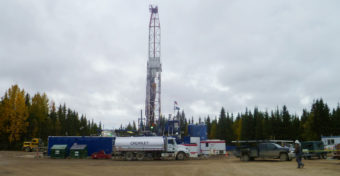
A rig drilling in the Kenai National Wildlife Refuge. A number of Kenai Peninsula residents advocated for more opportunity to weigh in when companies apply for hydraulic fracturing permits in Alaska. (Image courtesy BLM-Alaska)

The state agency that oversees oil and gas drilling is proposing a ten-day comment period for applications to use hydraulic fracturing on an oil or gas well.

The proposal falls in between what environmental groups and the industry say is sufficient opportunity for public input before a well can be fracked in Alaska.
The Alaska Oil and Gas Conservation Commission (AOGCC) also proposed posting fracking applications on its website, although companies would have the opportunity to redact information deemed confidential.

The commission made the announcement Wednesday in response to a proposal by Cook Inletkeeper, an environmental group. The group says current fracking regulations don’t give the public enough opportunity to weigh in. They had asked for a 30-day comment period and a public hearing when a company applies to frack a well.

Cook Inletkeeper executive director Bob Shavelson said the proposal for a ten-day comment period doesn’t go far enough.

“It’s a good step forward but it’s still a fairly tepid effort to provide real notice and comment opportunities for Alaskans to look at fracking applications that could potentially affect groundwater and salmon streams,” Shavelson said.

An industry group in the state is reacting cautiously to the proposal and is still reviewing it. Joshua Kindred, environmental council for the Alaska Oil and Gas Association, said his initial thoughts are that the regulation could be worse for industry, but he still has concerns.

“This is unnecessary and it doesn’t actually provide remedies. All it does is provide delays and increased costs,” said Kindred. “To be completely candid, this isn’t as onerous as what was originally proposed.”

Whether hydraulic fracturing poses a significant threat to groundwater is hotly debated; the U.S. Environmental Protection Agency recently concluded impacts are possible “under some circumstances.” The industry disputes that conclusion.

A hearing on the commission’s proposal is scheduled for March 23.

ConocoPhillips’ big new find on the North Slope could help replenish pipeline

conocopipeline_Harball
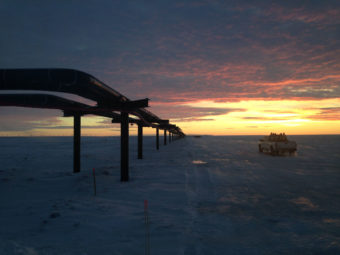
Pipelines stretch towards the horizon on NPR-A land leased by ConocoPhillips. The company announced it has found 300 million barrels of recoverable oil nearby. (Photo by Elizabeth Harball/Alaska’s Energy Desk)

ConocoPhillips announced Friday a major oil find in the National Petroleum-Reserve Alaska (NPR-A). The company is calling it the Willow Discovery. Experts say coupled with several other recent big discoveries in the region, it could portend a new wave of oil development on the North Slope. If developed, it could go a long ways toward replenishing the Trans-Alaska Pipeline.
Viewed from a van driving along an ice road on the Western North Slope, pipelines zigzag across the frozen tundra beneath a cotton candy sky. On a tour arranged and paid for by ConocoPhillips, (it’s the only way for reporters to access this remote part of the world) Conoco employee Jeff Osborne explained the company sees its growing presence here as a historic achievement.

“We’re in the frontier; we’re in the National Petroleum Reserve of Alaska, in lands that we’ve been exploring since the mid-’90s and now are just starting to gain access to produce the oil that has been found by our explorers,” said Osborne.

Conoco is already constructing drill sites in the National Petroleum Reserve: one being built this winter, the Greater Mooses Tooth 1 project, is expected to produce about 30,000 barrels per day. But after drilling two test wells nearby, the company announced an oil discovery that could produce much more than that.

“Depending on the development scenario, it could be up to maybe 100,000 barrels a day of production when we actually get it up and running, so I think it’s a pretty big deal,” ConocoPhillips Alaska president Joe Marushack said at an industry conference in Anchorage, right after he announced the Willow Discovery.

In total, Conoco thinks it’s found more than 300 million barrels of recoverable oil on the Western North Slope.

It’s relatively close to Conoco’s Alpine facility, and outside experts agree with Marushack that this is a big deal.

“It’s pretty significant,” said David Houseknecht of the U.S. Geological Survey. “It ranks up there with all but the top four or five oil fields in Alaska.”

Houseknecht says that for years, NPR-A was a bit of a disappointment for oil explorers. But recently, a series of companies — Armstrong Oil and Gas, Caelus Energy and now, Conoco — have announced they’ve made big oil discoveries in or near the reserve. Houseknecht says this trend could signal there’s much more recoverable oil beneath NPR-A than previously thought.

“I would not expect this to be the last discovery that is made in these two formations in this general area,” said Houseknecht.

ConocoPhillips will certainly be among those searching for more oil in and around the National Petroleum Reserve. At state and federal lease sales held in December, the company won close to 740,000 more acres in the region. Marushack says ConocoPhillips is optimistic there’s even more oil to be found south of their big discovery.

As BLM moves to protect the National Petroleum Reserve, Conoco pushes back

Harball_CD5
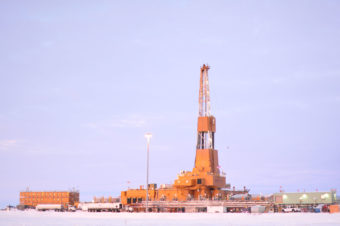
CD5, ConocoPhillips’ first oil development within the boundaries of NPR-A. (Photo by Elizabeth Harball/Alaska’s Energy Desk)

It may be called the “National Petroleum Reserve,” but the 23-million-acre chunk of federal land on the North Slope didn’t see a full-scale oil development until 2015. As this new era begins, the Bureau of Land Management is adding another layer of protection to this vast, sensitive area.
Depending on who you ask, the agency is either asking too much of oil companies or not enough.

Last month at the Bureau of Land Management’s lease sale for the the National Petroleum Reserve-Alaska (NPR-A), a pattern emerged: the oil company ConocoPhillips was winning — again and again and again.

ConocoPhillips picked up close to 600,000 acres in the National Petroleum Reserve last month. The company is behind the first oil project in Reserve, called CD5, and it’s steaming ahead with two more developments there, Greater Mooses Tooth 1 and Greater Mooses Tooth 2.

But Conoco is clashing with its landlord, the BLM. The federal agency is working on new, tougher requirements for oil development in NPR-A.

Oil companies are already required to minimize their footprint as much as possible, like by restricting traffic when caribou are nearby, but Stacie McIntosh, BLM’s Arctic Office Manager, explains some impacts are impossible to avoid. For example, an oil development could overlap with the subsistence hunting area used by the people who live nearby.

“There’s always going to be residual impacts because a development is going to remove a certain amount of acreage from a community’s harvest area,” said McIntosh.

That’s where this new strategy comes in: BLM will expect companies to compensate for the unavoidable impacts of oil development. For example, an oil company could build a road to provide access to other hunting areas.

But Conoco strongly opposes the new approach. In a letter to BLM, the company called a draft of the strategy “a polarizing document” that has “major flaws.” The company says there are already hundreds of requirements in place to protect the National Petroleum Reserve. Conoco also says BLM isn’t taking into account the benefits of oil development, like job opportunities for local communities.

A spokeswoman for ConocoPhillips declined to comment beyond the letter, but plenty of others were willing to speak out.

“We’re in a situation where the bar is constantly being raised and it’s becoming evermore challenging in terms of economically exploring and developing the resources in NPR-A,” said Carl Portman, deputy director of the Resource Development Council in Anchorage. ConocoPhillips is a member of RDC.

BLM’s new strategy also has political opponents like Senator Lisa Murkowski, who asked the agency to withdraw it altogether.

But environmental groups say the protections are important. If anything, they want the BLM to go further.

Nicole Whittington-Evans of The Wilderness Society says BLM should take into account how oil development could affect the climate.

“Clearly, oil and gas development and the burning of fossil fuels will have an impact on climate and will create a carbon footprint, and we believe that these types of impacts need to be addressed by the BLM,” said Whitington-Evans.

BLM hasn’t yet released a final version of the strategy. So as ConocoPhillips goes ahead with a new era of oil development in the National Petroleum Reserve, the federal government is still wrestling with how to manage the consequences.

Alaska’s congressional leaders renew push to allow ANWR drilling

ANWR-USGS
Alaska’s congressional delegation this week renewed their effort to allow development in the Arctic National Wildlife Refuge. (Image courtesy U.S. Geological Survey)

U.S. senators Lisa Murkowski and Dan Sullivan introduced a bill Thursday to open up a portion of the Arctic National Wildlife Refuge for oil and gas drilling.
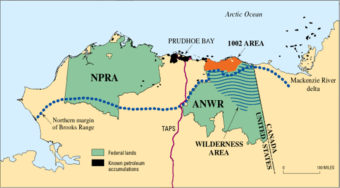
For decades Alaska politicians have pushed to allow development in the refuge’s coastal plain, but with Donald Trump taking the White House this month and a Republican-led Congress, the latest bill may gain more traction.

In a joint news release, the senators say the Alaska Oil and Gas Production Act would allow development on 2,000 surface acres within the refuge’s coastal plain, also known as the 10-02 Area.

On the House side, Alaska Rep. Don Young introduced a bill to open a portion of the refuge for development on Tuesday.

Environmental groups oppose the efforts, citing potential impacts to wildlife and subsistence hunting.

TAPS kicks off 40th year with a little more oil than expected

pumpstation3
The Trans-Alaska Pipeline System’s Pump Station 3. 2016 saw the first increase in production since 2002. (Photo courtesy Alyeska Pipeline Service Company)

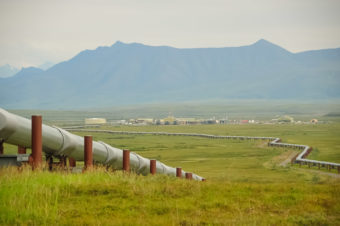
For the first time in over a decade, the operator of the Trans-Alaska Pipeline System announced a year-over-year increase in the amount of oil moving through the pipeline.

Last year, according to the Alyeska Pipeline Service Company, the pipeline moved about 517,500 barrels per day. That’s a 1.8 percent increase from 2015. Alyeska president Tom Barrett said he’s happy to kick off the pipeline’s 40th year with the announcement.

“Every barrel that either stops the decline or slows it, or, as in the last year, increases, is very positive for us as an operator,” Barrett said.

Oil flowing through the pipeline peaked in 1988 at 2 million barrels per day. It has declined steadily ever since, with small upticks in 1991, 2002 and now, 2016.

Alaska Department of Natural Resources deputy commissioner Mark Wiggin said he can’t point to a single factor behind the increase. There was a full year of production for ConocoPhillips’ first development in the National Petroleum Reserve-Alaska, at the CD5 drill site. The private company Hilcorp was also more active on the North Slope, drilling 10 wells at Milne Point. And, Wiggin said, fewer North Slope facilities were shut down for maintenance last year.

But Wiggin said the state isn’t predicting that TAPS will return to its glory days, at least not anytime soon.

“The uptick that we witnessed in 2016, while very positive, and it’s the direction we want it heading, surely does not suggest that we are heading back to the peak year in 1988,” said Wiggin.

In December, Alaska’s Department of Revenue predicted oil production from the North Slope will continue its decline. By 2025, the state forecasts production could dip below the 350,000 barrels-per-day.

If oil flows go even lower than that, below 300,000 barrels per day, Alyeska doesn’t know if the pipeline can keep operating safely. Slow-moving oil and a cooler pipeline causes wax that exists naturally in the oil to build up. It’s also likely that ice accumulation will become a bigger problem. Barrett says pipeline workers are already dealing with problems caused by slow-moving oil and cold weather.

“We’ve installed new pumps, we’ve installed methanol injection points, we’ve used [direct] fire heaters to manage at this lower speed — which is really not what we were designed for,” said Barrett.

Barrett said he’s hopeful production will increase this year, too, but Alyeska has to plan for all scenarios — including a continued decline in production.

Site notifications
Update notification options
Subscribe to notifications