Elizabeth Harball, Alaska's Energy Desk
Calls for Hilcorp to shut down leaking Cook Inlet gas line get louder

Chunks of ice float in Cook Inlet on Dec. 13, 2016 near Kenai, Alaska. (Photo by Rashah McChesney/Alaska’s Energy Desk)

An ongoing natural gas leak in Cook Inlet is sparking a debate over pipeline safety. Hilcorp, the responsible company, says it can’t shut off the flow of gas through the pipeline without risking an oil spill. But a number of environmental groups disagree.

A recent letter from the federal agency overseeing the incident, the Pipeline and Hazardous Materials Safety Administration (PHMSA), revealed the leak began in late December. It’s currently estimated to be leaking between 203,000 and 225,000 cubic feet of gas per day, according to Alaska regulators. Dangerous ice conditions in Cook Inlet mean divers may not be able to start repairs for weeks.

Hilcorp — the biggest oil and gas producer in Cook Inlet — has repeatedly claimed shutting off the gas would be unsafe for workers and the environment. The pipeline carried crude oil until it was converted to gas in 2005. Hilcorp argues shutting off the gas could lead to an oil spill from the residual oil in the line.

Lois Epstein of the Wilderness Society called Hilcorp’s argument, “frankly bogus.”

Epstein, who has advised the federal government on pipeline safety, said there shouldn’t be much oil in the fuel line, explaining it would have been flushed out when it was converted to a gas.

Because Epstein doesn’t think there’s a big oil spill risk, her message to Hilcorp is this: “If you can’t repair it, you need to shut it down and wait until you can repair things safely.”

Epstein isn’t alone. Last week, several national environmental groups, including Greenpeace and the Natural Resources Defense Council, sent a letter to the federal government demanding it force Hilcorp to immediately shut down the pipeline. A local environmental group, Cook Inletkeeper, is lobbying state legislators to call for a shutdown.

But in a March safety order, PHMSA gave Hilcorp until May 1 to fix the line or shut it down. The agency agreed with Hilcorp that it would be too risky to shut down the gas line immediately.

Hilcorp responded to PHMSA’s letter in an emailed statement, saying, “ensuring the safety of our response personnel is our top priority as we proceed. We are pleased that PHMSA’s Proposed Safety Order acknowledges this, recognizing that immediate repair is not a viable option due to current conditions and concerns for the safety of personnel.”

But in the same letter, PHMSA also noted there’s a second pipeline nearby, “operating in an environment substantially similar” to the leaking gas line. That pipeline is carrying crude oil

Epstein argued if the crude oil pipeline was leaking instead, the federal government would be cracking down on Hilcorp.

“Hilcorp was, in fact, lucky that it was a gas line, because they are having this argument about whether they need to shut down or not,” Epstein said. “But if it was the oil line or if the breach were closer to the platform, I’m very confident that the state or federal governments would be shutting down this line.”

Both Hilcorp and the Pipeline and Hazardous Materials Safety Administration turned down interview requests.

The state Department of Environmental Conservation says it’s reviewing Hilcorp’s environmental monitoring plan and also can’t comment until that process is finished.

Companies trumpet 1.2 billion-barrel oil discovery on North Slope

Armstrong1_Harball
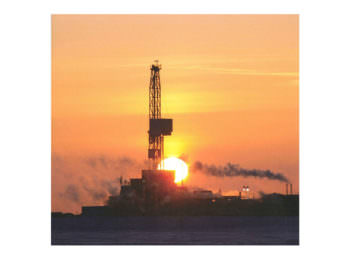
A rig in the Pikka unit, where oil companies Armstrong Oil & Gas and Repsol say they’ve found 1.2 billion barrels of oil. (Photo courtesy Armstrong Oil & Gas)

The companies behind an already significant oil find on Alaska’s North Slope on Thursday said they’ve confirmed the biggest onshore discovery in the U.S. in three decades.
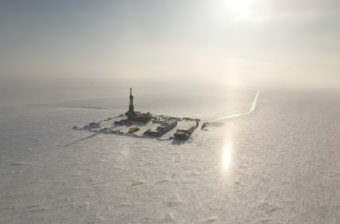
Spanish company Repsol says two wells it drilled this winter with partner Armstrong Energy show the companies have found 1.2 billion barrels of recoverable oil.

Denver-based Armstrong already announced it had made a discovery in the area that could produce about 120,000 barrels of oil per day. The company aims to deliver first oil from the discovery to the pipeline by 2022.

According to the Alaska Department of Natural Resources’ oil and gas division, Armstrong previously reported the reservoir could contain between about 500 million and 1.4 billion barrels of oil. The state says wells drilled this winter provide new evidence showing it’s likely the amount of oil in the reservoir is on the higher end of that estimate.

Armstrong and Repsol weren’t available to comment.

In an interview last week, petroleum expert David Houseknecht of the U.S. Geological survey said Armstrong’s discovery is notable and could hint more oil discoveries in the area are possible.

“There have been dozens and dozens and dozens and dozens of wells drilled there, and so to make a discovery of this size — [in] one of the earliest explored areas and one of the most intensely explored areas — is not only remarkable, but it indicates there are probably many, many, many more similar opportunities lurking out there,” said Houseknecht.

Two other companies also recently claimed major oil finds in or near the National Petroleum Reserve-Alaska — Caelus Energy and ConocoPhillips.

Alaska’s political leaders applauded the news, including Governor Bill Walker, U.S. Senator Dan Sullivan and leaders in the state legislature.

How certain is that big oil discovery? Would you bet the farm on it or just a six-pack?

Armstrong_Harball
An Armstrong rig on the North Slope. Multiple discovery wells, outside analysts and a good flow test mean Armstrong’s recent oil discovery is a good bet. (Photo courtesy Armstrong Oil & Gas)

There’s a lot of excitement building about three big oil discoveries on Alaska’s North Slope. Caelus Energy, Armstrong Oil and Gas and ConocoPhillips all recently announced they’ve found huge new oil fields.

But what does it take to prove an oil discovery?
Geologist David Houseknecht’s job is to answer some very practical scientific questions: How much oil is in Alaska? And where is it?

So it’s a little surprising to find out why Houseknecht became a geologist: A psychic.

To make a long story short, in the 1950s, a psychic advised some of Houseknecht’s distant relatives to drill a well in Michigan — and they struck oil. That bit of family lore (plus a childhood penchant for classifying rocks) put him on a path to where he is now: a corner office at the U.S. Geological Survey’s headquarters in Reston, Virginia, where he leads a team mapping Alaska’s oil resources.

Despite his New Age origin story, Houseknecht is a numbers guy. He likes to talk in terms of probabilities. Say his team reports there’s a 95 percent probability that a chunk of land contains a billion barrels of oil…

“What that means is that we would pretty much bet six months salary on that number being a reasonable estimate,” he said.

But if that probability comes in at five percent instead?

“We might be willing to bet a six-pack of Moose’s Tooth beer,” he said.

Whether he’ll bet on an oil discovery depends on evidence — how much evidence the company releases, and the nature of that evidence.

That brings us to the recent discoveries Alaska is buzzing about — huge finds made by Caelus Energy, ConocoPhillips and Armstrong Oil and Gas.

Houseknecht doesn’t think all three are equally certain to pan out.

“There are discoveries and there are discoveries,” he said.

Houseknecht ranks Armstrong’s oil discovery as most certain, Conoco’s as second most certain and Caelus’ third. That’s because there’s a wide range of evidence pointing to the three finds.

So what kind of evidence helps prove an oil discovery? First, he said, look at the number of discovery wells a company’s drilled. Caelus and Conoco each announced  two discovery wells. Armstrong and its partner Repsol drilled over a dozen.

“The more wells you drill into that oil bearing formation over as broad an area as possible the more confident you are,” he said.

Second, Houseknecht explained, check if a company’s done what’s called a flow test. That’s when companies drill a hole in the ground and see how fast the oil comes out.

Conoco released promising results from a flow test, reporting 3,200 barrels of oil per day. Armstrong completed several flow tests, and one reported over 4,000 barrels of oil per day.

“That’s excellent,” said Houseknecht.

There are other important factors going into whether an oil discovery actually gets developed. That includes the company’s size: a really big, public company like ConocoPhillips is more likely than a small company like Caelus to have cash on hand to get an oil field up and running.

It’s also helpful if outside engineers — people not on a company’s payroll — back up a discovery. This is especially important with smaller companies that may be looking for financing. Armstrong did this, adding to their credibility.

Another key factor is how far the discovery is from infrastructure:

“Every mile you have to build pipe further to get to the existing pipeline, the more onerous the costs become,” said Houseknecht.

Conoco’s discovery is within striking distance of already producing oil fields.  Caelus’ discovery is farther away from the pipeline.

So to the question — how likely is it that the three big discoveries are actually developed? Pretend you’re a detective trying to solve a murder with evidence on par with what the oil companies put forward.

“The Caelus estimates would be circumstantial evidence,” Houseknecht said. “You don’t have the murder weapon. You might have an indistinct description of a vehicle that was seen fleeing from the scene.”

Caelus has been up front about this uncertainty, saying it’s going to provide final results from a flow test in 2018.

Houseknecht said Armstrong’s level of evidence is probably enough to pin down a killer.

“Armstrong has apprehended someone who still is holding the gun that committed the murder and has powder traces on their shirtsleeve. Plus an eyewitness”

He explained the evidence for the Conoco “murder” — that is, discovery — falls somewhere in the middle.

But based on what’s currently known, even top geologists can’t definitively say if and when all three companies will actually start producing oil.

To answer that question, you might have to consult a psychic.

Ice in Cook Inlet likely to delay fix to Hilcorp gas leak for weeks

Still from footage taken by a helicopter of a gas leak in Cook Inlet, obtained by the environmental group Cook Inletkeeper. (Image courtesy Cook Inletkeeper)

Hilcorp recently informed state regulators that the company is unlikely to begin repairs on a gas leak in Cook Inlet until mid- to late March.

That’s according to a letter the Houston-based oil-and-gas company sent Feb. 20 to the Alaska Department of Environmental Conservation.

Alaska’s Energy Desk obtained the letter through a public records request.

“We all agreed that we would prefer to be able to either immediately repair the Pipeline, or, if unable to make repairs, to shut in the Pipeline if there were no adverse impacts of taking that action,” Hilcorp wrote. “Neither is possible at this time.”

Hilcorp added, “broken ice, exacerbated by high tidal flows and limited daylight” make it too dangerous to send divers to fix the leak at this time.

It’s estimated the fuel line is leaking at a rate of 210,000 to 310,000 cubic feet of natural gas per day.

The company also gave several reasons why it can’t simply shut off the gas.

Hilcorp said the fuel line used to carry crude oil, and shutting off the line could lead to an “unknown quantity” of oil escaping the line. The company added the fuel line powers its platforms, and shutting it off could endanger workers.

The letter was addressed to Alaska Department of Environmental Conservation’s Geoff Merrell, who is leading the state’s response to the leak.

He couldn’t say when the leak can be fixed, either.

“The bottom line is the pipeline will be repaired when it’s safe to repair the pipeline,” he said. “When that is, nobody knows.”

The line in question leaked twice before in 2014, when it was owned by a different company, according to Merrell. But those leaks happened in the summer, and repairs were made within a few days.

Merrell said safety concerns about fixing the leak in winter are legitimate, recalling a January 2009 incident in Cook Inlet when sea ice pushed a supply boat into an oil platform and sank.

But the letter also shows Hilcorp disputing the department’s assessment of the environmental risks associated with the leak.

For example, Hilcorp challenges the agency’s evidence that methane can harm aquatic species.

“Hilcorp has their opinion and their position, which is fine, they’re entitled to that,” Merrell said. “The department has access to environmental and science experts who are arriving at a position that is different than that of Hilcorp’s, and that’s fine too.”

Cook Inlet is home to a population of beluga whales, which are listed as endangered.

Hilcorp wrote in its letter to the state that the whales are likely to steer clear of the gas bubble stream coming from the leak. The company added, “belugas tend to avoid ice-covered areas.”

The National Oceanic and Atmospheric Administration said the opposite in a Feb. 24 letter it sent to the Pipeline and Hazardous Materials Safety Administration, the federal agency overseeing the incident.

“Cook Inlet belugas have shown a preference for ice cover,” the agency wrote in the letter.

NOAA added that the leak is taking place within preferred Cook Inlet beluga winter foraging areas.

In an emailed statement, Hilcorp spokeswoman Lori Nelson said the company is working with environmental consultants, who concluded “the potential impact to marine life is minimal.”

Nelson added the company is working closely with government agencies to respond to the incident.

The long time frame for fixing the leak is drawing criticism from local environmental groups.

“Basically Hilcorp is saying ‘we cannot respond to an event in Cook Inlet in the winter,'” said Bob Shavelson, advocacy director for Homer-based Cook Inletkeeper. “Our response to that is, ‘if you can’t address an event whether it’s a gas spill or an oil spill in Alaska in the winter, then you should go back to Texas, because you don’t have a right to do business here.'”

Earlier this month, Cook Inletkeeper announced it intends to sue Hilcorp over the leak, claiming it is violating of the federal Clean Water Act.

Waiting for winter: ice roads mean the North Slope can get to work

Harball_iceroad2
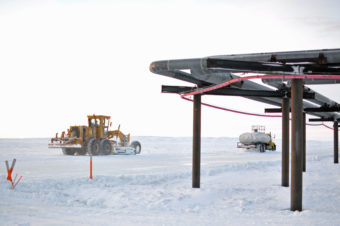
A water truck and blade add layers of ice chips and water to an ice road near one of ConocoPhillips’ flow lines on the Western North Slope. (Photo by Elizabeth Harball/Alaska’s Energy Desk)

Every winter, a massive infrastructure project takes place on the North Slope — one that’s designed to disappear. Ice roads are built to minimize the oil industry’s footprint on the sensitive tundra, and melt away in spring. Many of the oil industry’s multi million-dollar projects on the North Slope can’t be built until the ice roads are finished each year.

On a dim, 7-degree day in January, a van slowly lurches down the beginnings of an ice road on Alaska’s North Slope. Jeff Osborne, who oversees ice road construction for ConocoPhillips, says that the ice under the tires is as thin as one or two inches. It’s really bumpy.

“You get used to it,” says Osborne.

This tour has been arranged (and paid for) by ConocoPhillips. It’s the only way a reporter can see how the oil company operates in this remote part of the state.

Here on the North Slope, oil companies like ConocoPhillips build hundreds of miles of ice roads every winter, at a cost of about about $400,000 per mile. Osborne explains there are no permanent roads to the company’s Alpine facility, or to many of the pipelines nearby.

“That’s the amazing part,” Osborne says. “I don’t know anywhere else in the world where you can build pipelines and when we walk away and everything melts, you can look from the road or from afar and you wonder to yourself, ‘how did those pipelines get placed?'”

ConocoPhillips’ North Slope work schedule hinges entirely on ice roads. The season lasts 90 to 100 days. During that narrow window, the Alpine workforce doubles in size. Essential equipment like drill rigs, pipes, cranes and chemicals — too big or dangerous to carry in by plane — all have to be moved on ice roads.

Harball_iceroad2
An ice chipper moves across a frozen lake, leaving behind material used to build ice roads. (Photo by Elizabeth Harball/Alaska’s Energy Desk)

On a frozen lake near Alpine, a big yellow cat moves back and forth across the horizon. What’s left behind looks like a freshly-plowed field — only it’s frosty white. Huge backhoes scoop up ice chips and dump them into trucks.

Back at the road site, the ice chips are dumped onto ground that’s been pre-packed with snow.

“At some point in time the blade will call the water truck up and have the water truck put some water down on the chips that have just been dumped,” says Osborne

After water is sprayed down, mother nature takes charge, freezing everything into place. Layer after layer is added until the road is at least six inches thick.

And that’s pretty much it.

“I’ve always thought that ice roads were an elegantly simple solution to a problem,” says Melissa Head with Alaska’s Department of Natural Resources. “There really isn’t much that’s complicated about it and that’s the beauty of it.”

Head is on a team that manages ice road construction on the North Slope. The main purpose of ice roads, she explains, is to protect the tundra’s sensitive vegetation — some plants native to the region won’t grow back for years if they’re disturbed.

Environmental groups have raised concerns about ice roads. Lois Epstein with the Wilderness Society in Anchorage worries about the amount of water it takes to build them.

“Where that water comes from, making sure that it doesn’t deplete important lakes, river systems,” Epstein says.

But Epstein adds her group doesn’t oppose ice roads.

“It is true, ice roads are much better than permanent roads, gravel roads, so we do support their use,” says Epstein.

This winter, ConocoPhillips begins construction on its Greater Moose’s Tooth 1 drill site. It’s one of the company’s first big developments in the National Petroleum Reserve. ConocoPhillips usually builds about 35 miles of ice roads each winter, but for this $900-million project, they need an additional 80 miles.

That means Jeff Osborne is keeping busy. Driving back to Alpine in the van, I have to wonder if ice road building feels like a Sisyphean task. I ask him how he feels about the money, time and effort he puts into something that just melts away in the spring.

“Job security,” he says simply.

By late April, the ice roads Osborne completed just a few months earlier will fade back into the tundra. And next year, he’ll start all over again.

How is climate change affecting ice road construction?

To build an ice road, state regulators require the tundra to be frozen to a set depth and temperature. ConocoPhillips’ Jeff Osborne, who has worked on ice roads since 1998, said he hasn’t noticed the impact of rising temperatures on his work, but state data shows a shift has occurred.

According Alaska’s Department of Natural Resources, the length of tundra travel seasons decreased between 1970 and 2000. In the 1970s and 1980s, it was common for tundra travel season to begin as early as November. But by the mid-1990s and early 2000s, tundra travel season was commonly beginning in January. In 2003, the state adopted new technology and techniques, like temperature monitoring stations and pre-packing snow over the tundra.

As a result, “ice road season has actually increased quite considerably because of the pre-packing techniques and new vehicles that are being used,” said Melissa Head of the Alaska Department of Natural Resources’ Northern Oil and Gas Team. Head said the state is not studying the long-term effects of a changing climate on ice roads, and does not have data proving the shift was due to climate change.

“There was a recognition that the off-road travel season was changing and was decreasing, but no one attributed that to any specific thing,” said Head.

According to the National Oceanic and Atmospheric Administration average annual temperatures in the Arctic have risen 3.5 C since 1900 and continue to increase at double the rate of the rest of the globe.

Environmental group to sue Hilcorp over Cook Inlet gas leak

Still from footage taken by a helicopter of a gas leak in Cook Inlet, obtained by the environmental group Cook Inletkeeper. (Image courtesy Cook Inletkeeper)

Editor’s note: This story has been updated to reflect new information from Hilcorp and the Pipeline and Hazardous Materials Safety Administration.

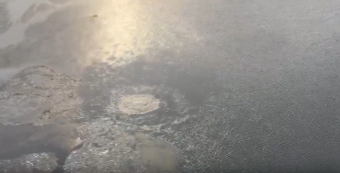
Footage taken from a helicopter provides a look at a gas leak first reported last week in Cook Inlet. The video, emailed to reporters by environmental group Cook Inletkeeper, shows gas steadily burbling to the water’s surface as chunks of ice float nearby.

Hilcorp, the biggest oil and gas producer in the Inlet, owns the pipeline. It carries natural gas from shore to fuel two platforms built in 1964 and 1967.

The leaking gas pipeline in Cook Inlet is drawing concern from environmental groups and state and federal agencies.

Along with the footage, Cook Inletkeeper provided reporters with a letter it sent to Hilcorp CEO Jeffery Hildebrand telling him their intent to sue the company in 60 days. They’re claiming Hilcorp is violating the federal Clean Water Act.

“We just feel there’s an obligation on Hilcorp to do the right thing, shut down this pipeline, deal with this antiquated infrastructure they have in Cook Inlet, and operate responsibly,” said Bob Shavelson, director of advocacy for Cook Inletkeeper.

Last week, Cook Inletkeeper asked state and federal agencies to force Hilcorp to shut down the pipeline.

According to information Hilcorp provided to the Alaska Department of Environmental Conservation (DEC), the company has reduced the flow of gas through the pipeline since the leak started. Hilcorp estimates the leak to be between 210,000 and 310,000 cubic feet of gas per day.

“It’s enough to heat probably around 700 households in Southcentral Alaska every day,” said Shavelson.

In a statement, Hilcorp said the safety of its people and the environment are its top priorities, but the company argues it would be unsafe to shut down the pipeline.

“If a minimum pressure is not maintained in the pipeline it could fill with water which would allow for the escape of residual crude oil, as this line was previously used as a crude oil pipeline,” the company said in a statement Wednesday night.

But fixing the leak is proving a challenge. The federal Pipeline and Hazardous Materials Safety Administration, which is investigating the leak, says ice in the inlet is impeding access to the leak.

Hilcorp spokesperson Lori Nelson said it is monitoring ice conditions around the leak but can’t dispatch divers until the company decides it is safe.

DEC reports it “may be some time until the leak is fixed,” but Nelson could not provide a more specific timeline. DEC agrees with Hilcorp that it would be unsafe to shut down the pipeline. The state agency is characterizing the leak’s risk to public health and safety as “small.”

But DEC also reports it’s hard to quantify the leak’s environmental impact. It has asked Hilcorp to provide an environmental monitoring plan.

Federal agencies also are worried about the leak’s environmental consequences.

“We are definitely concerned that this incident could have adverse impacts to marine life, particularly marine mammals. And our greatest concern is for the endangered Cook Inlet beluga whales and possible impacts to their critical habitat,” Julie Speegle, a spokesperson for the National Oceanic and Atmospheric Administration Alaska Region Fisheries, said in a statement.

NOAA estimates there are about 340 beluga whales in Cook Inlet, compared to more than a thousand in the 1980s.

Hilcorp has until Feb. 20 to respond to the state’s request for more information about the leak.

Site notifications
Update notification options
Subscribe to notifications