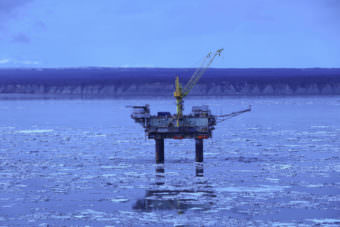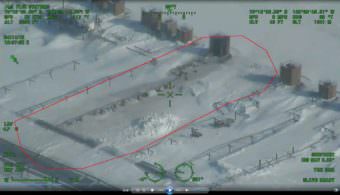
Image from the incident location, taken during an overflight on April 14, 2017. Well 2 and the extent of crude misting is visible on the snow within the red-lined area. (Photo courtesy Alaska Department of Environmental Conservation/BP Exploration (Alaska))
BP announced today that a leak from one of its North Slope production wells was stopped at 3:35 am Monday.
State regulators don’t yet have an estimate for how much oil and gas was released from the well. The cause of the incident is still unknown.
The well was spewing both gas and crude oil when BP first noticed the leak on Friday morning. State and federal regulators reported the well stopped spraying oil on Saturday after a safety valve was activated.
The well continued venting natural gas until it was killed Monday morning by pumping salt water down the hole. BP is currently maintaining the water pressure until it can use a mechanical plug to secure the well. It’s not yet known when that plug can be installed.
The initial response took place during challenging weather conditions, according to Suzanne Skadowski, the U.S. Environmental Protection Agency’s public information officer for the incident.
“It has continued to be very cold, and there have been pretty significant winds. Twenty to 30 miles per hour, upwards of 40 and 50 miles an hour,” said Skadowski.
But Skadowski said the main challenge was the well itself. Two separate leaks had formed and the well had risen three to four feet out of the ground. This caused a pressure gauge to break off, which hindered efforts to kill the well.
BP employees were forced to leave the pad during the incident and no injuries were reported.
Regulators are investigating the leak’s impact on the environment, but an initial overflight indicated the crude spray didn’t reach the nearby tundra.
Alaska Oil and Gas Conservation Commission Chair Cathy Foerster said her agency will observe the leak investigation, but there’s not yet any evidence that BP did something wrong.
“We have no reason to believe that BP did anything that was regulatorily non-compliant. We have no reason to believe that human error was involved. We just don’t know,” said Foerster.
Foerster said at the time of the incident, the well was producing about 300 barrels of oil and 30 million cubic feet of gas per day.
The well is located about five miles from the Deadhorse airport, and the nearest community, Nuiqsut, is approximately 50 miles west of the pad.
Update | 2:50 p.m. April 17.
This post has been updated to reflect the fact that the oil release was halted Saturday.
Chinese president Xi Jinping met with Alaska Gov. Bill Walker during a short visit to Anchorage on April 7, 2017. Xi stopped in Alaska on his way home from a summit with President Donald Trump in Florida. (Photo by Elizabeth Harball/Alaska’s Energy Desk)
Gov. Bill Walker hosted an unexpected guest on Friday — the President of China. Xi Jinping was headed back from a meeting with President Donald Trump in Florida.
It’s not unusual for foreign leaders to re-fuel in Anchorage, but this wasn’t just a pit stop. And experts say there are good reasons for China’s top leader to drop in.
Shortly before 7:00 pm on Friday, Xi and his wife stepped off a 747 at Ted Stevens International Airport. President Xi Jinping’s visit was a secret to most — Governor Bill Walker only found out two weeks in advance. But the governor offered a hearty welcome, with two of his grandchildren waiting on the tarmac with bouquets.
After deplaning, Xi and the Chinese delegation headed South to Beluga Point, to gander at the snow-capped mountains across Turnagain Arm. The Seward highway was closed for about 30 minutes to accommodate the visit — which came just a day after the same road was closed for 12 hours for a police manhunt and an unplanned avalanche.
Then Xi and his delegation returned to downtown Anchorage, strolling into a conference room on the bottom floor of the Hotel Captain Cook. Sounds of the Anchorage Rotary Club’s 100th Anniversary celebration emanated faintly from the ceiling as Walker and the president of China grinned, shook hands and sat down to talk.
Walker talked about the state’s seafood industry — of which China is a top importer, Native corporations and Alaska’s position as a major air cargo hub.
But the governor devoted the bulk of his public remarks to his favorite megaproject: a planned natural gas pipeline from the North Slope to Nikiski.
“Through the development of an 800-mile pipeline and liquefied natural gas facility, Alaska can provide a stable source of gas supply to the Asia-Pacific region for more than a century,” Walker said.
President Xi’s public remarks were more focused on the views.
“In the eyes of ours and in the eyes of many of the Chinese people, Alaska is a land that brings a lot of mystery in our mind,” Xi said through an interpreter. “It is where the people would like to go. It’s like Shangri-La to us.”
The Chinese president then made a prediction: “The very fact that we have now been here, I believe, will serve as a good advertisement for your state.”
Xi said his visit would likely fuel a Chinese tourist boom in Alaska.
But while the press was present for all of Governor Walker’s remarks, the bulk of Xi’s statement happened behind closed doors — in polite whispers, Chinese security guards ushered reporters out of the room. Neither leader took any questions.
Before taking off around 11 pm Friday, Xi and his delegation dined with Walker and his staff on king salmon and crab bisque.
At a press conference the next morning, Walker described the meeting as “very special” — although the Chinese president may have been disappointed by the restaurant’s stationary nature.
“When we sat down to have dinner at the Captain Cook we were facing the mountains,” said Walker. “And he asked if the room would spin — [would] be turning around. And I said I hoped it wouldn’t be.”
Walker said the discussion covered everything from climate change to the natural gas line to training opportunities for Chinese winter Olympic athletes. The governor didn’t announce any new initiatives, but said he felt the visit could lead to closer ties.
“If we had traveled to China, we could not have had a meeting like this; not be surrounded with this level of high level ministers at that meeting,” said Walker. “I’d have to say it was a little unprecedented.”
Experts say the Chinese president’s Anchorage excursion was probably more than just a chance to eat salmon with the governor.
“It makes a lot of sense for them to strengthen their relationship with Alaska,” said Nils Andreassen of the Institute of the North, an Arctic research group in Anchorage.
Andreassen said China has a strong interest in Arctic issues, focusing heavily on research and diplomacy in this area. They’re especially interested in the prospect of Arctic shipping routes, Andreassen said.
But, he added, there was probably another reason for the visit: “Because Anchorage is beautiful.”
Andreassen said China is keenly interested in expanding tourism opportunities here. So get ready, Alaska — Xi was probably dead serious when he said to expect a lot more Chinese tourists headed our way.
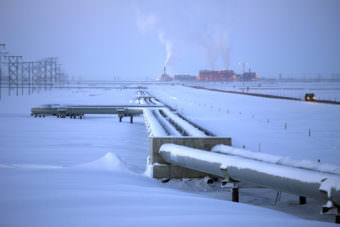
Pipelines lead to one of BP’s facilities on the North Slope. (Photo courtesy BP)
In an annual report released on Thursday, BP’s Alaska subsidiary reported a profit of $85 million in 2016. That’s compared to a $172 million loss in Alaska in 2015.
As oil prices plunged, BP cut about 260 jobs in Alaska last year, which was about 13 percent of its workforce. But according to a BP spokesperson, the company is not planning any broad-scale layoffs this year.
The company currently employs about 1,700 workers in Alaska.
BP also reported a global profit of $115 million for 2016. That’s after a global loss of $6.5 billion for 2015, its worst loss ever.
Despite the profit, the British company also announced a significant cut to CEO Bob Dudley’s pay. Multiple national news outlets report this is because BP’s shareholders were unhappy that Dudley was set to receive a raise despite the record loss in 2015.
BP also reported it paid the State of Alaska $464 million in taxes in royalties in 2016, compared to $358 million in 2015.
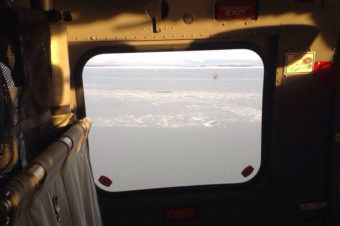
Pan ice in Cook Inlet on April 3, 2017, during an agency overflight near the Anna Platform. (Photo courtesy Cook Inlet Spill Prevention & Response Inc.)
Ten gallons or less: that’s how much crude oil state regulators think leaked from a pipeline in Cook Inlet last weekend.
The pipeline’s owner, Hilcorp, has an even smaller estimate: three gallons. The oil company said that’s based on the number and size of the oil sheens spotted, plus the amount of oil recovered from the pipeline after the platform was shut down.
Kristin Ryan, director of the Alaska Department of Environmental Conservation’s Division of Spill Prevention and Response, said she’s fairly confident the final estimate won’t exceed 10 gallons. But Ryan added that pinning down exactly how much oil escaped won’t be easy.
“This is always a really hot point in any response, and unfortunately, it’s just not an exact science,” said Ryan. “It is hard to really quantify a release.”
She added, “one of the main factors we use is how much of the product was recovered, and in this situation we’ve not recovered any product.”
Ryan said the state will continue reviewing the available evidence. For example, they’re looking at Hilcorp’s records on how much oil was in the line, and how much oil the company was able to pump out of the line into a storage tank. Divers will also inspect the pipeline when dangerous ice conditions in Cook Inlet dissipate.
The final estimate for how much oil leaked into the Inlet will factor into how the state penalizes Hilcorp. Ryan said the state has zero tolerance for oil spills so a fine is likely. But she also praised Hilcorp for how they handled the leak.
“This probably wasn’t a lot of oil, so that’s, to us, a success story,” said Ryan. “The response went correctly. The company did what it needed to do, and didn’t put anybody in harm’s way and was able to get rid of the oil before a larger release occurred.”
But Lois Epstein of the Wilderness Society said she’s skeptical of Hilcorp’s estimate that only three gallons of oil leaked into the Inlet. She noted the pipeline is 75 feet underwater, so some of the oil may not have risen to the surface. Epstein is calling for Hilcorp to publicly release the data they’re using to calculate how much oil leaked.
“We need to know not just the initial estimate, which I think sounds suspiciously low, but we need to know what are the assumptions behind it and come to some sort of technical consensus of what the actual amount is,” said Epstein.
The Alaska Department of Environmental Conservation expects to produce a final estimate in a couple of weeks.
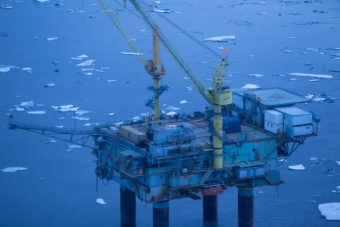
An oil leak from a pipeline connected to Hilcorp’s Anna Platform, pictured here, is unrelated to a gas leak from a different Hilcorp-owned pipeline that was first detected in February. (Photo courtesy Lighthawk Volunteer Pilot Kirk Johnson)
State regulators on Monday announced an oil leak from an underwater pipeline owned by Hilcorp in Cook Inlet was halted successfully.
But at this point, the state doesn’t have its own estimate for how much oil was released into the Inlet or knowledge of what caused the leak. It’s the latest in a string of incidents associated with Hilcorp, and the company is facing a wave of scrutiny from both regulators and environmental groups.
As of Monday, no one knows what hit Hilcorp’s Anna Platform in upper Cook Inlet on April 1. All that’s known is that workers felt an impact, then looked over the side of the platform to see every oil company’s worst nightmare: an oil sheen on the water.
Overflights conducted later that day observed six sheens; the biggest was 10 feet by 12 feet. The company thinks the leak came from an 8-inch pipeline which was at maximum capacity, carrying more than 19,000 gallons of crude oil when the impact happened.
Hilcorp shut down the oil platform, and on Sunday, the company put what’s called a pig through the oil line. This halted the leak and pushed the remaining crude into a holding tank. No sheens have been observed since Saturday.
Hilcorp estimates less than 10 gallons was released, based on the size and number of the oil sheens it observed. But the state says it still needs to do some arithmetic.
“We’ll be looking at the volume of the line and the amount of oil they removed from the line and then try to determine what’s missing,” said Kristin Ryan, director of the Alaska Department of Environmental Conservation’s Division of Spill Prevention and Response.
Ryan said the state hasn’t observed any impacts to wildlife. But she added there’s likely to be a penalty, based on the final calculation of the volume of oil released.
“We have a zero tolerance for oil in the environment, and the release of oil is something we take very seriously. So yes, I assume there will be a penalty, which is a fine for this release,” said Ryan.
Hilcorp is already dealing with another unrelated incident in Cook Inlet, a natural gas leak from a different pipeline. That leak started in December and is ongoing. Divers have been unable to fix the gas leak for weeks due to dangerous ice conditions in Cook Inlet. After talks with Governor Bill Walker, Hilcorp recently agreed to shut down the oil platform associated with the leak.
While various pieces of equipment have been upgraded over the years, much of the oil and gas infrastructure in Cook Inlet was first installed in the 1960s.
Ryan said there’s no indication at this point that Hilcorp was operating the oil pipeline outside of the state’s standards. Hilcorp reports it inspected the line in June 2016 and found it was in good condition.
But Ryan added it’s time for state regulators to take a holistic look at Cook Inlet’s aging infrastructure, to “try to have a better record of what pipes are where, who owns them, how old are they, what’s their inspection frequency.”
Over the next year, Ryan said the state will work with the Cook Inlet Regional Citizens Advisory Council to compile an updated report on the age and status of the Inlet’s oil and gas operations. Based on that report, Ryan said the state may decide to change its regulations.
Hilcorp, which is based in Texas, is now the biggest oil and gas producer in Cook Inlet, having bought up a lot of the old infrastructure from other companies in recent years. It also operates on the North Slope.
If Hilcorp is fined for the oil leak, it wouldn’t be a first. Over the past year, the Alaska Oil and Gas Conservation Commission penalized Hilcorp multiple times for safety incidents. In March, the Commission fined Hilcorp $200,000 for a 2015 incident on the North Slope that nearly resulted in the deaths of three workers.
Hilcorp turned down requests for interviews on both the gas leak and the oil leak.
To say the fines, the ongoing gas leak and the oil leak have alarmed environmental groups would be an understatement. Among the many species that live in Cook Inlet, the body of water is home to a population of beluga whales which is listed as endangered.
“We’ve seen a toxic corporate culture here,” said Bob Shavelson of Cook Inletkeeper, a group that’s threatened to sue Hilcorp over the gas leak.
“We’ve seen a complete disregard for worker safety and environmental protection,” he added.
As the state takes closer look at aging infrastructure in Cook Inlet, environmental groups are ramping up their scrutiny of all of Hilcorp’s operations.
Hilcorp’s Anna Platform in Upper Cook Inlet, where workers felt an impact before observing several oil sheens on Saturday. (Photo courtesy Cook Inletkeeper)
State regulators on Monday said a leak from a crude oil pipeline in Cook Inlet was halted successfully.
The state also announced it had stood down the Unified Command on the incident after an overflight Monday morning didn’t observe any additional oil sheens.
Hilcorp, the dominant oil and gas producer in Cook Inlet, is responsible for the leak. The company deployed a pig through the leaking line on Sunday. The state says the operation successfully removed all the oil from the line so there is no way for the leak to continue.
The leak was first reported on Saturday after workers on one of the company’s platforms in Upper Cook Inlet felt an impact. Hilcorp personnel did see oil sheens both from the platform and during an overflight on Saturday afternoon.
The total volume of oil released and the cause of the spill is still unknown, according the state Department of Environmental Conservation.
Hilcorp estimates less than three gallons of oil was released, based on the number and size of the observed oil sheens. But the state will do the final calculation based on the amount of oil Hilcorp was able to push from the line into a holding tank. The line’s maximum capacity is more than 19,000 gallons; it was at full capacity when the impact occurred.
The oil spill is not associated with a gas leak coming from a different line owned by Hilcorp in Cook Inlet. Ice conditions in the Inlet are delaying full repairs to both lines.
Close
Update notification options
Subscribe to notifications
Subscribe
Get notifications about news related to the topics you care about. You can unsubscribe anytime.