Elizabeth Harball, Alaska's Energy Desk
After over 40 years at Prudhoe Bay, general store manager to retire

Pritchard_Harball
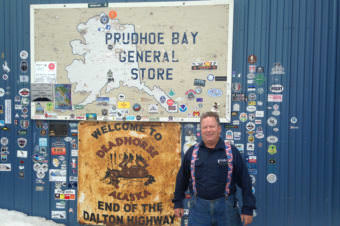
Dave Pritchard retires on June 27 after working at Prudhoe Bay for 42 years. (Photo by Elizabeth Harball/Alaska’s Energy Desk)

The North Slope community of Deadhorse is an unusual place. Its No. 1 purpose is to serve the oil field it’s next to: Prudhoe Bay. There are no houses, there’s no downtown and no parks; just a series of industrial lots and gravel roads in the middle of the tundra.

But Deadhorse does have a store. And the man who runs it is retiring this month, after 42 years.

If you find yourself in Deadhorse and you need some paint, an energy drink or a book about Sarah Palin, you’ll need to go to the Prudhoe Bay “general store.” It’s the only store in town.

Dave Pritchard, the manager, gave a tour of the general store, which is what people usually call it instead of its official name, Brooks Range Supply. As he walked around the store’s various rooms, he points out the inventory: pipe fittings, industrial hoses, candy, paint, copy paper, cases of water.

“We sell everything!” Pritchard said. “I always call us ‘the mall.'”

Pritchard’s clocked in at Prudhoe Bay since 1975 — longer than oil has flowed through the trans-Alaska pipeline. He started out working as a roustabout for a tug and barge company. After that, he took a job with the supply company that eventually bought the general store.

And over the next few decades, Pritchard said he worked his way to the top: “I’ve done the sales, I’ve been purchasing, I’ve done a little bit of everything — I was assistant manager for years, I’ve done the welding supply counter…”

Except for the occasional adventurous tourist driving the Dalton Highway, Pritchard’s customers are mostly oil workers. And the oil industry never stops — so when Pritchard’s on duty, he doesn’t stop, either.

“We are open 24 hours, seven days a week, 365 days a year,” he said. “We’re open Christmas, we’re open Thanksgiving, we’re open every holiday — we’re working.”

More than 15,000 oil workers move through Deadhorse every month, according to BP, but nobody lives there full time. Pritchard works “two and twos” — two weeks on and two weeks off, a pretty common schedule for the North Slope workers. When he’s off, Pritchard flies to his house in Cincinnati or a condo in Florida. Pritchard said that might sound great, but it takes a special kind of person to work where he does.

“There’s a lot of people that come up can’t handle the dark. There’s a lot of people who come up here and can’t handle the light,” he said.

Plus, he said, the two weeks away from home can be tough for families. Pritchard’s never been married and doesn’t have kids. And he’s seen a lot over the last 42 years, including some big changes. Back in the ’70s and ’80s, Pritchard recalls that things could get a little crazy.

“When Alaska Airlines first came up here, they brought Playboy Bunnies and beer kegs,” said Pritchard.

Did he actually meet the Playboy Bunnies?

“Oh yeah, I was at that party,” Pritchard said with a laugh.

Today, oil workers aren’t allowed to drink once they land at Prudhoe Bay. Things are more tranquil nowadays. And Pritchard doesn’t mind that. Working in the middle of the tundra, hundreds of miles away from the nearest city, he’s become more in tune with nature’s patterns.

“All of a sudden you’ll see the foxes will be plentiful. And then the squirrels — won’t be that many squirrels. All of a sudden, all the squirrels are around and the foxes aren’t that many because they birth that way – it’s a cycle,” Pritchard said

Another cycle Pritchard’s gotten used to is the fluctuation in oil prices.

He said, “I’ve seen it go both ways. I’ve gone through about three or four ups and downs. And right now we’re on a big down thing – it happened in the ’80s, it happened in the ’90s, and now it’s happening in the 2000s.”

Brooks Range Supply isn’t an oil company, but like every other business in Deadhorse, it’s suffering through the latest oil price slump. Pritchard said it’s hard — they’ve had to cut jobs and limit the number of hours employees can work.

But pretty soon, Pritchard won’t have to worry about that. He retires this month. Asked what he thinks the future holds for the Prudhoe Bay General Store once he’s gone, he replied, “Well, the future won’t have me here — I’m kind of looking forward to that. But it all depends on the price of oil.”

He added, “I always joke with my father and say, ‘you pay too little for your gas right now,’ and he laughs at me and says, ‘yeah, I know what you mean.'”

Pritchard’s last day at the General Store is June 27. After his final flight lifts off from Prudhoe Bay, he’s looking forward to golfing and spending more time with his father.

This story is part of our series, Midnight Oil, about the pipeline that shaped Alaska. Next week, we’ll look at why it was so hard to find oil at Prudhoe Bay.  Listen on Alaska Public Media or subscribe to the podcast on iTunes or wherever you get your podcasts. 

Caelus postpones appraisal well for big North Slope oil discovery

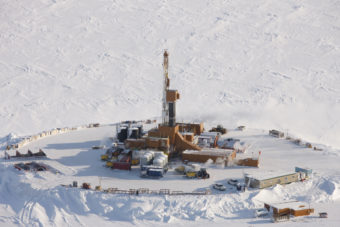
Caelus Energy’s Smith Bay rig. Caelus says tax credits are needed to help develop the find. (Image courtesy Caelus Energy)

The company behind what could be Alaska’s biggest oil discovery since the 1960s will not be drilling a well to confirm the find this winter, as originally planned.
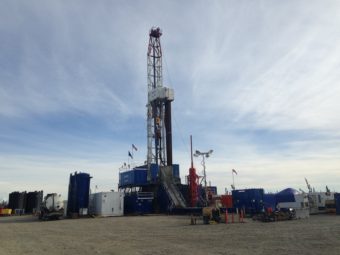
Last October — with great fanfare — Caelus Energy announced it found 6 billion to 10 billion barrels of oil beneath the North Slope’s Smith Bay, about 2 billion barrels of which is recoverable. If developed, the company said the field could increase the amount of oil going down the Trans-Alaska Pipeline by nearly 40 percent.

At the time, the company said it would release crucial final tests on the discovery in 2018 after drilling an appraisal well this winter. But today, Caelus spokesperson Casey Sullivan confirmed that those plans have changed.

“Our goal, really, is to get out there as soon as possible, but, there are certain external factors that play into making a large decision like that,” Sullivan said.

Sullivan said Caelus won’t be drilling the appraisal well this winter for financial reasons. First, oil prices have stayed lower than the company anticipated. Second, Sullivan said the ongoing oil tax policy debate in the legislature made drilling the appraisal well too risky.

“Without knowing quite what the rules are or the clarity around funding of past tax credit payments and things of that nature, it just creates a lot of uncertainty,” Sullivan said. “And for a program like Smith Bay, which really is a significant undertaking that takes a lot of front loading and logistics, we really need that sort of certainty to be able pull off a program like that.”

The state has delayed payment of hundreds of millions of dollars in tax credits to Caelus and other oil companies. State lawmakers originally designed the credits to attract small, private companies like Caelus to the North Slope to increase oil production.

But due to the state’s fiscal crisis, the legislature is currently locked in a debate over reforms to Alaska’s oil tax system, and changes to oil tax credits seem likely.

Sullivan said Caelus still believes Smith Bay is a “world class” discovery, but he couldn’t say when the company will be able to return to the North Slope to confirm it.

State proposes fine for safety violations at Ahtna-owned gas exploration well

Exploration well Tolsona No. 1 is located about 11 miles west of Glennallen, Alaska
Exploration well Tolsona No. 1 is located about 11 miles west of Glennallen, Alaska. (Photo by Elizabeth Harball/Alaska’s Energy Desk)

The state is proposing a $380,000 fine for Alaska Native corporation Ahtna, Inc., for safety violations at a gas well near Glennallen.

The Native corporation started drilling the exploration well last September, hoping to find natural gas to use as cheaper fuel for interior Alaska communities.

The Alaska Oil and Gas Conservation Commission stated the violations posed a “serious and significant risk to public health and the environment.”

In an order sent May 24, the commission charged that an oil and gas exploration company owned by Ahtna, Tolsona Oil and Gas Exploration, didn’t install proper safety equipment.

The commission also said the company “stonewalled” the agency’s attempts to address the issues.

Ahtna is challenging the fine. In a statement released yesterday, the corporation disputed parts of the commission’s account. The company said it took “immediate action” to comply with the state’s order, installing the required equipment this week.

Ahtna added the project has an “outstanding safety record,” but also stated that it lacks the “decades of experience that Alaska’s major oil and gas producers do.”

Interior Secretary signs order aiming to open more of the North Slope to oil leasing

zinke2
Flanked by Senator Lisa Murkowski and Governor Bill Walker, Interior Secretary Ryan Zinke speaks to reporters after signing an order to promote more drilling on Alaska’s North Slope. (photo by Elizabeth Harball/Alaska’s Energy Desk)

Interior Secretary Ryan Zinke today ordered new studies on the oil and gas potential of federal land on the North Slope, including in the coastal plain of Arctic National Wildlife Refuge (ANWR).

Zinke made the announcement at an oil and gas industry conference in Anchorage, marking a significant departure from the Obama administration’s approach to resource development in Alaska.

“The President has now declared — and thank you Donald J. Trump  — that the war on North American energy is now over,” Zinke said.

The order also sets in motion a review of the management plan for the National Petroleum Reserve-Alaska (NPR-A), with changes aimed at providing more land for oil and gas leasing.

The oil industry’s interest in the NPR-A has increased in recent months, following several significant oil finds that were announced in and near the area.

Zinke was flanked by Alaska’s political leaders when he signed the order, including Governor Bill Walker, Senator Lisa Murkowski and Congressman Don Young.

“Should have been done a long time ago,” Young said. “This is an exciting thing for Alaska.”

During a press conference, Zinke told reporters that the federal government plans on partnering with the oil industry to assess ANWR’s oil potential. The last federal assessment was done in 1998.

“I think it’s in the best interest of our country to at least know what our assets are,” Zinke said.

Zinke claimed the order doesn’t loosen environmental protections on the North Slope.

“Nothing I signed today in any way diminishes or relaxes the environmental protections that are necessary,” Zinke said. “And we understand that it’s sensitive area up there. We understand that people have made their living up there, subsistence, for generations and will in generations to come.”

Alli Harvey of the Sierra Club in Anchorage said they’ve been bracing for the order since President Trump got elected. Harvey says the secretary’s statement is bold, but to carry it out he’ll get a lot of pushback from people who want to preserve treasured areas of the Arctic.

“I’m not going to understate what the statements mean. They do have their sights on opening this place up and we are going to match that. The American people have spoken before and they’ll continue to speak and say that it’s not an OK place to drill,” said Harvey.

Lois Epstein with the Wilderness Society in Anchorage added that her group believes drilling isn’t allowed in certain parts of the NPR-A for a reason.

“From our perspective, given how valuable the lands are that are off limits, there’s no reason we should be opening up those areas because we have plenty of less sensitive places to be drilling,” said Epstein.

Any move to allow drilling in ANWR must go through Congress, and multiple attempts to do so in the past 30 years have been unsuccessful.

Zinke did not make clear whether the reassessment would require work on the ground. Drilling opponents say that would require congressional approval, too.

During the press conference, Zinke did not weigh in on President Trump’s decision on whether the U.S. should exit the international Paris Agreement to address climate change, which the President is expected to make public tomorrow.

“I have yet to read what the actual Paris agreement is,” Zinke said. “So before I make an opinion, I want to sit down and read it.”

Reporter Liz Ruskin contributed to this report.

Cook Inlet oil and gas lease sales set for June

Cook Inlet oil rig
An oil rig in Cook Inlet, Feb. 22, 2009. (Creative Commons photo by hig314)

The federal government this week announced it’s holding an oil and gas lease sale for over 1 million acres in Cook Inlet this June.

The offshore area spans from south of Kalgin Island to north of Seldovia.

The last three federal lease sales in Cook Inlet were canceled due to lack of industry interest.

In a letter submitted to the Bureau of Ocean Energy Management last year, environmental groups raised concerns about oil and gas development’s impact on marine species and subsistence activities. The groups also said Cook Inlet’s harsh conditions make development risky.

The agency said it will require mitigation efforts for all lease holders to protect the Inlet’s resources.

The federal sale is scheduled for June 21. That same day, the state is also holding an oil and gas lease sale for about 4.2 million acres in the Cook Inlet region.

State says harsh conditions, not aging infrastructure, culprit in Cook Inlet gas leak

CookInlet_Shelldoc
Still from a 1965 Shell video of Cook Inlet pipeline installations. (courtesy Cook Inletkeeper)

Everyone knew drilling for oil and gas in Cook Inlet wasn’t going to be easy.

This is made clear by a 1965 documentary produced by Shell Oil Company about the industry’s early work to lay pipes in Cook Inlet. In dramatic terms, the narrator talks about the winter ice that “only structures of the toughest steel” can withstand, “high winds and waves” and “swift currents, which move with each tide.”

A number of Cook Inlet’s platforms were built in the 1960s. Today, the Texas-based Hilcorp is the top producer in the Inlet. The company knew what it was getting into when it bought up platforms in the region. In a speech earlier this month, Hilcorp executive David Wilkins noted the company’s business model is to “give new life” to old production.

This business model drew a lot of scrutiny this spring when the company was forced to shut down multiple pipes and platforms after three separate incidents. One gas leak went on for weeks after it was discovered; icy conditions in the Inlet made it too dangerous for divers to repair the line. State regulators are still reviewing data to learn about the environmental impact.

During this time, watchdog groups repeatedly brought up Cook Inlet’s decades-old equipment. But now that the state’s had time to investigate, Geoff Merrell with the Alaska Department of Environmental Conservation said aging equipment probably wasn’t to blame for the gas leak.

“In this case, and as far as we know in any of the other recent cases that we’ve had in Cook Inlet, the age of the infrastructure was not a factor in the incident itself,” Merrell said.

The state thinks the gas leak was caused by a big rock that rubbed against the pipe because of Cook Inlet’s ultra-strong tides. Based on inspections he’s seen, Merrell doesn’t think the string of incidents means Cook Inlet’s old equipment is starting to fall apart.

“I’m not feeling like the system…is subject to imminent collapse,” Merrell said.

But Merrell said even though it wasn’t a factor in the gas leak, the state is paying attention to the fact that many of Cook Inlet’s platforms are getting up in years.

Lynda Giguere, a spokesperson for the Cook Inlet Regional Citizens Advisory Council, agrees that old pipes and platforms are a concern. But that’s just one of many worries.

The Inlet is rife with extreme conditions, including strong tidal currents, dangerous floating ice in the winter and heavy sediment loads and rocks that can eat away at equipment — all factors involved in Hilcorp’s recent gas leak. There’s also a risk of earthquakes and volcanic activity.

But Giguere said the recent series of mishaps has a silver lining:

“One positive aspect of these incidents is that they have focused more attention on Cook Inlet and heightened the public’s awareness of all the challenges that exist in the Inlet,” Giguere said.

The Cook Inlet Regional Citizens Advisory Council is working with the state to review all of the Inlet’s oil and gas infrastructure. The state says the review should be finished before the end of the year.


Site notifications
Update notification options
Subscribe to notifications