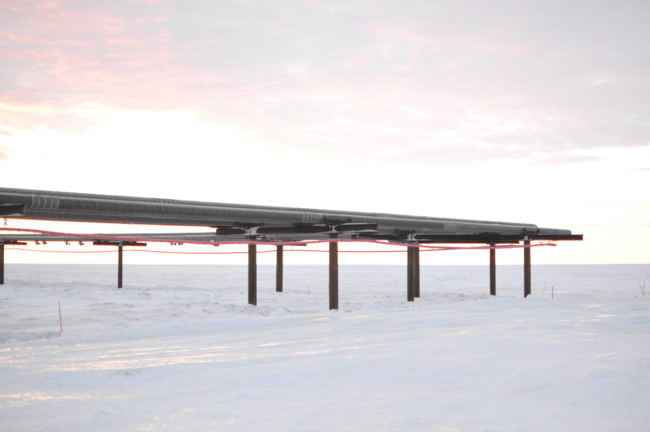
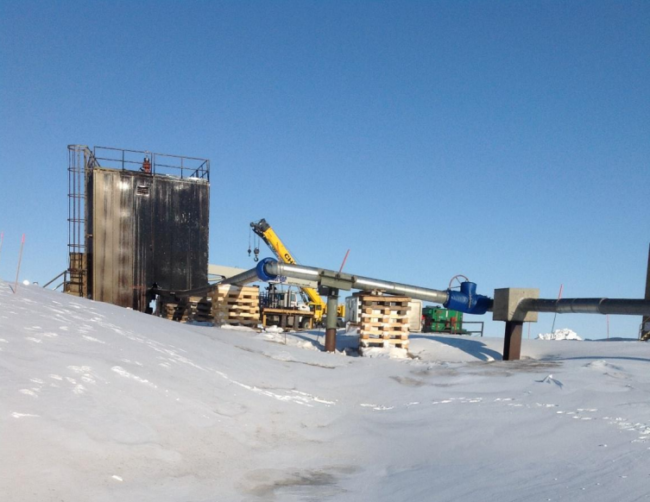
A flow line curves above the horizon on the western North Slope. ConocoPhillips wants to expand one of its units in the region. (Elizabeth Harball/Alaska’s Energy Desk)
The state is trying to speed up development of oil fields on the North Slope by putting pressure on ConocoPhillips to explore a new area.
This week, the Department of Natural Resources announced it’s allowing Conoco to expand one of its North Slope units, but only under certain conditions. In February, the state turned down Conoco’s request after the company paused plans to drill an exploration well there.
Now, the state’s approval requires Conoco to drill an exploration well in the new area by May 31, 2018. If Conoco doesn’t agree to the state’s terms and timeline, it will have to give up the area for other companies to bid on.
Andy Mack, head of the Department of Natural Resources, said the state sees potential where Conoco wants to expand so it’s eager to reap the rewards.
“This entire region is an area where we see a lot of excitement, a lot of interest, and the geology is tremendous,” he said. “And so we’re asking ourselves, how do we get this area on production quickly and safely? And that’s what we were faced with here in this decision.”
If Conoco agrees to the state’s conditions, its Colville River Unit, west of Prudhoe Bay will grow by more than 9000 acres. The lands are jointly owned by the state and the Arctic Slope Regional Corporation.
The state had originally wanted Conoco to drill an exploration well earlier this year. In a March letter to the state, Conoco said it delayed drilling because it needed to address concerns from the village of Nuiqsut, which is just south of the Colville River Unit.
Mack said he now agrees Conoco made the right call.
“I think it was very reasonable for them to ultimately step back from that well last winter and to continue to discuss how they could move forward safely,” he said.
The state’s decision also included a financial incentive for Conoco to hire at least 80 percent Alaska residents when it explores for oil in the new acreage. Mack said those incentives are a new strategy for the state.
“This is a unique way to do business, in some respects, and the state always has to do what is in its interests,” said Mack.
In an email, Conoco spokeswoman Natalie Lowman said Alaska residents already make up 85 percent of the company’s total workforce in Alaska. She added that the company is reviewing the state’s decision, but declined to comment further.
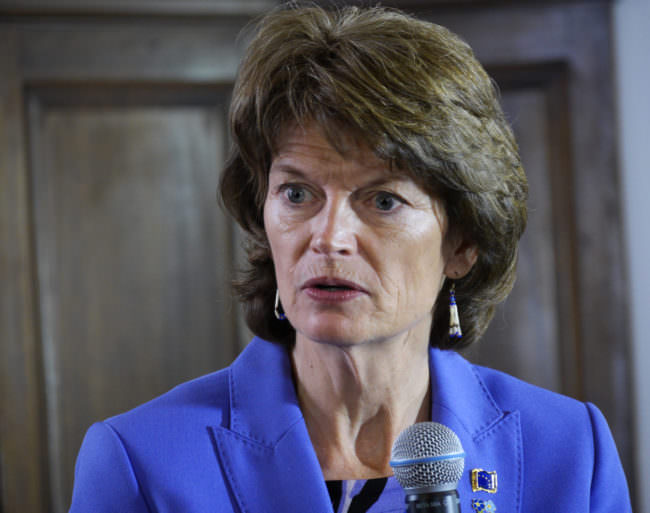
U.S. Sen. Lisa Murkowski speaks with reporters at a press availability following her annual address to the Alaska Legislature on Feb. 22, 2017. (Photo by Skip Gray/360 North)
The Alaska Dispatch News is reporting that the Trump Administration threatened to target Alaska as retribution for Senator Lisa Murkowski’s stand against Republican efforts to repeal the Affordable Care Act this week.
The story stated that Senator Murkowski and Senator Dan Sullivan received calls from Interior Secretary Ryan Zinke this week. During that call, Zinke reportedly told Sullivan that issues like the King Cove Road, drilling in the Arctic National Wildlife Refuge and the placement of Alaskans in leadership positions at the Interior Department could be at stake.
Sullivan responded to an NBC reporter asking about the call regarding Murkowski’s healthcare vote.
“The sooner we can get back to cooperation between the administration on these issues and the chairman of the Energy and Natural Resources Committee the better it’s going to be for Alaska and the better it’s going to be for the country. Particularly on the issues of resource development, energy dominance that the Secretary talks about — that has to include Alaska,” Sullivan said.
Murkowski is chair of the Senate Energy and Natural Resources Committee.
A spokesperson for Sullivan has not returned several calls for comment. The Interior department also has not responded to a request for comment.
A spokesperson for Senator Murkowski’s office confirmed that she received a call from Interior Secretary Zinke. The spokesperson said Zinke told Murkowski that the President was displeased with her vote on the healthcare bill, but the spokesperson declined to elaborate further.
This follows a tweet from the President criticizing Murkowski’s vote, stating that she “let the Republicans and our country down.”
In an emailed statement, Murkowski said, “while I have disagreed with the Senate process so far, the President and I agree that the status quo with healthcare in our country is not acceptable and reforms must be made.”
The Senator added she is committed to pushing for an open process to ensure Alaskans receive affordable healthcare. On Friday, she was one of three Republican senators who voted against a partial repeal.
So how do Alaskans feel about all this? At the busy Fred Meyer in Midtown Anchorage, Zachary Stephens was picking up water before a fishing trip when he stopped to talk about Murkowski’s vote.
“I think that she is a Democrat posing as a Republican and she should have voted on the complete repeal,” Stephens said.
Stephens said he thinks Murkowski should act based on what Alaskans want, not just on what the Trump Administration wants her to do. But he doesn’t think Murkowski should ignore the potential consequences of her vote.
“I hope that Sen. Murkowski does what’s in the best interest of Alaska, and so if she’s getting that kind of pressure about energy and stuff from the Presidential administration, that she does what’s going to be right for her constituents,” said Stephens.
Anchorage resident William Gooch, who was also on his way in to Fred Meyer, had a different view on Murkowski’s stand.
“I think, you know, she’s got some principles, bearing in mind we’re grading on a curve. So I’m glad she did the vote,” said Gooch.
Gooch didn’t have much time for the Interior Secretary’s actions.
“That’s bulls—,” he said. “I’m not paying much attention to what these guys are tweeting on their little tweeters.”
Image taken on April 18, 2017, showing the area of light crude spray near BP’s well. (Photo by Jade Gamble, Alaska Department of Environmental Conservation)
BP was forced to shut down five at-risk wells on the North Slope after investigating an oil leak that happened this April.
That’s according to a report the company provided to the Alaska Oil and Gas Conservation Commission (AOGCC).
BP told AOGCC that the April leak was most likely caused by thawing permafrost, which put uneven stress on the well. Eventually, the surface casing at the top of the well gave out. This caused the wellhead to rise up several feet, hit the top of the well house and knock off a valve, which spewed oil and gas.
According to BP, the oil didn’t impact the tundra and neither wildlife nor the workers were harmed. But the leak lasted several days and drew national attention.
After the leak was plugged, BP’s investigation found 14 other wells with a similar design. Five of those wells were still in production, so BP shut them all down. BP used mechanical plugs, so it’s possible for the wells to start producing again.
Cathy Foerster, who sits on the Alaska Oil and Gas Conservation Commission, said even though the incident was caused by thawing permafrost, she doesn’t connect it to global warming.
“This is not linked to climate change. The permafrost subsidence to which BP refers is very localized near the wellbore. And it’s caused simply by the thermal effect of bringing hot oil from a deep reservoir, deep in the earth, up to the surface,” said Foerster.
Foerster said BP did not violate any regulations, so AOGCC won’t fine the company. Foerster added because BP shut in the wells that were similar in design to the one that leaked, she’s not worried about it happening again.
Lois Epstein of the Wilderness Society disagrees. She’s worried other wells could be at risk — potentially wells owned by other companies.
“When you have something like this that’s completely unexpected, it’s important to see whether this is an anomaly or it’s something that could be a pattern,” Epstein said. “We need to pay a lot of attention to this particular incident, make sure the investigation is done well, both by the industry and by the state, and ask as many questions as possible and figure out whether this is something that could be recurring in the future.”
Epstein also said she thinks it’s too early to say climate change wasn’t a factor at all. But she agreed warm oil in the well could have caused the permafrost to melt, too.
BP shared its investigation with other oil companies. In its report to AOGCC, BP said it is expanding its monitoring plan for permafrost thaw.
BP didn’t agree to an interview for this story. In a statement, the company says it is “committed to operating Prudhoe Bay in a safe, reliable and complaint manner.”
Clarification: This story has been updated to clarify that the wells were not permanently plugged.
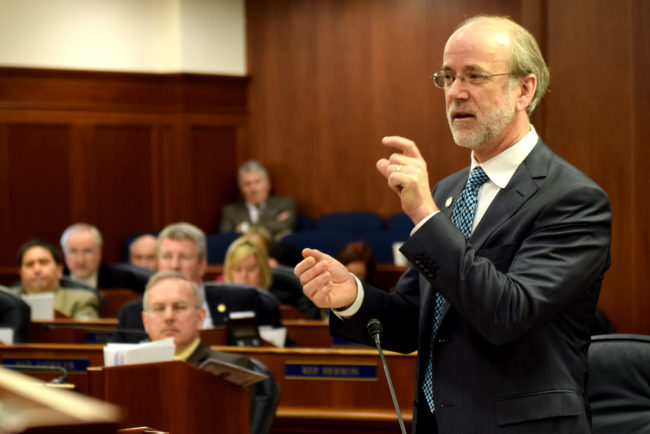
Hollis French addresses the Alaska Legislature in 2014. The former senator will now chair the Alaska Oil and Gas Conservation Commission. (Photo by Skip Gray/Gavel Alaska)
Gov. Bill Walker has appointed Hollis French to lead a state agency that oversees oil and gas production and enforces industry safety rules.
French took over as chair of the Alaska Oil and Gas Conservation Commission on July 1, and will serve a four-year term. He’s replacing Cathy Foerster, who served the previous term as chair and is still on the commission.
French has a long political history in Alaska. Most recently, he ran for lieutenant governor in 2014 with Democratic nominee Byron Mallott, before Mallott merged his campaign with then-Independent-candidate Walker. French also served as a Democratic member of the Alaska Senate for 12 years.
French has experience in the oil industry; before becoming a lawyer in 1995, he worked for ARCO and Shell in Alaska.
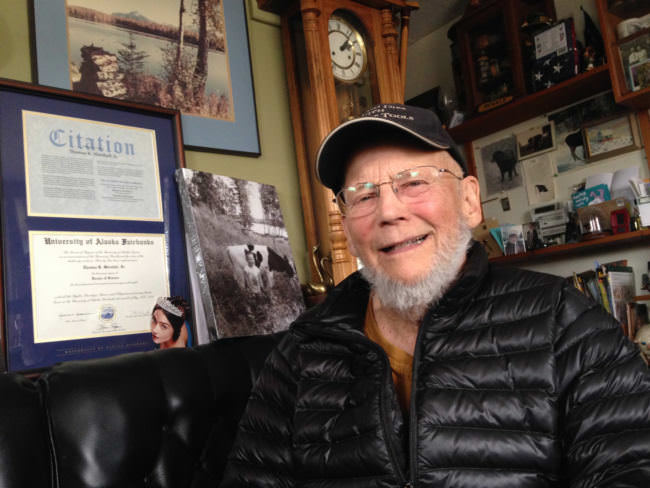
Tom Marshall was a geologist and a land selection officer for Alaska in the 1960s. He was the driving force behind the state’s Prudhoe Bay selection. (Photo by Elizabeth Harball/Alaska’s Energy Desk)
You could argue — and a lot of people do — that Alaska would be a completely different place if it weren’t for a man named Tom Marshall.
Marshall’s now 91 years old and lives in a little brown house in Anchorage. He won’t bring it up himself, but for many Alaskans, he’s a hero. There’s an award tucked between the photos lining his living room wall, for “professional discernment and courageous foresight.”
Marshall earned this award for something he did in the early 1960s, when he worked for the brand new state of Alaska. Back then, the state depended largely on federal dollars and a few resource industries, like salmon fishing. Marshall remembers it as a tense time; with a tiny economy and population, it was a real question whether Alaska could support itself.
“There was a great deal of anxiety of just how we were going to accomplish this,” said Marshall.
But under the statehood act, Congress handed Alaska something like a scratch off lottery ticket. While the federal government still controlled much of Alaska’s 375 million acres — the state could select over 100 million acres to develop as it pleased. If Alaska picked land with valuable resources, it would have a winning ticket.
“This land would put us in a position to pay our bills,” said Marshall.
That’s when Marshall, a petroleum geologist, quietly became one of Alaska’s most important employees. He was tasked with picking the land.
A ragged chunk of Arctic coast called Prudhoe Bay caught his eye. The geology reminded Marshall of big oil basins he’d seen in Wyoming. Marshall thought this could be the jackpot Alaska needed.
But when he suggested selecting a remote chunk of tundra on the icy ocean, Bill Egan, Alaska’s first governor, was not impressed.
“Gov. Egan’s comment was, ‘doesn’t he know it’s frozen?’” said Marshall.
Still, Marshall kept pressing Gov. Egan to select Prudhoe Bay. And some people thought Marshall was on to something. A handful of oil companies were intrigued with Alaska’s Arctic. The federal government had started leasing land on the North Slope in 1958, and a few companies were laying plans to drill there.
It took years and a combination of pressures from the oil companies, Marshall and others, but Egan relented and selected Prudhoe Bay for the state in 1964.
But there were also a lot of skeptics. When the Prudhoe Bay selection was posted, Marshall remembers someone scrawled a note across the map in 5-inch-tall letters:
“They wrote ‘Marshall’s Folly’ on there,” Marshall said.
Harry Jamison worked for one of the oil companies taking a risk on the North Slope. Like Marshall, Jamison hoped there might be a billion-barrel oil field hiding there. It would take that much to justify the astronomical cost of transporting the oil from the Arctic to market.
Jamison knew it would be a challenge.
“Billion-barrel oil fields don’t come along every day. There have been very, very few ever discovered in the United States,” Jamison said.
And soon, dreams of a billion-barrel oil field in Alaska’s Arctic started seeming like a long shot.
Starting in 1963, BP and Sinclair Oil Corp. teamed up and drilled six wells on federal land near the Brooks Range. All six were dry. After that, a series of other companies came up short, too. Eventually that included Jamison’s company, ARCO.
The oil companies that had taken a risk on Alaska’s North Slope started hemorrhaging money.
“It was extremely discouraging,” Jamison said. “The whole industry was really down on the North Slope by that time.”
As well after well came up dry, Marshall’s Prudhoe Bay selection started to seem like a mistake. By 1967, Jamison said most oil companies had given up.
But then, ARCO and Humble Oil teamed up and moved the only drill rig left on the North Slope to Prudhoe Bay. It was the oil industry’s last shot.
A young geologist named Gil Mul was there, working at the well. Mull said for weeks, drilling the well wasn’t all that exciting.
“Almost like watching grass grow,” Mull said.
Then one day, they tested the well’s pressure. When the crew opened the valve, Mull said there was a powerful burst of gas.
“It sounded like a jet plane overhead. It’s shaking the rig. It’s a rumble. It’s a roar,” he said.
The crews ignited the gas rushing from the pipe. It sparked a 50-foot flare that burned in the darkness of the North Slope sky for more than eight hours.
A few months later, the companies drilled a second well to confirm the size of the oil field and discovered it was huge. Initial estimates were that Prudhoe Bay held 9.6 billion barrels of oil – at the time, it was the biggest oil discovery in North America. It’s still the biggest ever found in the U.S.
Alaska’s leaders knew the state would never be the same.
“Alaska has become established as America’s greatest oil province,” Egan said in a 1970 speech. “Ponder for a moment the promise, the dream, and the touch of destiny.”
Finding Prudhoe Bay came down to a few things going exactly right. If the companies hadn’t decided to drill that one last well, if they hadn’t found enough oil and if Marshall hadn’t pushed the governor to select the land in the first place, there’s no question the state would be very different.
Marshall’s not one to brag about his contribution, though. He said he was just doing his job.
But that’s not to say Marshall doesn’t get any satisfaction out of it. Asked if it still bothers him that so many people doubted him for so long, Marshall burst out laughing.
“Oh, not at all, because they were so wrong!” said Marshall. “I mean, let’s face it — Prudhoe Bay oil field was the largest oil field ever discovered on the North American continent. Why should I feel bad about that?”
This story is part of Alaska Energy Desk’s series, Midnight Oil, about the pipeline that shaped Alaska. Next week, the story of how the Alaska Native Claims Settlement Act came to be. Listen on Alaska Public Media or subscribe to the podcast on iTunes or wherever you get your podcasts.
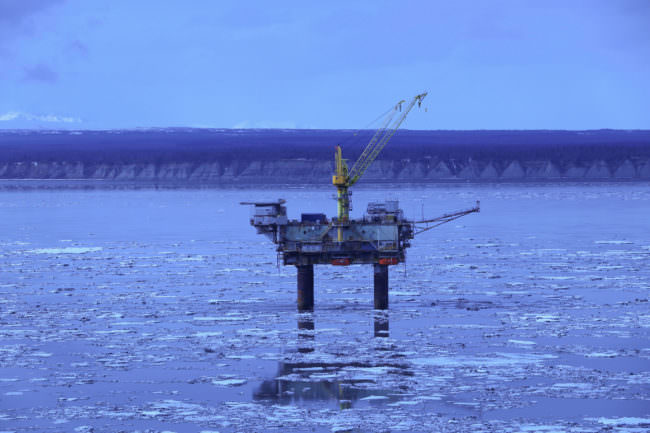
Hilcorp’s Anna Platform in Upper Cook Inlet. The company is looking to further expand its operations in the Inlet after buying up additional acreage at federal and state lease sales. (Photo courtesy Cook Inletkeeper)
Hilcorp snapped up more than 100,000 acres in Cook Inlet for additional oil and gas development at federal and state lease sales held Wednesday.
The federal Bureau of Ocean Energy Management offered over 1 million acres in the Inlet for lease. The agency’s last three Cook Inlet lease sales were canceled when the oil industry wasn’t interested in developing there.
But at this year’s federal sale, Hilcorp submitted over $3 million in bids. The private, Texas-based company is the Inlet’s predominant oil and gas producer.
The company picked up 76,615 acres at the federal lease sale and 26,822 acres at the state lease sale. In both sales, Hilcorp was the only bidder.
David Johnston, who oversees leasing in the region for the Bureau of Ocean Energy Management, said on a call with reporters that he wasn’t surprised to see Hilcorp’s interest.
“Hilcorp, as you know, has been very active in the upper Cook Inlet,” said Johnston. “I think this is just kind of a natural extension for Hilcorp to be looking in the southern end of the Inlet.”
Vincent DeVito, who advises the Interior Secretary on energy policy, added that he thinks the Trump administration’s more industry-friendly policies also influenced the results.
“We are focused on Alaska energy, and… the signaling that has been coming out of this administration is also catalyzing the optimism,” Devito said on the call.
Not everyone is happy about the lease sale results. In a statement, watchdog environmental group Cook Inletkeeper said the federal lease sale marked “a turning point” for Cook Inlet.
“For the first time ever, we are pushing oil and gas platforms and infrastructure into the heart of our commercial and sport fishing and tourism economies,” said Cook Inletkeeper’s Bob Shavelson.
Earlier this year, a gas leak from a fuel line powering one of Hilcorp’s oil platforms went on for months before it could be repaired, drawing intense criticism from Cook Inletkeeper and other environmental groups.
Close
Update notification options
Subscribe to notifications
Subscribe
Get notifications about news related to the topics you care about. You can unsubscribe anytime.