Elizabeth Harball, Alaska's Energy Desk

Alaska hatches plan for vast road network across the Arctic

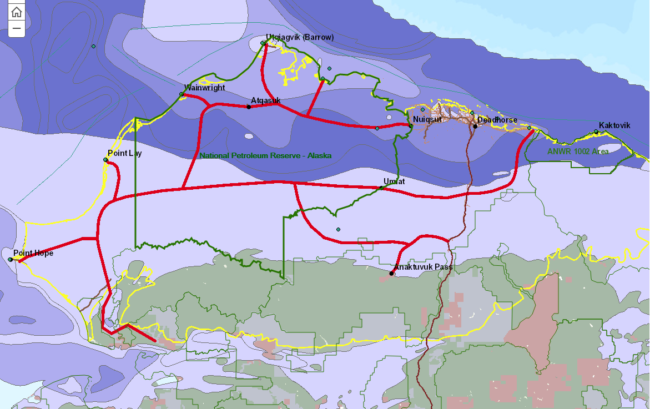
Potential transportation corridors to communities and resources are indicated in red on the state’s map outlining the ASTAR project. (Courtesy Alaska Department of Natural Resources)

Citing tough economic times, Alaska lawmakers and the governor slashed funding for several huge, controversial projects this year, including the Knik Arm bridge and the Juneau Access road.

But Gov. Bill Walker’s administration is now envisioning something new. This year’s capital budget includes $7.3 million in funding to plan the construction of a vast network of roads across the Arctic.

It’s being sold as a lifeline for both oil development and remote communities, but it’s already facing criticism.

There’s no denying that if the Arctic Strategic Transportation and Resource Project, or ASTAR, comes to fruition, it would be a massive undertaking.

“It’s a big project — it’s a megaproject,” said Dean Westlake, who represents the North Slope in the legislature.

ASTAR would mean a network of roads stretching across the Arctic. If built, you could potentially take a road trip from Nuiqsut, a community near the mouth of the Colville River, to Point Hope, more than 400 miles to the west.

Westlake said the road system would help people in remote North Slope villages where, most of the time, the only way to get from one place to another is to buy a plane ticket.

“It is expensive, a lot of times prohibitively so,” Westlake said. “You have people who want to go to the clinic out there, to the hub, that can’t afford to. And shipping goods to the village — if you lived in rural Alaska, you’d know what I’m talking about.”

The idea also has support from North Slope Borough Mayor Harry Brower; in May, Brower wrote a letter to the legislature in support of the project.

But connecting isolated Arctic communities isn’t the only thing Alaska’s leaders have in mind. On Alaska Public Media’s Talk of Alaska program last month, this is how Gov.  Walker responded to a question about why this year’s capital budget included a late addition of $7.3 million for ASTAR:

“We aren’t going to find another 1.6 million barrels of throughput without drilling more wells and having more access,” Walker said.

Walker argued that a network of permanent roads would make finding and developing oil fields in the Arctic a lot easier. The ASTAR project would crisscross one of Alaska’s most promising oil development regions — the National Petroleum Reserve-Alaska. One road could lead straight to Smith Bay, where oil company Caelus claims it’s discovered 2 billion barrels of recoverable oil.

The state is hoping the project will hit a sweet spot: it will benefit communities and someday lead to more oil in the pipeline. Andy Mack, who heads Alaska’s Department of Natural Resources, argues that’s why this megaproject makes sense when others don’t.

“Frankly it’s where we have oil plays, and there’s a lot of excitement…and those things are very, very important as we look at our future budgets,” said Mack.

The state also wants to get the project moving during today’s favorable political climate — the industry-friendly Trump administration is now reviewing its management plan for the National Petroleum Reserve. Mack hopes Interior Secretary Ryan Zinke will be open to the idea of permanent roads across the Arctic.

“When Secretary Zinke visited Alaska, he came with a very open mind about what the possibilities were for development in the Arctic,” said Mack.

But there are some big questions that still need to be answered. First, how much will it cost, and who will pay for it? In a letter to the Trump administration asking for support for infrastructure projects this spring, Walker suggested the road from Nuiqsut to Utqiaġvik alone could cost more than $300 million. In addition to federal money, another idea to help pay for the project is to charge industry a toll to use the road.

Some key stakeholders are still trying to figure out what the project might mean to them. That includes ConocoPhillips, which is doing a lot of the oil exploration in the region.

“It is too early in the process to understand how the proposed road system might affect us,” Natalie Lowman, a spokeswoman for ConocoPhillips, said in an email. “We have not been involved with its development.”

Lois Epstein of the Wilderness Society questions why the state is funneling millions into another megaproject that she thinks is unlikely to be built.

“Why are we spending, as a state, lots of money to study projects that have no viability at all? These megaprojects are already being canceled in the most recent capital budget, and at the same time, the ASTAR project is being added,” said Epstein.

Bernadette Demientieff, who leads the Gwich’in Steering Committee, is also against the project. The Gwich’in Steering Committee has long opposed oil development in the Arctic Refuge because of potential impacts to caribou herds. Dementieff said she’s worried a network of roads across the Arctic would threaten subsistence resources.

“The way we look at is they’re looking to do more development. And for us, this is our homeland, these are our children’s birthright to continue to survive off of these areas,” said Demientieff.

As it’s currently envisioned, the ASTAR project wouldn’t connect to any Gwich’in communities.

Amos AguvlukNashookpuk is office manager for Wainwright, a North Slope community that could get its first road out if ASTAR moves ahead. He said a road would reduce the cost of everyday essentials like food and medication — it would even make it easier for Wainwright’s students to travel to basketball games.

“This will help our residents and I hope that one day, it comes true,” said AguvlukNashookpuk.

The state aims to start consulting with communities on the project this winter.
Walker lends support to Trump in lawsuit over Arctic drilling

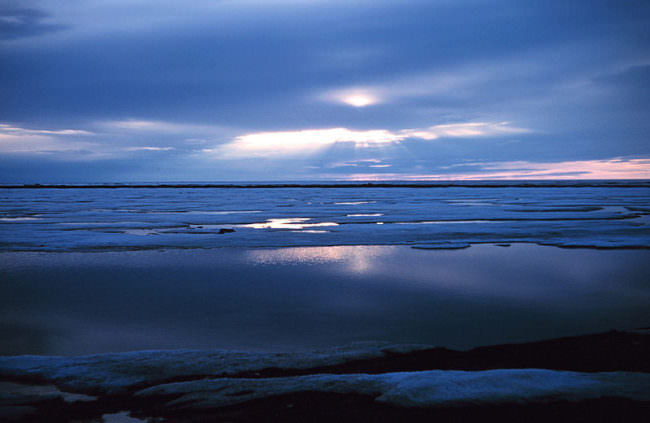
The Beaufort Sea, one of the areas the Trump administration would like to re-open for oil drilling. Now Trump will have Alaska’s support in court. (Photo courtesy NOAA)

The state of Alaska is going to stand by President Donald Trump’s side in court to defend an order aiming to reopen large parts of the Arctic Ocean to oil drilling.

Today, Gov. Bill Walker’s administration filed a motion to intervene in support of President Trump in a lawsuit over whether he can reverse President Obama’s Arctic drilling ban.

In the waning weeks of his Presidency, Obama removed the Chukchi Sea and most of the Beaufort Sea from any future oil leasing. Then in April, President Trump signed an executive order to reverse that decision.

Soon after that, a coalition of environmental groups filed a lawsuit against the Trump administration, claiming the reversal is illegal.

In a statement, Governor Walker said he’s supporting the Trump administration to ensure future opportunities for oil and gas development near Alaska.

Feds move forward with review of Hilcorp’s Arctic drilling plans

HilcorpLibertyrendering
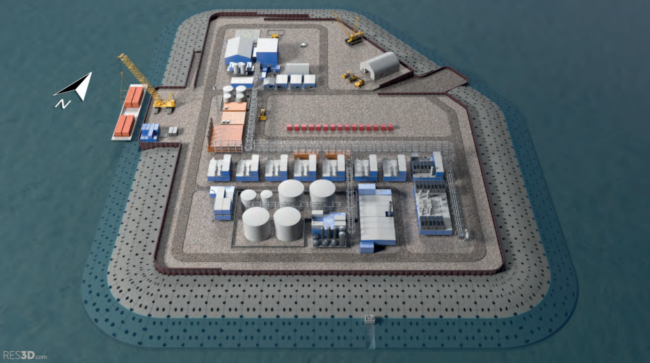
Hilcorp’s design plans for the gravel island it aims to build in federal waters in the Beaufort Sea, as submitted to federal regulators in 2015. (Image courtesy BOEM)

The federal government is moving forward with its review of Hilcorp’s proposal to drill offshore for oil in the Arctic.

Called the Liberty Project, it would be the first oil production platform in federal Arctic waters. Hilcorp wants to build an artificial gravel island in the Beaufort Sea, five miles off the coast in shallow waters near Prudhoe Bay. Oil would be carried to shore via a pipeline under the sea floor.

Several similar developments are already operating in state waters.

The Bureau of Ocean Energy Management (BOEM) released a draft of the environmental analysis for the project this week. The agency is now taking public comments on the proposal through mid-November.

Several environmental groups have already spoken out against the project, citing a months-long gas leak from one of Hilcorp’s fuel lines in Cook Inlet this spring.

In a news release, BOEM said Hilcorp “included numerous measures to mitigate potential impacts” in its project design.

There’s a new Arctic drilling battle brewing…and it’s not in ANWR

NPR-A_BLMphoto
The National Petroleum Reserve-Alaska encompasses important habitat for migratory birds. The vast region is also increasingly promising for oil development. (Photo by Bob Wick, courtesy BLM)

The National Petroleum Reserve-Alaska (NPR-A) is a region in the Arctic bigger than many U.S. states. But it’s flown under the radar for years, unlike a different chunk of federal land located just to the east: the Arctic National Wildlife Refuge (ANWR).

That’s likely to change. A series of promising oil discoveries and a recent move by the Trump administration mean this vast, remote area is about to get a lot more controversial.

In the 1920s, President Warren G. Harding set aside NPR-A specifically for its oil potential. Today, the federal government manages the petroleum reserve as a “multiple use” area — a place with room for both habitat and oil drilling.

But Melanie Smith, director of conservation science with Audubon Alaska, thinks the name is misleading.

“It’s a somewhat unfortunate name, actually, ‘Petroleum Reserve,” Smith said.

Conservation groups point out that a giant lake in the northeast corner of the Reserve, called Teshekpuk lake, is a globally significant area for migratory birds.

Because of NPR-A’s different federal status, “it took longer to discover just how important and influential and irreplaceable parts of the Petroleum Reserve are, and really realize they are on par with the Arctic Refuge,” said Smith.

That’s right, Smith called parts of the Reserve on par with the Arctic National Wildlife Refuge. The areas have different federal designations, but ecologically — well, birds can’t tell the difference.

In 2013, the Obama administration cited the need to protect “critical areas for sensitive bird populations from all seven continents” when it put close to half of the Reserve off limits to oil and gas leasing, including more than 3 million acres surrounding Teshekpuk lake.

But a lot has changed since then.

At an oil and gas conference in Anchorage this May, Interior Secretary Ryan Zinke signed an order that, among other things, requires a review of the Obama administration’s plan for managing NPR-A.

“This order, in effect, makes Alaska open for business,” Zinke said as he signed it.

It wasn’t clear exactly what that meant until last week, when the Interior Department sent out a call asking which parts of the Reserve should be opened up to oil and gas leasing. Environmental groups were alarmed because the request made it clear that areas the Obama administration protected could be back on the table.

But the move didn’t come out of nowhere. Andy Mack, head of Alaska’s Department of Natural Resources, said re-evaluating the plan makes sense. That’s because we know things now we didn’t know four years ago.

It turns out there’s a lot more oil in the Reserve than everyone thought — even as recently as 2013.

“It couldn’t be a more dramatic shift,” Mack said.

Back in 2013, the Obama administration slashed its estimate for the amount of oil in NPR-A — from 10 billion barrels to 1 billion barrels. In the 2000s, the oil industry tried drilling wells in search of oil there, and Mack said they didn’t have much luck.

Plus, when the Reserve’s current plan was crafted in 2013, the industry was focused on a different prize: offshore drilling in the Arctic Ocean. The Obama administration made a tradeoff — it protected parts of the Reserve, but also allowed for a pipeline across a different section of the Reserve, so oil from Arctic waters could be carried to market.

Fast-forward to 2017: Shell has abandoned its Arctic offshore drilling campaign. And over the last year or so, there has been a series of huge oil discoveries in and around the Reserve, including finds by ConocoPhillips and Armstrong Energy. Mack said the promise of NPR-A is a big deal for a state grappling with both a recession and a steady decline in oil production.

“This is certainly some of the most exciting well results we’ve seen, and it really is something that we as a state have to appreciate and understand and capitalize on,” said Mack.

The discoveries come on the heels of the first-ever oil development in NPR-A — a drill site run by ConocoPhillips, called CD5. That started producing oil in 2015, and two more are on the way.

And this could be just the beginning, according to David Houseknecht, one of the U.S. Geological Survey’s top experts on Alaska’s oil resources.

“There’s a lot of potential in all of Northeastern NPR-A for the kinds of discoveries that have just been announced,” Houseknecht said.

But it just so happens that the area with the most oil potential overlaps with the same area that environmentalists say is crucial wildlife habitat.

Nicole Whittington-Evans with the Wilderness Society says the recent oil finds — plus the Trump administration’s order “opening Alaska for business” — have groups like hers on high alert.

“We have a strong desire to see this area protected. And we are very concerned about the recent finds and the level of interest for drilling for oil in this extremely important place,” Whittington-Evans said.

If the Trump administration moves to allow oil exploration near NPR-A’s Teshkepuk lake, environmental groups are going to fight it, just as they’ve fought development in the Arctic Refuge for decades. The question is — will a place called a “Petroleum Reserve” capture hearts and minds as easily as the Arctic Refuge?

Correction: An earlier version of this story called the Trump administration’s order to review the Obama administration’s NPR-A management plan an executive order. It was a secretarial order.

North Slope well leak estimated at over 7,000 gallons

CaelusCleanup
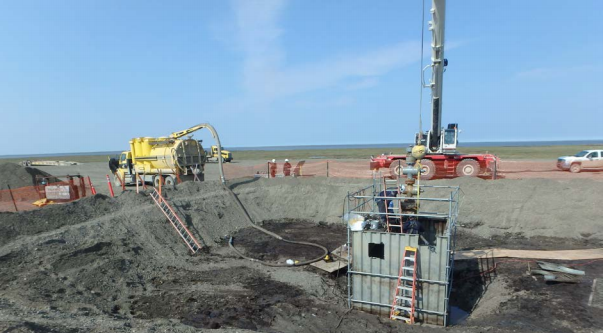
A “Super Sucker” truck helps with spill cleanup in July. Caelus first reported the spill in June. (photo by Wes Ghormley, Alaska Department of Environmental Conservation)

The state reports that over 7,000 gallons of oil leaked from a North Slope well owned by Caelus Energy.

Tom DeRuyter is overseeing the response to the leak with the Alaska Department of Environmental Conservation (DEC). He says DEC thinks most of the spill was contained to a gravel pad, but about three gallons of oil made it out to the tundra.

“I don’t want to minimize the size of this spill — that was a lot of oil that came out of this well,” said DeRuyter. “It was something that happened without notice and it took a long time to really understand what had happened and for everybody to react accordingly. And that is very unusual.”

Caelus first reported the spill in mid-June. Then, the company thought just 5 gallons had escaped a cellar surrounding the well.

“The spill itself was significantly larger than anybody had thought up front, and that led to the migration outside of the gravel pad,” said DeRuyter.

According to Caelus, the spill came from a well that was drilled and plugged in 2013.

The oil that leaked is not crude. Rather, it’s a mixture of fluids Caelus put in the well, described by the state as mineral oil and “diesel freeze protect fluid.”

The state thinks the incident happened after water filled the cellar and froze. Ice damaged a valve and allowed the oil to escape.

The state also reports that plugs in the bottom of the cellar were not in place, allowing the water to flow in. But DeRuyter said until the investigation is complete, he can’t say if human error was a factor.

Cleanup on the spill is ongoing.

Caelus did not agree to an interview for this story. In a statement, the company said it is working with DEC to minimize damage.

“We appreciate the hard work of our employees, contractors and the Alaska Department of Environmental Conservation on this incident,” spokesman Casey Sullivan said in a text message.

Caelus Energy is a small, private company based in Texas. It’s the company behind the potentially massive Smith Bay oil discovery announced in October.

Trump administration signals it could open more of the Arctic to drilling

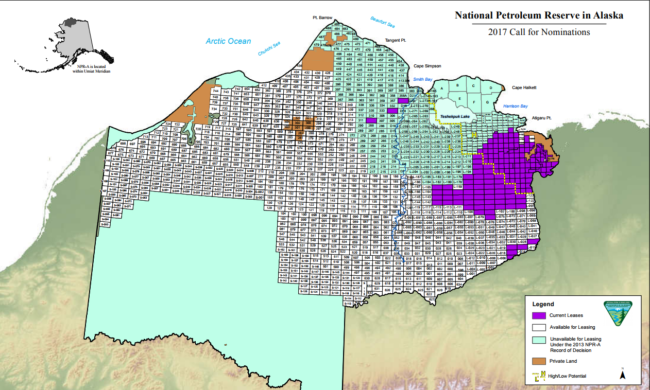
BLM’s map of NPR-A acreage available for leasing. The Trump administration is gauging industry interest in portions of the region not currently available for drilling. (Image courtesy BLM)

The Trump administration is taking a first step towards potentially opening up new parts of Alaska to oil drilling.

The Bureau of Land Management announced Monday that it will consider allowing oil development in parts of the National Petroleum Reserve on Alaska’s North Slope that are currently protected.

The National Petroleum Reserve-Alaska (NPR-A) is an Indiana-sized chunk of federal land west of Prudhoe Bay. The BLM is asking for input on what parts of the Reserve should be available for drilling, including areas that were blocked off from oil and gas leasing under the Obama administration.

BLM spokesperson Lesli Ellis-Wouters said the announcement is a direct result of an order signed by Interior Secretary Ryan Zinke when he visited Alaska this spring. It ordered the agency to review the existing plan.

“His direction was to review that Integrated Activity Plan, to ensure that we’re promoting a balance of conservation and development,” said Ellis-Wouters.

Ellis-Wouters said the 11 million acres that are now blocked off won’t be available at this year’s oil and gas lease sale. At this point, she said, the Interior Department is just gauging industry interest in the region.

And there may be a lot of interest from the oil industry. There have been several big oil discoveries in and around the National Petroleum Reserve-Alaska in the past year. According to BLM, some of the area that’s now off-limits has high potential for oil and gas development.

But Susan Culliney of Audubon Alaska said that part of the Reserve was protected for a reason. It’s near a giant lake that’s key habitat for many species.

“Teshekpuk Lake [and] the special area in and around Teshekpuk Lake are very crucial for wildlife species such as caribou, molting geese, hundreds of thousands of shorebirds congregate in that area,” Culliney said.

The deadline for public comment is September 7.

Site notifications
Update notification options
Subscribe to notifications