Elizabeth Harball, Alaska's Energy Desk

As Trump administration removes federal roadblocks, Pebble Mine fight shifts to state

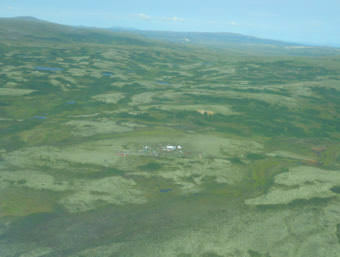
EPApebblepic
In this 2011 photo, an exploration camp sits on top of the Pebble deposit, one of the largest undeveloped copper, gold and molybdenum deposits in the world. (Photo courtesy U.S. EPA)

The proposed Pebble Mine is gaining momentum again, based on a settlement with the Trump Administration.

Last week, developers released a new vision for the project in southwest Alaska. Now that the federal government has removed a major roadblock, Alaskans can expect a lot more action at the state level.

When Pebble CEO Tom Collier took the podium at an industry gathering in Anchorage earlier this month, he recalled a speech he gave to the same crowd during the Obama years.

“I gave a detailed presentation on how we were going to win this battle with EPA — how we were going to get them off our backs and be able to go into permitting,” Collier said. “And as I looked around I saw a lot of very skeptical faces at the time.”

Fast forward to this year, and Collier’s prediction has come true.

In 2014, the Obama administration effectively halted the project after hearing concerns that the mine could harm the Bristol Bay salmon fishery. The Environmental Protection Agency took the unusual step of proposing steep restrictions before the normal permitting process could begin. Pebble argues this amounted to blocking the project.

But after a meeting with Pebble’s Collier this spring, new EPA Administrator Scott Pruitt announced a settlement allowing Pebble to move forward with permitting.

Collier — who claims he can build the mine without hurting the fishery — aims to start that process in December.

In an interview after his speech, Collier said all Pebble needs is a chance — if the project is allowed to go through the normal process, he believes the mine will be approved.

“You know when you’ve invested $750 million getting ready to go into permitting, it ought to go pretty smoothly,” Collier said.

That smooth permitting process is exactly what Pebble’s opponents are worried about.

“I thought the fight was over when EPA proposed its determination, and I thought that it would be finalized during the Obama administration,” said Lindsey Bloom. Bloom used to fish for salmon in Bristol Bay, and has opposed the mine for years as part of advocacy groups SalmonState and Commercial Fishermen For Bristol Bay.

Now that the federal government is back to following the process Pebble demanded, the mine’s opponents are increasingly turning their attention to the state.

They worry that Alaska’s existing laws might not be tough enough to protect Bristol Bay’s salmon.

“What we’ve seen is a permitting process that at every turn is geared and interpreted to get to the ‘yes,’ and to get to the permit,” Bloom said.

So Pebble opponents are trying to change state laws. This week, a judge upheld a ballot initiative that, if approved by voters, would significantly beef up protections for Alaska’s salmon streams. The measure’s backers say it’s not intended to block projects, but an attorney for the state said building the Pebble Mine would be impossible if the measure becomes law.

Opponents are also lobbying Gov. Bill Walker — and he’s listening to their arguments.

“I am not supportive of the Pebble mine,” Walker said in an interview in early October, the day before Pebble rolled out new details on the proposed mine.

“When it comes to two resources, renewable and non-renewable, I always go for the renewable and that certainly is the fish,” Walker said. “So I’m a fish-first person, and I have been historically and I stand there today.”

Walker didn’t propose any specific steps he’d take to halt the mine, but multiple state agencies will be involved in approving the project.

Unlike many of the Pebble’s opponents, the governor expressed confidence in the state’s existing laws.

“I don’t know that there’s a lever for me to pull that’s going to absolutely stop it. I think there are a lot of protections that are already in place,” Walker said.

As the groups fighting the mine ramp up pressure on the state, Pebble isn’t sitting idly by. It plans to challenge at least one current state law that could spell trouble for the project. In 2014, voters approved a ballot initiative requiring the Alaska legislature to approve a large-scale gold and copper mine in the Bristol Bay region. Last week, Collier announced plans to sue, claiming the statute is unconstitutional.

Alaskans can expect a lot more of that back-and-forth as the state takes on a bigger role in deciding the future of the proposed mine.

EPA is accepting public comments on withdrawing its restrictions on the Pebble project through October 17.

Industry, environmental groups speak out as Hilcorp paves the way for drilling in federal Arctic waters

Liberty
A 3-D rendering of Hilcorp’s proposed Liberty project as represented in the Bureau of Ocean Energy Management’s draft environmental impact statement. (Image courtesy BOEM)

Regulators are taking input on what could be the nation’s first oil production platform in federal Arctic waters.

The oil and gas company Hilcorp wants to build a gravel island in shallow waters in the Beaufort Sea, east of Prudhoe Bay. The Liberty project would be similar to several gravel islands built to produce oil in nearby state waters.
The federal Bureau of Ocean Energy Management, or BOEM, held its last hearing in Anchorage, on Tuesday, asking the public to weigh in as it prepares its environmental impact statement.

Many of the speakers were from industry or trade groups, who all argued in favor of the project.

“The Liberty Project represents a positive step towards perpetuation of the oil and gas industry in Alaska by curtailing oil production decline at this crucial time in Alaska’s history,” said Bob Stinson of Price Gregory, a company that constructs pipelines.

Most of the speakers echoed Stinson, saying the Liberty project would give a much-needed boost to the trans-Alaska pipeline. The pipeline is now running at about 500,000 barrels per day. Hilcorp plans to produce up to 70,000 barrels per day from Liberty.

There were a few dissenters. Protesters with the Center for Biological Diversity, an environmental group, briefly held up a banner in the hallway reading, “NO ARCTIC DRILLING.” During the hearing, the Center’s Blake Kopcho argued Hilcorp’s record in Alaska should disqualify it from a project in the Arctic Ocean.

“Hilcorp has a documented history of accidents and safety violations, which heighten the numerous inherent risks with offshore drilling in the Arctic,” said Kopcho.

Hilcorp was responsible for a months-long natural gas leak in Cook Inlet this spring.

The company did get a vote of confidence from a top state regulator. Andy Mack, who leads the state Department of Natural Resources, delivered the final public remarks.

“There’s no doubt — there’s no doubt at all — that the economic benefits are substantial,” Mack said. “It’s one of the projects in Alaska that’s been studied very, very extensively and I think that it’s a good project.”

The public comment period for the Liberty Project ends November 18.

Judge overrules state, says salmon initiative can go forward

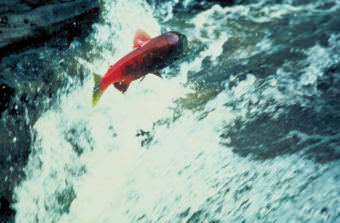
Alaska_salmon_jumping_out_of_water
A ballot initiative aimed at making salmon habitat protections more stringent will likely result in a fierce fight over the right use of state resources. (Photo courtesy U.S. Fish and Wildlife Service)

A controversial ballot initiative intended to protect salmon habitat has cleared a major hurdle, setting up what could be an intense political fight.
A judge in Anchorage on Monday ruled that Lt. Gov. Byron Mallott was wrong to deny the initiative, organized by the nonprofit Stand for Salmon.

Mallott rejected the ballot measure in September, arguing it would tie the state’s hands and prioritize salmon habitat over other potential uses of state land, like mining or oil development. The state says if it’s enacted, the measure could complicate efforts to build projects like roads, pipelines and the proposed Pebble Mine. The initiative is also opposed by a wide range of industry groups.

At a hearing last week, Valerie Brown with Trustees for Alaska, who represented Stand for Salmon, argued the ballot initiative isn’t aimed at prohibiting development, though it would add to the permitting process.

Superior Court Judge Mark Rindner agreed. In his ruling, he called it “pure speculation” to predict the impact of the initiative.

“The court has no competent evidence regarding the impact of the initiative,” Rindner wrote. “Nor does such evidence exist.”

Rindner said the initiative leaves enough room for the legislature to decide how resources are used.

“Because the impact of the initiative can only be determined after legislative action occurs, the court finds, as a matter of law, that the initiative is not an allocation and is thus constitutionally permissible,” Rindner wrote.

Mike Wood, one of the ballot measure’s organizers, applauded the decision.

“I think the ruling that the judge had was awesome,” said Wood. “Set politics aside and read it for what it is. And I think he did that.”

Wood, a commercial fisherman, was involved in opposition to the Susitna Dam. Two of the initiative’s other organizers, Gayla Hoseth and Brian Kraft, have been involved in fighting the proposed Pebble Mine.

Marleanna Hall is executive director of the Resource Development Council, one of the groups opposed to the ballot initiative. Hall said she’s disappointed, and her group is asking the state to appeal.

“Unfortunately, this initiative, as it is, poses a grave threat to community and resource development,” said Hall. “It puts economic activities highly at risk.”

Assistant Attorney General Elizabeth Bakalar said the state is evaluating whether to appeal the decision to the Alaska Supreme Court.

“Clearly we disagree with the court’s legal conclusion that the measure is a constitutional use of the initiative,” Bakalar wrote in an email. “…Whether to appeal to the Alaska Supreme Court includes an evaluation process that will take several weeks to complete, and that process is underway. In the meantime, we are complying with the superior court’s order and working on printing petition booklets for circulation as quickly as possible.”

Stand for Salmon can now begin collecting signatures. It aims to get the initiative on the ballot in 2018.

Barring a Supreme Court decision blocking the initiative, “the next decision is whether this is a good idea or not,” said Brown of Trustees for Alaska. “That’s the decision of the voters, not of the Lieutenant Governor.”

The initiative isn’t the only effort to make state laws protecting salmon habitat more stringent. It’s similar to a bill introduced in the state House by Kodiak Republican Louise Stutes, and co-sponsored by Anchorage Democrats Andy Josephson and Les Gara.

Correction: An earlier version of this story said the bill was introduced by Reps. Stutes, Josephson and Gara. In fact, the legislation was introduced by Rep. Stutes and later co-sponsored by Reps. Josephson and Gara. 

Walker doubles down on opposing Pebble Mine

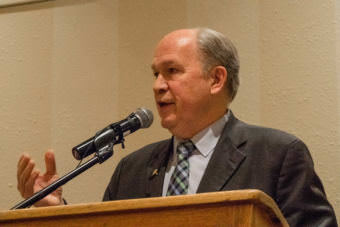
walkerpic
While Gov. Bill Walker expressed concerns about EPA’s earlier actions, he came out strongly against the project in an interview. (Alaska Governor’s Office photo)

Tomorrow, Pebble Limited Partnership CEO Tom Collier is expected to publicly outline a plan for the proposed Pebble Mine project for the first time.

But in an interview today, Governor Bill Walker said he’s against the controversial mine.
“I am not supportive of the Pebble Mine,” Walker said.

Walker said the mine’s developers have not yet proven to him that the project can be done without harming the Bristol Bay region’s salmon fishery.

“I do not have information sufficient for me to be comfortable or supportive of the Pebble Mine. The burden is on them to prove that it can be done without a risk to the fish in that area. It’s a high burden – it’s the highest burden, and to me, they have not met that yet,” Walker said.

Walker said he will consider what Pebble’s developers have to say, but he’s also listening closely to concerns from people who could be affected by the mine.

The governor did not say he’s planning to take any specific actions to halt the project.

“I don’t know that there’s a lever for me to pull that’s going to absolutely stop it,” Walker said, adding, “I think that there are a lot of protections that are already in place.”

It’s not the first time the Governor has said he’s not in favor of the mine — he came out against the project while campaigning for office in 2014. But the state will likely take on a bigger role in the Pebble Mine controversy soon.

Under the Obama administration, U.S. EPA proposed restrictions on the mine before the standard permitting process began.

Walker said he did have concerns about EPA’s previous action.

“Alaska’s a resource state…and my concern with that is that they sort of overstepped and didn’t let a process play out. If [EPA] could do that on that issue, then there are other issues they could do that as well,” Walker said. “It’s a delicate issue, but I certainly would not want to have that happen on a development that was not anywhere near a risk to a fishing area.”

However, Scott Pruitt, the EPA Administrator under President Donald Trump, reached a settlement with Pebble this spring, opening the door for the project to begin the permitting process. If that happens, the state also will begin its review of the mine.

Mike Heatwole, a spokesman for Pebble Ltd. Partnership, responded to Walker’s remarks in an emailed statement.

“The governor is correct that the burden is on us to demonstrate we will not impact the fish resource in the region,” Heatwole said. “While we believe our plan meets this hurdle, the next step is to have our plan thoroughly and objectively evaluated via the permitting process to determine if we meet the high standards Alaskans expect for development.”

Judge weighs whether ballot initiative favors salmon over mining, oil

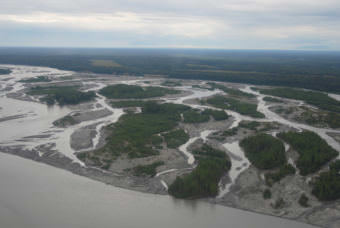
SusitnaRiver
Salmon habitat in the Susitna River could get additional protections under a proposed ballot initiative, but the state argues the protections go too far. (Wikimedia Commons photo by olekinderhook)

Last month, Lt. Gov. Byron Mallott rejected a potential ballot measure that would strengthen state law protecting salmon habitat. The state’s position is that if voters approved the measure, the legislature would be forced to protect salmon over other resource development, like mining or oil infrastructure.

The people behind the ballot measure — the nonprofit Stand for Salmon — appealed. Now, a Superior Court judge has to decide whether Mallott was right.

At a hearing Tuesday in Anchorage, the key question was this: does the ballot initiative give the state enough wiggle room to consider projects like the proposed Pebble Mine or Susitna Dam even if they impact salmon streams?
The state argues it doesn’t.  Assistant Attorney General Elizabeth Bakalar said the initiative would violate the state constitution by forcing the legislature to prioritize salmon habitat over other natural resource development.

Bakalar said megaprojects like the Pebble Mine proposal could be at stake.

Asked after the hearing if the Pebble Mine or Susitna Dam could be permitted if the ballot measure was approved, Backalar replied, “No, we don’t think so. That’s basically the crux of our case.”

But the attorney for the nonprofit Stand for Salmon, the group behind the initiative, argued the opposite. Valerie Brown with Trustees for Alaska said the language in the initiative does toughen regulations, but it doesn’t force the state to shut projects down.

“This sets up a system where really big projects that will cause a lot of harm to salmon habitat get increased scrutiny,” Brown said after the hearing.

Many Alaska industry groups came out in force against the ballot initiative, including the Alaska Oil and Gas Association, the Alaska Miners Association and the Resource Development Council.

Marleanna Hall, executive director of the Resource Development Council, said current law does enough to protect salmon habitat.

“We truly believe that [the ballot initiative] is a disproportionate response to a problem that doesn’t exist,” Hall said.

Hall said new language in the initiative could effectively halt a wide range of projects, from oil fields to roads.

Two of the initiative’s organizers, Gayla Hoseth and Brian Kraft, are outspoken opponents of the proposed Pebble Mine. A third, Mike Wood, has led efforts fighting the Susitna Dam.

But Wood, a commercial fisherman, said the ballot initiative is not intended to halt projects. Instead, he argued that Alaska’s laws protecting fish habitat are too weak.

“Let’s give this permit system some teeth again, so that we can be ensured that when these projects are built, that they won’t be impacting our fish resources,” Wood said.

Under current law, the Alaska Department of Fish and Game is charged with approving projects unless they are deemed “insufficient for the proper protection of fish and game.”

The ballot measure would add some specifics on what “proper protection” looks like. It aims to add language about water quality, temperature and flow. It would also set up a new permitting process for companies, one that’s based on the level of impact a project might have on fish habitat.

The initiative is similar to a bill that Kodiak Republican Louise Stutes introduced in the House Fisheries Committee this spring; Anchorage Democrats Andy Josephson and Les Gara later signed on as co-sponsors. Wood said his group supports the bill, too, but is taking a “belt and suspenders” approach by also pushing for the ballot initiative.

Judge Mark Rindner is expected to make a decision this week on whether voters should decide this issue at the ballot box. But that may not be the final word. The case will likely be appealed to the Alaska Supreme Court.

Stand for Salmon aims to get the initiative on the ballot in 2018.

Correction: An earlier version of this story failed to include Republican Louise Stutes as the lead sponsor of House Bill 199. Stutes introduced the bill, and Reps. Josephson and Gara later signed on as co-sponsors.

Valdez spill response continues as Alyeska investigates cause

Valdezspill
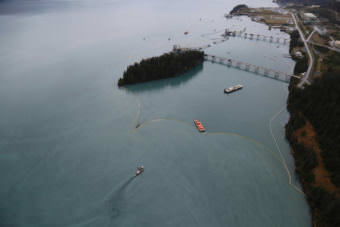
Response task forces of fishing vessels and self-propelled skimmers at the Valdez Marine Terminal on Sept. 23. (Photo courtesy Alyeska Pipeline Service Company)

Alyeska Pipeline Service Company is investigating how crude oil ended up in the Port of Valdez after a spill last Thursday. Since cleanup efforts began, Alyeska estimates about 400 gallons of oily water have been recovered.

Alyeska reports the spill happened during yearly testing of the loading arms at the Valdez Marine Terminal — the pipes that deliver crude oil to tankers. During an unplanned pause in testing, oily water flowed back through the system, out of the intake pipe and into the Port of Valdez.

There was containment boom in place at the end of the berth during the testing — that’s standard procedure, according to Kate Dugan, a spokeswoman for Alyeska. However, the intake pipe was located outside of the boom.

Dugan said Alyeska has ruled out a mechanical failure, but it isn’t ready to pinpoint human error during testing as the cause of the spill.

“That’s what the investigation is going to determine,” Dugan said.

Cleanup of the spill is continuing. Dugan said Monday morning overflights of the area confirmed that the only remaining sheen is contained to the vessel decontamination area.

The state has not yet confirmed the total amount of crude oil that ended up in the water. Geoff Merrell at the state Department of Environmental Conservation said the nature of the spill makes it hard to figure out.

“This is not a traditional spill and so oil volume estimating is very difficult and is an inexact thing,” Merrell said.

Merrell said the state is also investigating the root cause of the spill, but it hasn’t come to any conclusions yet because the current focus is on cleanup. Merrell added he’s received no reports of wildlife harmed by the spill.

Donna Schantz, executive director of the Prince William Sound Regional Citizens’ Advisory Council, said her group is generally happy with Alyeska’s response to the incident.

But Schantz added the amount of work it’s taking to recover from a relatively small spill should be a wake-up call.

“We’re fortunate that it wasn’t a larger amount spilled, fortunate that the weather cooperated… But I think it really makes people realize the challenges that we’d be faced with had this been a larger spill,” said Schantz.

Since the spill was first reported, more than 290 people, dozens of vessels and just under 22,000 feet of boom have been deployed.

Clarification — an earlier version of this post said over 23,000 feet of boom has been deployed. Alyeska has updated its estimate for the amount of boom deployed to just under 22,000 feet.

Site notifications
Update notification options
Subscribe to notifications