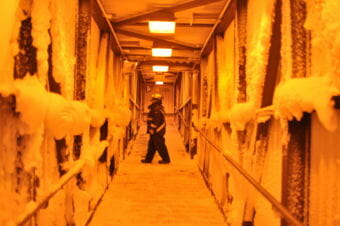
A ConocoPhillips worker at one of the company’s North Slope facilities last winter. (Photo by Elizabeth Harball/Alaska’s Energy Desk.)
This year, job numbers in the Prudhoe Bay region dropped to the lowest levels in a decade, according to the Alaska Department of Labor and Workforce Development.
State data shows that in May, 8,923 workers were employed in the region, which is dominated by the oil sector and the industries that support it. The last time numbers were that low was in May 2007, when 8,836 workers were employed there. That’s compared to record-high of 13,485 jobs in March 2015.
Oil prices have gone up a bit recently, but Neal Fried, an economist with the state, said it’s hard to predict whether the industry will stop shedding jobs any time soon.
“We’re not quite sure whether those numbers are beginning to flatten out or not,” Fried said. “We can’t answer that question.”
Fried estimates that in the first half of this year, 2,100 people lost their jobs in Alaska’s oil sector. Fried introduced the data at a recent Resource Development Council conference in Anchorage.
The oil price crash that began in 2014 — and the industry layoffs that followed — are at the root of Alaska’s current recession.
But Fried said an economic recovery for Alaska doesn’t have to lean entirely on the oil industry.
“It’s not going to take a recovery in the oil sector to necessarily cause the recession to come to an end,” Fried said. “There could be other industries that even are just growing marginally.”
For the first half of 2017, overall job losses in Alaska slowed. Fried said sectors like fisheries, tourism and the military could help pull the state out of the recession, even if the oil industry doesn’t start adding jobs again.
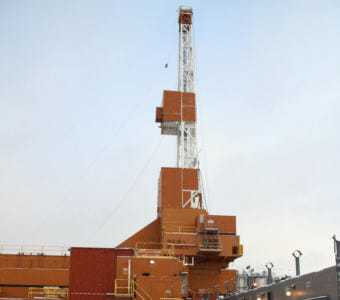
The drilling rig on Spy Island. Eni aims to begin exploration in December. (Photo courtesy Bureau of Safety and Environmental Enforcement)
The federal government has given an Italian company the go-ahead to explore for oil in Arctic waters this winter.
It’s the first oil exploration in Arctic federal waters since Shell abandoned its campaign in 2015.
The company, Eni, aims to begin drilling in December. It will operate from an existing man-made gravel island, called Spy Island. Spy Island is about three miles offshore, in state waters west of Prudhoe Bay.

The prospect is about four miles away from the island, so Eni plans to use extended-reach drilling. According to the company, it will be be the longest extended-reach well in Alaska.
Eni already produces about 20,000 barrels of oil per day from its facilities on state land. If the exploration in federal waters goes well, Eni thinks it could double production.
Eni secured its leases before the Obama administration’s decision last year to remove the Arctic Ocean from new oil and gas leasing for five years. The Trump administration is currently reconsidering that decision.
In a statement, Bureau of Safety and Environmental Enforcement Alaska Region director Mark Fesmire said, “Exploration must be conducted safely and responsibly in relation to the Arctic environment and we will continue to engage Eni as they move forward with drilling its exploratory well.”
At least one environmental group is worried about the approval.
“Offshore drilling threatens coastal communities and wildlife and will only push us deeper into the climate crisis,” Kristen Monsell of the Center for Biological Diversity said in a statement.
Clint Winzenburg was at this year’s Resource Development Council conference, and he thinks the Trump administration can help take Alaska’s economy a positive direction. (Photo by Elizabeth Harball, Alaska’s Energy Desk.)
When Donald Trump was elected president, Alaskans immediately started wondering what changes were in store — especially when it came to oil and mining.
One year later, we have a better idea. The Trump administration is moving to get rid of many Obama-era policies, affecting everything from the Pebble Mine, to offshore oil drilling, to the Arctic National Wildlife Refuge.
Last week, at two different gatherings in Anchorage, Alaskans expressed very different feelings about the big shift in Washington.
The first event was the Resource Development Council’s annual conference. As Governor Bill Walker took the stage to speak, he was practically walking on air.
“What a great day this is — it started off wonderfully in Washington, D.C.,” Walker said.
Walker was feeling celebratory because, that morning, Congress took another step towards allowing drilling in the Arctic National Wildlife Refuge — just one of many pro-oil developments happening under the Trump administration. And, Walker said, the push is coming from the very top.
“We have an administration that wants energy dominance,” Walker said. “And I love it when President Trump has said a number of times to me, ‘America cannot have energy dominance without Alaska at full potential.'”
At this year’s conference, the optimism was in the hallways, too, where there was a general feeling that a door that was once closed has opened up again.
Clint Winzenburg was working a booth for Alaska Industrial Hardware. He thinks Alaska’s future is looking up under the Trump administration.
“I think mining’s going to take off, I think there’s going to be new exploration up on the [North] Slope,” Winzenburg said. “I see good things, positive things.”
“There’s more potential and more opportunity than there ever has been,” said Kate Blair, who works for the oil refining company Andeavor.
Kate Blair thinks the Trump administration is opening up opportunities, but worries things might be happening too quickly. (Photo by Elizabeth Harball, Alaska’s Energy Desk.)
But Blair does see one reason to be concerned about all the actions Trump is taking. She thinks if this administration moves too aggressively in the industry’s favor, it could backfire at the ballot box.
“What’s scary is how many restrictions are being rolled back that… the pendulum could swing the other way,” Blair said. “At the next election, people could think he’s gone too far.”
Blair summed up her feelings about what the Trump administration means for her industry in two words: cautious optimism.
The conference ended with a focus on the optimism part as participants cheered and clinked champagne glasses.
But the mood couldn’t have been more different at a gathering organized by a local left-leaning group, 49 Moons. It was held at the Williwaw restaurant, less than a block away from the industry conference.
“The dread and fear that we all felt last November, for me, has really found a place to roost,” Valerie Brown of Trustees for Alaska, one of the speakers, told the audience. Trustees for Alaska is a law firm that represents environmental groups.
“I know some of us here were thinking maybe, maybe, maybe he would not act as badly as his campaign rhetoric promised,” Brown continued. “And those of us who dared to hope for the best, now, I think, have all the information we need to join the ranks of those who feared for the worst.”
The Pebble Mine, the potential for drilling in the Arctic Refuge, the rollback of environmental regulations — everything people were feeling exited about at the Resources Development Council conference, here it was cause for sadness and alarm.
“I’m not hopeful at all,” said Dana Durham of Girdwood, who was at the event.
Joan Galt (left) and Dana Durham at the Williwaw event (photo by Elizabeth Harball/Alaska’s Energy Desk)
Durham said she’s worried that if the oil industry starts drilling in the Arctic Refuge, that land will be shut off to people who want to enjoy the wilderness. She’s been there four times.
“Everything in that area there is going to be tied up, it’s going to be like private land. Nobody will be able to go there,” Durham said. “I hate to see that place change.”
Durham came to the event with her longtime friend, Joan Galt. They met on a flight from Anchorage to Washington, D.C. more than a decade ago; they were going there to lobby against drilling in the Arctic Refuge. Galt is also deeply unhappy with the way things are going under Trump.
“I feel depressed and anxious about how hard I’m going to fight over the next few years,” said Galt.
But unlike her friend, Galt does find one reason to be optimistic.
“I do hope that we don’t open the Arctic Refuge to drilling,” Galt said. “But I kind of feel like maybe the oil companies aren’t going to be that interested.”
Galt believes there’s no guarantee it will be economic for oil companies to drill in the Refuge. And that, she said, is a reason for her to stay hopeful.
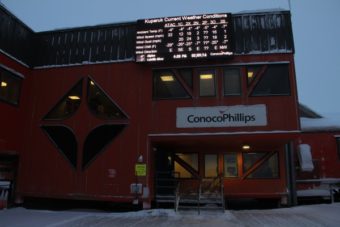
The entrance to ConocoPhillips’ Kuparuk Field camp. (Photo by Rachel Waldholz/Alaska’s Energy Desk)
ConocoPhillips announced today that its newest development on the North Slope is producing oil, two months earlier than anticipated.
The project, called 1H NEWS, had to overcome several challenges. One was the type of oil. Lisa Bruner, Conoco’s vice president of North Slope Operations and Development, explained it’s a harder-to-produce viscous oil, requiring new technology to get it out of the ground.
“The oil is heavier, so it flows more slowly, and as cold as it is here, it’s harder for the oil to flow than some of our other reservoirs,” Bruner said.
Another challenge was economics. Conoco first announced the project in 2014, but put it on hold in early 2016 after oil prices crashed.
“[We] went back to the drawing board and rolled up our sleeves and tried to figure out a way to reduce our costs to a point where it is economic,” Bruner said. “And it’s economic, but it’s not as competitive as some of the best things in our portfolio.”
According to Conoco, the project cost about $400 million, $60 million less than the initial estimate. But Bruner said it’s unlikely the company would green-light the same project today.
“If we were to look at it today and drill the exact same wells in the exact same way, and go for funding approval now within ConocoPhillips, it’s probably not something that would compete for funding,” Bruner said.
The development is in the Kuparuk Oil Field. Most of the company’s most promising new projects are further West, in and around the National Petroleum Reserve.
It’s expected to produce about 8,000 barrels of oil per day.
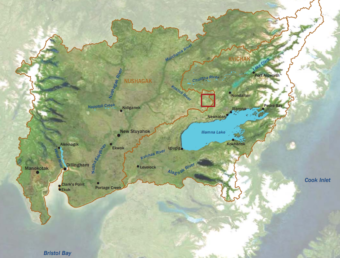
Map of the Bristol Bay region. Iliamna and Newhalen are close to the Pebble Deposit location, indicated by the red box. (Photo courtesy U.S. EPA)
The Trump administration is currently weighing a decision that could alter the future of the Pebble Mine — and the Bristol Bay region communities that would see the mine built in their backyard.
That includes Dillingham and Iliamna. They were the only two places the Environmental Protection Agency visited last month to get public input on whether to scrap an Obama-era proposal to put restrictions on the mine. In Dillingham, residents spoke unanimously against the idea. But in Iliamna, the reaction was more mixed.
At least one resident is still deciding whether the mine is a good idea.
Evelynn Trefon wears a lot of hats; she’s the school secretary, she’s on the city council, she’s on the board of the electric co-op. She also runs a business selling fruit in the summer. And she was also my tour guide, driving me around the roughly 16 miles of quiet roads that run through Newhalen and Iliamna. As Trefon showed me the lay of the land, her 4-year-old daughter sat patiently in the back seat.
Evelynn Trefon is secretary at the Newhalen school, and also serves on the city council and the board of the electric co-op. (Photo courtesy Evelynn Trefon)
Trefon’s originally from Kansas, but she moved to Newhalen in 2011 with her husband, who grew up here. Newhalen and Iliamna together are home to about 350 people, spread out by the north shore of Lake Iliamna, the biggest lake in Alaska. We turned a corner and got a spectacular view.
“When it’s blowing, when the waves are coming up, it looks like an ocean,” said Trefon.
But as we continued on, Trefon started to describe the other landmarks she pointed out in a very specific way:
“So that’s the clinic there – the clinic employs quite a few people,” Trefon said. “The post office only employs one person.”
Whenever we passed a business or an office, Trefon told me how many jobs it provides. The same thing happened when we passed the Iliamna village council.
“And they employ probably four people — probably four or five people,” Trefon said.
It’s not a random fixation. Poverty rates here are higher-than-average for Alaska. The top employer is the Newhalen school, where Trefon works as the secretary. But that might not always be the case.
If it’s built, the Pebble mine would be about 20 miles from Iliamna. The company argues one reason it belongs there is it would provide more local employment. Trefon told me when the large mining company Anglo American left the Pebble project in 2013, some people in the community lost their jobs. Trefon said today, some find work in far-off places, like with the oil industry on the North Slope.
“But then that takes them away from their families, that takes them away from their friends, that takes them away from their subsistence lifestyles,” Trefon said. “So it’s hard, it’s a hard choice if you want to work.”
That helps explain why opinions were so mixed at EPA’s hearing in Iliamna last month. Local mothers like Trefon stood before federal officials and argued both for and against the mine. That included Margie Olympic from Newhalen, who has worked for Pebble for the last 11 years.
“I am very grateful that I have a job that I can put food on the table, pay bills have private insurance, get what my kids need and want and enjoy the luxuries of a car, boat, snow machine, new car,” Olympic said. “And the best part is I don’t have to get up and leave my community.”
But a different mother told EPA officials she feared the mine could endanger the salmon fishery — and that provides jobs, too. Renee Zackar of Igiugig explained how salmon have supported her entire family.
“My husband and I put up fish every summer. My two sons commercial fish in Bristol Bay. All three of my daughters worked at commercial fish processing at Naknek for two years. Two of my daughters went to the fly fishing academy program,” Zackar said.
Trefon was at the hearing, but she didn’t stand up to speak. She simply sat quietly and listened to what others had to say.
As Trefon started to drive back to where I was staying for the night, I asked: so, what about the salmon? Trefon said yes, subsistence fishing here is abundant. She turned down a gravel road and pointed towards another local spot.
“This road just takes you to the rapids, which is a pretty world-famous place to go fishing,” Trefon said.
I ask if she does any fishing, herself: “Oh yeah, I love to fish.”
Every summer, Trefon sees two species of salmon return to spawn in the river behind her house — a phenomenon she calls “miraculous.” The Pebble Partnership argues it can build the mine without harming the fishery. But if something goes wrong, Trefon wonders if the salmon could find their way back.
I asked Trefon if the Pebble Mine controversy has made things uncomfortable in Newhalen and Iliamna.
“Well there’s always drama, in any small community,” Trefon said with a laugh. “But the main thing we always come together for is always the kids. Both communities are fed into the Newhalen school and we always come together for the kids.”
That’s part of why Trefon decided to make a life here — for her, her husband and her daughter, who had fallen fast asleep in the back seat.
“I love living here,” Trefon said. “I can’t imagine living anywhere else.”
If the Pebble Mine gets built, it will bring significant changes to this small slice of rural Alaska. Just like her community, Trefon has mixed feelings about the mine. She hasn’t decided whether she thinks it’s a good idea or a bad idea.
She said Newhalen and Iliamna do need jobs. But a few hours after Trefon dropped me off and we said goodnight, she sent me a text. It read: “One last thought. Jobs are important, but salmon are more important.”
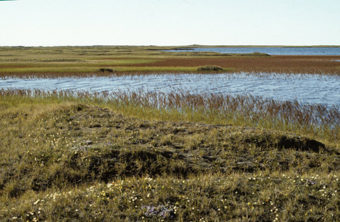
Pond on ANWR coastal plain. The Trump administration is asking federal geologists for a new assessment of the area’s oil potential. (Photo courtesy of U.S. Fish and Wildlife Service)
All eyes were on a Senate hearing in Washington D.C. yesterday, as Democrats and Republicans once again sparred over whether to drill for oil in the Arctic National Wildlife Refuge.
But one federal scientist whose work could sway the Arctic Refuge’s future wasn’t at the hearing — he was here in Alaska, giving a talk to an industry group.
David Houseknecht works for the U.S. Geological Survey, and he’s trying to figure out two key questions: How much oil is in the Arctic Refuge, and where is it? The answers could decide ANWR’s fate, no matter how the politics play out.
Houseknecht’s audience was packed with industry people and their political allies, eager for clues on where more oil might be hiding in the Arctic.
But Houseknecht wanted to make one thing clear right off the bat: he’s doesn’t like taking sides.
“I’m one of those persons who has always been registered independent voter — never missed an election, and always felt like people who belonged to one of the two parties ought to be taken out behind the woodshed somewhere,” Houseknecht said.
That statement was met with silence from the crowd.
As much as Houseknecht would like to avoid politics, he’s the guy who’s trying to figure out the Arctic Refuge’s oil potential. And that puts him in the crosshairs of a decades-long environmental fight.
“The thing about my job is that regardless of the estimate that we make, half of the population seems to be unhappy with us,” Houseknecht said. “So through the years as the administration goes from one party to the other, the bruises get equally distributed across my back.”
Houseknecht is bracing for some new bruises. The Trump administration has tasked his team with coming up with a new estimate of the Arctic National Wildlife Refuge’s oil potential. The last one was completed in 1998.
Houseknecht explained coming up with a new estimate is a challenge — mainly because he doesn’t have much to work with.
“In essence there’s nothing new there. We have not assessed or reassessed the ANWR area for 20 years because there’s no new data. We have no reason to think differently today than we did 20 years ago,” he said.
There’s been only one exploration well drilled in the Arctic Refuge’s coastal plain, and Houseknecht can’t access the results — it’s kept under lock and key by the companies that drilled the well. And the seismic data Houseknecht does have access to was collected in the 1980s, with old, 2-D technology. At the moment, all Houseknecht can do is reprocess the old data using new technology.
But the Trump administration is making a controversial push to allow what’s called 3-D seismic testing in the Arctic Refuge’s coastal plain. That could give geologists a clearer picture of how much oil might be there.
Houseknecht warned his audience that the results of that testing might not be what they’re hoping for.
“If a 3-D data survey were collected on the ANWR coastal plain and we interpreted that survey and did an assessment, there’s no guarantee that numbers will go up or numbers will go down,” said Houseknecht.
If the Trump administration manages to allow 3-D seismic testing in the Arctic Refuge, Houseknecht would get a much better idea of its oil potential. He might see evidence that there are giant, easily recoverable oil pools hiding deep beneath the coastal plain. Or he might not. Either way, how much oil is actually there will have a big impact on what happens to the Arctic National Wildlife Refuge.
But speaking to reporters after his talk, Houseknecht said it isn’t his job to think about that.
“We’re trying to look at the whole geological picture and evaluate what’s there,” Houseknecht said. “The policy issues come later and do not involve me.”
Houseknecht expects to finish the new assessment of the Arctic Refuge’s oil potential late next year.
Close
Update notification options
Subscribe to notifications
Subscribe
Get notifications about news related to the topics you care about. You can unsubscribe anytime.