Elizabeth Harball, Alaska's Energy Desk
Watchdog group calls for tougher training standards for oil spill response

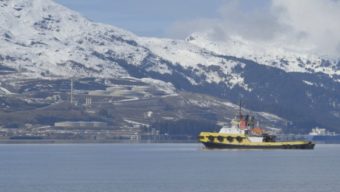
Crowley Marine Services currently holds the contract to provide oil tanker escorts and spill response and prevention in Prince William Sound. (Photo by Eric Keto/APRN)
Crowley Marine Services currently holds the contract to provide oil tanker escorts and spill response and prevention in Prince William Sound. The contractor will be replaced by Edison Chouest this summer (Photo by Eric Keto/APRN)

The Prince William Sound Regional Citizens Advisory Council, a citizens watchdog group, today passed a resolution asking for changes to how oil spill response crews are trained.

Alyeska Pipeline Service company is replacing its contractor in charge of guiding oil tankers through Prince William sound this summer, with the Louisiana-based Edison Chouest Offshore. New vessels are being built and crew training is underway.

The Council is concerned that new crews coming to Prince William Sound aren’t being trained in rough weather conditions they might have to operate in. Brooke Taylor is a spokesperson for the Council.

If the industry has determined conditions are unsafe to train in, we also feel they are unsafe to transport oil in,” Taylor said. 

The Council’s resolution states it “believes it is unsafe to require crews to respond to a vessel emergency in Prince William Sound during adverse weather conditions with inadequate or no training or experience in these conditions.”

Alyeska strongly disagrees with the resolution, saying they don’t want to put crews at risk unnecessarily. Scott Hicks is senior director of operations for Alyeska in Valdez.

“Some of the components of this resolution are actually asking for and advocating for conditions that put people, vessels and the environment in harm’s way, which is something we just don’t support,” Hicks said.

The Council is an advisory group, not a government agency, so Alyeska isn’t required to abide by the resolution. Alyeska wants Edison Chouest’s new vessels and crews to be working in Prince William Sound by July.

State-ordered investigation following BP leak finds no additional problem wells

BPfix
Image taken on April 18, 2017, showing the area of crude spray near BP’s well. (Photo by Jade Gamble, Alaska Department of Environmental Conservation)

A state-ordered review of thousands of oil wells on the North Slope is complete, following a multi-day oil and gas leak at one of BP’s facilities last spring.

The Alaska Oil and Gas Conservation Commission (AOGCC) found no additional wells that could lead to a similar accident, according to commissioner Cathy Foerster.
The state called for oil companies to review all North Slope wells after BP’s internal investigation found five of its producing wells had a similar design to the one that failed. Companies were required to complete the investigation by Dec. 31.

The failure happened after thawing permafrost put uneven stress on the well, causing the wellhead to shoot up and knock off a valve, which then spewed oil and gas. Foerster says the permafrost thaw was unrelated to climate change and was caused by the heat of the oil being recovered.

AOGCC is changing its regulations as a result of the accident.

“We are in the process of amending our regulations to prohibit that specific well geometry,” Foerster said.

Alaska’s leaders got more than they bargained for from Interior’s offshore drilling proposal

Cook Inlet oil platforms are visible from shore on Dec. 13, 2016 near Kenai, Alaska. (Photo by Rashah McChesney/Alaska’s Energy Desk)

The Trump administration recently proposed a vast expansion of federal waters available for oil development. Many U.S. states were not pleased — states like California, Oregon and Florida don’t want oil development off their coastlines.

Alaska is a different story. Alaska’s leaders got what they wanted in the plan — and then some. Now the question is: will Alaska ask the Trump administration to cut back?
Interior Secretary Ryan Zinke’s offshore oil leasing proposal has quickly evolved into a political hot-potato. Only five days after Zinke proposed making over 90 percent of federal waters available for oil leasing, he removed Florida from the plan, following objections from its Republican governor, Rick Scott. Then came the political firestorm, from Democratic leaders of states like Virginia and Oregon, who also want to be excluded. Among other things, critics accused Zinke of political favoritism. Now, the Interior Secretary says he’ll meet with every governor — Republican and Democrat — before making a final decision.

So — where does Alaska fit in? Of course, Alaska wants offshore development. The Walker administration wants the Beaufort and Chukchi seas opened to drilling. But Zinke also proposed allowing drilling off all of Alaska’s other shores, too, except for the region around Bristol Bay. That sparked outrage from environmental groups and concerns from the fishing industry and tribes across the Bering Strait region.

When asked if the state requested all federal areas but the North Aleutian Basin to be opened for offshore oil development, Alaska Department of Natural Resources Commissioner Andy Mack said, “No, we didn’t make the request.”

To confirm that, the Walker administration provided a letter Mack sent to the federal Bureau of Ocean Energy Management in August. The letter specifically asks for lease sales in the Chukchi Sea, the Beaufort Sea and Cook Inlet — but nowhere else. Mack said the state wasn’t looking at expanding oil development beyond those areas.

“We’re going to focus on the Arctic, and we think that is where the real opportunity sits,” Mack said.

So will Walker ask Zinke to remove areas besides Cook Inlet and the Arctic from the final offshore plan? The Governor’s office hasn’t yet responded to a request for comment on that.

Senator Lisa Murkowski, however, has already taken a stand on whether every offshore area Interior proposed for Alaska should be included in the final plan.

“Are all of these areas, areas that should move forward? No. I’ll just say that right out — no,” Murkowski said.

But Murkowski wasn’t criticizing Zinke. She stressed that this is just a proposal that can be winnowed down in the future — and she likes this proposal a lot more than what the Obama administration rolled out.

“I think for some it was a little bit shocking because it was like, ‘whoa, he’s just opened up everything!’ The Secretary didn’t open up anything,” Murkowski said. “What he did was put a draft out there, saying, ‘This is the universe that we’re talking about.'”

Murkowski wants — and expects — that universe to shrink. As long as it includes offshore oil lease sales in the Arctic and Cook Inlet, Zinke can expect continued support for his plan from both Murkowski and the Walker administration.

Alaska Public Media Washington Correspondent Liz Ruskin contributed to this story.

Four decisions in three weeks: How Trump is transforming Alaska

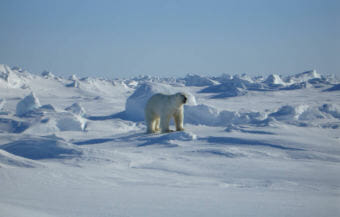
A male polar bear near Kaktovik. Polar bears have long been a powerful symbol for environmental groups fighting oil development in the Arctic. (Photo courtesy U.S. Fish and Wildlife Service)

Blink and you might have missed it: in just three weeks, there was a profound shift in the landscape for energy and environmental issues in Alaska.

While many Alaskans might have been busy with Christmas plans or ringing in the New Year, some of the state’s biggest resource battles reached turning points.

In total, there were four big developments since mid-December, largely thanks to the Trump administration.

If you didn’t catch them all, here’s a quick review:

No. 1 — Congress approves drilling in the Arctic National Wildlife Refuge

President Donald Trump congratulates U.S. Sen. Lisa Murkowski on passage of a bill to open the coastal plain of the Arctic National Wildlife Refuge to oil drilling. Rep. Don Young and Sen. Dan Sullivan flank Murkowski at the mic. (Video screenshot courtesy White House)
U.S. Sen. Lisa Murkowski speaks opening part of the Arctic National Wildlife Refuge to oil drilling.  (Screenshot courtesy White House)

Most Alaskans probably caught the biggest news story on the list, because it’s a doozy: on Dec. 20, President Donald Trump signed a tax bill into law that opened part of the Arctic National Wildlife Refuge to oil development.

This was a huge win for Alaska’s political leaders and a huge loss for environmental groups, who fought oil drilling in the Refuge for nearly four decades.

Then, in early January, the Trump administration made another big announcement related to oil and the Arctic.

No. 2 — Trump administration proposes re-opening Arctic offshore to oil development

The Noble Discoverer in Unalaska in 2012. (KUCB file photo)
Shell’s Noble Discoverer rig in Unalaska in 2012. (KUCB photo)

Interior Secretary Ryan Zinke announced he is putting Arctic waters back on the table as part of a new, 5-year draft plan for offshore drilling leases. Zinke called it part of “a new path for energy dominance in America.”

The plan includes the Beaufort and Chukchi seas, which the Obama administration controversially removed from its offshore drilling plan back in 2016. But it also opens the door for oil development off nearly all of Alaska’s other coasts — except for the North Aleutian Basin, near Bristol Bay.

Speaking of Bristol Bay…

No. 3 – Pebble mine permit submitted

A map of the mine plan submitted by Pebble. Image courtesy U.S. Army Corps of Engineers)

In late December, the Pebble Limited Partnership finally submitted a permit application to build a gold and copper mine in Southwest Alaska, a controversial proposal because of its proximity to the Bristol Bay salmon fishery. The Obama administration pretty much stalled Pebble when the U.S. Environmental Protection Agency proposed restrictions on the mine. But under the Trump administration, a settlement was reached, and now Pebble is moving forward again.

How much have things changed now that Donald Trump is in the White House?

“I think it’s dramatic,” Pebble CEO Tom Collier said in October.

No. 4 – Deal struck on King Cove road

A view of King Cove, which could build a road through the Izembek Refuge. (Photo by Berett Wilber/KUCB)

Another part of Alaska feeling the dramatic shift in Washington, D.C. is King Cove. In the first week of January, the city of King Cove said it reached a deal with the Trump administration to build a road through the Izembek National Wildlife Refuge.

King Cove has long argued it needs a road to access the airport in Cold Bay for emergencies. But environmental groups believe a road will jeopardize sensitive habitat. The Obama administration took environmentalists’ side and rejected the road in 2013. But as with a lot of Obama-era policies, it appears the Trump administration is trying to turn it around.

Those were the four biggest developments, but there are a few other stories worth noting.

— Just before Christmas, the Trump administration announced it has dramatically increased its estimate for how much oil is in the National Petroleum Reserve-Alaska, or NPR-A. NPR-A usually plays second fiddle to the Arctic Refuge in the headlines. But there’s a fight brewing there, too — oil companies are increasingly interested in drilling there, but the Obama administration put about half of it off-limits. The Trump administration is thinking about changing that. If there’s more oil in NPR-A than previously thought, that’s likely to influence the decision.

— Finally, at the end of 2017, Congress allowed an excise tax collected on American oil to expire, which goes into a government trust used for oil spill cleanup and prevention. However, Congress could eventually renew the tax, and the current balance is approximately $5.7 billion, according to Public Employees for Environmental Responsibility.

All told, the Trump administration is ushering in a historic shift in how Alaska’s resources are managed, from the North Slope to Bristol Bay. However, it’s important to note that many of these decisions aren’t final yet. Environmental groups have vowed keep fighting these changes — including in court.


Citizens group investigates Cook Inlet’s aging oil infrastructure

Cook Inlet oil rig
An oil rig in Cook Inlet, Feb. 22, 2009. (Creative Commons photo by hig314)

A watchdog citizens group is working on a series of reports on Cook Inlet’s oil and gas infrastructure, following several accidents last spring.
“Cook Inlet’s arguably one of the most challenging bodies of water in North America to conduct oil recovery operations in,” said Lynda Giguere, a spokesperson for the Cook Inlet Regional Citizens Advisory Council, or CIRCAC.

Those challenges were highlighted last year, when oil company Hilcorp took weeks to halt a gas leak in Cook Inlet because icy conditions hindered repair efforts.

To help prevent future leaks, the Council is working with government agencies and oil companies to inventory all the pipelines in Cook Inlet. The area is known for its harsh environment. Also, some of Cook Inlet’s oil infrastructure has been around since the 1960s. Giguere said that’s part of why compiling the report is a challenge.

“It’s an old field, there’s been a lot of operators there. There wasn’t always the record-keeping that we are looking for and expecting now done in the early ears. So it’s a lot of information, there’s a lot of gaps in that information,” Giguere said.

One report aims to pin down where all the pipelines are, how much they carry and if they have leaked before. CIRCAC will investigate the details of 88 spills in the Cook Inlet region between 2001 and 2017, according to an initial report to the council prepared by the Nuka Research and Planning Group.

A separate report will address the complicated web of government agencies that oversee oil and gas operations in Cook Inlet.

With the gas line leak, “it took a while to clear up the jurisdictional confusion and who had oversight,” Giguere said in an email. “When regulators can’t decide who has jurisdiction there is no effective regulatory oversight, because each agency thinks someone else is overseeing it. The more agencies that could have oversight, the more complicated it gets.”

She added, “by sorting out in advance who has jurisdictional authority over any given area, infrastructure, process, etc., industry can more effectively understand what regulations are in play and how they must comply.”

Giguere says the first reports will be presented to the CIRCAC board in April, but the group hasn’t yet determined when it can deliver final recommendations.

North Slope oil production ticked up again in 2017

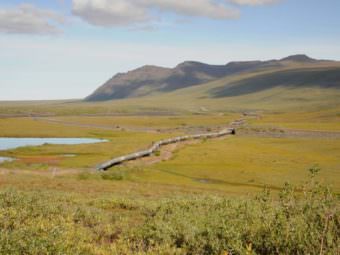
In 2017, the trans-Alaska pipeline moved 192,472,797 barrels of oil. (Photo courtesy the Center for Land Use Interpretation)

For the second year in a row, there was an increase in the amount of oil flowing down the trans-Alaska pipeline.

That’s according to its operator, Alyeska Pipeline Service Company. Alyeska announced that the pipeline’s average throughput went up by about 10,000 barrels per day in 2017 compared to 2016, a 1.5 percent increase.

“When we see two years in a row of increase, it gives us lots of optimism for the state of Alaska and also for pipeline operations going forward,” said Michelle Egan, a spokesperson for Alyeska.

North Slope oil production declined steadily starting in the late 1980s, when throughput peaked at over 2 million barrels per day. Before 2016, the last uptick in pipeline throughput was in 2002. Back then, it carried over one million barrels per day. In 2017, throughput averaged 527,323 barrels daily.

The pipeline was designed to carry much higher volumes of oil; in 2011, Alyeska released a study raising questions about whether it can continue operating below about 300,000 barrels per day. Egan said two years of increased throughput gives Alyeska some breathing room.

“Decline and low throughput creates a lot of technical challenges for us, so anything that can happen to slow that is a big help,” Egan said.

Alaska Department of Natural Resources deputy commissioner Mark Wiggin said the increase is due to a combination of factors. (Wiggin is an Alaska Public Media board member.) Wiggin said newer oil fields west of Prudhoe Bay, like ConocoPhillips’ CD5, are performing better than expected. Wiggin added that companies have managed to get oil out of old fields like Prudhoe Bay more efficiently.

“I think the takeaway is that the industry figured out how — in a very, very challenging price environment — to do some good work,” Wiggin said.

The state of Alaska officially projects that North Slope oil production will continue to go up this year, but then begin to decline again in 2019. However, Wiggin said recent new oil discoveries, such as Pikka, could contribute to raising North Slope production again.

Site notifications
Update notification options
Subscribe to notifications