Elizabeth Harball, Alaska's Energy Desk
Alaskans comment on Trump draft proposal to open state waters to oil, gas development

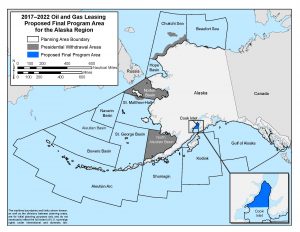
Alaska’s congressional delegation has asked that only three Alaska offshore areas remaining in the leasing plan. (Photo courtesy of The Bureau of Ocean Energy Management)
Alaska’s congressional delegation has asked that only three Alaska offshore areas remain in the leasing plan. (Photo courtesy of The Bureau of Ocean Energy Management)

Alaskans gathered in downtown Anchorage on Wednesday night to weigh in on the Trump administration’s proposal to open almost all Alaska waters to oil and gas development.

The Wednesday night meeting was the only opportunity for Alaskans to comment on the draft proposal in person, and many showed up to speak out against it.

Adrienne Titus helped organize a protest outside the meeting.

“When it comes to oil and gas development in our water and on our land, it’s going to highly affect not just our land and our water, but our people, our cultures, who we are — our identity, our food security,” said Titus, who is with the nonprofit Native Movement.

But another group of Alaskans showed up to support more offshore drilling opportunities.

Resource Development Council deputy director Carl Portman says his group doesn’t necessarily want to open up all the areas proposed by the Trump administration.

But Portman sees a lot of economic potential for Alaska in Arctic waters.

“23, 24 billion barrels. That’s huge. But that’s a very long-term prospect,” he said. “But if you have children here in Alaska that want to make Alaska home and raise their children here, then this is something you need to be paying attention to.”

The Interior Department expects to make a final decision on the offshore plan by the end of 2019.

Hilcorp CEO steps down

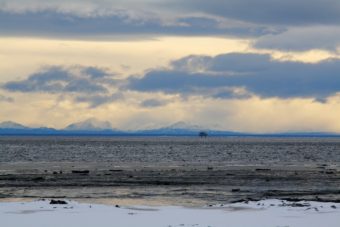
Cook Inlet oil rig
An oil rig in Cook Inlet, Feb. 22, 2009. (Creative Commons photo by hig314)

The CEO and founder of one of the biggest oil companies in Alaska has stepped down.

Hilcorp’s Jeffery Hildebrand has handed the reins over to the company’s former executive vice president, Greg Lalicker. A spokesperson from the company’s Texas headquarters confirmed the transition, saying in an emailed statement it was announced internally last November.

“The organizational change comes as the company, a longtime producer in Alaska, Texas and Louisiana, continues to see substantial growth in other legacy assets across the United States,” said Justin Furnace, Hilcorp’s corporate director of external affairs.

Hildebrand is known for being among the wealthiest people in the world, with a net worth of $7.6 billion, according to Bloomberg.

However, Hildebrand isn’t leaving Hilcorp altogether — in a statement, the company said he’s staying on as executive chairman and will “continue to be heavily involved with the company.”

According to state data, in 2017, Hilcorp was Alaska’s third largest oil producer and second largest gas producer. The company operates several fields on the North Slope. One of Hilcorp’s new North Slope projects, the Moose Pad, is likely to start up this year, with a peak estimated production of 16,000 barrels of oil per day. Hilcorp is also pursuing development of the first offshore oil production in federal Arctic waters, called the Liberty Project.

Additionally, Hilcorp is heavily invested in Cook Inlet production, although last year the company faced criticism when one of its fuel lines was discovered to have been leaking gas into the Inlet for months.

State leaders push to take next steps on ANWR drilling

MurkowskiYoung_ANWR
U.S. Sen. Lisa Murkowski and U.S. Rep. Don Young pose for a photos after speaking about the future of oil development in ANWR at an Anchorage event. (Photo by Elizabeth Harball/Alaska’s Energy Desk)

Now that Congress has approved drilling in part of the Arctic National Wildlife Refuge (ANWR), Alaska’s leaders are eagerly pursuing the next steps needed for oil development.

This week, the Walker administration asked the legislature for $10 million to help pay for seismic testing on the coastal plain of the refuge. Seismic testing will provide the first clues about how much oil is in the refuge, and where.

Alaska Natural Resources commissioner Andy Mack told the state Senate Finance Committee that seismic testing could attract more oil companies to the Arctic Refuge lease sales.

“It would be a very powerful tool to generate interest and to make sure that we got the full value that is called for in this proposed lease sale,” Mack said.

In the new federal law allowing oil development in ANWR, half of the revenues will go to the state of Alaska, and the other half goes to the federal government. It also requires two lease sales to be held within the next seven years.

Senator Lisa Murkowski wrote that section of the bill. But Murkowski isn’t done with ANWR. After speaking at an event in Anchorage this week, the Senator told reporters there are a lot of details that need to be filled in.

“Our bill was five pages long. And in previous iterations of ANWR legislation, it has been 20, 30, 40 pages of bill text,” Murkowski said.

Murkowski said because Congress approved ANWR drilling as part of a budget bill, Senate rules prevented her from including non-budget items. That included protections for North Slope communities that could be impacted by drilling in the Refuge. The Senator said she plans to introduce legislation to help deal with those impacts, such as requiring air quality monitoring near oil developments.

Environmental groups vehemently oppose any oil development in the Arctic Refuge and are expected to mount legal challenges against efforts to drill there. Still, the Interior department is expected to roll out more details on oil lease sales in the Arctic Refuge in the coming weeks.

Protesters call for gun control at event featuring Murkowski, Young

Protesters at an event featuring Sen. Lisa Murkowski and Rep. Don Young are quickly ushered out of the room on Monday, Feb. 19, 2018. (Photo by Elizabeth Harball/Alaska's Energy Desk)
Protesters at an event featuring U.S. Sen. Lisa Murkowski and U.S. Rep. Don Young are quickly ushered out of the room on Monday, Feb. 19, 2018. (Photo by Elizabeth Harball/Alaska’s Energy Desk)

A Monday night Anchorage event headlined by U.S. Sen. Lisa Murkowski and U.S. Rep. Don Young was interrupted by a small group of protesters, calling for action on gun control.

“You’ve got blood on your hands! You’ve got blood on your hands!” one protester said.

The event was intended to be a victory lap for Murkowski and Young, who were at the Anchorage Petroleum Club speaking about successfully opening the Arctic National Wildlife Refuge for oil development.

“The thing that we really want them to know is that the blood money with NRA is not going to go over any longer,” said protester Joni Bruner, who is with Alaska Grassroots Alliance.

One protestor refused to leave the building, and Anchorage police were called.

According to the protesters, no arrests were made.

After the event, Murkowski told reporters there aren’t easy answers when it comes to curbing mass shootings, such as the one that happened Feb. 14 at a school in Florida.

“I am so torn as a lawmaker, as a parent, as an Alaskan and clearly a supporter of the Second Amendment,” Murkowski said. “But I think we have not dealt with our present day reality, which quite honestly is an unacceptable reality.”

Murkowski added that dealing with mental health issues must be the first step in addressing mass shootings.

According to Murkowski’s spokesperson, the senator is planning on co-sponsoring legislation to provide grants for training in schools aimed at preventing future violent incidents.

New EPA head for Alaska talks Pebble, budget cuts and climate change

Chris Hladick was appointed as EPA Region 10 administrator in October. (Photo by Wesley Early/Alaska Public Media)

The U.S. Environmental Protection Agency (EPA) has a big part to play in some very controversial issues in Alaska and beyond, from the proposed Pebble Mine to national climate policy.

The Trump administration recently appointed Chris Hladick to lead EPA Region 10. Hladick will oversee EPA’s work in Alaska, as well as in Washington, Oregon and Idaho.

Alaska’s Energy Desk got a chance to catch up with Hladick at the Alaska Forum on the Environment conference in Anchorage this week. In a wide-ranging interview, Hladick answered questions about the agency’s recent Pebble Mine decision, EPA’s budget and climate change.

Before landing his federal post, Chris Hladick spent a lot of time at various levels of government in Alaska. Most recently, Hladick was a member of Governor Bill Walker’s cabinet, serving as commerce commissioner. Before that, he worked for the cities of Unalaska, Dillingham and Galena.

Hladick thinks that experience will come in handy:

“I bring to the table local knowledge of how things can actually work on the ground here in Alaska,” Hladick said.

Hladick said his boss — EPA administrator Scott Pruitt — recently called him up seeking some of that local knowledge, on a hot topic for many Alaskans: the proposed Pebble Mine.
“He was interested in knowing how many people the commercial fishing out there employs, as opposed to what the mine will employ. I think he went through a process in his mind of weighing all the issues together,” Hladick said.

Shortly after that conversation, Pruitt made news: he decided to keep in play EPA’s proposal to put environmental restrictions on the mine, a move that surprised and thrilled Pebble’s opponents.

Hladick declined to speculate how Pruitt came to the decision.

“I think you’d have to ask him that,” Hladick said.

Hladick said despite Pruitt’s decision, EPA is keeping busy with Pebble. The company still aims to get its permits, so EPA is working with the Army Corps of Engineers as it prepares an environmental impact statement for the mine.

That’s just one of many big projects EPA is involved with in Alaska. Others include the Donlin mine and the Nanushuk project, a big North Slope oil development. EPA also provides millions of dollars in grant funding for projects in Alaskan communities and tribal villages, including grants to help with drinking water infrastructure and cleaning up Superfund sites.

Meanwhile, the Trump administration just proposed steep budget cuts for EPA as a whole, reducing its funding by more than a quarter and eliminating thousands of jobs at the agency. Hladick didn’t criticize the cuts, saying part of his job is to figure out how to do “more with less.”

“Our workload is expanding while our budgets are decreasing, so we have to make sure we focus on the right things,” Hladick said.

Hladick noted that last year, Congress didn’t go through with all the cuts the Trump administration requested, and he expects the same thing to happen again this year. But Hladick did acknowledge that if Congress went through with budget as proposed, it would impact EPA’s work in the region.

“If there’s a 30 percent cut, I think everybody will feel it. That’s a lot of money,” Hladick said.

In the document outlining its proposed budget, EPA touts the cuts, saying it’s “proud to be a good steward of taxpayer resources and to efficiently deliver environmental protection.”

Environmental groups, on the other hand, criticized the budget proposal, saying it would endanger the environment and public health.

Environmental groups are also slamming Trump’s EPA for its approach to climate change.  Pruitt questions the extent to which human activity is causing climate change, and under him, EPA is walking back Obama-era proposals to regulate greenhouse gases.

Being from Alaska, Hladick said he can’t deny climate change is an issue.

“I’ve been involved in Arctic issues since at least 16 years ago, and there’s no doubt the Arctic is changing,” Hladick said.

EPA may be stepping away from its Obama-era focus on regulating greenhouse gases, but Hladick said he wants the agency to continue working with communities seeing on-the-ground impacts from global warming.

More layoffs announced at Prudhoe Bay

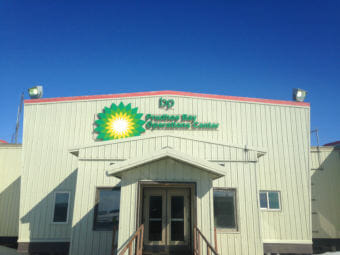
As a result of a contract change with BP, over 230 Prudhoe Bay workers will be laid off in March, although they can pursue employment with the new contractor (Photo by Elizabeth Harball/Alaska’s Energy Desk}

Over 260 Alaska workers — including over 180 union employees — will be laid off March 31 as a result of a contract change with oil company BP. Most of the employees were working at Prudhoe Bay.

That’s according to a report to the Alaska Department of Labor and Workforce Development, sent by the contractor, New Jersey-based Mistras Group, Inc.

According to BP spokesperson Dawn Patience, the decision to end the contract was made to reduce costs amid continued low oil prices. Mistras performed inspections on pipelines and other infrastructure for BP.

BP instead awarded the contract to Anchorage-based Kakivik CCI, a subsidiary of Bristol Bay Industrial. Kakivik is non-union, according to BP. Kakivik was already doing a large portion of BP’s pipeline inspection work.

Kakivik spokesperson Sheila Schooner said the company is now seeking over 200 workers to fill the contract, although Schooner could not say whether the contract change would result in a net loss of jobs. Schooner Kakivik is encouraging Mistras workers to apply for the jobs.

Site notifications
Update notification options
Subscribe to notifications