
Elizabeth Harball, Alaska's Energy Desk

The trans-Alaska pipeline fights off 22 million cyber attacks. Daily.

Bill Rosetti, Alyeska Pipeline Service Company’s chief information officer, at the company’s Anchorage headquarters. (Photo by Elizabeth Harball/Alaska’s Energy Desk)

The symbol of a well-known caped crusader is taped to the door of a secure room at Alyeska Pipeline Service Company’s Anchorage headquarters. The sign reads: “THE BAT CAVE.”

My guides don’t know why the sign’s there. Maybe it’s the lack of windows. Or maybe it’s because the people who work in this room see themselves as undercover crime-fighters, like Batman — because they sort of are. This is the office of Alyeska’s cybersecurity team.

The trans-Alaska pipeline has dealt with its share of problems — earthquakes, declining oil flow, even gunfire. But today, the pipeline is facing another, more modern threat: cyberattacks. Energy infrastructure is a tempting target for hackers, and the trans-Alaska pipeline is no exception. Alyeska, which operates the pipeline, now ranks cyberattacks as one of its top three risks.

In the room where part of the pipeline’s cybersecurity team is stationed, Alyeska’s Bill Rosetti points at a wall of data flowing down three giant screens hanging above the cubicles. It’s all totally incomprehensible to a layperson. But for Rosetti and his staff, weird activity on one of the colorful charts rippling across the screens could indicate something serious.

“The idea here is that we are looking for things to be normal,” Rosetti explained. “And anything that’s not normal is something that needs to be investigated.”

Rosetti is Alyeska’s chief information officer. He’s in charge of keeping cyberattackers at bay. Rosetti takes that job seriously, because the trans-Alaska pipeline is getting hit by cyberattacks all the time — and not just a few.

“We see about 22 million attacks a day,” Rosetti said.

And that’s an average.

“It can be six or seven million some days and 45 million the next,” Rosetti said. “I wish I could tell you why it changes that way, but I really don’t know.”

Of course, there aren’t millions of people carrying out these attacks individually. These are mass, automated attacks, often coming from servers overseas.

Rosetti said so far, none of the cyberattacks have been successful; Alyeska has never been breached. But the challenge is growing. Rosetti said the rate of cyberattacks has roughly doubled in the last five years.

So how are hackers going after the trans-Alaska pipeline, and why? Rosetti says they have all kinds of goals, and all kinds of techniques. There’s phishing, for example:

“Some are very focused — that’s called spear-phishing — where they’re aimed at our CFO, trying to get people to wire them money,” Rosetti said.

And then there are attacks that threaten the trans-Alaska pipeline itself. As the energy industry settles into the Internet age, more of its machinery is controlled remotely by computers. If someone manages to breach those systems, there could be dangerous real-world consequences. I asked Rosetti what the worst-case scenario would be if there was a major cyberattack on the trans-Alaska pipeline.

“We think about what the worst case is so we can protect against the worst case. And I don’t want to share what that is,” Rosetti said.

Throughout the interview, Rosetti was very vague and careful with his words, because, he said, he didn’t want to give hackers any clues. But he did acknowledge that a successful cyberattack could interrupt the flow of oil down the pipeline. It could even result in people getting hurt.

The growing cyber threat to pipelines and other infrastructure is worrying the topmost levels of government — late last year, the Department of Homeland Security and the FBI issued a warning that sophisticated cyberattackers have targeted the U.S. energy sector, in particular.

Jim Guinn leads the company Accenture’s cybersecurity business for the energy, utilities, chemicals and metals and mining industries. Part of Guinn’s job is to help energy companies prepare for cyberattacks. As far as he’s concerned, the potential consequences of a major cyberattack should be the No. 1 thing keeping energy executives up at night, if it isn’t already.

“It could be anywhere from a spill, to loss of the command of the plant itself, to explosion, to loss of life. It would be no different than losing a platform in the Gulf of Mexico or in the North Sea,” Guinn explained.

Guinn said the threat level to America’s energy system hinges on two factors: the bad guys’ capability to pull off a cyberattack and the bad guys’ desire to actually inflict damage. So far, those two factors haven’t lined up.

But “there are those in the intelligence community that have openly said that they believe that an attack at scale could occur on U.S. soil, or against a U.S. company within the next 12 to 24 months,” Guinn said.

Guinn couldn’t speak specifically to the cyber threat facing the trans-Alaska pipeline. But he said one thing’s for sure: the risk isn’t going away.

“The reality is, as long as these assets are attached to networks and they are managed the way that they are today, there is a real threat that they could be manipulated for malintent. It’s just the unfortunate world that we live in.”

Trump official says Interior aims to move ‘pretty quickly’ on Arctic Refuge oil development

Interior Deputy Secretary David Bernhardt speaks at an industry breakfast in Anchorage on March 8. (Elizabeth Harball/Alaska’s Energy Desk)

A top Interior Department official today said the Trump Administration is working to speed along the process leading to oil development in the Arctic National Wildlife Refuge.

Interior Deputy Secretary David Bernhardt and Assistant Secretary Joe Balash spoke at an industry gathering in Anchorage this morning after spending several days in North Slope communities.

Bernhardt said in the next few weeks the Interior Department will kick off the regulatory process required before it can hold an oil lease sale in the refuge.
“We expect to move pretty quickly on that project,” Bernhardt said.

Congress is requiring that two lease sales be held in the refuge’s 1002 area within the next seven years. But when he was asked exactly when the first lease sale will happen, Bernhardt didn’t directly answer. The Deputy Secretary instead noted he issued a memo saying that environmental impact statements must be completed in a year.

“If you were looking for a time frame, Joe [Balash] might tell me that that’s a little ambitious. But…we’re starting this process very, very soon, and I take my memos very, very seriously,” Bernhardt said.

Environmental groups, which have long opposed oil development in the refuge, reacted with alarm.

“The Trump administration is in a headlong rush to sell off America’s public lands for development, and cannot possibly  complete important processes or fully consider the concerns of local communities in their attempt to drill at the earliest possible date,” Nicole Whittington-Evans of the Wilderness Society said in a statement.

Earlier this week, Senator Dan Sullivan reportedly said he wants the first oil lease sale in the refuge to take place next year — one year before President Donald Trump must seek re-election.

State regulator pushes for stronger laws to deal with abandoned oil wells

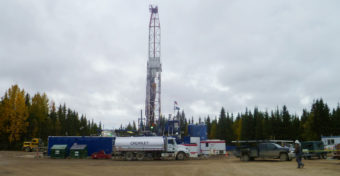
A rig drilling in the Kenai National Wildlife Refuge. (Image courtesy BLM-Alaska)

A top state regulator is asking the legislature to make sure oil companies pay to clean up old oil wells, even after the wells are sold to a different company.
Cathy Foerster of the Alaska Oil and Gas Conservation Commission testified before the Senate Resources Committee on Monday.

Foerster said it’s becoming more common for smaller oil companies to operate in Alaska, and those companies may be more financially unstable. She gave the example of Aurora Gas, which declared bankruptcy last year. Foerster said the company is unable to pay to plug and abandon its wells, three of which are on state land, making the state financially responsible for cleaning them up.

“Aurora Gas doesn’t exist anymore, we cannot go back to Aurora gas and ask them for the money to [plug and abandon] those wells. It ain’t going to happen — just take a deep, cleansing breath and let that one go,” Foerster said.

Foerster warned that if a big oil field like Prudhoe Bay is sold to a smaller company that goes bankrupt and can’t pay for cleanup, it could cost the state billions of dollars. She said the state currently has a $200,000 bond to cover the cost of plugging and abandoning all the wells at Prudhoe Bay.

“For $200,000 we couldn’t even pay for the engineering study that would give us the estimate on what the true cost is to plug all of those wells,” Foerster said. “So we’re in a bad situation on having adequate bonding for our wells, and we’re working it.”

Foerster says her agency has the authority to increase bond amounts. But Foerster argued the legislature should also act. One idea she floated is to update the law so the state can require former operators to pay to clean up abandoned oil wells.

“Don’t we want to have the ability to go back on BP, Exxon and Conoco and say ‘you guys made a boatload of money off of this, and you drilled these wells, now get back up here and clean them up?’ We need you guys to take care of that,” Foerster said.

Foerster said two other states, California and Kansas, have passed similar laws.

Alaska Oil and Gas Association president Kara Moriarty said her group wants to see legislation before it forms a position on Foerster’s proposal, but she added that the issue of future well abandonments is “a potential problem that may not exist.”

Moriarty said her group is generally wary of additional regulations.

“I would just be cautious of anything that seems to put another hurdle on companies either coming to Alaska or being interested in investing in Alaska,” Moriarty said.

What can unflappable geese teach us about the future of Arctic development?

A nesting female white-fronted goose. (Photo courtesy U.S. Geological Survey, Alaska Science Center)

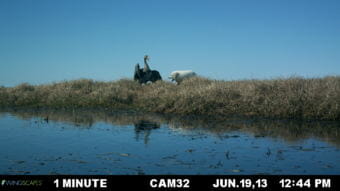
Here’s a drama in three acts. The year: 2013. The setting: a marshy patch of brown grass in Alaska’s National Petroleum Reserve. And there in the middle is a nesting female greater white-fronted goose. For a while, not much happens: the goose just sits on her eggs.

But then comes the second act. A small, fuzzy, white Arctic fox approaches the nest. Mother goose springs into action.

An Arctic fox approaches. (Photo courtesy U.S. Geological Survey, Alaska Science Center)

“Upright, wings spread, mouth open, very aggressive — she actually looks quite mean,” said Brandt Meixell, a researcher with the U.S. Geological Survey, narrating a series of photos taken by a camera set up about 20 feet from the goose’s nest.

But not mean enough to deter Mr. Fox. The tangle intensifies: in the next photo, the fox bares its teeth as the goose flaps her wings.

A fight! (Photo courtesy U.S. Geological Survey, Alaska Science Center)

Finally, act three: the mother goose’s aggressive defense pays off, and the fox turns tail and leaves.

goose 4
Soon after this photo was taken, the fox departs (Photo courtesy U.S. Geological Survey, Alaska Science Center)

“And then one minute later, she’s back on her nest, relaxed, and it looks as though nothing happened,” Meixell said.

The moral of the story? Mother geese do not like to leave their nests. Meixell explained that’s because they need to protect their eggs from foxes, gulls and other Arctic opportunists.

“To be honest, the predators know where every goose nest is,” Meixell said.

So what happens if a new character enters the scene?

Oil companies have started to see a lot of potential in the National Petroleum Reserve-Alaska following several recent, big discoveries. But every summer, millions of migratory birds like the greater white-fronted goose descend on the reserve to lay eggs, molt their feathers and fatten up. A lot of the oil potential lies squarely in migratory bird habitat.
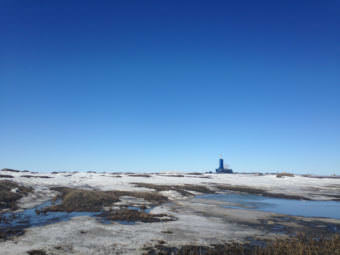
So Meixell and his colleagues wondered if industrial activity would drive geese away from their nests more often or for longer, leaving the eggs vulnerable to hungry predators.

A perfect opportunity to investigate came about in 2013 and 2014. There was a cleanup of an old Air Force radar station in the reserve, involving a lot of noisy machinery like vehicle traffic, heavy equipment and helicopter activity — things that seem likely to spook a greater white-fronted goose.

The scientists set up cameras at nests near the cleanup and at nests a few kilometers away, for comparison. Over the course of two summers, they collected millions of photos, of which 1.6 million were interpretable.

Those photos told a surprising story. Meixell pointed out a particularly striking example:

A DC-6 landing close to a nesting goose. (Photo courtesy U.S. Geological Survey, Alaska Science Center)

“Here’s a photo where there’s a female goose, and a DC-6 is landing on the runway, just about five meters from the nest,” Meixell said.

Amazingly, the goose stays put, even as the plane’s wing is about to pass right above the nest.

“She certainly notices it and makes the decision to remain and protect her eggs,” Meixell said.

Meixell and his colleagues collected a series of photos of white-fronted geese staying on their nests as planes flew by, backhoes dug up holes and helicopters buzzed overhead.

goosebackhoe
A nesting goose sits at center, not far from an ongoing cleanup. (Photo courtesy U.S. Geological Survey, Alaska Science Center)

In the end, the scientists concluded that nearby industrial activity only had a minor effect — the geese close to the noisy cleanup did leave their nests for a few minutes longer each day on average, but it didn’t result in a lot more eggs getting munched up by predators.

In fact, the thing that had the biggest impact were the researchers. When they walked directly up to the nests to check on them, that’s when geese left the longest.

So does this mean the oil industry can go ahead and drill and the geese will be fine?

“Of course, as a scientist, I’m going to say that it’s much more complicated than that,” Meixell said.

Audrey Taylor, a migratory bird researcher and assistant professor of environmental studies at University of Alaska Anchorage, agreed.

“I think we don’t want to jump to the conclusion that industrial disturbance doesn’t affect birds in any way,” said Taylor, who wasn’t involved with the study.

Taylor said the study spells out some important lessons for oil companies. For example, it shows that it’s a good idea to avoid walking directly up to nesting geese, so companies could potentially document where nests are to avoid them.

But Taylor also said there are still questions about how the oil industry could impact migratory birds in the National Petroleum Reserve. For example, what happens if there’s industrial activity while the geese are molting? Every year, geese take refuge in the reserve while they shed and re-grow their flight feathers.

“Activity or disturbance during that time could certainly have a bigger effect because they’re going to be running away from it rather than flying,” Taylor said.

Taylor said that as the oil industry pushes further into the habitats of mother geese, foxes and all the other species living in the reserve, studies like this one are becoming a lot more important.

Murkowski sends letter questioning oil companies about drop in Alaska hire

BPrig
An oil rig at Prudhoe Bay this spring. (Photo by Elizabeth Harball, Alaska’s Energy Desk)

Senator Lisa Murkowski on Friday released a letter she sent to five oil company leaders, saying she is concerned about the steady decrease in Alaska hire in the oil industry.

Murkowski cited a recently released Alaska Department of Labor report, stating the share of out-of-state workers in Alaska’s oil industry rose to 37.1% in 2016. That’s compared to a low of 28.1% in 2009.

The Senator addressed the letter to the heads of ConocoPhillips Alaska, BP Exploration Alaska, Alyeska Pipeline Service Company, ExxonMobil Alaska and Hilcorp Alaska.

As the Senator does every year, Murkowski asked for data on how many Alaskan residents the companies employ, including contractors and subcontractors.

In response to a request for comment, three of the companies provided statements including data on how many Alaskans they employ.

BP reported 76% Alaska hire.

“We do encourage our contractors to hire Alaskans,” BP spokesperson Dawn Patience said in an email. “BP will respond directly to the Senator’s request.”

Conoco reported 84% Alaska hire.

“We strongly support Alaska hire and buy, and encourage our contract companies to hire Alaskans,” Conoco spokesperson Natalie Lowman said in a statement.

Alyeska reported the highest share of in-state hire at 95%.

“All of our active recruiting is in Alaska. We work with Alaska colleges and universities, trade training programs [and] local job fairs,” Alyeska spokesperson Michelle Egan said in an email. “We are very committed to hiring Alaskans.”

Hilcorp reported 89% Alaska hire. A spokesperson said the company was unable to provide further comment.

A spokesperson for Exxon also said the company was unable to comment for this story. Exxon’s website states its percent Alaska hire is roughly 85%.

Offshore drilling public meeting draws supporters, critics and criticism

Alaskans enter comments on the Trump administration’s offshore drilling draft proposal at a meeting held in Anchorage on Feb. 21, 2018 (Photo by Elizabeth Harball/Alaska’s Energy Desk)

Alaskans gathered in Anchorage this week to weigh in on the Trump administration’s proposal to open almost all Alaska’s federal waters to oil and gas development.

The Wednesday night meeting was the only opportunity for Alaskans to comment on the draft proposal in person. But it wasn’t the meeting some participants had hoped for.

When it came to the 100 or so Alaskans who showed up to the meeting, there were no surprises. Outside, a group of protesters gathered, waving signs and chanting about the potential environmental consequences of offshore drilling. Inside, a pro-industry group had rented a room by the meeting to hold their own mini-rally, during which speakers extolled the economic promise of oil development off Alaska’s shorelines.

But once participants got to the meeting itself, the federal Bureau of Ocean Energy Management (BOEM) took over the choreography. Citizens were greeted by a video projected on a large screen, offering a cheery explanation of the Trump administration’s sweeping offshore drilling proposal.

“Based on comments received from citizens, elected officials, tribes and others, as well as BOEM’s analysis, the Secretary made the decision to consider the areas shown on this map for potential oil and gas leasing,” the video’s narrator said.

A map of Alaska flashed across the screen, surrounded by potential areas for oil and gas development. Everywhere from the Arctic Ocean to the Gulf of Alaska is under consideration for offshore drilling under the Trump administration’s draft proposal; only the Bristol Bay region is off the table.

“This video plays on a loop so we encourage people to come in here and watch it,” said BOEM spokesperson John Callahan.

In the neighboring room, Callahan introduced friendly federal employees standing behind tables, ready to explain the complex bureaucratic process the federal government uses to decide where drilling should and shouldn’t be allowed.

Jason Brune of the Consumer Energy Alliance Alaska held a gathering for supporters of offshore oil development in a room next to the meeting. (Photo by Elizabeth Harball/Alaska’s Energy Desk)

By now you might be wondering: at what point in this process did Alaskans get to speak out?

“Here are the stations where people input their comments,” Callahan said, pointing to a table near the doorway.

BOEM has changed how it runs public meetings. At this forum, there was no podium and no formal process for participants to give speeches or listen to what other Alaskans had to say about the Trump administration’s offshore drilling proposal. Rather, there was a line of five laptops, where meeting attendees quietly typed in their comments.

Those comments are available to read at regulations.gov. Reporters were also free to chase down people at the meeting and ask them what they wrote in their comments.

In the hallways, several participants had complaints about the meeting itself.

“I was here to voice my frustration that there was no comment drawn from coastal communities, no meetings were held in any coastal communities,” said Noah Sunflower with the Alaska Marine Conservation Council.

Anchorage is hundreds of miles away from parts of Alaska that could be directly affected by the draft offshore drilling proposal — fishing ports like Dutch Harbor, or North Slope villages like Kaktovik. This time around, there were no meetings in those places. Sunflower didn’t think that was fair. Neither did Adrienne Titus, who is originally from Unalakleet but now lives in Fairbanks.

Of course, there’s only one meeting, and it’d be in the metropolis of Anchorage,” Titus said, adding that many people from Native communities couldn’t make it to the meeting.

That’s part of why Titus, who is with the activist group Native Movement, helped organize the protest that was held outside.

Adrienne Titus helped organize a protest held outside the meeting. (Photo by Elizabeth Harball/Alaska’s Energy Desk)

Jim Kendall, who’s in charge of the BOEM’s Alaska branch, said there were good reasons behind the decision to have one meeting in Anchorage.

“We needed to keep on schedule, we don’t have unlimited resources and we are taking a very national approach to this national program,” Kendall said.

Kendall said the meeting was held in Anchorage because it’s centrally located, rather than Juneau, where it was initially proposed — public meetings in other states about the offshore drilling draft proposal were held in state capitals.

Kendall added that this isn’t the end of the process. When Interior releases the next stage of its proposal, Alaskans can weigh in again. And at that stage, Kendall said it’s likely meetings will be held in communities near where offshore drilling is proposed.

This particular exercise in American democracy will end at the end of 2019, when the Interior department is expected to make a final decision on its offshore drilling plan. That means the first offshore oil lease sale in Alaska’s Arctic could happen as soon as next year.

Site notifications
Update notification options
Subscribe to notifications