Elizabeth Harball, Alaska's Energy Desk

Army Corps addresses criticism of environmental review process for Pebble

EPApebblepic
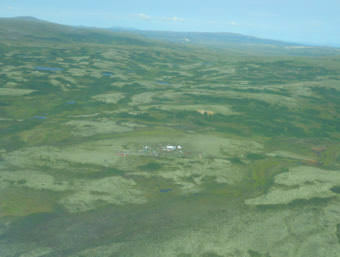
In this 2011 photo, an exploration camp sits on top of the Pebble deposit, one of the largest undeveloped copper, gold and molybdenum deposits in the world. (Photo courtesy U.S. EPA)

Another environmental assessment of the proposed Pebble Mine is underway. This time, the lead agency is the Army Corps of Engineers, and in a call with reporters yesterday, the agency addressed criticism it’s already receiving as it weighs whether to give the controversial mine a permit.

Sheila Newman, regulatory division deputy chief with the Army Corps’ Alaska District, said the agency recognizes that Pebble is not an average project proposal — it has a long history in Alaska, so the agency is trying to make adjustments for that. For example, it gave the public a longer-than-usual period to read the permit application before the first comment period.

“We went for complete public access and transparency as soon as we possibly could for this project by making the application publicly available, I think was 15 days after we received it. So that was a first,” Newman said.

The Army Corps recently extended the first period for the public to weigh in on the proposed mine — called the scoping period — by two months, after Native Corporations and top officials like Lisa Murkowski said 30 days wasn’t long enough.

Newman also spoke to questions about the format of the public scoping meetings. The Army Corps is not using the traditional public hearing format at the Homer, Dillingham and Anchorage meetings this month; rather, it’s taking comments “orally to a dedicated court reporter, electronically using a number of dedicated laptop computers, and submitting handwritten comments using a comment form,” according to its website.

This move was criticized by mine opponents like the United Tribes of Bristol Bay, which said the Army Corps was trying to “avoid” public testimony.

Newman responded that this is due to “confusion” about the purpose of a scoping meeting versus a public hearing. The Army Corps is having more public meetings in the future after it releases its draft environmental impact statement, which they estimate will happen early next year.

“Both things occur during our process; the public hearings where we’re actually asking folks for public testimony, if you will, occur at the draft [environmental impact statement] stage. The scoping meeting is that the sole purpose of it is to help us form that table of contents for the document,” Newman said.

The criticism of the meeting format, Newman added, “comes from maybe a poor word choice on our part and maybe not a clear explanation of the differences between a scoping meeting and a public hearing. We haven’t produced anything yet for the public to actually comment on or give testimony on. We are just now trying to establish the framework of the document that we are going to produce.”

Mine opponents also charge that the Army Corps is fast-tracking its environmental review for Pebble. The agency says its final decision on Pebble could happen as soon as early 2020, which would be faster than the review for the Donlin Mine, for example, by several years. Newman says the shortened timeline is because the Army Corps has improved its review process.

“We had already decided from our learning experience on these other large mine projects — Donlin and Chuitna — that we were going to build as many efficiencies into the process as we could, so we are not spending unnecessary time,” Newman said.

Of course, Newman didn’t say whether the Army Corps will grant Pebble its permit once the process is complete. She also wouldn’t say what factors would lead the agency to deny a permit. But Newman acknowledged a denial is rare for the Army Corps — the district has denied less than 1 percent of permits over the last fiscal year, she said.

However, she added, many applicants withdraw their permit applications before a decision is made, if the project can’t minimize environmental damage to the Army Corps’ standards.

During the current scoping period, the Army Corps is asking for public input on what they should consider in their environmental analysis for the proposed Pebble Mine. It’s currently holding a series of meetings on that topic. That comment period now ends June 29.

Opponents of salmon ballot initiative raise over $2 million

Alaska_salmon_jumping_out_of_water
A ballot initiative aimed at making salmon habitat protections more stringent is facing well-financed opposition. (Photo courtesy U.S. Fish and Wildlife Service)

A group opposing a controversial ballot initiative to strengthen protections for salmon habitat has raised over $2 million since Jan. 8, roughly 10 times more than the initiative’s supporters brought in over the same period.

Those figures include non-monetary contributions like air travel and staff time.

In a filing this week with the Alaska Public Offices Commission, the opposition group, called Stand for Alaska, reported major contributions from some of Alaska’s biggest industry players.
Oil company BP gave $500,000 and ConocoPhillips gave $250,000, in addition to staff time. Other big donors included mining companies Pebble Limited Partnership, Donlin Gold, Kinross Fort Knox and Hecla, which contributed $200,000 each.

Yes for Salmon, the group backing the initiative, reported contributions of just over $200,000. Its largest contribution was $100,000 from John Childs, who is chairman of a Massachusetts private equity firm. Childs is also on the board of the Wild Salmon Center, an environmental group in Portland that’s supporting the ballot initiative. Other support came from national environmental groups like Trout Unlimited and local groups like the Alaska Center and Cook Inletkeeper.

Yes for Salmon supporters say the state’s current permitting rules for projects that could impact salmon habitat are too lax, while industry argues the measure would effectively shut down a wide range of projects.

But it’s not yet guaranteed that voters will weigh in on the initiative. The state believes it’s unconstitutional and is opposing it in court. The Alaska Supreme Court will hear arguments in the case later this month.

As new oil spill response vessels arrive, Alyeska argues Prince William Sound is safer than ever

COMMANDERIMG_7994
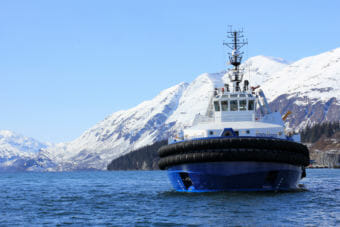
The Commander, a new tugboat operated by Edison Chouest, in Port Valdez. (Photo by Elizabeth Harball/Alaska’s Energy Desk)

On a picture-perfect April day in Port Valdez, Alyeska Pipeline Service Company, the operator of the trans-Alaska pipeline, took a small band of reporters and camera crews on a tugboat ride.

During a spin around the Port Monday — during which reporters were encouraged to wander around, chat with the captain and take photos — Alyeska staff and the boat’s crew eagerly showed off the Commander, a sparkling new, blue tug built by the Louisiana-based company Edison Chouest Offshore.

The tugboats, barges and crews now arriving in Port Valdez are the most visible sign of a huge transition taking place in Prince William Sound. Alyeska Pipeline Service Company is bringing on Edison Chouest as a new contractor responsible for oil spill prevention and response. The switch has drawn scrutiny and criticism, so Alyeska is trying hard to reassure Alaskans that Prince William Sound — the site of the 1989 Exxon Valdez oil spill — will be safer than ever before.

Nine new tugboats like the Commander will help guide oil tankers. Four new custom-designed response barges are outfitted and crewed to respond to an oil spill.

DAYTOUR_IMG_7883
Alyeska’s Mike Day (center) speaks to reporters on one of Edison Chouest’s new oil spill response barges. (Photo by Elizabeth Harball/Alaska’s Energy Desk)

Earlier, on board one of the new barges, Alyeska’s Mike Day guided reporters to the new oil spill cleanup equipment. Pointing at the underside of a skimmer, where there was a line of fuzzy white discs designed to collect oil, Day explained how they’re a big improvement from the old ones.

“The existing skimmers pick up about 22 percent oil and about 78 percent water, these skimmers are roughly twice that efficient,” Day said.

That theme continued throughout the tour. Alyeska and Edison Chouest staff highlighted upgrade after upgrade, from the tugboat’s more powerful engines to the toilets in the living quarters.

When it comes to the transition to Edison Chouest, that’s the message Alyeska wants to hit home: “It’s an improvement — we’re roundly convinced that it’s an improvement,” said Day.

There’s a reason Alyeska is working so hard to make this case. The contractor that Edison Chouest is replacing, Crowley Marine Services, has had a long, successful history in Prince William Sound. When Alyeska said in 2016 it was ending its contract with Crowley, it drew a lot of skepticism. Day said that’s understandable.

“We knew that this would receive a lot of scrutiny. And we welcome that,” said Day. “So no, there was no illusion that this was going to be a matter of swapping out some tugboats and some people and continuing business.”

Some of the loudest criticism has come from unions; Crowley’s workers are union members and Edison Chouest’s are not.

“It’s quite frankly a disgrace. That’s how we feel about it,” said Don Marcus, president of the International Organization of Masters, Mates & Pilots.

Marcus branded Edison Chouest as “exceedingly anti-union;” it’s not clear if the company will hire Crowley workers once its contract ends, although the company won’t rule out the possibility.

“Edison Chouest said that they intend to hire Alaskans over time but that for mariners, they will likely draw from their existing workforce of experienced captains and crew,” Alyeska spokesperson Michelle Egan said in an email, adding, “Every applicant will be considered as positions become available.”

Marcus argued that by bringing in crews new to Alaska waters, Edison Chouest is putting Prince William Sound at risk. Alyeska disagrees. It says Edison Chouest’s captains have an average of 26 years of sailing experience and that they’re undergoing extensive training to prepare for the Sound’s conditions.

But training is also an issue for another group, the Prince William Sound Regional Citizens Advisory Council (RCAC). Amanda Bauer is president of the RCAC board, and for over a decade, she’s also captained a tour boat in Valdez.

“Working in the Sound like I do, I don’t see a whole lot of winter weather, but I see enough in the fall to know what it can do, how different it can be and how even the smallest conditions — even six to nine foot seas — can sometimes be the worst,” said Bauer.

AmandaBauerIMG_8043
Amanda Bauer on board one of the tour boats she captains in Prince William Sound (Photo by Elizabeth Harball/Alaska’s Energy Desk)

In January, the RCAC unanimously passed a resolution stating Alyeska should require Edison Chouest’s crews to train in all weather conditions they’re expected to operate in. Alyeska flatly rejected this request — its position is that training in rough weather would put crews in danger unnecessarily.

Bauer said that’s a big reason why she still has reservations.

“There’s ways to get rid of the skepticism… but until something is done in some heavy seas, I’m always going to be skeptical,” Bauer said.

Still, Bauer said she’s “cautiously optimistic” about Edison Chouest’s arrival. She said the new tugs and barges are a huge investment for Alyeska, and from her perspective, that shows commitment.

In a harbor near where Edison Chouest’s new tugs are docked, Bauer is getting her tour boats ready for the season: big, white catamarans that seat about 150 tourists. Standing by the captain’s seat, Bauer said the visitors come to see glaciers and whales.

But also, “Every year, I think this is the year I’m not going to talk about the Exxon Valdez anymore — it’s been 29 years,” Bauer said. “But it’s always the first question that somebody asks when they get on the boat: ‘Where was the Exxon Valdez? What happened?’ And so we still talk about it, we still narrate the whole thing.”

“I don’t know if that’s ever going to change. I don’t know when we’ll ever get away from that,” Bauer added.

The lasting memory of the Exxon Valdez disaster is why regulators require Alyeska to put so many resources into preventing an oil spill. It’s why there are two tugboats guiding every oil tanker and it’s why barges with boom and skimmers are constantly standing by.

And it’s why Alaskans like Bauer will be watching very closely when Edison Chouest officially takes over the job on July 1.

Why a Papua New Guinea company is taking over one of Alaska’s biggest oil fields

Oil Search Alaska LLC President Keiran Wulff at the company’s Anchorage office. (Photo by Elizabeth Harball/Alaska’s Energy Desk)

Before getting in to who’s drilling there and why, let’s make one thing clear about this oil field: the state of Alaska thinks it’s a very big deal.

“Literally, if you line up the big fields up on the North Slope, this probably ranks third behind Prudhoe Bay and Kuparuk,” said Alaska Department of Natural Resources Commissioner Andy Mack.

Prudhoe Bay and Kuparuk, of course, are the giant oil fields responsible for making Alaska the oil state it is today. And on a chunk of state and native owned land west of Prudhoe Bay called the Pikka Unit, one company thinks there might be over a billion barrels of recoverable oil. Mack said the oil in this area alone could reverse the long-term decline in the amount of oil flowing down the trans-Alaska pipeline.

“If all goes well, it could lead to not only flattened production, but also increased production,” Mack said.

So last fall, when a company a lot of Alaskans hadn’t heard of moved to take over developing this oil field, it got people’s attention.

Oil Search is a company based in Papua New Guinea, a country just south of the equator and just north of Australia, where it also has offices. An oil project in the Arctic may seem like an odd leap for a company from an island nation in the South Pacific. But in a recent interview, the newly-minted president of Oil Search Alaska, Keiran Wulff, said the company is serious about its new venture.
“We see Alaska as a place of enormous opportunity,” Wulff said.

Wulff said its first planed development in Alaska could represent a significant investment for Oil Search — in the range of $4 billion to $6 billion. The company bought a significant stake in the project last year from its main partner, Denver-based Armstrong Oil and Gas, with an option to take over the rest of Armstrong’s stake if all goes well. (The Spanish oil company Repsol continues to own a significant percentage.)

Last week, Oil Search officially took over as operator of the field. That means when it comes to actually getting an oil development off the ground, Oil Search is in the drivers seat.

Sitting in the conference room of the company’s new offices in downtown Anchorage, which it now shares with Armstrong, Wulff makes it clear Oil Search is gearing up for what could be something big.

“We’ve just taken the whole floor here — we’re actually expanding so that we can fit over 120 people on this floor, and the majority of them will be Alaskans,” Wulff said.

So why did Oil Search come to Alaska? The company operates all the producing oil fields in Papua New Guinea. But the bulk of what it’s invested in there is gas  — it’s a partner in a major LNG project there — so the company decided it needed to balance its portfolio. True to its name, Wulff said Oil Search came to Alaska searching for more oil.

“Gas projects — as the state’s finding out right now — often take many years to come to fruition, whereas oil projects are a lot quicker to market, so it’s very important for any company to have a balance between oil and gas,” Wulff said.

It might not seem like Papua New Guinea and Alaska have much in common. But Wulff said his company sees a lot of similarities.

“Papua New Guinea is one of the most challenging places to work on the planet. It’s very remote, very mountainous, there are no roads, there is no infrastructure to speak of. And everything has to be brought in on helicopters and such,” Wulff explained.

Beyond logistics, Wulff said Oil Search has experience negotiating with local communities living near where the company wants to drill. Wulff thinks in some ways, communities in Papua New Guinea and communities on the North Slope have similar values.

“[They are] very passionate about their environment, very passionate about their way of life. And so an important part there — and a strong analogy between Papua New Guinea and Alaska — is the commitment and passion of the local community to their areas, and that’s something you’ve got to respect and be very cognizant of,” Wulff said.

Wulff said Oil Search’s discussions with Nuiqsut — the community closest to the company’s first planned development — are still in their infancy. Kuukpik, the village corporation for Nuiqsut, has spoken in favor of the development, but records from public meetings show that some in the community have concerns about the project’s potential impacts.

“We’ve been doing a lot of listening,” Wulff said.

And that’s not the only remaining issue. Oil Search wants to drill a few more appraisal wells to get a better idea of how much oil it’s actually sitting on.

“Look, I think it’s still a long way to go before people understand how big this field is,” Wulff said. “Our company is quite a conservative company. We don’t over-promote and we don’t over-promise. Our style is much more to under-promise and over-deliver.”

Depending on whether and how all the details come together, it’s possible that by 2023, a Papua New Guinea company could begin producing from one of the biggest oil developments in Alaska’s history.

Feds take key step toward approving another Conoco development in NPR-A

Harball_DSC_0090
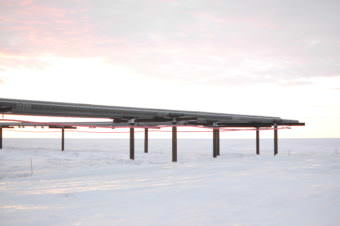
A flow line curves above the horizon on the western North Slope, not far from where Conoco hopes to build the Greater Mooses Tooth 2 project. (Elizabeth Harball/Alaska’s Energy Desk)

The federal government has taken a key step in the permitting process for a new oil development in the National Petroleum Reserve-Alaska, west of Prudhoe Bay.

The Bureau of Land Management today released a draft environmental impact statement for the Greater Mooses Tooth 2 project, or GMT2. If it goes forward, GMT2 would be ConocoPhillips’s third oil development inside the boundaries of the National Petroleum Reserve-Alaska.
“This [environmental impact statement] will help us look at the best way to develop this project, and it’s a really important step in developing on the North Slope,” said Conoco spokesperson Natalie Lowman.

For Conoco, the permitting process for GMT2 has taken much longer than expected. The company is now aiming for first oil in 2021, a year later than it originally planned. But the company now thinks the project is back on track.

“We believe that permitting is now proceeding on a reasonable schedule,” said Lowman.

Lowman said the $1.5 billion project could produce up to 30,000 barrels of oil per day.

The project would be west of the Village of Nuiqsut. The BLM says potential impacts to Nuiqsut and its subsistence resources will be “of particular interest” as it weighs permitting the development.

Those impacts “may result from hunter avoidance of the area, changes in access to subsistence use areas, resource (particularly caribou) availability, community participation in subsistence activities, aircraft traffic, spills, and rehabilitation of infrastructure upon abandonment,” the agency states in the draft environmental impact statement.

In the document, BLM notes Conoco has taken steps to mitigate impacts to subsistence resources. The agency will take public comments on Conoco’s proposal until May 7.

Salmon initiative clears another hurdle

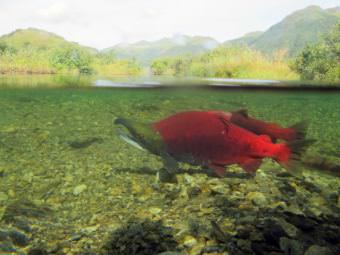
A new report says salmon, including sockeye, shown here, could have habitat disrupted by new rainfall and snow patterns caused by climate change. (Photo by Katrina Mueller/U.S. Fish and Wildlife Service)
The Yes for Salmon initiative has enough signatures, but the state Supreme Court still has to weigh in before it lands on the ballot. (Photo by Katrina Mueller/U.S. Fish and Wildlife Service)

Sponsors of a controversial ballot initiative that aims to strengthen state law protecting salmon habitat say its been certified by the Alaska Division of Elections.

The Yes for Salmon initiative reports it received close to 42,000 signatures, significantly more than required. The initiative will appear on the ballot either during the primary election in August or the general election in November, depending on whether the Legislature ends its session on time.

“Economic development is necessary, but protecting salmon habitat is too,” Stephanie Quinn-Davidson, Yes for Salmon ballot sponsor and director of the Yukon River Inter-Tribal Fish Commission, said in a statement. “Promoting responsible development is something we can control and is the most important proactive step we can take to keep our runs strong. And now we officially have the chance to vote on this critical issue.”

But a vote on the issue isn’t guaranteed. The state of Alaska claims the ballot initiative is unconstitutional and is challenging it in court. If the Alaska Supreme Court rules in the state’s favor, Yes for Salmon won’t be on the ballot.

Many of the state’s biggest mining and oil companies are against the initiative, saying it threatens the viability of future projects like the Donlin Mine.

“This misguided and poorly written ballot measure is ripe with unintended consequences,” said Kati Capozzi, manager of the group Stand for Alaska, in a statement. Stand for Alaska is a coalition formed to oppose the initiative. Capozzi previously worked for the Resource Development Council, an industry group.

“We look forward to a robust discussion in the coming months so voters will learn that this proposed ballot measure is not what it claims to be,” Capozzi said.

Correction: An earlier version of this article stated that Kati Capozzi currently works for the Resource Development Council. Capozzi is working solely for Stand for Alaska, not RDC, for the duration of the campaign. 

Site notifications
Update notification options
Subscribe to notifications