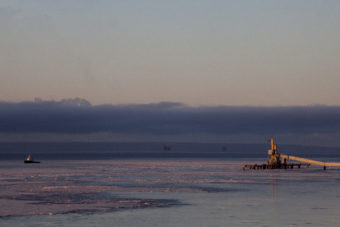
Cook Inlet oil platforms are visible from shore on Dec. 13, 2016, near Kenai, Alaska. (Photo by Rashah McChesney/Alaska’s Energy Desk)
The State of Alaska held a lease sale for offshore acreage in Cook Inlet today, with modest results.
The state offered 2.6 million acres, but just one company — Hilcorp — bid on 16,636 acres.
Hilcorp is currently the biggest oil and gas producer in Cook Inlet. The Texas-based company will pay $298,800 for the additional acreage it picked up at the sale. Hilcorp was also the sole company bidding during last year‘s state oil and gas lease sale for Cook Inlet.
“We’d always like to see a larger lease sale and more money come into the state,” said Kyle Smith, leasing section chief with the Alaska Department of Natural Resources. “With the Cook Inlet, the gas demand has mostly been met through 2023, 2024 through existing gas contracts. And the incentives aren’t quite what they were years ago.”
Faced with dwindling funds, the legislature phased out tax credits for oil and gas companies in Cook Inlet over the past two years.
Smith added that the sale also shows most companies in Cook Inlet are focusing investments on producing from areas they’ve already leased, rather than exploring in new areas.
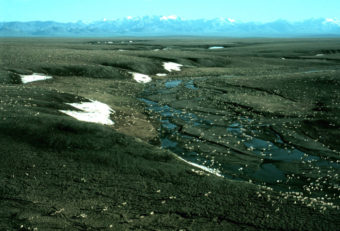
The Porcupine Caribou herd in the Arctic National Wildlife Refuge’s coastal plain. (Photo courtesy U.S. Fish and Wildlife Service)
Congress has voted to allow oil development in the Arctic National Wildlife Refuge, but drilling opponents haven’t given up. As part of their strategy going forward, they’re looking beyond Washington, D.C. and across the U.S.-Canada border for support.
Canada has a long history of opposing oil development in ANWR. That opposition comes down to the caribou.
“If there is development in this area and when we do lose the caribou, that will be a significant channel of life that will have dried up and shut down forever,” said Dana Tizya-Tramm, a Vuntut Gwitchin council member in Canada’s Yukon Territory. “My people will remember the death of the caribou and the death of this area for thousands of years.”
The Porcupine Caribou Herd migrates into Canada and is hunted by the Gwitchin who live there. Like the Gwich’in in Alaska, Tizya-Tramm believes any disturbance of the herd’s calving grounds in the refuge is a threat to his community.
This is not a new issue. In 1987, the United States signed a treaty with Canada, requiring both countries to “avoid or minimize activities” that would disrupt the Porcupine Caribou Herd. Now, as the Trump administration pursues oil development in the Refuge, Tizya-Tramm said the agreement means the U.S. is obligated to consult with Canada before it drills there.
“We really have a legitimate voice here…that belongs in this issue,” said Tizya-Tramm.
Canada’s leadership agrees — its position is that the Porcupine Caribou Herd’s habitat should be permanently protected. In an emailed statement, Colin Shonk, a spokesperson for the Canadian Embassy, said, “the federal, territorial and Indigenous governments in Canada are united in their commitment to conservation of the herd and its habitat.”
“We remain committed to the implementation of the 1987 Agreement between Canada and the U.S. to protect the herd,” said Shonk.
Environmental groups in the U.S. see the treaty as a way to stall the push for oil development in the refuge.
“Certainly the Canadians have made it clear that they expect the treaty to be observed and implemented,” said Mike Anderson, a lawyer with the Wilderness Society in Seattle. “This is not what necessarily the Trump administration wants, in terms of their rushed timeline.”
Anderson said if the U.S. abides by the treaty, it will have to take a careful look at potential impacts on the Porcupine Herd. And that, he hopes, will spur Congress to reconsider whether drilling should be allowed. But Anderson acknowledges the treaty has limits — he said the final decision will be up to the U.S.
Jutta Brunnée, a professor and an expert in international environmental law with the University of Toronto, agreed. Brunnée said the agreement is legally binding, and its strength lies in the requirement for the U.S. to “promptly” consult with Canada if the herd is significantly harmed.
Canada is entitled to consultation, but “that’s, I think, as far as we can take it,” Brunnée said. “There is no commitment that either side makes that they would stop development.”
That said, American supporters of oil development in ANWR are not unconcerned about Canadian interference. To the dismay of Alaska’s congressional delegation, Canadian representatives in Washington, D.C., lobbied against the provision in last year’s Tax Bill that opened up the refuge to drilling. Senator Dan Sullivan said in response, he called the Canadian ambassador for what he referred to as “a very frank discussion.”
“And the first thing I said was, ‘Ambassador, I’m not sure you understand what your own country’s interests are,'” Sullivan said.
Sullivan said he told the Canadian Ambassador that Alaska’s congressional delegation is “the most pro-Canada delegation in Congress.” Then, Sullivan said, he told the Canadian ambassador to cease and desist the lobbying campaign.
In later meetings with Canadian officials, Sullivan said he passed along this message:
“We’re of course going to work with Canada, but this kind of action undermines your own country’s interest. Because we’re going to remember it,” Sullivan said.
True to his word, Sullivan said he’s preparing to introduce a bill related to the Oil Spill Liability Trust Fund — a fund that oil producers must pay in to, used to cover the cost of oil spill cleanups.
“And there was always a glitch — always…in some ways, a loophole, that Canadian tar sands that comes across the border into the United States, produced in Alberta, has never had to pay that fee,” Sullivan said. “Well, I think we should close that loophole.”
Asked if the bill will be in direct response to Canada’s lobbying actions last year, Sullivan said the move was under consideration before Canada opposed the ANWR provision.
But, the Senator added, “let’s just put it — we were thinking about it. We hadn’t made a final decision. And their actions certainly helped us make the final decision.”
Like many proponents of drilling in ANWR, Sullivan said he believes the Porcupine Caribou Herd can stay healthy alongside oil development, if it’s done responsibly.
But Sullivan also didn’t dismiss the fact that the U.S. has an obligation to uphold the 1987 treaty. So Canada could ultimately take its seat at the table — but whether it can convince the U.S. to stop oil development in ANWR is a much taller order.
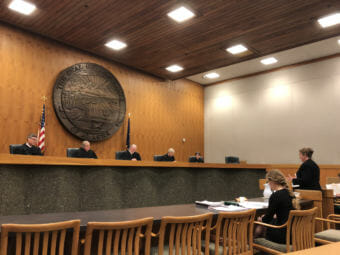
Valerie Brown of Trustees for Alaska delivers arguments before the Alaska Supreme Court on the Yes for Salmon ballot initiative. (Photo by Elizabeth Harball/Alaska’s Energy Desk)
The Alaska Supreme Court yesterday heard arguments in a case that will decide the fate of the closely watched Yes for Salmon ballot initiative.
Representatives from both sides of the controversy filled the courtroom to listen in, including staff from the Alaska Oil and Gas Association and the Resource Development Council, and environmental groups like the Wild Salmon Center. One of the ballot initiative’s sponsors, Michael Wood of Talkeetna, was also there.
Yes for Salmon’s backers want Alaska to toughen the permitting process for mines, dams and other projects in salmon habitat. But during yesterday’s oral arguments, the state argued it goes against the state constitution because it forces the legislature to prioritize salmon habitat — technically referred to in the initiative as “anadromous fish habitat” — over other uses.
“Many large projects in Alaska, including natural resource development projects, cannot be built without permanently displacing some amount of anadromous habitat as it is very broadly defined in this bill,” argued assistant attorney general Joanne Grace. “The second critical element is the plain language of the bill, which gives Fish and Game no discretion to grant a permit or an activity that will permanently displace the habitat for that category of activities.”
Yes for Salmon’s lawyer, Valerie Brown of Trustees for Alaska, acknowledged the initiative would lead to some permits being denied.
But, she argued, “that is not the test that this court applies. If the permitting scheme could lead to a denial after the exercise of legislative discretion, that’s permissible.”
Brown added, “I think what the initiative does is it forces maybe re-siting or technology for projects that will cause adverse impacts.”
The Justices appeared to grapple with the complexity of the initiative, asking lawyers on both sides to clarify how it would actually work if enacted. Pointing to specific technical language in the initiative, Justice Daniel Winfree asked the Brown how it doesn’t block projects altogether.
“One more time, for an old man who is slow, explain to me again why the language about ‘notwithstanding B, that the permit may not be granted for an activity that will — and then one through six ‘- tell me why that is not pretty concrete, that a permit will not be granted?” Winfree said.
The Justices also asked multiple questions about whether the Supreme Court could cut out some parts of the initiative, while allowing the rest to end up on the ballot. The Justices said that’s a possible outcome — but under the state constitution, they indicated it’s allowed only if the Supreme Court doesn’t alter why Alaskans provided signatures for the initiative to go forward.
“We have this principle that when reviewing initiatives, we’re supposed to construe them so as to preserve them whenever possible. And presumably that means something, and it’s not just something pretty that we put into the opinions,” said Chief Justice Craig Stowers.
The state was against the idea of removing some parts of the initiative but allowing the rest to go on the ballot.
“To make it constitutional, the court would essentially have to cut the heart and soul out of this bill,” Grace argued.
Brown disagreed: “What the state has repeatedly called its main problem with this initiative — that section is easily severable,” she said.
The state is asking the Supreme Court to make a decision by early September. If the Court decides in Yes for Salmon’s favor — or if the Court decides it will simply strike out sections of the initiative — it will be on the ballot this November.
The Porcupine caribou herd in the Arctic National Wildlife Refuge’s coastal plain. (Photo courtesy U.S. Fish and Wildlife Service)
Today, the Trump administration took the first official step towards allowing oil drilling in the Arctic National Wildlife Refuge.
The Department of Interior released a notice saying it will hold “no fewer than two” oil lease sales in a 1.6-million acre portion of the refuge, known as the 1002 area or the Coastal Plain. It adds those lease sales must be held by December 2024.

The announcement, while expected, was immediately celebrated by Alaska’s political leaders and condemned by environmental groups.
“We welcome this scoping announcement and the Department’s continued work to implement our legislation opening the Coastal Plain to responsible energy development,” Sens. Lisa Murkowski and Dan Sullivan and Rep. Don Young said in a joint statement.
“In its rush to drill America’s Last Frontier, the Trump Administration is trying to sell leases in the iconic Coastal Plain of the Arctic National Wildlife Refuge as fast as they can, with no regard for why the refuge was created in the first place,” said Geoffrey Haskett, president of the National Wildlife Refuge Association, in a statement. “This race to drill flies in the face of the Arctic refuge’s true purposes such as conserving natural diversity and shows the disdain this administration has for the natural world.”
The notice kicks off the first public comment period on drilling in the refuge.
“This scoping process begins the first step in developing a responsible path forward,” Assistant Secretary of the Interior for Land and Minerals Management Joe Balash said in a statement. “I look forward to personally visiting the communities most affected by this process and hearing their concerns.”
Interior said it will hold public meetings in Anchorage, Arctic Village, Fairbanks, Kaktovik, and Utqiaġvik. It did not announce any meeting locations outside Alaska, although it said meetings could be held in other places “if there is strong community interest.”
Kara Moriarty, president of the Alaska Oil and Gas Association, said she thinks limiting the public meetings to Alaska is a good idea.
“I’m encouraged that the Department of Interior is not having a scoping meeting in D.C., and they’re not having a scoping meeting in California or Washington or other areas of the country that they’re sole mission in life is to keep our resources locked in the ground,” Moriarty said.
Moriarty said that’s because much of the opposition to drilling in ANWR comes from the Lower 48, while many Alaskans support it.
But Bernadette Demientieff, executive director of the Gwich’in Steering Committee, said she thinks the number of Alaskans who don’t want oil development in the refuge is growing.
The Coastal Plain “has been protected so long that people just thought it would never open,” Demientieff said. “But now that it is, I have faith that many Alaska Natives are going to stand up against it.”
The public now has until June 19 to submit comments to the Bureau of Land Management. Interior will announce the times and locations of the public meetings in late May.
Huey Winston, Forest Masters and Suzanna Caldwell discuss their website design for the Volt49 renewable energy competition. (Photo by Elizabeth Harball/Alaska’s Energy Desk)
“Failing fast” sounds like a bad thing. But when it comes to fostering the state’s growing renewable energy sector, the University of Alaska Center for Economic Development thinks failure can be useful. So this spring, it designed a unique competition called Volt49. The organizers want Alaskans to come up with renewable energy business ideas as quickly as possible, knowing that many of the ideas probably won’t work — at least not at first.
In late March, Volt49’s organizers assigned a different challenge related to renewable energy in Alaska to four teams across the state, and they have had five weeks to solve it. One team, for example, has been trying to figure out how to power a server farm.
Another team was tasked with coming up with a tool to help power an off-grid cabin with renewables. That team met at a sports bar in downtown Anchorage on Monday. There, Huey Winston, Forest Masters and Suzanna Caldwell put the final touches on a renewable energy website they’re creating, hammering out details like whether a sun or a mini-lightning bolt would look better on the home page.
Winston said their concept has changed a lot over the past few weeks. His first idea was a backpack filled with equipment.
“Then it evolved into this cube which was made of solar panels that kind of fold out,” Winston explained.
But then, three weeks into the competition, the organizers arranged for the team to meet with a solar energy expert, who told them, “‘that’s never going to work, it’s way too heavy” to carry out to a remote location, Winston said.
The expert also pointed out another issue:
“Every solar panel is rectangular, so there’s no way to make a cube with solar panels,” Winston said.
Finding out their cube was a flop was a setback. But organizer Julia Casey with the Center for Economic Development said that’s exactly what the Volt49 competition is designed to do.
“Most ideas are garbage. And I say that in a loving way,” said Casey.
Casey said by forcing teams to develop a renewable energy tool in five short weeks, they “fail fast.” The concept is based on what’s called a “design sprint,” an exercise born in Silicon Valley; Google uses it to jump start new business ideas. And Casey said the tight timeframe is key.
“A lot of times people have a great idea, build it and ten years later they realize, ‘this doesn’t work,'” she said.
But putting “garbage” ideas out there can be helpful, Casey said: “There’s a nugget of gold in every idea, but you have to figure out what that is.”
Casey acknowledged the ideas the Volt49 teams are coming up with during the competition probably aren’t going immediately lead to multi-million dollar businesses — and she’s okay with that. She said the goal is to unearth those “nuggets of gold” a little faster, and meanwhile, teach the teams about what makes Alaska’s renewable energy sector so valuable.
“In renewable energy we have a lot of expertise and very specific challenges that happen in remote rural places, that happen where energy is very difficult to create,” Casey said. “That is really, really cool and can be translated throughout the world in other places that have similar challenges.”
There are now over 100 Alaska businesses working in renewable energy, according to a report released this week by the Center for Economic Development and the state Department of Commerce, Community and Economic Development. Based on interviews with dozens of renewable energy businesses in the state, the report concludes most of those firms aren’t focused on products — often, their biggest selling point is expertise.
“In this knowledge-based industry, many specialize in optimizing energy systems for remote or extreme conditions,” the report states.
Back at the Volt49 team meeting, Caldwell explained that’s roughly the idea behind the website their team developed. It’s called “Surge AK,” and it’s designed as a “one-stop-shop” for off-grid cabin owners wanting power from renewables.
“There’s a lot of renewable energy information out there, and a lot of products…but if you’re an Alaskan, where could you go to find all of that?” Caldwell said.
Caldwell and her teammates said they don’t think this website is going to make them a lot of money — none of them are quitting their day jobs after the competition ends. But Caldwell said she’s learned a lot.
“If I ever decide to become an entrepreneur, it really has shifted my perspective on how you do that,” said Caldwell.
And that’s exactly what Volt49’s organizers are after: giving Alaskans new skills, and if they’re lucky, an early “garbage” idea that could someday lead to the state’s next big renewable energy startup.
The Volt49 teams will present their ideas at a showcase this Friday at Anchorage Community Works from 5:30 to 8:30 pm.
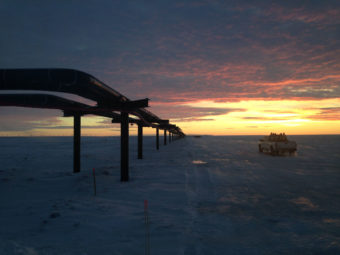
Pipelines stretch toward the horizon on NPR-A land leased by ConocoPhillips. (Photo by Elizabeth Harball/Alaska’s Energy Desk)
ConocoPhillips announced today it made three new oil discoveries on the Western North Slope.
Conoco didn’t release many details about the discoveries, including how much oil was found. But in a press release, the company called the results of this winter’s drilling season “promising.”
Conoco drilled a total of six wells this winter, one of its most extensive exploration efforts in years. All six encountered oil. Five were drilled in the National Petroleum Reserve-Alaska, which is managed by the federal government.
In addition to the wells indicating the three new discoveries, Conoco spokesperson Natalie Lowman said the other wells increased the company’s confidence in last year’s Willow oil discovery. Conoco estimates Willow could produce up to 100,000 barrels of oil per day, roughly a fifth of the amount currently moving down the trans-Alaska pipeline.
Based on the results of this year’s drilling season, Lowman said the company plans another active drilling season in 2019.
There have been a number of major oil discoveries in and around the northeast corner of the National Petroleum Reserve-Alaska in recent years. Conoco has asked the federal government to make more land in the Reserve available for oil leasing, saying the land can be safely developed. But the Obama administration put roughly half the Reserve off limits, citing the need to protect habitat and subsistence resources.
The Bureau of Land Management is currently holding a public comment period on Conoco’s third proposed oil development in the Reserve, called the Greater Mooses Tooth 2 project. Upcoming public meetings are in Anchorage, Fairbanks and Nuiqsut.
Close
Update notification options
Subscribe to notifications
Subscribe
Get notifications about news related to the topics you care about. You can unsubscribe anytime.