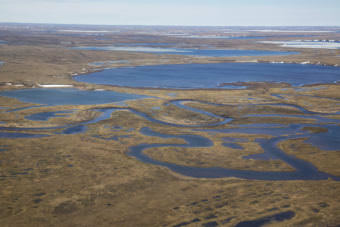
There are 895 tracts — approximately 10.25 million acres — available for nomination and comment for this year’s oil and gas lease sale for NPR-A. (Photo by Bob Wick, courtesy BLM)
The federal Department of Interior is formally kicking off the process for this year’s oil and gas lease sale in the National Petroleum Reserve-Alaska (NPR-A), an Indiana-sized area of land on the North Slope.
Today, the Bureau of Land Management asked for public comment on what land should or shouldn’t be available for drilling.
Last year, the Trump administration put all 900 available tracts up for bid. That added up to over 10 million acres, the most ever offered in a single lease sale in NPR-A according to the federal government — a move that drew criticism from environmental groups.
But in the end, oil companies only bid on seven tracts.
Earlier lease sales were more successful. Oil company ConocoPhillips is currently pursuing several significant developments in NPR-A. According to the Bureau of Land Management, about 1.4 million of the Reserve’s 22.8 million acres are currently leased; the majority of that is held by Conoco.
Environmental groups are legally challenging both last year’s sale and the 2016 sale, held under the Obama administration. One of the groups’ arguments is that federal government did not sufficiently consider the potential climate impacts of oil development when planning for the sales. Those lawsuits are still pending.
Roughly half of NPR-A was put off limits to oil development by the Obama administration, which cited the need to protect habitat for caribou and migratory birds. However, much of the currently off-limits land is considered to have high potential for oil development. The Trump administration is currently considering opening up more land in NPR-A to oil leasing.
For this year’s lease sale, BLM is only taking nominations on tracts offered under the current plan. The agency is accepting comments on the 2018 lease sale until August 20.
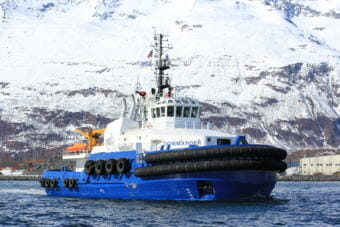
One of Edison Chouest’s new tugs, the Commander, near Valdez. (Photo by Elizabeth Harball/Alaska’s Energy Desk)
Following two minor accidents, a citizens’ watchdog group is asking the state’s top environmental regulator to require tougher training for new oil spill response crews in Prince William Sound.
In late June, an Edison Chouest tugboat hit an oil tanker during a docking maneuver. Two days later, a skiff was caught between an Edison Chouest response barge and tugboat. During both accidents, there were no injuries and no oil was spilled.
Edison Chouest is the new oil spill response and prevention contractor in charge of escorting oil tankers in Prince William Sound. Alyeska Pipeline Service Company is replacing Crowley Marine Services with Edison Chouest this summer.
In response to the accidents, the Prince William Sound Regional Citizens Advisory Council is asking the state Department of Environmental Conservation to require the new crews and equipment to be trained in rougher weather conditions. That’s something the group has called for before.
In a letter sent July 5, the group stated it “believes a gap exists in prevention and response competency and proficiency.”
The group added the two incidents are “clear symptoms that this transition was too rushed.”
Alyeska reports it is taking measures to ensure the circumstances leading to both accidents don’t happen again. In an emailed response, Alyeska spokesperson Kate Dugan said Edison Chouest crews have undergone thousands of hours of training and will continue to train going forward.
However, Dugan said Alyeska is standing firm in its position that it won’t train crews in rough conditions.
“We won’t risk human life or environmental damage to demonstrate something where capability can be demonstrated in other, more safe ways,” Dugan wrote.
“This transition has been years in the making and has been carefully planned and executed,” Dugan added. “We have brought some of the most high-performing tugs in the world to Prince William Sound and they are operated by highly trained and experienced crews.”
Officials with the Department of Environmental Conservation are meeting with the council today, and the agency will issue an official response after that meeting.
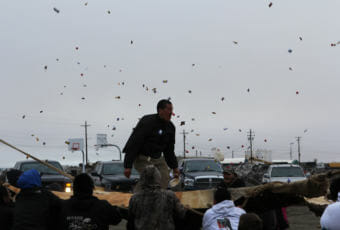
Nuiqsut residents enjoy the blanket toss, one of the whaling festival’s most well-known events. (Photo by Elizabeth Harball/Alaska’s Energy Desk)
Whaling captain Herbert Ipalook Sr. is sitting in the driver’s seat of a white pickup truck. It’s parked at the center of a sandy baseball field in Nuiqsut, a village of about 400 on the North Slope, not far from where the Colville River meets the Arctic Ocean.
It’s the day of the summer solstice, and all around Ipalook’s truck, a celebration is beginning. Today is nalukataq, a feast hosted by a successful whaling crew. And nalukataq is special.
“Special, because it was created thousands of years ago, and passed down to the younger generation, to the next generation,” Ipalook says.
Ipalook upholds this tradition. In fall, Nuiqsut’s whaling crews travel roughly 80 miles by boat to the village’s camp at Cross Island, north of Prudhoe Bay. From there, last year, Nuiqsut’s crews harvested four bowhead whales. The Ipalook crew took one of them.
“It’s about the whale. The whale gives up to you, to the people that worked really hard,” Ipalook says. “Some people might get left out, some people will gain, but everybody gains something to eat.”
The crew distributes the whale based on the number of people per household. Some is eaten on the spot. (Photo by Elizabeth Harball/Alaska’s Energy Desk)
Next to Ipalook’s truck, folding tables are weighed down with big, steaming pots and colorfully frosted cakes. The baseball field’s bleachers are filling with family members and neighbors, kids and elders, bundled up in puffy coats, furs and blankets and waiting patiently with paper plates and cups. People wish each other “happy nalukataq!”
The crew starts serving: homemade goose and caribou soup, bread and crackers, and hot drinks.
Later, the focal point — the whale — arrives in large plastic tubs. It’s prepared several ways, like mikigaq, fermented meat, urraq, cooked meat and muktuk, frozen skin and blubber, carved into hand-sized chunks. The crew carefully distributes the whale based on the number of people per household, and everyone’s coolers start to fill up. Some is eaten on the spot, and the rest is stored for take-home, in plastic containers or ziploc bags.
Vera Ipalook, the whaling captain’s wife, is at the center of the action. She plays an important role, working long hours with the crew to prepare the whale for nalukataq.
In between making sure everything is going smoothly, Vera sneaks in a few hugs. Her family is here from near and far — almost all her kids and grandkids, she says. But it’s not just about the relatives. She wants everyone there to feel welcome.
Vera Ipalook, the whaling captain’s wife, helps her crew with serving. (Photo by Elizabeth Harball/Alaska’s Energy Desk)
“I make sure that my crew have big smiles on their faces, to keep people happy,” Vera says.
There are many moments of joy. Like the candy — there’s so much candy. Every half-hour or so, Hershey’s chocolates, Laffy Taffy, Sour Patch Kids and the like are tossed over the bleachers, and all the kids pounce.
There’s even more candy during the event nalukataq is known for: the blanket toss. A circular sealskin blanket is suspended about ten feet above the ground. Men and women grab hold of the edges and start pulling in unison, and one brave soul holding a bag of candy jumps on top.
Getting the timing down isn’t as easy as it looks. But when it’s done right, the person on the blanket is catapulted upwards, and candy goes flying. It makes your average trampoline look tame.
Once everyone has their turn on the blanket, the day ends at Nuiqsut’s city hall, where the village gathers for drumming, singing and dancing. The sealskin from the blanket toss becomes a dance floor at the center of the room.
A line of men in folding chairs leads the singing, keeping time with shallow hand drums. James Taalak is among them.
Nalukataq ends with drumming, singing and dancing at Nuiqsut’s city hall. Taalak is at center, in green (Photo by Elizabeth Harball/Alaska’s Energy Desk)
“I have been drumming all my life. Since infancy. Since probably before I could walk,” Taalak says with a laugh.
Taalak says nalukataq songs have been passed down for generations, heard not just in Nuiqsut, but across the Arctic, in Canada, even parts of Russia.
Some of the music has even more universal themes:
“Some songs will urge people in the crowd to come out and dance,” Taalak says. “You know, get them motivated.”
And most everyone does — elders and children, Nuiqsut residents and visitors from far away, all take their turn on the sealskin blanket.
“It’s an open celebration for anyone that’s present,” Taalak says. “There really isn’t anything held back, as far as community — not just community service, but that feeling of being welcome.”
The dancing continues into the early hours of the morning. On the wall behind the drummers, there’s a line of framed photographs of elders who have passed on: Nuiqsut’s past leaders, whaling captains and whaling captain’s wives, looking on as today’s generation carries forward the nalukataq tradition.
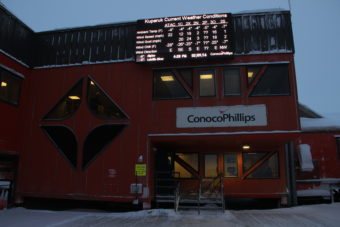
The entrance to ConocoPhillips’ Kuparuk Field camp in February 2016. (Photo by Rachel Waldholz/Alaska’s Energy Desk)
Oil company BP is selling its stake in the second-biggest oil field in Alaska.
In a deal announced today, ConocoPhillips said it will take over BP’s 39.2 percent interest in the Greater Kuparuk Area.
The deal will “continue our strategy of coring up our legacy asset base in Alaska,” Conoco CEO Ryan Lance said in a statement.
Conoco is already the biggest oil producer in Alaska, but buying BP’s interest in Kuparuk adds to its growing presence west of Prudhoe Bay. Conoco is also pursuing several new oil projects in the National Petroleum Reserve-Alaska, including potentially a new production facility.
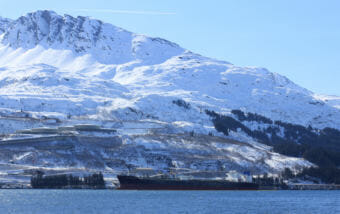
Conoco already operates Kuparuk, so BP spokeswoman Dawn Patience said the deal won’t mean big changes on the ground.
“It will continue to add barrels to the trans-Alaska pipeline, the state continues to collect royalties and production continues. So there won’t be that much difference on the North Slope,” Patience said.
BP will still operate Prudhoe Bay, the state’s biggest oil field. Patience said the deal means BP can prioritize keeping up production there.
“It’s an opportunity in Alaska to increase our focus on the resource base at Prudhoe Bay,” Patience said.
Also as part of today’s deal, BP is acquiring part of Conoco’s stake in the Clair Field offshore of Scotland.
An oil tanker docked at the Valdez Marine Terminal in April. (Photo by Elizabeth Harball/Alaska’s Energy Desk)
The U.S. Coast Guard in Valdez is investigating an accident that happened early Wednesday morning involving a new tugboat and an oil tanker.
The Coast Guard is characterizing the incident as “minor;” no oil was spilled and no injuries were reported.

But it comes at a time of intense scrutiny for Alyeska Pipeline Service Company, which operates the trans-Alaska pipeline and the Valdez Marine Terminal, and the tugboat’s operator, the Louisiana-based Edison Chouest Offshore. This summer, Alyeska is replacing Crowley Marine Services with Edison Chouest as its spill response and prevention contractor in Prince William Sound.
According to Coast Guard Lieutenant Carlos Quintero, the tug called the Ingot, hit the tanker during a docking maneuver.
“The Ingot made the routine approach on the tanker, which consists of having the bow of the tug lean and touch perpendicular against the hull of the tanker,” Quintero said. It was during this process that “it was reported that minor damage was sustained,” Quintero said.
Alyeska reports that after the two vessels made “a hard landing and metal-to-metal contact,” the tanker ended up with a dent 20 inches long, 6 inches wide and 3 inches deep.
Joe Lally with the Prince William Sound Regional Citizens’ Advisory Council, a watchdog group that is closely monitoring the transition from Crowley to Edison Chouest, said tugs and tankers commonly make contact during docking maneuvers.
“It happens. I think it was sort of unique in that it was struck hard enough to cause the dent,” Lally said.
Alyeska spokesperson Michelle Egan said Alyeska ordered an immediate investigation of the incident. Based on Alyeska’s preliminary review, it has ruled out mechanical issues or vessel design as the cause. But Egan said it’s not necessarily the tugboat captain’s fault — two other parties, the master of the tanker and the pilot, also play key roles in the docking process.
“We don’t know where the breakdown occurred,” Egan said.
Egan said Alyeska is taking measures to prevent another incident, including slowing the speed of the vessels and increasing the level of communications during docking and undocking.
“Scrapes and dents are not unheard of,” Egan said in an email. “Even so, we don’t want to see damage to either vessel and we will learn what happened in this case and take action to reduce the risk of it happening again.”
Egan said the damaged tanker was cleared to load after an inspection. It departed Valdez on Thursday.
EPA leader Scott Pruitt cited the Pebble Mine in a memo asking his agency to change how it uses the Clean Water Act to regulate projects. (Photo courtesy US Environmental Protection Agency)
Citing the proposed Pebble Mine, the head of the Environmental Protection Agency wants to rein in his agency’s regulatory power.
In a sweeping memo released today, EPA administrator Scott Pruitt asked the agency to propose changes to how it uses the Clean Water Act.
In the memo, Pruitt wrote that the action would fit in with his larger aim to “ensure predictability and regulatory certainty and take actions based upon a comprehensive understanding of the facts.”
The proposal would eliminate EPA’s power to preemptively or retroactively veto permits for waste discharge in waterways, restricting the agency’s ability to step in and regulate large projects. However, the proposal is far from final.
Under the Obama administration, EPA used its authority under Section 404(c) of the Clean Water Act to propose restrictions on the Pebble Mine before the developer applied for a permit with the U.S. Army Corps of Engineers.
That essentially halted the controversial project until last year, when EPA reached a settlement with Pebble under the Trump administration. Then in January, Pruitt suspended the agency’s move to reconsider the Obama-era proposal, saying Pebble may pose an “unacceptable” risk to Bristol Bay, home to one of the most valuable salmon fisheries in the world.
But in the memo released today, Pruitt wrote, “I am concerned that the mere potential of the EPA’s use of its section 404(c) authority before or after the permitting process could influence investment decisions and chill economic growth by short-circuiting the permitting process.”
Pebble Mine opponents condemned the memo.
“This is a reckless proposal that ignores the plain text of the Clean Water Act. If enacted, this would hamstring EPA’s ability to safeguard our streams and fisheries from the dumping of many tons of toxic waste,” Jon Devine, director of federal water policy at the Natural Resources Defense Council, said in a statement.
Norm Van Vactor, a spokesperson for the Bristol Bay Economic Development Corp., said in an email his organization is “very disappointed” by the news, adding, “this has not been an authority that has been misused in the past.”
But Mike Heatwole of Pebble Limited Partnership praised the memo, saying it would allow a “full, fair and rigorous” environmental review.
“We’re calling today’s announcement a strong policy decision regarding the many problems with preemptive and retroactive 404(c) actions,” Heatwole said in an email.
However, EPA indicated it’s too soon to say how the decision could affect the fate of the proposed Pebble Mine.
“It is premature to say how any changes to the existing regulation would impact current or existing actions,” an EPA spokesperson said in a statement.
Close
Update notification options
Subscribe to notifications
Subscribe
Get notifications about news related to the topics you care about. You can unsubscribe anytime.