Elizabeth Harball, Alaska's Energy Desk

Major oil development planned in NPR-A to get ‘streamlined’ environmental review

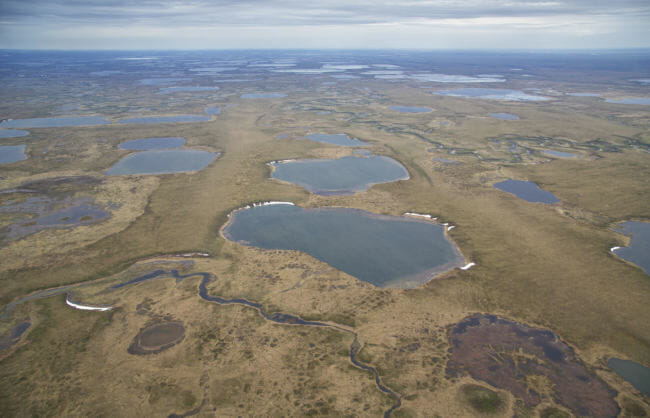
BLM_NPRA
Northeast National Petroleum Reserve in Alaska. (Photo by Bob Wick, image courtesy Bureau of Land Management)

The federal Bureau of Land Management last week kicked off the environmental review process for what could be one of Alaska’s biggest future oil developments — ConocoPhillips’ Willow project, in the National Petroleum Reserve-Alaska.

In the past, this process has taken years, and thousands of pages of analysis. The Trump administration wants to make that process go faster, and dramatically reduce the amount paperwork involved. But environmental groups worry a faster review won’t do enough to protect the Arctic wilderness.

Top Interior Department official Joe Balash thinks paring down the government’s environmental review process makes sense.

“When it comes to a decision maker such as myself, who has to make decisions on multiple fronts every week, you can’t legitimately sit down and read through 2,500 pages of analysis,” Balash said in a recent interview.

Federal environmental reviews are meant to look at all the potential impacts of projects like mines and oil developments on federal land, and try to avoid — or at least minimize — those impacts. But Balash argues the National Environmental Policy Act, or NEPA, has gotten way out of hand.

“These complex, mind-numbing NEPA documents have become a field for very specialized consultants and litigants. And it really is not serving the public interest,” Balash said.

Republicans have long argued environmental groups use NEPA to slow or halt development. So last year, the Interior Department put forth an order to speed along the NEPA process. Among other things, it caps the number of pages agencies can fill with analysis about environmental impacts at 150, or 300 “for unusually complex projects, excluding appendices.” It also says environmental impact statements can’t take longer than a year to prepare.

Previous environmental reviews in Alaska have been well over 1,000 pages, and have taken multiple years to complete.

“If we can’t describe the project, the alternatives, the affected environment and the impacts in 150 to 300 pages, then we’re probably using too many words to describe something,” Balash said.

One of the first projects in Alaska to benefit from the Trump administration’s truncated environmental review is a major oil development ConocoPhillips is proposing on the North Slope. Last year, Conoco announced a huge oil discovery in the federally-managed National Petroleum Reserve-Alaska, or NPR-A. Conoco’s plans to recover all that oil involve a central processing facility, an airstrip, pipelines and up to five drill pads with up to 50 wells on each pad, according to the Bureau of Land Management. It’s a big deal, and it’s called the Willow project.

“It’s not just a step forward in the NPR-A — it’s one of those big leaps forward,” said Susan Culliney, policy director for Audubon Alaska.

Audubon keeps close tabs on NPR-A because the area encompasses important habitat for a huge number of migratory birds. Culliney thinks it’s a mistake for the Trump administration to apply a faster, shorter environmental review to the Willow project.

“These public lands that belong to us — they belong to people on the North Slope, they belong to people all over the U.S. — they’re important and we need to take the time and the consideration to think about these things,” said Culliney. “Especially for a place as complex and sensitive as the Arctic landscape.”

Culliney said Audubon doesn’t oppose the Willow oil development at this point — it is waiting to see how things play out. But she thinks the Trump administration’s streamlined environmental review could mean they miss something important in the process.

“That’s the risk of doing something too quick, too hasty. You open yourself up to those errors,” Culliney said.

Another environmental group, the litigious Center for Biological Diversity, is also objecting to how the Trump administration is going about its environmental review for Willow. The group is against the project.

“Skirting comprehensive review to drill hundreds of oil wells on Alaska’s rugged, unpredictable northern frontier is a recipe for disaster,” Kristen Monsell, a senior attorney at the Center for Biological Diversity, said in an emailed statement.

Balash said Interior isn’t trying to invite lawsuits by putting limits on environmental reviews.

“Certainly we’re not doing this just to get tossed out in court,” he said.

For its part, Conoco thinks an environmental review that takes less time doesn’t mean it will cut corners. In an emailed statement, spokesperson Natalie Lowman said, “ConocoPhillips supports a robust and efficient analysis of the Willow development in line with the requirements of NEPA and the BLM’s Integrated Activity Plan for the NPR-A.”
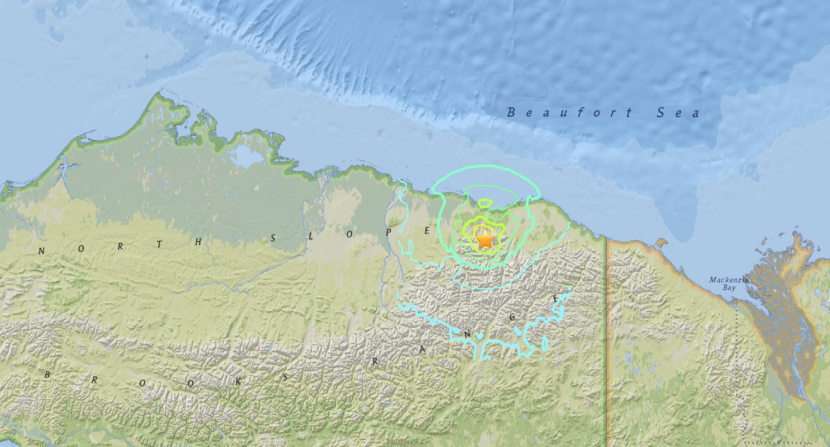
Biggest-ever earthquake recorded on North Slope

The main earthquake was recorded 52 miles Southwest of Kaktovik. (Image courtesy U. S. Geological Survey)

This story has been updated.

The biggest-ever earthquake on the North Slope was recorded just before 7 a.m. Sunday morning, about 50 miles southwest of Kaktovik.

So far, there are no reports of any significant impacts to communities or infrastructure as a result of the 6.4 quake.

“This is the biggest earthquake within a few hundred miles, at least, of that area that we have records for,” said state seismologist Michael West at the Alaska Earthquake Center.

In the hours after the main quake, there were series of substantial aftershocks in the region, including a magnitude 6 earthquake at 1:15 p.m. — that’s the second largest earthquake ever recorded north of the Brooks Range.

West said earthquakes are common in the region, but what was surprising about this event was its size.

“This earthquake will definitely cause people to re-evaluate the seismic potential of the Eastern Brooks Range and ANWR area,” West said.

A North Slope Borough spokesperson said Sunday they were not yet aware of injuries or damage, but the event was felt across the Arctic.

Kaktovik resident Amanda Kalaek was at home when she felt the earthquake hit.

“I was actually sleeping and got woken up because my bed started swaying and I could hear the pilings on my house shaking as well,” Kalaek said.

“I couldn’t believe it was actually shaking the house,” she added. “I was kind of freaked out, but then I was good after a while.”

Kalaek got up and checked on her three daughters, who all slept through the event. But it wasn’t long before people across the North Slope were taking to social media to talk about it.

“Everybody was posting on Facebook, and there were family members in different places that were checking to make sure we were OK, and we told them we were all OK,” Kalaek said.

The quake was also felt in the state’s biggest oil fields — the Alaska Earthquake Center reports the epicenter was 85 miles southeast of Prudhoe Bay. But North Slope oil operators aren’t reporting any problems.

Kate Dugan, a spokesperson for Alyeska Pipeline Service Company, said Sunday that the trans-Alaska pipeline is operating normally. Alyeska has sent up helicopters to survey for any impacts along the northern part of the pipeline.

“At the same time, we’re dispatching crews out to our facilities, to the pipeline itself, to work pads, to check for any settlement or movement,” Dugan said.

Reached on Sunday, spokespeople for ExxonMobil, ConocoPhillips and BP were also reporting no damages as a result of the quake.

“Our team did a walkthrough this morning and for now it appears everything is fine,” BP spokesperson Megan Baldino said in an email.

Reporter Ravenna Koenig contributed to this report.

Interior official: ‘millions’ more acres in NPR-A to open for oil development

The National Petroleum Reserve-Alaska in June. The Trump administration wants to allow oil development in more of NPR-A. (Photo by Elizabeth Harball/Alaska’s Energy Desk.)

A Interior Department official says the Trump administration is moving to open “millions” more acres in the National Petroleum Reserve-Alaska, or NPR-A, to oil development.

Interior Assistant Secretary of Land and Minerals Management Joe Balash delivered a speech this week in New Orleans at a conference hosted by the Heartland Institute, a free-market think tank known for questioning climate science.

Balash, who once served as Alaska’s Natural Resources commissioner, said allowing more fossil fuel development on federal land in Alaska is one of his top priorities.

“In Alaska, there are literally billions of barrels of oil and trillions — tens of trillions — of cubic feet of natural gas on federal lands waiting, just waiting, to be found, developed and transported to markets,” Balash said.

Balash said that effort includes allowing oil exploration in parts of the National Petroleum Reserve-Alaska the Obama administration put off limits.

Last year, the Interior Secretary Ryan Zinke signed an order to re-evaluate the Obama-era Integrated Activity Plan for the NPR-A — currently, it doesn’t allow oil development in roughly half of the Indiana-sized area on the North Slope. Balash said that process will likely lead to much more land in the Reserve being made available for oil development.

“We’re working now with the state of Alaska and the local government, the North Slope Borough, to redevelop an Integrated Activity Plan in the region that will make millions more acres available for leasing,” Balash said.

Environmental groups oppose opening up more of NPR-A to oil development, saying the region provides critical habitat for migratory birds and caribou.

But oil companies are increasingly interested in the area’s oil potential — ConocoPhillips recently announced a major oil discovery there, and it’s planning to pursue a new processing facility to accommodate it.

This week, the federal Bureau of Land Management began the environmental review process for the development, called the Willow project.

“The proposed project includes the construction, operation, and maintenance of a central processing facility, infrastructure pad, up to five drill pads with up to fifty wells on each pad, access and infield roads, an airstrip, pipelines, and a gravel mine,” the agency wrote in a release.

In a statement, Ben Sullender of Audubon Alaska said his group is concerned about the project’s impacts.

“The Willow project raises a series of scientific concerns, including impacts to migrating caribou, anadromous fish like salmon, and nesting Yellow-billed Loons, especially when we consider these issues against a backdrop of climate change and cumulative impacts,”  Sullender said.


With tweaks, Alaska Supreme Court rules Yes for Salmon can go on ballot

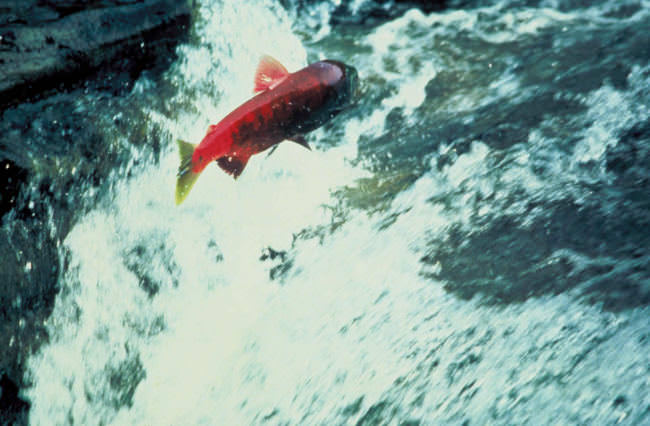
Alaska_salmon_jumping_out_of_water
It’s official — Yes for Salmon will be on the Nov. ballot. (Photo courtesy U.S. Fish and Wildlife Service)

The Yes for Salmon initiative — or at least most of it — will be on the November ballot.

The Alaska Supreme Court today ruled that only certain provisions of the controversial ballot initiative are unconstitutional. Whether the rest becomes state law will be up to Alaska voters.

The decision guarantees a big fight ahead. The initiative is aimed at putting in place a much tougher permitting regime for projects built in salmon habitat, and is fiercely opposed by a coalition of mining and oil companies, Alaska Native corporations and other groups.

The court ruled that only two of the initiative’s provisions are unconstitutional because they explicitly bar the state from giving some projects a permit, in specific situations. That goes against a section of Alaska’s Constitution, which states that ballot initiatives can’t prioritize one state resource — here, certain fish species — over others, like mines and oil developments.

So the Alaska Supreme Court is ordering that those two provisions must be cut out. But the court says the rest of the Yes for Salmon initiative is good to go.

Stand for Salmon director Ryan Schryver, who is organizing the campaign in support of the initiative,  said he’s satisfied with the outcome.

“We’re a little bit bummed that the Supreme Court removed a couple of provisions of the initiative. But they have left intact the heart and soul of what we were trying to do,” Schryver said.

Lawyers for the state, who challenged the initiative in court, are also counting the outcome as a win. That’s because they weren’t arguing whether Yes for Salmon is good policy or not — they just said it violated a specific part of the Alaska constitution. Now that the Supreme Court took out the unconstitutional provisions, the state’s narrow legal challenge ends.

“Our role as the attorneys for the Division of Elections and the Lieutenant Governor’s office is to ensure that no measure that violates article 11, section 7 [of the Alaska constitution] reaches the ballot. And so we succeeded in upholding that mission today,” said Elizabeth Bakalar, an assistant attorney general for the state who helped argue the case.

Yes for Salmon’s opponents said the decision doesn’t change how they feel about the initiative.

“The ballot measure still is just as concerning to our group and our 400-plus coalition members as it was yesterday,” said Kati Capozzi, the campaign manager for Stand for Alaska, a group formed to fight the initiative.

Stand for Alaska is backed by the state’s biggest oil, gas and mining companies, like BP, ConocoPhillips, the Pebble Limited Partnership and Donlin Gold, as well as Alaska Native corporations, trade unions and other groups. Capozzi argued even in its altered form, Yes for Salmon will still have wide-reaching impacts on resource development in Alaska.

“We plan to march forward, we plan to still continue informing Alaskans on the negative impacts this ballot measure will have on their lives,” Capozzi said.

Stand for Alaska will march forward with a lot of money behind it — recent filings with the state show the group has raised more than $9 million over the entire campaign, including staff time. Yes for Salmon reports raising significantly less — just under $1 million, also including staff time.


As Alaska’s climate team floats carbon pricing, not everyone jumps on board

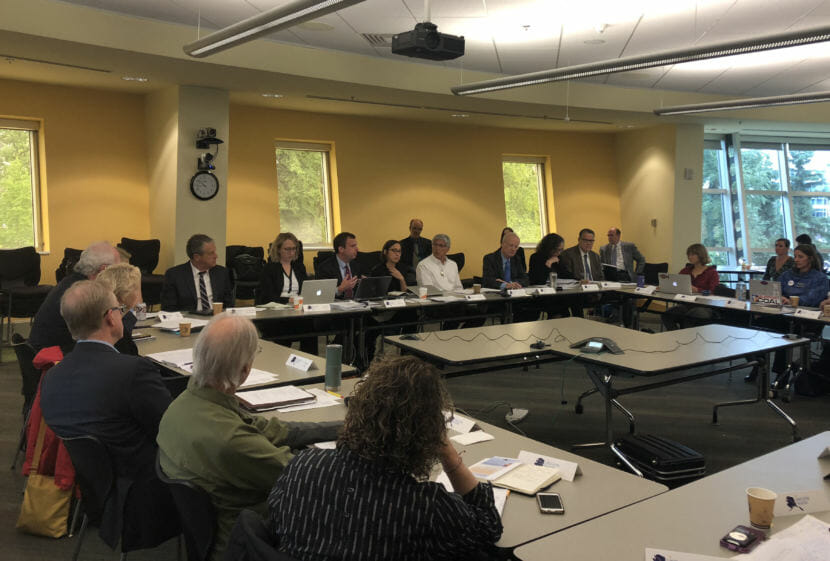
The Climate Action Leadership Team met in Anchorage to discuss its recommendations for how Alaska should deal with climate change. (Photo by Elizabeth Harball/Alaska’s Energy Desk)

Gov. Bill Walker’s Climate Action Leadership Team met Thursday in Anchorage to discuss its draft climate action plan, which recommends Alaska consider a carbon tax — a fee paid by entities that produce or burn fossil fuels, like oil companies, aimed at reducing carbon emissions.

But the plan is not a consensus document, and not every member of the team agrees that pricing carbon is a good idea.

A recently released draft of the plan states, “since Alaska is a state where massive amounts of carbon-based fuel are taken out of the ground, a carbon tax would be levied on far more carbon-based fuel than Alaskans actually consume themselves. This is a potential advantage of a carbon tax that Alaska has over other states and nations.”

In an interview, Lt. Gov. Byron Mallott, who is leading the group, didn’t say a carbon tax is definitely a good idea, but he added that Alaska should study all possible ways to deal with climate change.

“If a carbon pricing mechanism allows that to be responsibly done and does not increase the cost of energy to Alaska’s residents, and is done in a fair and equitable way, then that should be looked at,” Mallott said.

A carbon tax is one of many strategies to deal with climate change included in the 45-page draft plan. It includes other ideas that would need funding, like helping communities plan for climate impacts and scientific research.

Chris Rose of the Renewable Energy Alaska Project is one of the team’s biggest advocates for a carbon tax. Rose argued that in addition to helping reduce planet-warming emissions, a carbon tax could help pay for other work the state needs to do to deal with climate change.

“You can call it a fee or a tax, it doesn’t really matter; you’ve got to put some price on it,” Rose said. “And then you can have revenues here in the state of Alaska, either to develop other state programs, and/or make people whole who already have to pay really high energy prices.”

Not everyone at the meeting agreed.

“I think a carbon tax is a horrible idea,” said ex officio team member Lorali Simon with the Usibelli Coal Mine, raising concerns about the potential impacts to the economy and jobs.

BP Alaska President Janet Weiss is also a member of the team. In an interview, Weiss noted that BP does think carbon pricing “is a part of the solution, globally,” but she said creating a state-level policy could be “tricky.”

“When it comes to the state-level — what I like about where the Climate Action Leadership Team is going is they talk about advising and suggesting that we get after understanding the appropriate mechanism,” Weiss said. “Because you could set it up in a way that disadvantages Alaska in a global energy industry.”

A carbon tax has been proposed in other states and in Congress. But if Alaska went through with a carbon tax, it would be the first state to do so.

When the climate change action plan is finalized, the team will send its recommendations to Gov. Walker for consideration.

Using data as a carrot, Alaska hopes to entice interest in oil lease sale

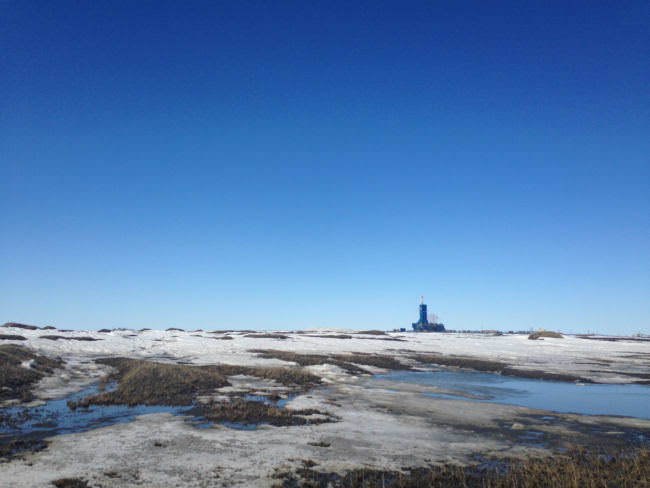
BPrig
An oil rig at Prudhoe Bay. (Photo by Elizabeth Harball, Alaska’s Energy Desk)

The state of Alaska is offering oil companies a sneak preview on three North Slope areas it’s putting up for bid at this year’s oil and gas lease sale.

Under a tax program enacted in 2003, oil companies agreed to release exploration data to the state in exchange for tax credits. Now, the state is offering some of that data on three North Slope areas to other oil companies for a fee. It also has pulled together a wide range of other public data on the areas, like a historical record of bids from previous oil and gas lease sales, and compiled it for companies to peruse on the state’s website.

The state is putting the three areas up for bid at its annual lease sale later this year.

Department of Natural Resources deputy commissioner Mark Wiggin said he hopes the effort attracts new oil companies to Alaska.

“What would be a really fabulous outcome is if we would incentivize or motivate additional explorers to come in and take a look,” Wiggin said.

The three areas add up to about 120,000 acres. One encompasses land and waters north of Prudhoe Bay and another is just south of Prudhoe Bay. The third is in Harrison Bay, east of the National Petroleum Reserve-Alaska.

Companies have explored for oil in these areas before. But Kevin Frank, a petroleum geologist for the state Department of Natural Resources, said some recent oil discoveries in Alaska were in places other companies explored in the past.

“There are things that are still out there — there are still discoveries being announced,” Frank said. “That’s part of the excitement right now is the discoveries that are announced are in areas that have been looked at over and over and over again.”

Editor’s note: Mark Wiggin is a member of the Alaska Public Media Board of Directors.

Site notifications
Update notification options
Subscribe to notifications