Elizabeth Harball, Alaska's Energy Desk
ConocoPhillips to begin work on $1 billion North Slope oil development this winter

Harball_DSC_0090
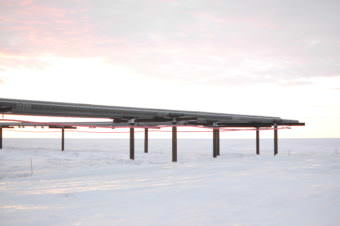
A flow line curves above the horizon on the western North Slope. (Elizabeth Harball/Alaska’s Energy Desk)

ConocoPhillips today announced the company has made the final decision to build a new, roughly $1 billion drill site on the North Slope.

The announcement comes a week after the Trump administration handed the oil company final approvals for the project. Called Greater Mooses Tooth 2, it will be in the federally managed National Petroleum Reserve-Alaska, west of Prudhoe Bay.

ConocoPhillips aims to begin construction this winter. The project is expected to employ up to 700 workers. First oil is anticipated in 2021. The company says it will produce up to 40,000 barrels per day.

Greater Mooses Tooth 2 is one of a string of projects oil companies are pursuing in the region. Another ConocoPhillips drill site, Greater Mooses Tooth 1, started producing oil for the first time earlier this month. In a recent interview, ConocoPhillips Alaska president Joe Marushack noted Alaska Native corporations will financially benefit from the company’s new projects in NPR-A; they own a significant portion of the subsurface rights in the area.

“ASRC — Arctic Slope Regional Corporation — has a piece of the royalty, which is very important to those communities up there in terms of the dividends they can provide,”  Marushack said.

Environmental groups have raised concerns about the pace of oil development happening in the Reserve, arguing the federal government isn’t doing enough to offset impacts.

“Development in the NPR-A is advancing quickly and is compromising irreplaceable subsistence use areas and habitat,”  Nicole Whittington-Evans, Alaska regional director for the Wilderness Society, said in a statement after federal regulators approved the project.

Trump administration approves first oil production in federal Arctic waters

Liberty
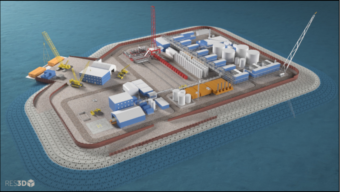
A 3-D rendering of Hilcorp’s proposed Liberty project represented in the Bureau of Ocean Energy Management’s environmental impact statement. (Image courtesy BOEM)

Three years after Shell abandoned its oil exploration program in the Chukchi Sea, and with much less fanfare and controversy, another company has taken a big step toward being the first to produce oil from federal Arctic waters.

The Trump administration today handed a key approval to the Texas-based Hilcorp for a proposed oil development in the Beaufort Sea, east of Prudhoe Bay.

Called the Liberty Project, Hilcorp aims to build a 24-acre gravel island in shallow waters about five miles from shore and drill for oil from there. A pipeline buried beneath the ocean floor will carry the oil to shore.
“We consider Hilcorp’s plan to represent a relatively conservative, time-tested approach toward offshore oil and gas development,” Joe Balash, Interior Department’s assistant secretary for land and minerals management, said in a statement. “Using input from North Slope communities, tribal organizations and the public, we have developed a robust set of environmental mitigation measures and safety practices that will be applied to this project.”

In a presentation last month in Anchorage, Hilcorp’s Senior Vice President for Alaska, David Wilkins noted similar offshore oil developments are already built and operating in the Arctic; the difference is that they are in waters controlled by the state, not the federal government.

“This will be the fifth island that has safely and responsibly developed resources offshore in the Beaufort Sea,” Wilkins said.

In an emailed statement today, Wilkins said Hilcorp is “pleased with today’s announcement.”

“If granted final approvals, the Liberty Project will provide decades of responsible resource development and strengthen the energy future of Alaska and the United States,” Wilkins said.

According to Hilcorp, the Liberty Project will produce about 60,000 barrels of oil per day and will operate for 15 to 20 years. The project is planned to start up in the early 2020s.

Before the project moves ahead, Hilcorp still needs to receive additional approvals, from agencies like the U.S. Environmental Protection Agency and the U.S. Army Corps of Engineers.

Hilcorp has so far avoided the level of opposition Shell faced in with its effort in Arctic federal waters, but in comment letters, environmental groups have sent the federal Bureau of Ocean Energy Management a long list of concerns about the Liberty Project.

Among other things, they criticized the agency’s analysis of the risk of an oil spill and Hilcorp’s track record — the state has fined the company several times for safety violations in recent years.

EarthJustice associate attorney Jeremy Lieb acknowledged Liberty wouldn’t be the first project of its kind in Arctic waters, “but I don’t think the fact that an accident hasn’t happened yet at sites in state waters is in any way dispositive of the fact that there’s no risk of a spill here,” Lieb said.

Lieb did not say if environmental groups are definitely planning on suing the federal government to halt Liberty. He said they still need time to look at the Bureau of Ocean Energy Management’s final decision to see if it’s legally vulnerable.

Q&A: ConocoPhillips Alaska president discusses his prediction for a “North Slope Renaissance”

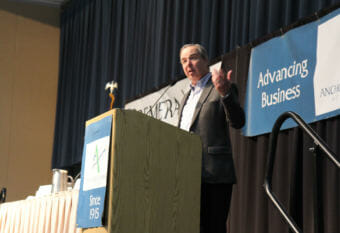
ConocoPhillips Alaska president Joe Marushack told an Anchorage audience that he predicts a new wave of oil development in Alaska. (Photo Elizabeth Harball/Alaska’s Energy Desk)

It’s been a good year for ConocoPhillips Alaska.

Last week, the company announced first oil from a drill site called Greater Mooses Tooth 1, ahead of schedule. Greater Mooses Tooth 1 is the first oil development on federal leases in the 22.8-million acre National Petroleum Reserve Alaska, or NPR-A, a west of Prudhoe Bay. Conoco estimates Greater Mooses Tooth 1 will produce up to 30,000 barrels of oil per day.

Today, Conoco received a key federal approval for another oil development in NPR-A, called Greater Mooses Tooth 2. Greater Mooses Tooth 2 is estimated to produce even more oil than Greater Mooses Tooth 1, up to 40,000 barrels per day.

And the company is laying plans for a much bigger oil development nearby, called the Willow project. Conoco estimates that project could produce up to 100,000 barrels per day, a fifth of the amount of oil currently flowing down the trans-Alaska pipeline. The federal government began the environmental review process for Willow this summer.

Conoco’s steady push to expand oil production westward into NPR-A is being closely watched by environmental groups, which are concerned about impacts to caribou, migratory birds and other species that live there. Earlier this year, a coalition including Earthjustice, the Natural Resources Defense Council and the Center for Biological Diversity filed a lawsuit challenging the Bureau of Land Management’s 2016 and 2017 oil lease sales in the reserve.

Still, last winter, Conoco had its most extensive oil exploration season in over a decade, drilling six wells in and near NPR-A. According to ConocoPhillips Alaska president Joe Marushack, Conoco’s exploration program this year is going to be even bigger: the company is planning to drill up to eight wells this winter.

In a presentation to an Anchorage business group on Monday, Marushack said Conoco’s projects are part of a new wave of oil production in Alaska, something he called a “North Slope Renaissance.”
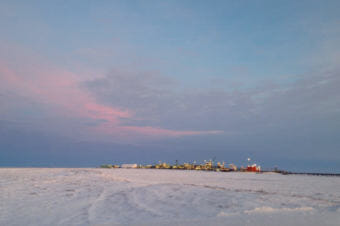
Alaska’s Energy Desk caught up with Marushack after his speech and asked him what he thinks a “North Slope Renaissance” could mean for Alaska — and if that could include development in another chunk of federal land east of NPR-A: the Arctic National Wildlife Refuge.

This interview has been edited for length and clarity.

Marushack: When we look at what we’re doing, and then we look at what some of the other operators are doing with their opportunities out there, we believe there’s the opportunity for hundreds of thousands of barrels of incremental production to come on over the next, let’s say, five to 10 years. Now, it doesn’t come on all at the same time — it kind of gets feathered in — but we still believe there’s the opportunity for hundreds of thousands of barrels of incremental production over this time period.

Elizabeth Harball: A couple of years ago, there was real concern about the future of the trans-Alaska pipeline and low flow. Does this mean that that is not a concern anymore?

Marushack: Well, we have to maintain a stable fiscal environment, and we have to make sure that the regulations are in place that allow us to develop these and get permits in a timely fashion. But yeah, I think that if those two things are maintained — we’ve got to be able to weather these cycles, these up-and-down cycles  in oil — we still have to worry about low flow at some point in time, but I think if we can get some of these projects moving forward, that that will go a long way to solving that problem, for a long time.

Harball: A lot of these developments are happening in a region where there’s lots of wildlife, there’s a community — Nuiqsut — that cares very deeply about subsistence. So as these developments move forward, can Conoco makes sure that the impacts don’t add up in a negative way?

Marushack: Obviously, there’s a lot of consultation that goes through. We try to operate in an environmentally very sensitive fashion. We do lots and lots of studies on fish and wildlife and we share that with folks. So yeah, we believe these developments can happen in an environmentally sensitive way, and it’s really important to us that we do that — it’s just good business for us to do that, too.

Harball: Oil prices are up around $80. What does that mean for everything Conoco has planned and does it mean you might be able to hire more Alaskans?

Marushack: So these developments that we are doing, especially the Willow project, will mean lots of opportunity for Alaskans. And it’s extremely important to me that ConocoPhillips does look carefully at what Alaskans can do and what they can participate in. We’ll be working, obviously, with the unions in order to develop these opportunities — we need a lot of labor on them.

Harball: On the oil price, though, I think I was hearing you say you don’t think $80-per-barrel oil is here to stay, necessarily. Why is that?

Marushack: We are not good at predicting oil prices. So what we’ve decided we need to do is we need to make sure we have our costs that are maintained at a low enough fashion that we can weather these cycles. And we believe there will be cycles. There’s $80 now, we didn’t necessarily see that coming. We certainly didn’t see $28 oil coming in 2015. But we’ve got ourselves in a position where we think we can be competitive as we go through these cycles over time.

Harball: I think I heard you mention [during your presentation] — and this is a good question to clarify — that you saw [the Arctic National Wildlife Refuge] as a potential opportunity. What did you mean by that — are we going to expect Conoco to show up at a lease sale, if the [federal government] holds one?

Marushack: Well, we’re looking at it. I can’t tell you for sure yet because we’re looking at it. But just like all opportunities, we look and see if it makes sense for us to be there or not. And we’ll look at this one, too.

Feds approve second Conoco oil project in National Petroleum Reserve-Alaska

ConocoPhillips’ Alpine facility on the North Slope. Conoco’s Scott Jepsen said a new processing facility in NPR-A would be about the same size. (Photo by Elizabeth Harball/AED)
ConocoPhillips’ Alpine facility on the North Slope. Oil from Greater Mooses Tooth 2 will be processed at the Alpine facility. (Photo by Elizabeth Harball/AED)

The Trump administration has handed a key approval to ConocoPhillips for an oil development on the North Slope, west of Prudhoe Bay.

The Bureau of Land Management today announced it has issued a joint record of decision with the U.S. Army Corps of Engineers for the Greater Mooses Tooth 2 project in the National Petroleum Reserve-Alaska.

In a statement, BLM Alaska Acting State Director Ted Murphy called it a “milestone for responsible energy development.”

According to Conoco, the Greater Mooses Tooth 2 drill site could produce up to 40,000 barrels of oil per day. The company aims to begin construction this winter, and complete the project by 2021.

Greater Mooses Tooth 2 will be connected via an 8.6-mile pipeline to Conoco’s Greater Mooses Tooth 1 project. Greater Mooses Tooth 1 started producing oil last week, and is the first oil development on federal leases in the National Petroleum Reserve-Alaska.

One environmental group quickly came out against the decision to approve Greater Mooses Tooth 2.

“Opening the country’s largest roadless area to industrial oil development is a huge step in the wrong direction,” Kristen Monsell, oceans program legal director for the Center for Biological Diversity, said in a statement.

Conoco now controls the majority of leased federal land in the reserve.

West of the Greater Mooses Tooth sites, Conoco is also pursuing an even bigger oil development, called the Willow project. The Bureau of Land Management began the environmental review process for Willow this summer.

Conoco estimates Willow could produce up to 100,000 barrels per day — a full fifth of the amount of oil currently flowing down the trans-Alaska pipeline.

Campaign complaint filed against salmon ballot backers

Voters cast ballots in the Aug. 21, 2018, primary election at Glacier Valley Baptist Church in Juneau.
Voters cast ballots in the Aug. 21, 2018, primary election at Glacier Valley Baptist Church in Juneau. Alaskans will be vote on the salmon habitat ballot initiative on Nov. 6. (Photo by Andrew Kitchenman/KTOO)

The group Stand for Alaska — Vote No on One is accusing organizations behind the fish habitat protection initiative of “flouting Alaska’s campaign finance laws” and misleading voters about their money.

In a complaint filed Thursday with the state, Stand for Alaska alleges a series of violations by the organizations Stand for Salmon, the Alaska Center and Yes for Salmon — Vote Yes on One.

“We believe the campaign disclosure laws aren’t being followed and Alaskans aren’t able to get a clear picture of who is financing the Stand-for-Salmon-slash-Yes-for-Salmon effort,” said Kati Capozzi, Stand for Alaska’s campaign manager.

Stand for Alaska was formed to oppose the ballot initiative, and the group gets much of its financial support from mining and oil companies. The initiative would toughen permitting for projects built in salmon habitat.

Stand for Alaska claims the three environmental groups are improperly reporting how they are coordinating the campaign, underplaying the Alaska Center’s role. Stand for Alaska also alleges they aren’t properly disclosing campaign contributions.

The groups “failed to report the true source of the dark money they have received from Lower 48 non-profit entities that are used to launder large Outside donations into respondents’ campaign in support of Ballot Measure 1,” the complaint reads.

In an interview, Stand for Salmon Director Ryan Schryver said the accusations are groundless.

“Stand for Salmon has taken many steps to make sure that we are fully compliant with all of the state and federal rules and laws and regulations. We take transparency very seriously,” Schryver said in an interview.

The Alaska Center, which supports the initiative, does raise money from groups outside Alaska like the Washington, D.C.-based League of Conservation Voters, as well as individual Alaskans, according to Meghan Cavanaugh, the center’s political director.

“The Alaska Center has been diligent in working with [the Alaska Political Offices Commission] throughout this process to ensure that we are in compliance with state election law. We believe strongly in public transparency in all elections,” Cavanaugh said in an email.

The complaint comes about a week after Stand for Alaska was fined by the state for leaving out the group’s opposition — the “Vote on One” — from its name. That fine came after a complaint filed by Stand for Salmon. Capozzi said Stand for Alaska’s complaint was not spurred by that fine.

Stand for Alaska’s allegations echo a common talking point in the debate over the salmon habitat initiative. Each side has repeatedly accused the other of receiving money from entities outside Alaska. Both sides have, in fact, received money from entities based outside Alaska, in addition to support from people who live and work in Alaska.

Opponents pack Anchorage hearing on salmon habitat ballot measure

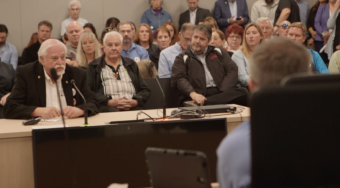
Roger Jenkins testifies on the salmon habitat ballot measure to a packed room at the Alaska Legislative Information Offices in Anchorage. (Joey Mendolia/Alaska’s Energy Desk)

A ballot initiative aimed at protecting salmon habitat is facing stiff opposition from industry groups, unions and Native corporations in Alaska. That opposition was on full display at an Anchorage hearing on the measure held this week.

As required by law, the state is holding a series of public hearings on the initiative.

Before the hearing, about a dozen demonstrators gathered to chant and wave signs saying “Vote No on 1” on a nearby street corner. The demonstration was organized by Stand for Alaska, a group formed to oppose the measure. Supporters of the ballot measure, which would toughen the state’s permitting requirements for projects built in salmon habitat, also showed up to demonstrate ahead of the hearing.

Inside, the hearing room was packed, with attendees lining the walls and spilling out into the hallway. Lt. Gov. Byron Mallott, who oversees the Alaska Division of Elections, presided over the hearing.

“Time will be very tight,” Mallott said in his opening remarks. “With the number of folks that have signed up, it looks like we will be hard-pressed to hear everyone.”

The first speaker was Stephanie Quinn-Davidson, one of the measure’s sponsors and head of the Yukon River Inter-Tribal Fish Commission. She argued that as companies pursue more large mines and oil developments in Alaska, the state needs to protect salmon runs from impacts seen in the Lower 48.

“We have the opportunity to finally get it right here in Alaska. My hope for our future is that we can learn from our past and choose a different path forward,” Quinn-Davidson said.

Doyon President and CEO Aaron Schutt delivered the opposition’s official response.

“This not only threatens our jobs and our economy, it threatens our rights as property owners,” Schutt said.

After that, there was a long string of testimony echoing Schutt’s arguments against the measure. Alaskans working for mining, oil, other resource development companies and those that support them turned out in force. That included Jim Hill.

“It’s a development killer,” Hill said.

There was also testimony from groups that advocate for industry like the Resource Development Council, the Alaska Miners Association and the Alaska Oil and Gas Association — all against the ballot measure.

Eventually, a handful of initiative supporters had their turn, including Georgeanna Heaverley, a commercial fisherman in Cook Inlet, who argued the ballot measure will ensure resource development is done responsibly.

“We are willing to do what it takes to protect what we love so that our future grandchildren — and their grandchildren — know what it’s like to stand on the aluminum deck of a boat and pick salmon from a net and provide the world a sustainable food,” Heaverley said.

As he began his testimony, ballot initiative supporter Charles Treinan remarked on the imbalance at the hearing.

“I was feeling pretty lonely as a proponent of the initiative until I heard a few of my fellow proponents here,” Treinan said.

Of the over 60 people who testified during the two-hour hearing, most were against it.

When it comes to campaign fundraising, there’s an even bigger imbalance. Yes for Salmon, the official group campaigning for the initiative, has raised just over $1 million, with support from environmental groups like Cook Inletkeeper and the Portland-based Wild Salmon Center. Stand for Alaska has raised over $10 million with major recent contributions from ExxonMobil and mining companies Coeur Alaska and Hecla.
This article has been updated to include a more accurate estimate of Stand for Alaska’s fundraising total.
Site notifications
Update notification options
Subscribe to notifications