Elizabeth Harball, Alaska's Energy Desk
Fallen dishes, water leaks and borrowed shoes: Scenes after the earthquake in downtown Anchorage

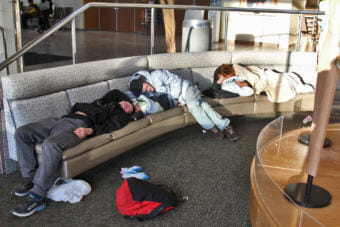
People take shelter at the Egan Center in downtown Anchorage after an earthquake on November 30, 2018. (Photo by Rashah McChesney/Alaska’s Energy Desk)

The earthquake hit just as Anchorage was beginning its day, causing widespread damage, derailing plans and snarling traffic.

At the Dena’ina Convention Center in downtown Anchorage, water was steadily dripping from the ceiling. Greg Spears, general manager for Anchorage Convention Centers, said it was from the sprinkler system as he walked around to assess the damage, stepping around large puddles and pointing out fire retardant on the floors. Spears said in all his decades living here, Friday’s earthquake was one of the biggest he had ever experienced.

“I had just gotten out of my car behind the building and felt it, heard it,” Spears said. “I had to hang on to a light pole just to stand up. It was one of the most significant shakers I’ve seen in 40 years.”

Anchorage Convention Centers general manager Greg Spears at the Denai’ina Center in downtown Anchorage shortly after the earthquake on November 30, 2018. (Photo by Elizabeth Harball/Alaska’s Energy Desk)

At first, state officials told people in Anchorage to go to the Dena’ina Center if they needed shelter.

Anna Oxereok was there with her sister and her eight-year-old grandson. They are from Wales in Western Alaska, but came to Anchorage for a conference. Oxerok said they were in a coffee shop with the earthquake hit.

“Heard the rumble before we felt anything,” Oxerok said.

Oxereok said she told her family members to get under the table.

“Dishes, the cups and stuff started falling off,” Oxerok said. “We saw some people go under the table and there were others that were kind of surrounding each other, like in a big hug. We waited for a while, and then there was an aftershock, then we went back under the table.”

Soon, because of the damage to the Dena’ina Center, people needing shelter were directed to a different convention center, the Egan Center, a few blocks away. Many there were also from out of town, temporarily evacuated from their hotel rooms.

Angela Johnson from Nelson Lagoon was holding her dog, Mavis, with a makeshift leash made of bathrobe ties. She said she was just waking up in her hotel room at the Hilton when the shaking started.

Angela Johnson of Nelson Lagoon was staying in a hotel when the earthquake hit. (Photo by Elizabeth Harball/Alaska’s Energy Desk)

“The power went out, so we were standing in the doorway like you’re supposed to, right?” Johnson said. “And the doorway was moving so hard back and forth, it was like the frame was made of twigs.”

Johnson was staying on the 14th floor. Wrapped in a blanket and wearing borrowed flip-flops, she was waiting at the convention center to hear from the Hilton when she could go back.

“We had to run outside,” Johnson said. “We didn’t have any shoes on or anything. We don’t have our wallet, we don’t have our phones.”

Outside, a few windows were shattered and several traffic lights were out, but otherwise things were surprisingly quiet downtown. Most businesses were dark, having shut down for the day.

Mike Middleton was standing outside Flattop Pizza and Humpy’s, two of the restaurants he manages. He said he was dealing with water damage, a power outage and other, less urgent problems.

“We lost quite a lot of alcohol and things fell, obviously,” Middleton said.

But Middleton predicted a quick recovery, at least for his businesses:

“Hopefully by mid-afternoon, we might be able to open in some fashion,” Middleton said, laughing.

As the rest of Anchorage got busy picking up the pieces from the 7.0 quake, Flattop did, indeed, re-open by Friday afternoon.

Climate change will cost Alaska hundreds of millions per year, report finds

NPS_glacier
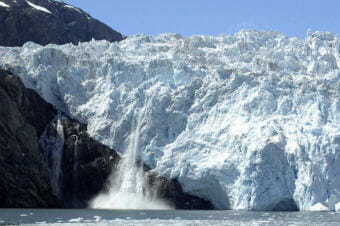
Holgate Glacier in Kenai Fjords National Park. Rising temperatures that are accelerating the loss of Alaska’s glaciers may also lead to significant economic effects across the state. (Photo courtesy National Park Service, Alaska Region)

A report out of the University of Alaska Anchorage estimates some of the most certain consequences of climate change in Alaska will cost the state between $340 and $700 million per year over the next three to five decades.

That’s “a significant, but relatively modest net economic effect for Alaska as a whole,” the report notes.

But co-author Matthew Berman, a professor of economics at UAA’s Institute of Social and Economic Research, said the dollar figures don’t capture the large disparity between climate change’s cost to urban and rural Alaska.
“It’s not surprising that people in urban Alaska are not as concerned about climate change as people in rural Alaska,” Berman said. “I mean we all see it, but we enjoy the better weather. We don’t worry about our homes — the ground under our homes sinking and our home turning into a pond.”

The report notes some of the biggest climate change-related costs come from damage to infrastructure and communities in rural Alaska as permafrost thaws and coastlines erode.

People in rural Alaska will also be disproportionately affected by changes to subsistence harvest cycles and reduced barge service because rivers are becoming too shallow, the report states.

Meanwhile, Alaskans across the state are already benefiting from lower heating costs as temperatures rise. Berman and his co-author Jennifer Schmidt, also with the Institute of Social and Economic Research, found this will lead to a savings of at least $100 million per year by 2050, significantly offsetting the overall cost of climate change to Alaska.

But Berman cautioned that the amount the report predicts climate change will cost the state is “almost certainly” an underestimate. The report is a review of available scientific publications on the issue, and it didn’t tally other potentially expensive impacts because not enough is known to put a dollar figure to them.

That includes impacts to Alaska’s fisheries, both from rising temperatures and ocean acidification.

“Even though we don’t know what the consequences are, it could be fairly substantial,” Berman said. “In a sense…this is a massive uncontrolled experiment on people’s livelihoods. We really don’t know what is going to happen.”

Findings from the report were included in the National Climate Assessment released last week.

ConocoPhillips executive: more land around Teshekpuk Lake should be available for drilling

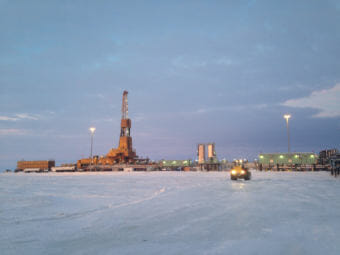
ConocoPhillips’ CD5 drill site. The company thinks there’s more oil potential further west, but some of that land is currently off-limits to drilling. (Photo by Elizabeth Harball/Alaska’s Energy Desk)

A top executive with ConocoPhillips said the federal government should shrink — but not eliminate — the protected area around Teshekpuk Lake, the biggest lake in Arctic Alaska, which is important habitat for wildlife.

His statements come a week after the Trump administration announced it is overhauling the management plan for the 22-million-acre National Petroleum Reserve-Alaska where Teshekpuk Lake is located.

Teshekpuk Lake is in an area thought to have rich oil potential. But in 2013, the Obama administration expanded the area around the lake where drilling isn’t allowed from 1.75 million to 3.65 million acres, citing the need to protect caribou herds and migratory bird habitat.

ConocoPhillips holds the most leases of any oil company in NPR-A. Tuesday on Talk of Alaska, Alaska Public Media’s call-in show, ConocoPhillips Alaska President Joe Marushack said the Trump administration’s decision to revise the NPR-A management plan “makes sense.”

“We agree that the area around Teshekpuk Lake ought to be sectioned off. Not as much as is sectioned off right now; we think that you can still do very responsible development in areas around that,” Marushack said.

ConocoPhillips has been pushing for more access to land in the Reserve. It is pursuing several developments near the Teshekpuk Lake Special Area.

Asked about potential environmental impacts, Marushack argued new technology means oil development has a smaller footprint than it did in the past.

“There’s an awful lot of work goes into making sure that the way of life of the folks that live up there can be sustained and that the wildlife can be sustained,” Marushack said.

Susan Culliney with Audubon Alaska said she’s glad that ConocoPhillips recognizes Teshekpuk Lake is important habitat. But Culliney added she thinks the current management plan for the Reserve strikes a good balance between protecting wildlife and oil development.

“We don’t see a good reason to open more acreage for development and we see a lot of good reasons to keep the Teshekpuk Lake area protected,” Culliney said.

The Bureau of Land Management is now taking public input on its effort to revise the management plan for NPR-A. The comment deadline is January 7.

An unexpected agency weighs in on offshore Arctic oil drilling: NASA

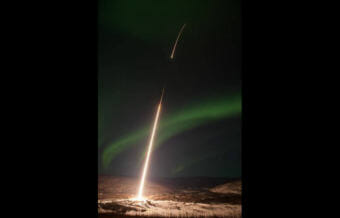
Photo of March 2017 ISINGLASS mission at Poker Flat Research Range in Fairbanks. (Courtesy Chris Perry)

Earlier this year, the federal Bureau of Ocean Energy Management asked for public input on allowing more oil development in Arctic waters — the Trump administration is aiming to hold an oil lease sale in the Beaufort Sea next year.

Letters came from all the usual places: oil lobbying groups called for more access to drilling. Environmental groups raised concerns about climate change and how oil development could harm wildlife.

But one letter arrived from an institution you might not think of as having a stake in Arctic oil development: NASA.

That’s right, the space agency.

NASA funds Poker Flat Research Range, near Fairbanks. Operated by the University of Alaska Fairbanks, it’s the only high-latitude rocket range in the United States.

“What we’re known for is doing research on the aurora,” said Kathe Rich, director of Poker Flat.

To do this, scientists launch rockets that pass through the aurora. Rich said that research is important because the aurora is like a visual manifestation of the sun’s energy entering the earth’s upper atmosphere, and that energy can affect things like cell phone communications or the electrical grid.

But Rich said sometimes the rockets they launch to study the aurora can end up flying quite a ways.

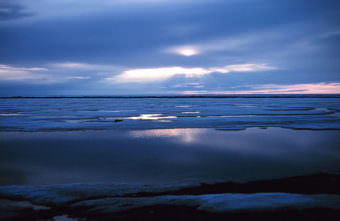
“If we’re looking for something that’s fairly far north, it’s going to come down in the Beaufort Sea or the Arctic Ocean, one or the other,” Rich said.

In April, the NASA Goddard Space Flight Center sent a letter to BOEM estimating that 70 rocket parts have landed in the Beaufort Sea since the 1960s.

The agency’s concern, it wrote, “is that future oil and gas development in the Beaufort Sea could result in the need to protect additional persons and property when conducting launch operations.”
And because scientists are using higher performing rockets nowadays, NASA thinks an increasing number could need to land in the Beaufort Sea — just as the Trump administration is gearing up to allow more oil development there.

To be sure, Rich said it’s extremely unlikely that rocket parts will come crashing down on oil rigs. That’s because scientists wouldn’t launch them in the first place if they think anyone or anything of value could be in danger.

Rich said what’s more likely to happen is that more oil activity in the Beaufort Sea could limit research opportunities.

“The downrange area that we have, it can be kind of like threading a needle with all the various things that we need to avoid,” Rich said. “So every time that you have to add something else in that can be avoided, that can result in fewer launch opportunities for us.”

But Rich said she’s optimistic that NASA and the BOEM will be able to work something out.

In an emailed statement, BOEM spokesman John Callahan said the agency will work with NASA to explore the best options as they move forward with potential oil and gas leasing.

“We’re happy they’ve reached out to us to talk about safe operations in the Beaufort,” Callahan said. “It’s a great example of good lines of communication between federal agencies here.”

Callahan added BOEM recognizes the value of NASA’s research, saying “it’s not all rocket science, but it is incredibly important work.”

Trump administration moves to open environmentally sensitive National Petroleum Reserve land to oil drilling

BLM_NPRA
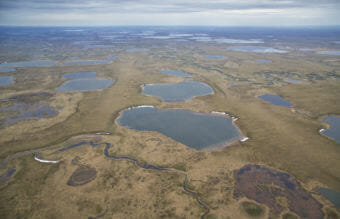
Northeast National Petroleum Reserve in Alaska. (Photo by Bob Wick, image courtesy Bureau of Land Management)

The Trump administration has moved to open up even more federal land in the Arctic to oil development, kicking off what could be Alaska’s next big environmental controversy.
The National Petroleum Reserve-Alaska (NPR-A) has become one of the most promising areas on the North Slope for oil development. But the Obama administration expanded protections of the area, putting roughly half of the 22-million-acre Reserve off-limits to drilling, citing the need to protect important wildlife habitat.

The Interior department today announced it is beginning the environmental review process to re-do the management plan for NPR-A, which is west of Prudhoe Bay. As the process moves forward, both the oil industry and environmental groups will be keenly interested in the fate of a chunk of land in the northeast corner of NPR-A called the Teshekpuk Lake Special Area.

“Geologists believe that the area is extremely prospective,” Interior Assistant Secretary of Land and Minerals Management Joe Balash said yesterday in a call with reporters.

Federal scientists recently estimated the region surrounding Teshekpuk Lake holds roughly between one and 11 billion barrels of recoverable oil — that’s in the ballpark of how much oil they estimate could be in Arctic National Wildlife Refuge’s 1002 area. And just to the east of Teshekpuk Lake, there’s been a surge of oil development and new discoveries, leading one oil company to herald a “North Slope Renaissance.”

Balash acknowledged that was a big reason why Interior decided to re-do the plan for NPR-A.

But in addition to having huge oil potential, the Teshekpuk Lake Special Area is also hugely ecologically important. It’s habitat for birds that migrate there from all over the world, in addition to hundreds of thousands of caribou relied on by subsistence hunters.

During the press call, Balash hinted at the controversy to come.

“The big question is, can we make some of that acreage available in a manner that is responsible and honors the subsistence way of life that the people who live in the NPR-A have lived for thousands of years,” Balash said.

Environmental groups have been expecting — and dreading — this announcement for a while. They were generally happy with the plan put out in 2013. But not long after President Donald Trump took office, Interior Secretary Ryan Zinke signed an order to revise the plan for NPR-A.

“There were good reasons behind putting these areas into an unavailable for leasing category,” Susan Culliney with the Audubon Society said in an interview last year, when the Interior Department first hinted it was considering opening more of NPR-A to oil development.

Groups like Audubon have raised concerns about the oil drilling already happening in NPR-A, but they haven’t fought it like they have with the Arctic National Wildlife Refuge. Oil development has long been allowed in NPR-A, unlike the Refuge.

But today, a number of environmental groups signaled they are ready to push back against oil development near Teshekpuk Lake.

“This is just another example of this Administration’s shortsightedness and desire to sell off America’s public lands to oil companies,” Nicole Whittington-Evans, Alaska regional director for the Wilderness Society, said in a statement. “We are committed to ensuring that the Reserve’s five Special Areas, including the Teshekpuk Lake and Colville River Special Areas, remain free of development.”

At this point, the Trump administration hasn’t proposed how much land near Teshekpuk Lake it wants to open up for drilling. They could slightly shift the boundaries, they could open up the entire area, or something in between. That could determine just how fierce the next fight over oil and habitat in Alaska’s Arctic will be.

The Bureau of Land Management, the agency that manages NPR-A, begins a 45-day public comment period on revising the NPR-A plan today. The agency said it plans to hold public meetings in Anchorage, Fairbanks and North Slope communities.

Clarification: This story has been clarified to note that the Obama administration enlarged previously established protected areas within NPR-A.

Shrugging off lawsuit, Trump administration forges ahead with offshore Arctic drilling proposal

The Beaufort Sea, where the Trump administration would like to hold an oil lease sale next year. (Photo courtesy NOAA)

The Trump administration has taken another step towards restarting offshore oil development in a part of the Arctic Ocean that former President Barack Obama mostly placed off-limits.

The Bureau of Ocean Energy Management announced today that it is beginning the environmental review process needed to hold an offshore lease sale for the Beaufort Sea next year.

In one of his last efforts to cement his environmental legacy, President Obama closed off the vast majority of federal Arctic waters to drilling, saying oil development there is too risky. But shortly after taking the White House, President Donald Trump signed an order to reverse Obama’s action. The Interior Department then released a draft proposal to open up nearly all Alaska’s waters to offshore oil development.

That overarching proposal hasn’t been approved yet. But according to a spokesman with the Bureau of Ocean Energy Management, if the federal agency is going to hold an oil lease sale in the Beaufort Sea in 2019 as scheduled in the draft proposal, the environmental review process needs to start now.

Alaska Oil and Gas Association President Kara Moriarty said she’s not surprised by the announcement because the Trump administration has consistently followed through with its pledge to pave the way for more resource development.

“We see it as an encouraging sign, a recognition that they really do want to make America energy dominant, and the way to do that is through Alaska,” Moriarty said.

But there’s a possibility that the drive to allow drilling in the Arctic could hit a snag.

A coalition of environmental groups have sued the Trump administration, arguing that the president lacks the authority to undo the protections Obama placed on the area. That court case is still pending.

“The Trump administration is putting the cart before the horse because the vast majority of the area may not be legally available for leasing,” said Lois Epstein with the Wilderness Society, one of the groups that filed the lawsuit.

Epstein said Obama made the right decision in banning offshore oil development in most Arctic federal waters, adding that the Beaufort Sea is a “near-pristine ecosystem.”

Earlier this year, another group aired concerns about the Trump administration’s earlier offshore drilling announcement: Voice of the Arctic Inupiat, or VOICE. While not against oil development — the group advocated to allow drilling in the Arctic National Wildlife Refuge — the advocacy group comprised of Inupiat leadership organizations said it was “disturbed” that Interior’s draft proposal didn’t specifically exclude previously agreed subsistence whaling areas.

In its most recent announcement, Interior did propose an alternative aimed at minimizing conflict between whaling and oil development.

Steve Wackowski, a top Interior Department official, said the Trump administration will work closely with Alaska Native groups to limit impacts to the North Slope’s subsistence whale harvest.

“We are going to go through this process hand-in-hand with the North Slope Borough and the whaling captains. We know that we’re drilling in their garden, essentially,” Wackowski said.

Public meetings on the offshore drilling proposal for the Beaufort Sea begin soon: the first will be held in Utqiaġvik on Dec. 3. Other meetings are scheduled on the following days in Nuiqsut, Kaktovik and Anchorage. The public comment period runs through Dec. 17.

Clarification: This story has been clarified to emphasize that VOICE’s concern was that areas used for subsistence whaling were not specifically excluded from the Interior Department’s draft proposed offshore leasing plan. Voice of the Arctic Iñupiat has not taken a position on offshore drilling in the Beaufort Sea.

Site notifications
Update notification options
Subscribe to notifications