Elizabeth Harball, Alaska's Energy Desk
This winter, a major oil exploration effort is happening in a familiar place: Prudhoe Bay

BPrig
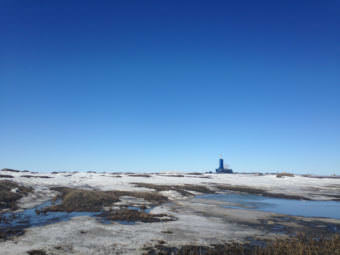
An oil rig at Prudhoe Bay in 2017. This winter, BP is undertaking a massive 3-D seismic exploration program at Prudhoe Bay. (Photo by Elizabeth Harball, Alaska’s Energy Desk)

Several big new oil discoveries have been announced in Alaska over the past few years, and a lot of attention is focused on the next wave of North Slope oil exploration, especially when it comes to what might happen in the Arctic National Wildlife Refuge.

But this winter, a massive exploration effort is aimed at finding new oil in a field that was discovered five decades ago: Prudhoe Bay.

Prudhoe Bay is the biggest oil field in North America and it has been in production for over 40 years now — a decade longer than expected. But today, if you could peek inside the machinery at Pump Station 1 that collects everything pumped up from Prudhoe Bay, less than one percent of what’s in there is oil. There’s a little bit of water. The other 97 percent? Natural gas.

“So while we’re still a very big oil field, we’re a huge gas field and a big water field,” said Scott Digert of BP Alaska. Digert is the area reservoir development manager for the east side of Prudhoe Bay.

At least for now, Alaska doesn’t have a second pipeline to get all that gas to market, so most of it is pumped back into Prudhoe Bay to help recover more oil. Digert said there’s still plenty left in Prudhoe Bay, but now, they have to work a lot harder to get it, using increasingly advanced technology.

This winter, BP is getting ready to use some of that technology. The oil company is launching a massive effort to get the clearest picture yet of what the Prudhoe Bay oil field looks like. The idea is that, after all these years, there’s more oil at Prudhoe to drill, but it’s in harder-to-find pockets.

“We have thousands of wells that have gone through this area,” Digert said. “But now we’re down to smaller and smaller oil pools that we’re trying to target.”

Digert explained that this winter, BP is going to go over 470 square miles with a fine-toothed comb.

“This is an unusually large survey for us,” Digert said.

To do it, BP is using what’s called 3-D seismic technology. BP geophysicist Gino Alexander said simply put, 3-D seismic is the process of using sound waves to figure out what it looks like beneath the ground.

“What we do is we create a seismic source, a sound wave, and it reflects on the subsurface, and we record it,” Alexander said.

That seismic source is a huge vehicle that rolls over the snow-covered tundra and vibrates the ground. A recording device, similar to a microphone, measures the signal that comes back.

“We then take that recorded signal, and we use physics and mathematics to turn that into an image,” said Alexander, “in very much the same way that you would take a picture from your digital camera, when it records ones and zeroes into an image, we do that in a very similar way.”

The picture will give BP the best, most detailed, data yet on what’s going on in the layers of rock far beneath the tundra and where to find the remaining oil.

Efforts like this have paid off for the company. After years of decline, BP has managed to flatten production at Prudhoe Bay; its new mantra is “40 more.”

Digert said that while other companies like ConocoPhillips and Hilcorp are working to bring new oil fields online, BP thinks it’s important to keep Prudhoe Bay going.

“There’s a lot of space in the trans-Alaska pipeline right now, so there’s lots of room to get more oil off the Slope,” Digert said. “But we do have to have that critical volume of oil going down the pipeline.”

Digert said this winter’s 3-D seismic program will guide the next decade of drilling, helping BP squeeze every last drop out of Alaska’s biggest oilfield.

State and police investigating accident that led to North Slope worker’s death

The North Slope Borough police department has released the name of the oil field worker who was killed in an accident last week.

As first reported by the Anchorage Daily News, according to the North Slope Borough chief of police Jeffrey Brown, Shawn Huber died at the Milne Point facility on Friday, December 7. Huber was 36.
In an email, Alaska Department of Labor spokesperson Claire Pywell said Huber “was struck by a drilling pipe and died as a result of his injuries.”

Milne Point is operated by the oil company Hilcorp. Huber was employed by Kuukpik Drilling, a contractor for Hilcorp.

According to Kuukpik Drilling, Huber had worked for the contractor since July 2016.

Both the state and the North Slope Borough Police Department are investigating the accident. Pywell said it could be one to six months before the state’s findings are released.

Hilcorp suspended drilling operations at the location of the incident. In separate statements, Hilcorp and Kuukpik Drilling said they were cooperating fully with authorities to determine the cause of the accident.

“Our deepest regrets and condolences go to the employee’s family, as well as the tight-knit group of co-workers on the North Slope,” Kuukpik Drilling general manager Kenny Overvold said in an email.

A GoFundMe account set up for Huber’s family has raised over $100,000.

Milne Point is also where three contractors nearly died in 2015, according to an investigation by the Alaska Oil and Gas Conservation Commission.

Judge dismisses challenges to oil lease sales in the National Petroleum Reserve-Alaska

NPR-A_BLMphoto
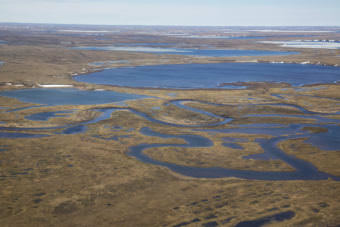
Two oil lease sales held in the National Petroleum Reserve-Alaska were at stake in the case, one held under the Obama administration in 2016 and the other held under the Trump administration . (Photo by Bob Wick, courtesy BLM)

A federal judge in Anchorage has dismissed two lawsuits brought by environmental groups against the Trump administration challenging oil lease sales in the National Petroleum Reserve-Alaska, or NPR-A.

Environmental groups had argued the federal Bureau of Land Management did not do an adequate environmental review before it held oil lease sales in 2016 and 2017.
In one of the lawsuits, the groups also argued the federal government failed to fully consider how oil produced in the 23-million acre Reserve could worsen climate change.

The federal government argued it did complete an extensive environmental review for oil leasing in the Reserve under the Obama administration, as part of a management plan for NPR-A finalized in 2013. The Trump administration is currently considering an overhaul of that management plan.

District Court judge Sharon Gleason ruled that in one case, the groups missed the time window to challenge the Obama-era management plan for NPR-A, which was finalized in 2013. In the other, Gleason wrote in her decision that the groups were wrong to ask for an entirely new environmental review for the 2017 oil lease sale.

ConocoPhillips, the oil company that holds the most leases in NPR-A, intervened in the case.

Attorneys for the environmental groups said they may appeal the ruling.

A week after the Anchorage earthquake, city continues to find damaged homes

Jessica Fox stands outside her home, which was badly damaged by the Nov. 30 earthquake. Fox said her porch was level before the earthquake hit. (Photo: Elizabeth Harball/Alaska’s Energy Desk)

On a quiet side street in Anchorage’s Sand Lake neighborhood, a yellow sign appeared Wednesday on resident Chris George’s front door.

“RESTRICTED USE,” it states in bold, capital letters, with a handwritten note beneath: “Not recommended to occupy until engineer evaluation of foundation and soils.”

George is still living there, though, with his son and mother.

“Nowhere else to go,” George said.

The sign was placed there by the city. It’s the beginning of an inspection process that could take weeks, showing how Anchorage is still coming to grips with the extent of the damage to buildings and homes following the 7.0 earthquake that struck the region on Nov. 30.
As of Dec. 6, the municipality had declared 33 buildings and homes unsafe to occupy, most in Eagle River, one of the hardest-hit areas. Another 149 are labeled with yellow “restricted use” signs.

As the municipality continues inspecting neighborhoods and homes, those numbers are expected to climb.

An inspector told George the earthquake caused his house to sink about six inches. The damage to his home isn’t immediately noticeable driving by, but a closer inspection reveals that things are slightly askew. The deck is tilted, and there’s a crack between the roof of his carport and the wall.

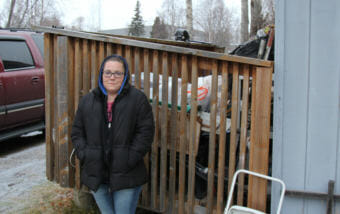
Anchorage resident Chris George stands next to the sign the city posted on his door following the Nov. 30 earthquake. (Photo: Elizabeth Harball/Alaska’s Energy Desk)

About a half-dozen other homes have yellow signs on George’s street. They indicate the homes are damaged and need inspection and repairs.

That’s better than a red sign, which means a home is unfit to occupy.

George said he is still figuring out next steps. He doesn’t have earthquake insurance and at this point, he has no idea how much fixing his home will cost.

But, he said, “I’m pretty lucky because a lot of other people got it a lot worse…I’m not complaining, really.”

George’s next-door neighbor, Jessica Fox, also got a yellow sign. She described the damage from the couch in her living room, beneath a line of wind chimes that started ringing when the ground shook a week ago.

“The morning of, we realized that our house sank and actually split in half,” Fox said.

The split wasn’t immediately visible from the living room, but one of the side rooms angles away from the rest of the house. Fox had been told it’s not safe to go inside. Her front porch slopes down towards her house at a more extreme angle. And Fox has a series of photos on her computer documenting even more extensive damage beneath her home, showing twisted beams and a crack in the foundation running the full length of the house.

Fox said she’s looking into what it would take to make repairs, but after a conversation with a contractor, she wasn’t feeling hopeful.

“Because of how the house was built and how it sank, it’s probably going to be deemed a total loss,” Fox said.

Fox does have earthquake insurance. But that doesn’t mean the process is going to easy. She said she’s lived in this home for 15 years.

“It was the first house that my husband and I got together,” Fox said. “Our kids have grown up here.”

The municipality doesn’t yet have a good sense of how many other Anchorage homeowners are dealing with similar problems. After checking commercial buildings, hospitals and schools, the city’s building inspectors have had just a few days to look at homes, according to Don Hickel, lead structural inspector with the municipality of Anchorage.

Hickel said many homes still need to be inspected and they can only work in daylight hours. Still, they are trying to at least lay eyes on every neighborhood in Anchorage.

“It’s going to take some time,” Hickel said.

That means in the coming days and weeks, more red, yellow and green signs will start to pop up around the Anchorage area.

According Ross Noffsinger with the municipality’s Development Services Department, the signs don’t trigger anything related to insurance or government assistance. They’re posted simply for safety purposes.

Still, as far as the city’s concerned, most Anchorage buildings performed well in the earthquake. Anchorage Mayor Ethan Berkowitz said it’s not surprising the city is continuing to find homes with damage.

“The level of damage is something you can anticipate from an earthquake of this magnitude,” Berkowitz said. “We need to remember how fortunate we are that nobody was killed, there were very few injuries, and that whatever is a material thing that was broken can be replaced.”

To request an inspection from the city, Anchorage-area homeowners can go to the website muni.org. More resources are available at the website ready.alaska.gov. Residents can also call the State Individual Disaster Assistance Hotline at 1-855-445-7131.


Alaska railroad on the way to recovery following severe earthquake damage

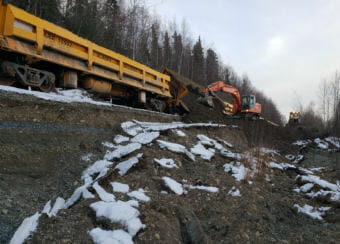
Workers making repairs to a section of the Alaska Railroad south of Eklutna that was damaged by the earthquake on Nov. 30. (Photo courtesy Alaska Railroad)

Parts of the Alaska Railroad were severely damaged by Friday’s earthquake, interrupting both freight and passenger service.

But according to an Alaska Railroad spokesperson, thanks to the speed of repairs, trains are likely to start running again by early this week.
Alaska Railroad external affairs director Tim Sullivan said there were six areas north of Anchorage that needed to be fixed.

There were different degrees of damage, he said — in some spots the ground crumbled away from the edge of the track.

There were also “some amazing situations where the track, the ties and the ground were all frozen together, but the ground underneath it dropped out so it was just hanging there,” Sullivan said.

Sullivan said the railroad’s operation center in Anchorage was also damaged.

“It got shook up pretty well,” Sullivan said. “We also had some water pipes that burst, had flooding on the second and first floors. It was in some pretty bad shape.”

Sullivan said repairs to the railroad won’t be complete for a while, but essential fixes are happening quickly, an effort he described as “miraculous.”

The first train could head north by Monday afternoon. Passenger service is likely to resume by this weekend, although trips could take an hour or so longer, Sullivan said. Railroad dispatch is expected to be fully back in its normal location by the end of the week.

Sullivan didn’t yet have an estimate for how much repairs to the railroad will cost. But he said he’s hopeful federal and state emergency funds will be available to help pay for the damage.

Following earthquake, significant road damage around Southcentral Alaska

The Minnesota Dr. airport off-ramp buckled by an earthquake in Anchorage, Alaska, on Nov. 30, 2018. (Photo by Nat Herz/Alaska’s Energy Desk)

For the latest information on road conditions, visit the Department of Transportation’s website

Significant road damage remains following the 7.0 earthquake that struck Southcentral Alaska on Friday.

As of Saturday morning, the state Department of Transportation had documented over 40 damaged sites. DOT reports that many aftershocks have continued to cause cracking and settling.

DOT spokeswoman Shannon McCarthy said there are two areas in particular drivers should be aware of. She points to one area on the Glenn Highway.

“Because we are having these continuing aftershocks, the Mirror Lake and Thunderbird Falls area, damage is continuing to spread and it’s moving into the driving lanes,” McCarthy said. “We have two detours set up, people can get through, but it is awfully slow.”

McCarthy advised drivers to add significant time to their commute if they plan on traveling through those areas.

The other area drivers should be especially aware of is the Seward Highway, south of Anchorage. McCarthy said the road is open, but aftershocks are causing rockfall and they are not recommending travel unless it is an absolute necessity.

The interchange in Palmer remained shut down as of Saturday morning. There is also a detour in Eagle River to get around the northbound Eagle River bridge.

To make matters more complicated, McCarthy said the weather service alerted DOT that poor weather conditions are on the way.

“We’re going to get snow, we’re going to get rain, we’re going to get high winds,” McCarthy said. “So this might be a time… just plan on extra time, no matter what.”

McCarthy said DOT workers and contractors are working on repairs around the clock, but at this time she did not have a good estimate on when that work will be finished.

She also didn’t have an estimate of how much repairs will ultimately cost, but she said it’s safe to say it will be in the millions of dollars.

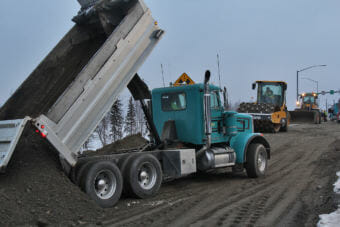
Construction began immediately to repair the ramp at the intersection of International Airport Road and Minnesota Drive after it collapsed during a magnitude 7.0 earthquake on Friday, November 30, 3018 in Anchorage, Alaska. (Photo by Rashah McChesney/Alaska’s Energy Desk)
Site notifications
Update notification options
Subscribe to notifications